Friluftsliv — The open-air life
The Norwegian word for time spent outdoors as a default condition of daily life — not a hobby, not a sport. The closest thing the country has to a national philosophy.
Friluftsliv (literally “free-air life”) is the Norwegian word for time spent outdoors as a default condition of life rather than as a hobby or a sport. It is the closest thing the country has to a national philosophy, and many of the other Norwegian concepts — Kos 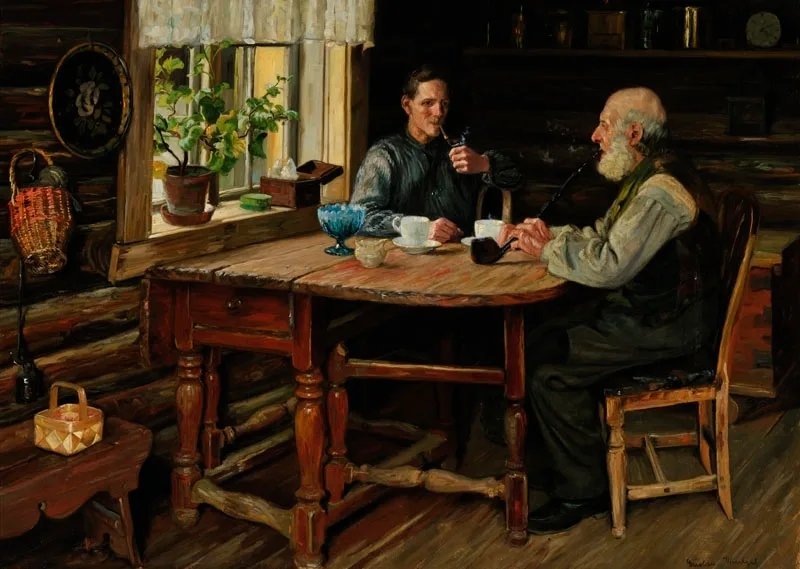 Gustav Wentzel, Øktakaffe (1900), Lillehammer Kunstmuseum Wentzel's Øktakaffe — the work-break coffee: two men, two cups, pipes lit, nobody going anywhere. The warmth sits in the company and the pause rather than any arranged scene — exactly the ground kos claims from hygge. Kos is the Norwegian word for a particular kind of unhurried warmth — company over decor. Its nearest English proxy arrived by way of the Danish cognate hygge, but Norwegians draw a real distinction: hygge leans toward the arranged setting (candles, wool socks, the composed scene), kos leans toward the people and the moment. The adjective is koselig, applied to an evening, a kitchen, a walk, a person — anything carrying the warmth. It is not the same as comfort or luxury; usually all it takes is a small number of people, no hurry, something warm to hold, and an unspoken permission to simply be where you are. In this article Kos sits downstream of friluftsliv: a thermos of coffee shared on a rock halfway up a trail carries the same unhurried warmth as an evening indoors, and Norwegians count the cold and the effort as part of what makes it koselig. On the trip The family meets kos most directly at the table — dinner together on the Oslo harbor near City Hall the first night, the unhurried meals through the Lillehammer reunion, the long light of a late-July evening that makes lingering easy. It is not a special occasion so much as what happens when nobody is trying to get anywhere. Also discussed in (*Draft)Kos — the warmth of being togetherIdentitet — what it means to be NorwegianLanguage basics — just enough Norwegian to be polite , Allemannsretten
 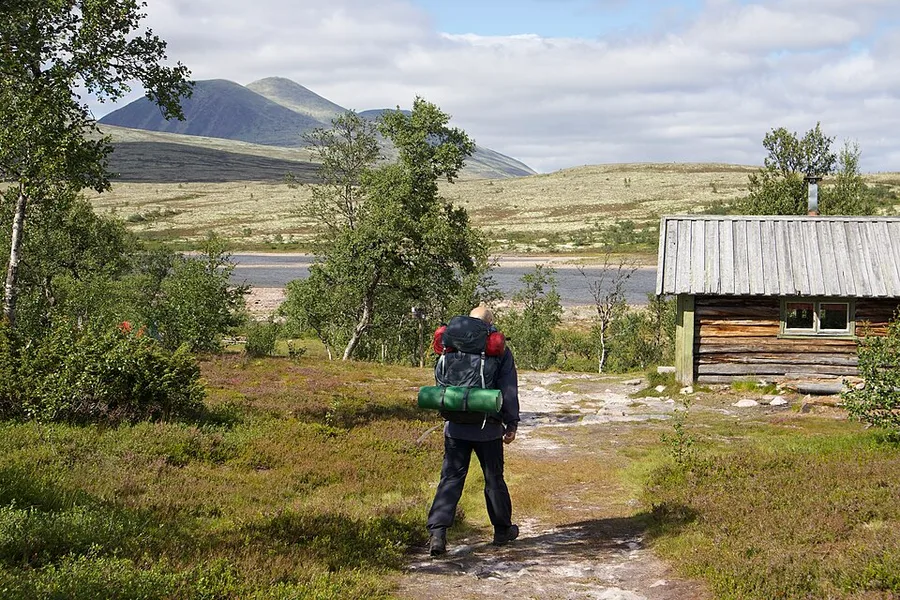 Photo by Anne Sande (2022), CC BY-SA 4.0, via Wikimedia Commons A hiker with a full pack walks across open, unfenced mountain heath toward a hut with no gate, ticket booth, or landowner in sight — the everyday, unticketed access to uncultivated land that allemannsretten protects. Norwegian right of public access to uncultivated land — literally "every-man's right." On anyone's forest, mountain, or shoreline, a person may walk, ski, swim, camp a night, forage, and pick berries without the landowner's permission, subject to limits (a 150-metre tent distance from inhabited houses, seasonal fire bans, and rules on what may be picked). Existed for centuries as customary law traceable to Magnus Lagabøte's Landslov of 1274 before being codified in the Outdoor Recreation Act of 1957 (friluftsloven), among the first laws of its kind anywhere. The statute divides all land into cultivated innmark (private in the ordinary sense) and uncultivated utmark (shared) — and because most of Norway is mountain, forest, bog, and rough coast, most of the country counts as utmark. In this article Named in the friluftsliv article as the legal floor beneath the outdoor-as-ordinary ethos — the 1957 codification that keeps casual, no-permission access to the countryside intact as land use modernizes. On the trip No single stop on the itinerary is built around the right to roam, but the family moves through the kind of open, unfenced ground it protects — the walked-over grass of the emptied Kylloplass farm-place, the open slopes around the Stegastein platform above Flåm — without a ticket, a permit, or a landowner's permission ever entering into it. Also discussed in Allemannsretten — the right to roamMat og Drikke — Norwegian food and drinkRespecting nature — why you can roam and camp on private land , Søndagstur
 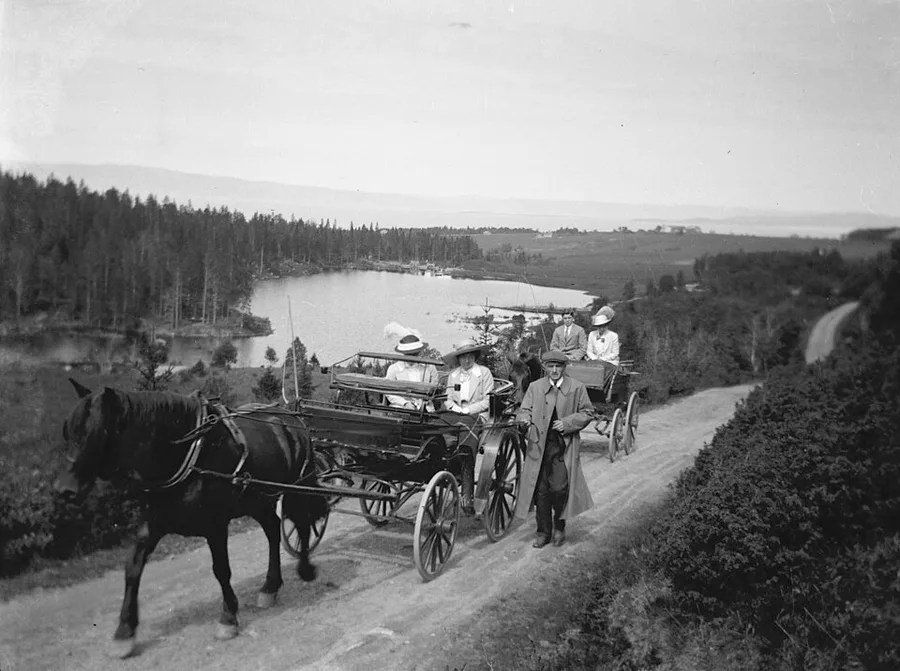 Andreas Moe / Trondheim byarkiv, Søndagstur på landet ca. 1910, CC BY 2.0 A Trondheim family archive negative literally titled 'Sunday outing in the country' around 1910 — two carriages paused on a country road above a lake, the same weekly ritual the card describes taking shape in the romantic-nationalist decades. The Norwegian Sunday walk — not necessarily long, not necessarily strenuous, but a near-obligatory outing that happens nearly every week in nearly any weather. A nineteenth-century invention that grew up alongside friluftsliv in the romantic-nationalist decades, it carries a recognizable kit: a thermos of black coffee, a packed matpakke, an orange, and a bar of Kvikk Lunsj. The shops stay shut behind it by law — the Helligdagsloven keeps a Norwegian Sunday quiet — and the walk has filled the space weekly churchgoing left behind: a set-apart day, a small group of familiar people, something shared at a pause. In this article The Sunday søndagstur is friluftsliv's weekly, ordinary expression — the same instinct that built the DNT cabin network, scaled down to an afternoon. On the trip Day 1 falls on a Sunday, and the group's first full day in Norway — the crossing to Hovedøya and its ruined monastery and swimming coves — has the shape of a søndagstur before anyone in the family has heard the word: an unhurried walk on the one day of the week Norway quiets all the way down. Also discussed in Søndagstur — the Sunday walk(*Draft)Hverdagsliv — Norway on an ordinary Tuesday , Hyttekos
 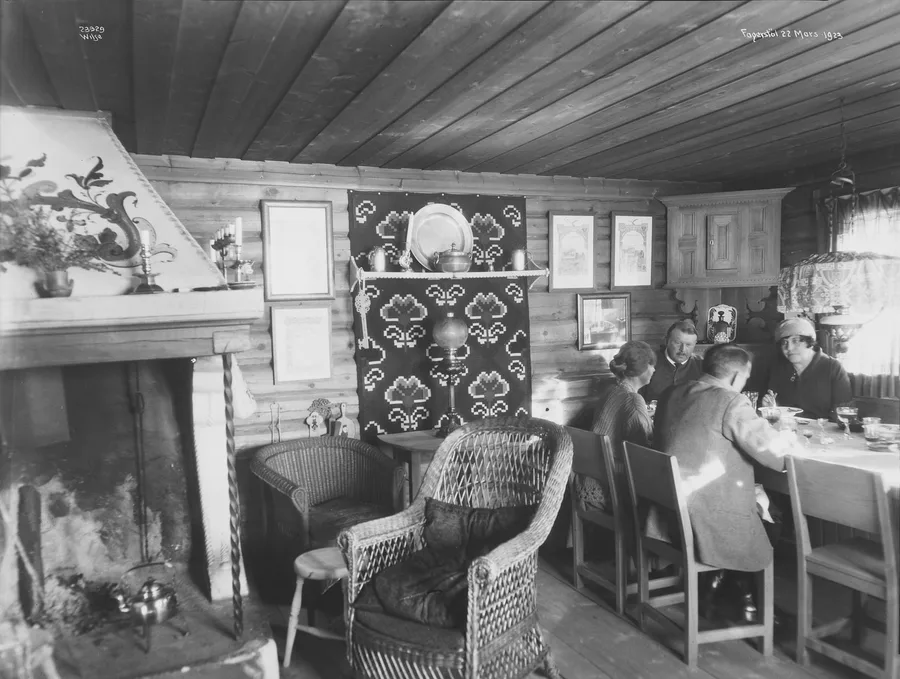 Photo: Anders Beer Wilse, Schumans hytte, interiør, Hol (1923), Norsk Folkemuseum / National Library of Norway Hyttekos in progress, March 1923: a party at the table of a log hytte below Hallingskarvet, hearth swept and kettle at the ready — the company, the meal, and the cabin doing all the work, a century before the word needed explaining to visitors. The specific warmth that happens inside a hytte — the wood stove lit against the cold, the unhurried evening meal, the absence of electric light and running water that keeps the ritual close to what it has always been. Hyttekos is kos with a particular setting attached: a small group of people, no hurry, and a cabin standing in for the whole idea of rest. The word names why so many Norwegian families keep pouring real money into the woodwork and the view of a cabin while deliberately leaving the outhouse in place. In this article Hyttekos sits alongside søndagstur and kos as one of the everyday expressions friluftsliv's national philosophy takes — the warmth specifically bound to the cabin rather than to any other setting. Also discussed in The Hytte — a sacred pastime of modern Norway(*Draft)Kos — the warmth of being together — sit downstream of it.
The poet who coined the term
The word enters the Norwegian language with Henrik Ibsen 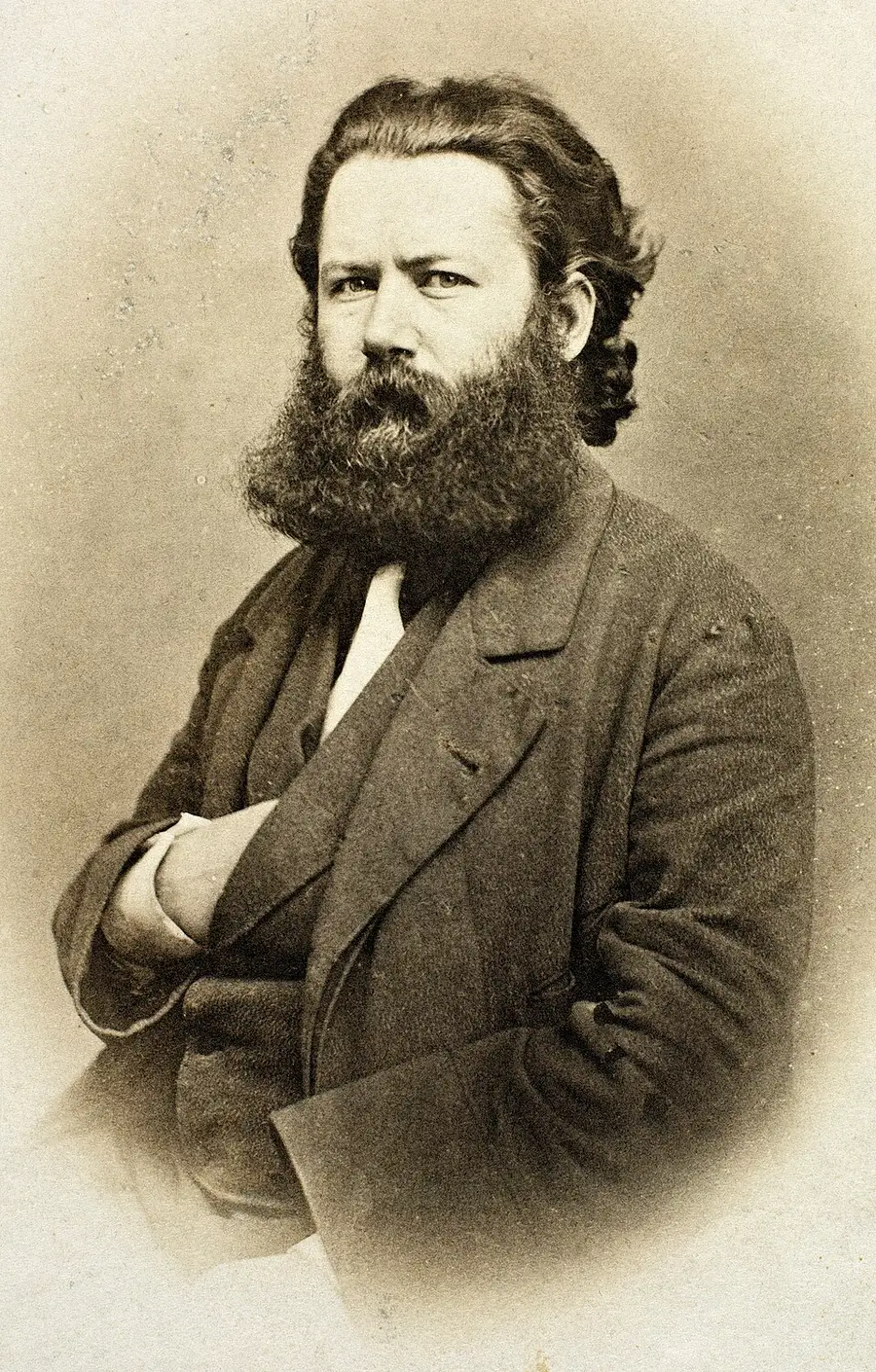 Daniel Georg Nyblin, portrait of Henrik Ibsen (1863–64), National Library of Norway Ibsen at about thirty-five, photographed a few years after *Paa Vidderne* — the young poet who sent his narrator into the mountains and gave Norwegian the word friluftsliv, decades before the white-bearded playwright of the familiar portraits. Norwegian playwright (1828–1906), born in Skien in Telemark
and dead in Christiania. The central figure of nineteenth-
century European theatre and one of the founders of modern
drama. Best known for Brand (1866), Peer Gynt (1867),
A Doll's House (1879), Ghosts (1881), An Enemy of the
People (1882), The Wild Duck (1884), and Hedda Gabler
(1890). Spent twenty-seven years in self-imposed exile in
Italy and Germany before returning to Norway in 1891.
Coined the phrase firehundreårsnatten — the four-
hundred-year night — in Peer Gynt, where it appears in
the Cairo madhouse scene as satire of romantic-nationalist
mythology about Norway's lost language. The phrase was then
adopted in earnest by the mythology Ibsen had been mocking.
In this article Ibsen coins the word itself — his 1859 poem Paa Vidderne uses friluftsliv for the first time, for mountain air as a condition under which the mind can think clearly. Also discussed in The 400-Year Night — when the Northern Lion lay dormantSøndagstur — the Sunday walk , in an 1859 poem called Paa Vidderne — “On the Heights.” The narrator climbs into the mountains alone and uses the line Friluftsliv for mine tanker — free-air life for my thoughts. Ibsen meant the mountain air as a condition under which the mind could think clearly. The word stuck.
Daniel Georg Nyblin, portrait of Henrik Ibsen (1863–64), National Library of Norway Ibsen at about thirty-five, photographed a few years after *Paa Vidderne* — the young poet who sent his narrator into the mountains and gave Norwegian the word friluftsliv, decades before the white-bearded playwright of the familiar portraits. Norwegian playwright (1828–1906), born in Skien in Telemark
and dead in Christiania. The central figure of nineteenth-
century European theatre and one of the founders of modern
drama. Best known for Brand (1866), Peer Gynt (1867),
A Doll's House (1879), Ghosts (1881), An Enemy of the
People (1882), The Wild Duck (1884), and Hedda Gabler
(1890). Spent twenty-seven years in self-imposed exile in
Italy and Germany before returning to Norway in 1891.
Coined the phrase firehundreårsnatten — the four-
hundred-year night — in Peer Gynt, where it appears in
the Cairo madhouse scene as satire of romantic-nationalist
mythology about Norway's lost language. The phrase was then
adopted in earnest by the mythology Ibsen had been mocking.
In this article Ibsen coins the word itself — his 1859 poem Paa Vidderne uses friluftsliv for the first time, for mountain air as a condition under which the mind can think clearly. Also discussed in The 400-Year Night — when the Northern Lion lay dormantSøndagstur — the Sunday walk , in an 1859 poem called Paa Vidderne — “On the Heights.” The narrator climbs into the mountains alone and uses the line Friluftsliv for mine tanker — free-air life for my thoughts. Ibsen meant the mountain air as a condition under which the mind could think clearly. The word stuck.
Nansen and the national project
The second half of the nineteenth century picked up the word and made it national. Norway was urbanizing, a back-to-nature current was running through Europe, and a country building toward independence from Sweden — it came in 1905 — was looking for symbols that were its own. Fridtjof Nansen 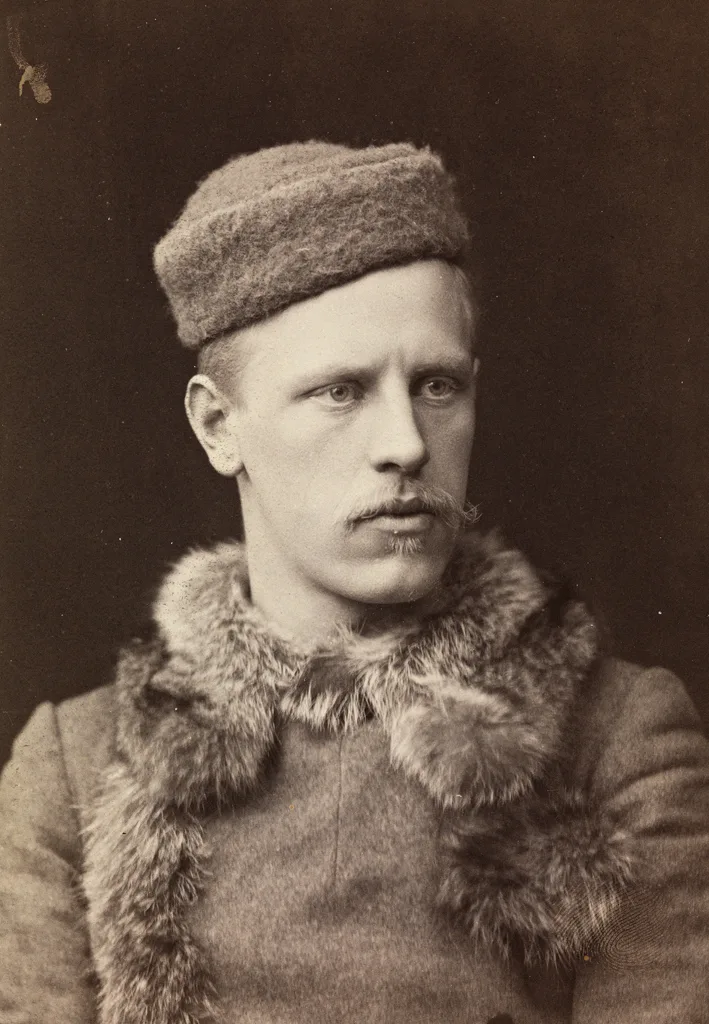 Ludwik Szaciński, Portrett av Fridtjof Nansen (1888), Nasjonalbiblioteket Szaciński photographs Nansen in 1888, the year he skis across the Greenland ice cap at twenty-six — the expedition that makes him the national exhibit for what an ordinary Sunday habit can grow into. Norwegian polar explorer, scientist, diplomat, and statesman (1861–1930). Led the first crossing of the Greenland ice sheet on skis in 1888, then let his ship Fram freeze into the Arctic pack ice from 1893 to 1896, drifting to a record northern latitude of 86°14′. Lectured and wrote widely on skiing and mountain life in the decades Norway built its outdoor-recreation identity toward independence from Sweden (1905), becoming friluftsliv's most visible public face. After the First World War, served as the League of Nations' High Commissioner for Refugees, repatriating roughly 450,000 prisoners of war and creating the Nansen passport, a travel document for stateless refugees. Awarded the Nobel Peace Prize in 1922 for this humanitarian work. Also discussed in Søndagstur — the Sunday walkThe Quiet Revolution — how Norway won its independence without a war — polar explorer, statesman, future Nobel Peace laureate — became the public face of the idea. He wrote and lectured on skiing, hut culture, and the mountain life, and the country listened.
The DNT and the cabin network
The institution that turned this national virtue into infrastructure was Den Norske Turistforening, usually just Den Norske Turistforening (DNT) 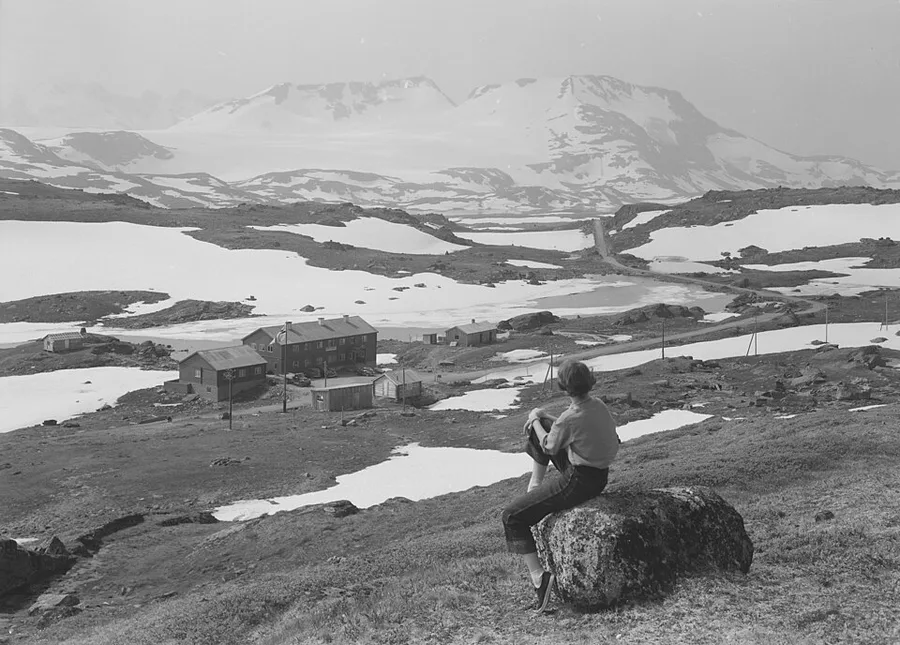 Jac. Brun, Sognefjellshytta (1957), Nasjonalbiblioteket Sognefjellshytta, one of DNT's staffed mountain lodges, photographed on the high Sognefjellet road in 1957 — the same cabin-and-trail network the card says the association has run since 1868. Norway's national trekking association, usually shortened to the DNT, founded in Oslo on 21 January 1868 to develop tourism in the country. Today runs roughly 550 cabins nationwide — a mix of staffed mountain lodges, self-service huts, and unstaffed shelters where members let themselves in with a standard key and pay on the honor system — plus a network of marked trails maintained largely by volunteers. Counts over 300,000 individual members, more than five percent of Norway's population. Local chapters, such as Bergen og Hordaland Turlag (founded 1890), organize regional hikes and maintain trail networks like the ones on Mount Fløyen above Bergen. On the trip The family doesn't overnight in a DNT hut on this itinerary, but the funicular ride up Mount Fløyen in Bergen climbs through trail country the local DNT chapter, Bergen og Hordaland Turlag, has organized hikes on since 1890 — the same trail-and-cabin culture, encountered without ever booking a bunk. Oslo Also discussed in (*Draft)Ildsjel — the ones who keep it all goingSøndagstur — the Sunday walk , founded in Oslo in 1868. Today the DNT runs roughly 550 cabins across the country, from staffed mountain lodges to unstaffed shelters where members let themselves in with a standard key and pay on the honor system. Even from the middle of Oslo, a marked trail with a hut on it is rarely more than a day away.
But beneath the development and use of cabins, Friluftsloven Norway's Outdoor Recreation Act, passed by the Storting on 28 June 1957 and in force from 1 July 1957 — among the first laws of its kind anywhere. Its first section states its purpose directly: to safeguard the public right of access to and passage through the countryside, and to maintain outdoor recreation as a leisure activity that is healthy, environmentally sound, and gives a sense of well-being. Rather than inventing a new right, the act mostly ratified centuries of customary practice — Norwegians walking across each other's utmark (uncultivated outland) — moving it inside the legal system before postwar prosperity, fencing, and suburban growth could erode it. The right the act codifies is known as allemannsretten. In this article Named as the legal codification underneath Den Norske Turistforening's trail-and-cabin network — the DNT built the infrastructure for friluftsliv over nearly a century before the 1957 act gave the underlying right of access a statutory floor. Also discussed in Allemannsretten — the right to roam — friluftsloven — codified the legal floor: every person’s right to walk, camp, and forage on uncultivated land, whoever owns it — the right Norwegians call allemannsretten.
What it looks like day to day
The maxim every visitor hears is “Det finnes ikke dårlig vær, bare dårlige klær” — there is no bad weather, only bad clothes. Weather is not a reason to stay in. It is a reason to dress correctly.
The American instinct treats outdoor time as a category — hiking, camping, the weekend trip, the gear bought at REI for each. In Norway it is a baseline.
Norwegians dress for weather that keeps Americans indoors, then fold the outdoors into ordinary life. The Sunday søndagstur, the weekend at Hytte 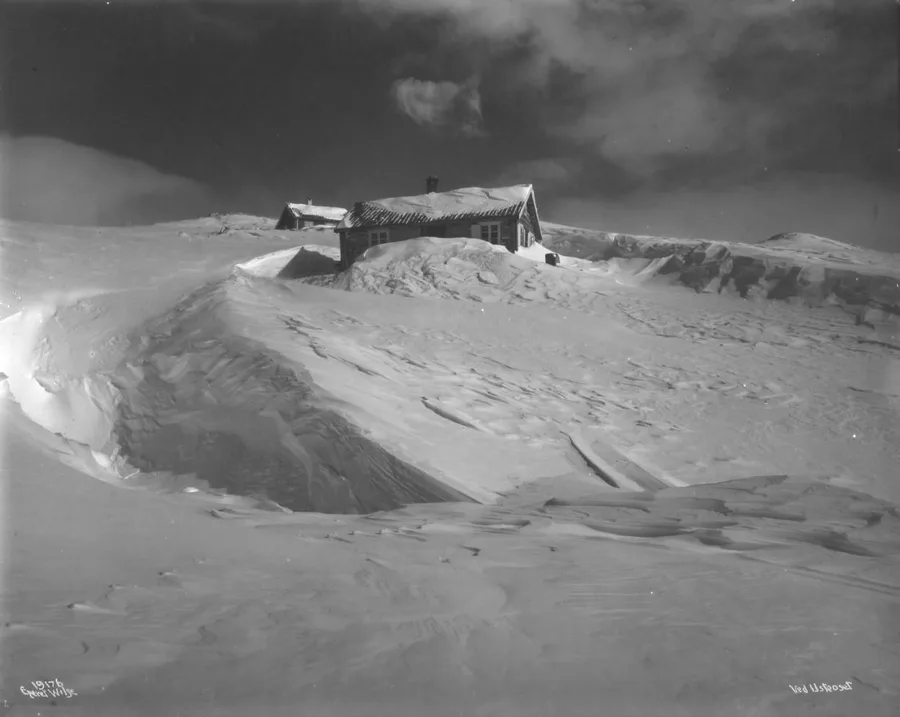 Photo: Anders Beer Wilse, Hytte paa Høifjeldet, ved Ustaoset (1917), Norsk Folkemuseum / National Library of Norway A fjellhytte above the treeline near Ustaoset, photographed by Anders Beer Wilse in 1917 — snowed nearly to the eaves and holding its ground: the mountain branch of the cabin tradition, on the same high plateau the Bergen line crosses. The Norwegian cabin — roughly 451,000 of them across a country of 5.6 million people, one of the highest ratios of second homes to population anywhere. The cabin map sorts loosely into three traditions: fjellhytter above the treeline, sjøhytter on the coast and inner fjords, skogshytter in the eastern forests. Many, even expensive ones, keep no electricity or running water by choice — an outhouse and a wood stove, a deliberate holding onto hardship rather than a mark of poverty. The modern hytte took shape as a bourgeois romantic-nationalist object in the late nineteenth century and broadened down the class ladder after 1945; today it is where much of the country's real rest happens, across the fellesferie July holiday and påskefjellet, the Easter week in the mountains. In this article The hytte anchors the friluftsliv system's cabin network — DNT huts run on the same honor-system logic as the roughly 451,000 privately owned hytter scattered across the country, keeping most Norwegians within a day's reach of one or the other. On the trip Both tracks pass hytter constantly without stopping at one — the Ungdommene (the Youngsters) watch them scatter across the mountainsides on the Norway-in-a-Nutshell train down toward Flåm, and the Gråhårsklubben (the Oldsters) pass them dotting the hillsides on the long Day-3 E6 drive north through the Gudbrandsdalen toward Trondheim, and again on the short Day-4 run out to Stjørdal and Hegra. The group's own lodging this trip is hotels, not cabins, but the roofs scattered through every valley they pass are proof of how much of Norwegian life happens in exactly this kind of building. Also discussed in The Hytte — a sacred pastime of modern Norway(*Draft)Hverdagsliv — Norway on an ordinary TuesdayTradisjoner — celebrations across the Norwegian year , the barnehage (kindergarten) where babies nap outdoors and three-year-olds are out in any weather — the habit is learned years before the word is.