The Hytte — a sacred pastime of modern Norway
Roughly 451,000 cabins for 5.6 million people — about four Norwegians in ten have access to one, in the woods, on a fjord, or above the treeline. The rest grew up visiting somebody else's.
The Norwegian word is hytte, and the practice of going to one is so woven into the year that it has its own word: hytteliv, cabin life. The warmth that happens inside a cabin — the long evening, the wood smoke, the unhurried meal — is hyttekos.
The cabin map
The Norwegian cabin map sorts loosely into three traditions: fjellhytter sit above the treeline, sjøhytter cling to the coast and the inner fjords, and skogshytter hide in the forests of the eastern interior. Innlandet county alone holds about 90,000 cabins; the former Viken area (now Akershus, Buskerud and Østfold) adds another 83,000; Trøndelag 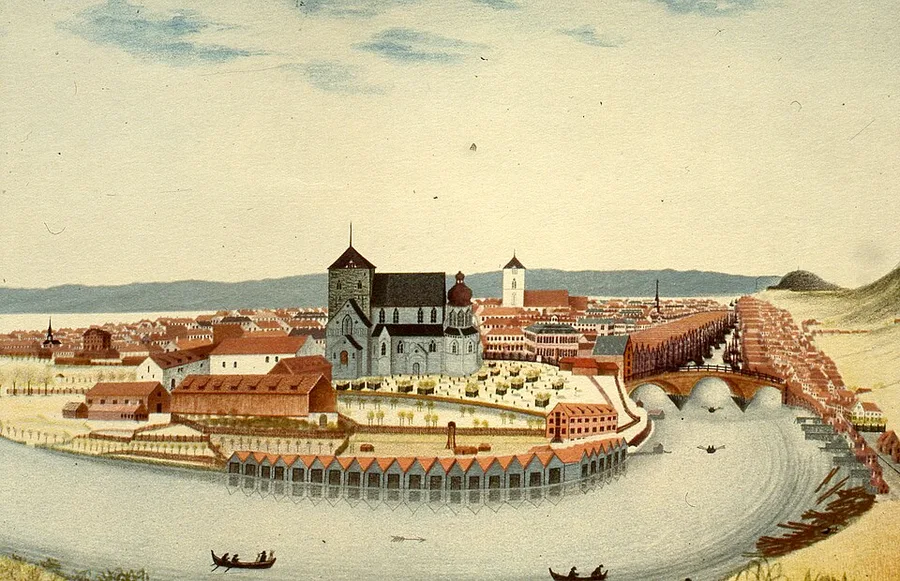 Johannes Aas, Prospect af Staden Trondhiem (1826), Municipal Archives of Trondheim (CC BY 2.0) An 1826 prospect of Trondheim, Nidaros Cathedral rising over the river bend. Founded by Olav Tryggvason as Nidaros in 997, the town became the seat of Norway's archbishopric in 1153 and the country's ecclesiastical capital. Region of central Norway around the Trondheim Fjord, north of Stadt
and south of Hålogaland. Its agriculturally rich Trondheim plain
is the second-largest area of arable land in the country and the
base of the medieval earls of Lade. Trondheim — founded by Olav
Tryggvason in 997 as Nidaros — became the seat of the Norwegian
archbishopric in 1153 and remains the country's third-largest city
and ecclesiastical capital.
In this article Counted here for its cabin belt — roughly 53,000 hytter stand across the region, the same country the Gråhårsklubben (the Oldsters) drive through on the Slektsreisen days. On the trip Day 3-5 of the trip routes the Gråhårsklubben (the Oldsters) through
Trøndelag for the Slektsreisen heritage drive — Trondheim and the
Nidaros Cathedral on Day 3, then Stjørdal and Hegra, then on up
the Stjørdalen valley to Kylloplass.
Trøndelag (Trondheim) Also discussed in Before There Was Norway — petty kingdoms at the edge of the worldWorshiping Odin and Thor — the lived religion of pre-Christian NorwayThe King Who Became a Saint — how the Nordmen came to ChristThe Long Fall — the sudden loss of Norwegian nobility, the end of the kings, and half of Norway gone foreverLutheran Norway and Pietism — a farmer named Hans Nielsen Hauge and a lay revival that could not be silencedDraugen — the drowned man who never came home has roughly 53,000. New-build numbers have fallen sharply — sales of newly built cabins in 2023 dropped to their lowest level since 2015 — but the existing stock is enormous and largely inherited.
Johannes Aas, Prospect af Staden Trondhiem (1826), Municipal Archives of Trondheim (CC BY 2.0) An 1826 prospect of Trondheim, Nidaros Cathedral rising over the river bend. Founded by Olav Tryggvason as Nidaros in 997, the town became the seat of Norway's archbishopric in 1153 and the country's ecclesiastical capital. Region of central Norway around the Trondheim Fjord, north of Stadt
and south of Hålogaland. Its agriculturally rich Trondheim plain
is the second-largest area of arable land in the country and the
base of the medieval earls of Lade. Trondheim — founded by Olav
Tryggvason in 997 as Nidaros — became the seat of the Norwegian
archbishopric in 1153 and remains the country's third-largest city
and ecclesiastical capital.
In this article Counted here for its cabin belt — roughly 53,000 hytter stand across the region, the same country the Gråhårsklubben (the Oldsters) drive through on the Slektsreisen days. On the trip Day 3-5 of the trip routes the Gråhårsklubben (the Oldsters) through
Trøndelag for the Slektsreisen heritage drive — Trondheim and the
Nidaros Cathedral on Day 3, then Stjørdal and Hegra, then on up
the Stjørdalen valley to Kylloplass.
Trøndelag (Trondheim) Also discussed in Before There Was Norway — petty kingdoms at the edge of the worldWorshiping Odin and Thor — the lived religion of pre-Christian NorwayThe King Who Became a Saint — how the Nordmen came to ChristThe Long Fall — the sudden loss of Norwegian nobility, the end of the kings, and half of Norway gone foreverLutheran Norway and Pietism — a farmer named Hans Nielsen Hauge and a lay revival that could not be silencedDraugen — the drowned man who never came home has roughly 53,000. New-build numbers have fallen sharply — sales of newly built cabins in 2023 dropped to their lowest level since 2015 — but the existing stock is enormous and largely inherited.
The preference for less
What surprises a first-time visitor is how many of these cabins, in a country wealthy enough to do otherwise, still have no electricity, no running water, an outhouse out back, and a wood stove as the only source of heat. This is not a relic of poverty; it is a preference. A cabin wired up and plumbed in like a city apartment stops being a hytte and becomes a second house. The hardship is part of what is being kept.
The pattern recurs even in expensive cabins. A family will pour real money into the woodwork, the stove, and the view, then keep the outhouse on purpose.
The second center of gravity
For most Norwegians the hytte is where the year’s real rest happens. Weekends in winter belong to these cabins. Fellesferien — the collective July holiday inherited from interwar factory agreements — empties the cities into them for three weeks. Easter pulls families up into the snow for påskefjellet, the mountain at Easter, with skis, oranges, and Kvikk Lunsj 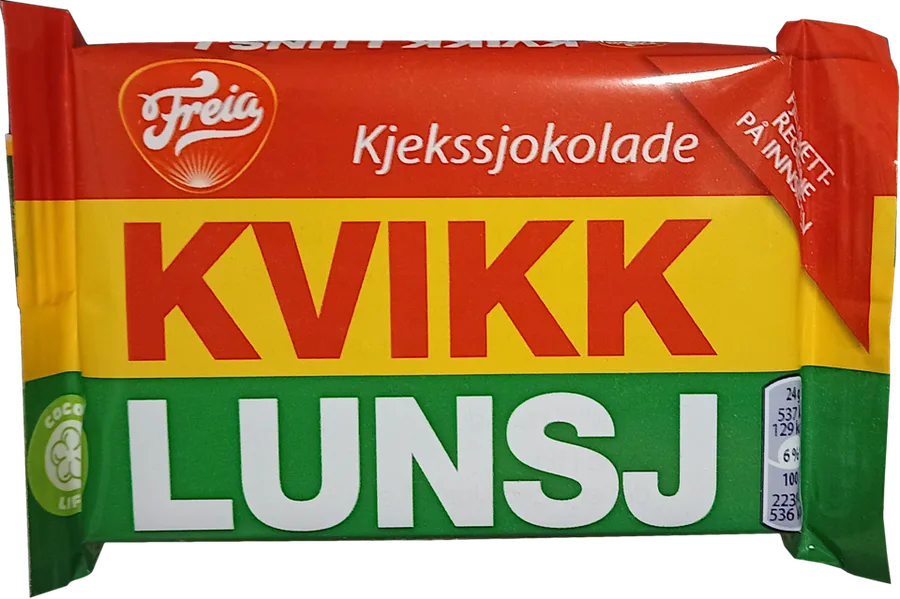 TigerfraMars, Kvikk Lunsj front (2024), CC BY-SA 4.0, via Wikimedia Commons The Freia Kvikk Lunsj bar in its familiar red-yellow-green wrapper — the trail-food staple the card describes as the standard companion to a Norwegian tur since 1937. Norway's traditional hiking-and-skiing chocolate bar — four rectangular wafer fingers under milk chocolate, launched by the Oslo chocolate maker Freia in 1937 and marketed, then and now, as portable trail food (the name means, plainly, quick lunch). An early dark-chocolate version sold poorly and was pulled; production also paused between 1941 and 1949 during and after the wartime sugar shortage. Once reformulated in milk chocolate it became the standard companion to the Norwegian tur — the wrapper printed each season with a different marked DNT trail — and today some sixty million bars leave the factory each year in a country of 5.6 million people. Norwegians are well aware the bar is nearly identical to the British Kit Kat and treat the resemblance as beside the point. In this article Named as part of the standard påskefjellet kit — skis, oranges, and Kvikk Lunsj — that empties the cities into the hytte belt at Easter. On the trip A Kvikk Lunsj bar is the obvious thing to tuck into a daypack on any walking day — the Aurlandsdalen overlook at Stegastein, the Nærøyfjord ferry, a loop around Lillehammer. Both travel groups are equally likely to end up with a wrapper in a pocket: the Ungdommene (the Youngsters) on the Nutshell route west, the Gråhårsklubben (the Oldsters) on the Slektsreisen drive north. Also discussed in Søndagstur — the Sunday walkTradisjoner — celebrations across the Norwegian year chocolate. A lot of the country effectively runs on two addresses: the apartment, where life is administered, and the hytte, where it is lived.
Romantic-nationalist roots
The modern hytte is younger than it looks. As a bourgeois leisure object, it took shape in the late nineteenth century, when urban Norwegians, a generation or two off the farm, began building country cottages modelled on the peasant farms their grandparents had left. The movement grew with the national-romantic search for a distinctly Norwegian identity, and it shared its visual language with the painters and folktale collectors of the same wave — Asbjørnsen and Moe 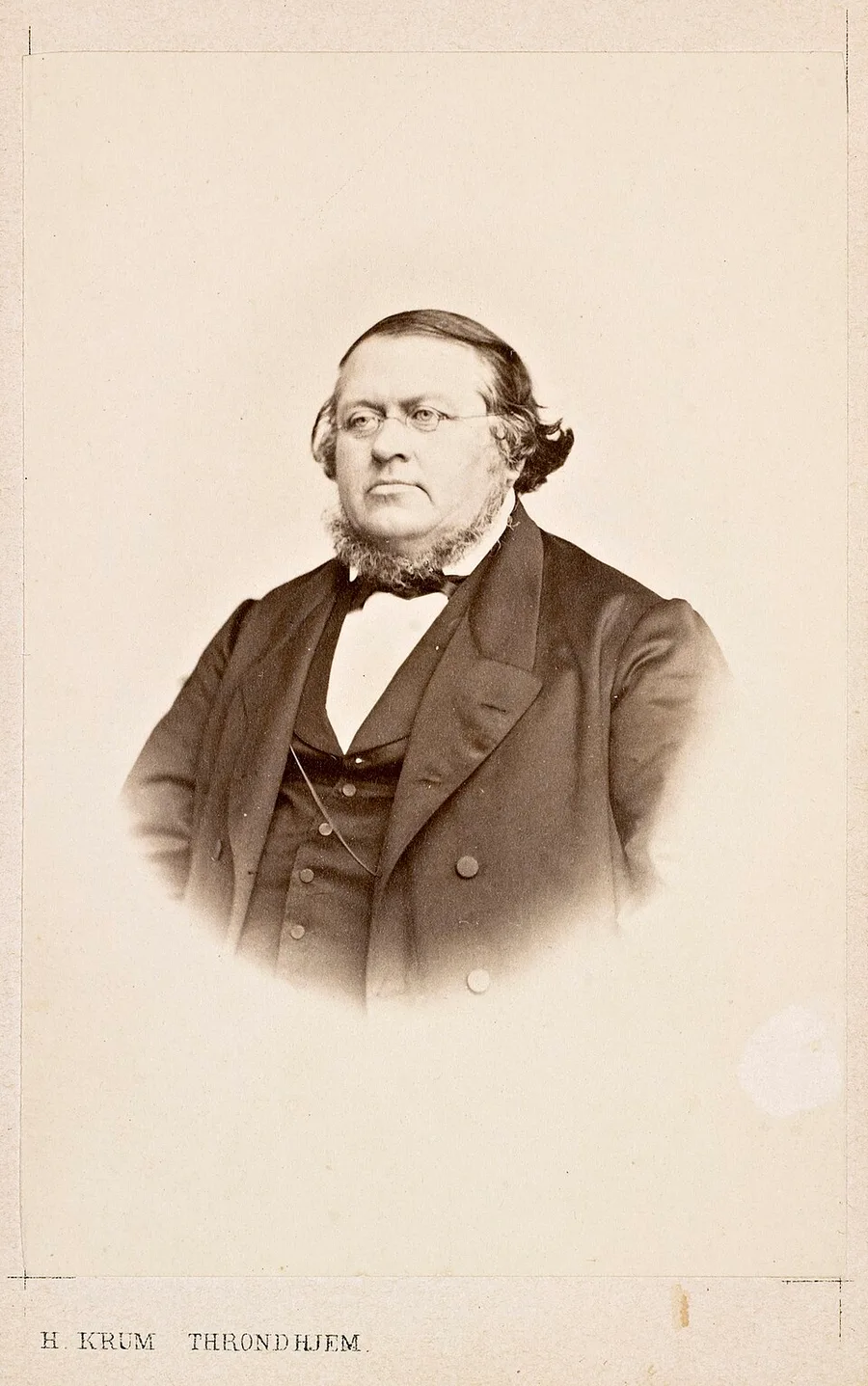 Hans Krum, portrait of Peter Christen Asbjørnsen (c. 1865–1875), Nasjonalbiblioteket A studio photograph of Peter Christen Asbjørnsen, the naturalist half of the collecting pair, whose journeys through the eastern valleys with Jørgen Moe gathered the tales printed as Norske Folkeeventyr. Peter Christen Asbjørnsen (1812–1885) and Jørgen Moe
(1813–1882) — the collectors of the Norwegian folktales.
Friends from their schooldays at the Norderhov rectory on
Ringerike from around 1826, they spent the 1840s writing
down oral tales in the eastern valleys. Their joint
Norske Folkeeventyr began in December 1841 as an
anonymous, unbound pamphlet from Johan Dahl's shop in
Christiania, grew by further installments through 1844,
and in its enlarged 1852 edition was dedicated to the
brothers Grimm. Jacob Grimm wrote back that these were
die besten Märchen, die es gibt — the best folktales
there are. Asbjørnsen alone published the legend
collections Norske Huldreeventyr og Folkesagn (1845,
1848). The first fully illustrated edition of the
folktales followed in 1879.
Also discussed in Norske eventyr — the folk tales almost lost foreverSoria Moria — the shining castle always out of reachBytting — the changeling left in the cradle among them. After 1945 the practice broadened down the class ladder, and by the 1960s the working-class hytte was as ordinary a part of Norwegian life as if it had always been there.
Hans Krum, portrait of Peter Christen Asbjørnsen (c. 1865–1875), Nasjonalbiblioteket A studio photograph of Peter Christen Asbjørnsen, the naturalist half of the collecting pair, whose journeys through the eastern valleys with Jørgen Moe gathered the tales printed as Norske Folkeeventyr. Peter Christen Asbjørnsen (1812–1885) and Jørgen Moe
(1813–1882) — the collectors of the Norwegian folktales.
Friends from their schooldays at the Norderhov rectory on
Ringerike from around 1826, they spent the 1840s writing
down oral tales in the eastern valleys. Their joint
Norske Folkeeventyr began in December 1841 as an
anonymous, unbound pamphlet from Johan Dahl's shop in
Christiania, grew by further installments through 1844,
and in its enlarged 1852 edition was dedicated to the
brothers Grimm. Jacob Grimm wrote back that these were
die besten Märchen, die es gibt — the best folktales
there are. Asbjørnsen alone published the legend
collections Norske Huldreeventyr og Folkesagn (1845,
1848). The first fully illustrated edition of the
folktales followed in 1879.
Also discussed in Norske eventyr — the folk tales almost lost foreverSoria Moria — the shining castle always out of reachBytting — the changeling left in the cradle among them. After 1945 the practice broadened down the class ladder, and by the 1960s the working-class hytte was as ordinary a part of Norwegian life as if it had always been there.
The luksushytte
Today, the luksushytte — the three-million-kroner mountain cabin with underfloor heating, Wi-Fi, a wine cellar, and a panorama window the size of a wall — has become common in the resort belts around Geilo, Trysil, and Hafjell. Traditionalists are not quiet about it, conservationists count the climate and land-use costs of the country’s roughly 451,000 second homes, and older hytte owners argue that a plumbed cabin breaks the spell — that the missing comforts are the whole point. The other side answers that every generation has built with the comforts of its time, and that asking the next one to keep using an outhouse is itself a kind of nostalgia. What both sides are defending is the same evening — the stove lit, the meal slow, the dark outside — and the argument is really about how much comfort that evening can stand before it stops being hyttekos.