Identitet — What it means to be Norwegian
Janteloven, modesty, directness, a long relationship with the landscape, and the residue of being a small country between bigger ones — the everyday self-understanding underneath Norwegian behavior.
Ask a Norwegian what it means to be Norwegian and the answer is usually short. Norwegian identity is not some loud and proud proclamation; it shows up in the way people carry themselves, and in a set of instincts an outsider passing through can easily misread. The old Norwegian word for the shared temperament is folkesjel — “the soul of a people.” It is a nineteenth-century romantic-nationalist idea, and a slightly suspect one, but it points at something Norwegians abroad still recognize in each other across a room.
Janteloven
The most useful single key to Norwegian behavior is the Janteloven, the unwritten social code Aksel Sandemose 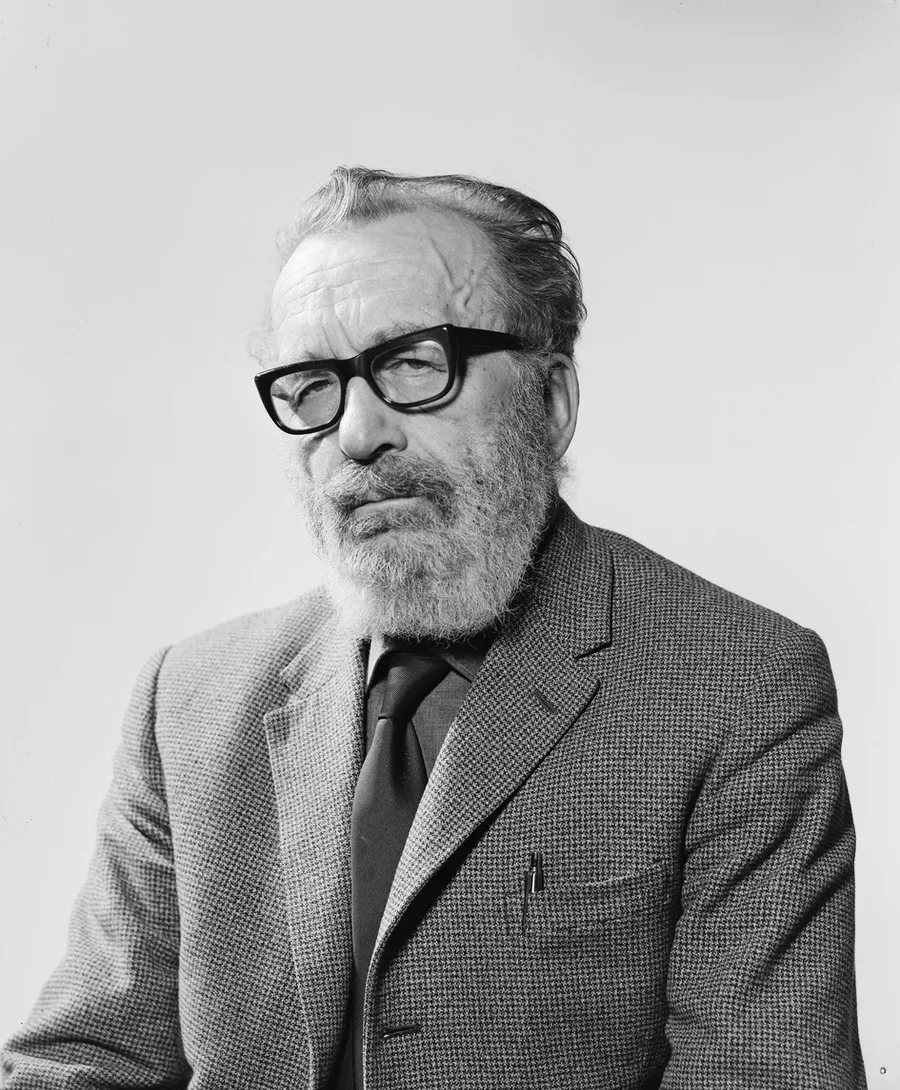 Leif Ørnelund, portrait of Aksel Sandemose (1963), Oslo Museum Leif Ørnelund's 1963 studio sitting — Sandemose three decades after *En flyktning krysser sitt spor*, by then known above all as the man who wrote down the rules Norway calls Janteloven. Danish-Norwegian novelist (19 March 1899 – 6 August 1965), born Axel Nielsen in the small Danish port town of Nykøbing Mors and a merchant sailor before he turned to writing. He settled in Norway around 1930 and wrote in Norwegian for the rest of his life. His 1933 novel En flyktning krysser sitt spor (A Fugitive Crosses His Tracks) — a fictionalized reckoning with the small-mindedness of his own childhood town, renamed Jante — formulated the ten rules that became known as Janteloven, the Law of Jante. Sandemose meant the rules as an indictment of one town's conformism; Norway and Denmark both adopted them as self-description instead. He was a Dobloug Prize winner (1959) and a Nobel Prize in Literature nominee (1963). Also discussed in Janteloven — no one is better than anyone else named in a 1933 novel and Norway adopted as a description of itself: don’t think you’re anything special. The instinct underneath — that no one is to claim more than their portion — quietly governs how much a Norwegian will let themselves stand out.
Modesty and directness
Two everyday habits follow. The first is modesty as social currency — the understatement, the deflected compliment, the refusal to gush, the instinct not to be the loudest one in the room.
The second surprises Americans more: Norwegians are direct. Conversation is shorter, flatter, lower on small talk and social cushioning. A Norwegian will not spend three sentences softening a simple statement, and the absence of the cushioning can read, at first, as coldness. It is not. The warmth in Norwegian social life is real; it sits behind the directness rather than on top of it, and it is given to people once they are inside rather than sprayed lightly over everyone.
The small country
Some of the identity is the residue of history. Norway spent much of the last thousand years as the junior partner — under Denmark, then in union with Sweden — wedged between larger neighbors and the open sea. Full independence is recent: 1905, close enough that living Norwegians grew up with grandparents who remembered the union. The slight wariness of being told what to do by a bigger neighbor, the quiet pride that does not need to announce itself, and the twice-rejected EU membership all make more sense once you remember how new the sovereignty actually is.
The land
The Norwegian self-understanding is unusually attached to landscape. Centuries on a thin, hard, mountainous coast — long dark winters, short bright summers, the sea on one side and the rock on the other — shows up in a temperament that takes the weather as given rather than as something to complain about. Hardship is not a story Norwegians tell at length. The mountain is not conquered; it is walked. The country’s writers work from the same ground — Olav H. Hauge on his orchard and a few mountains, Karl Ove Knausgård on thousands of pages of ordinary Norwegian life and weather.
The Lutheran inheritance
Much of what reads as innate Norwegian character is, on inspection, a Lutheran inheritance that a now-secular country has stopped attributing. Janteloven 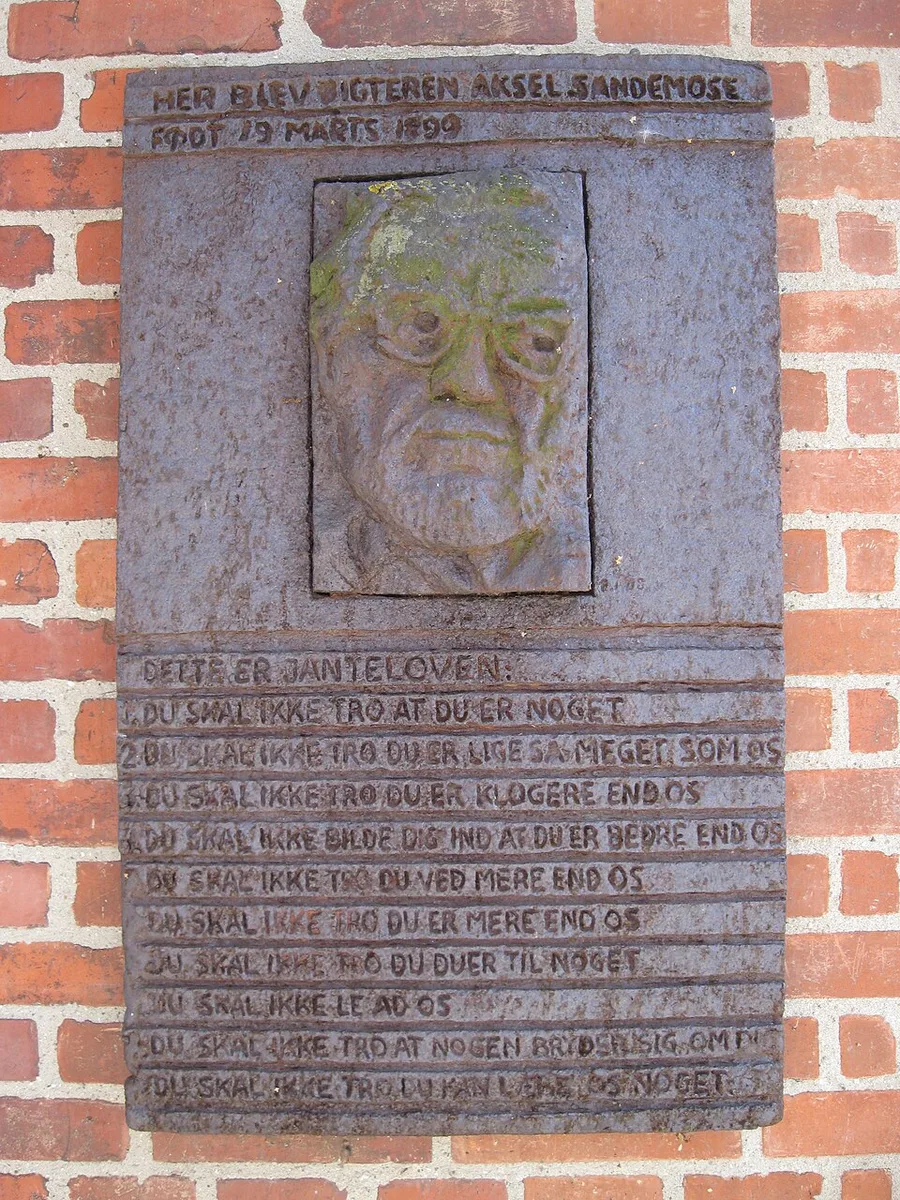 Photo: Poul Krogsgård (2011), CC0, via Wikimedia Commons The memorial plaque on Aksel Sandemose's birth house in Nykøbing Mors — the real town behind fictional Jante — carries his portrait in relief and all ten rules under the heading 'Dette er Janteloven'. The town he indicted wears the law on its wall. The Law of Jante — ten unwritten rules of collective modesty that Norwegians (and other Scandinavians) use to describe their own culture's suspicion of standing out. Formulated by the Danish-Norwegian novelist Aksel Sandemose in his 1933 novel En flyktning krysser sitt spor (A Fugitive Crosses His Tracks) as a satire of his fictional hometown of Jante. Each rule begins Du skal ikke tro (You shall not believe) — the first is Du skal ikke tro at du er noe, "You shall not believe that you are someone." Written as an indictment of one small town's pettiness, the rules were adopted across Norway and Denmark as a portrait of the whole culture, and the reading has held for nearly a century: muted status display, narrow salary differentials, and a real social cost for self-promotion. Also discussed in Janteloven — no one is better than anyone else(*Draft)Dugnad — showing up to helpSøndagstur — the Sunday walk(*Draft)Pålegg — Norwegian toppings itself — do not claim more than your portion — is a recognizably Pietism
 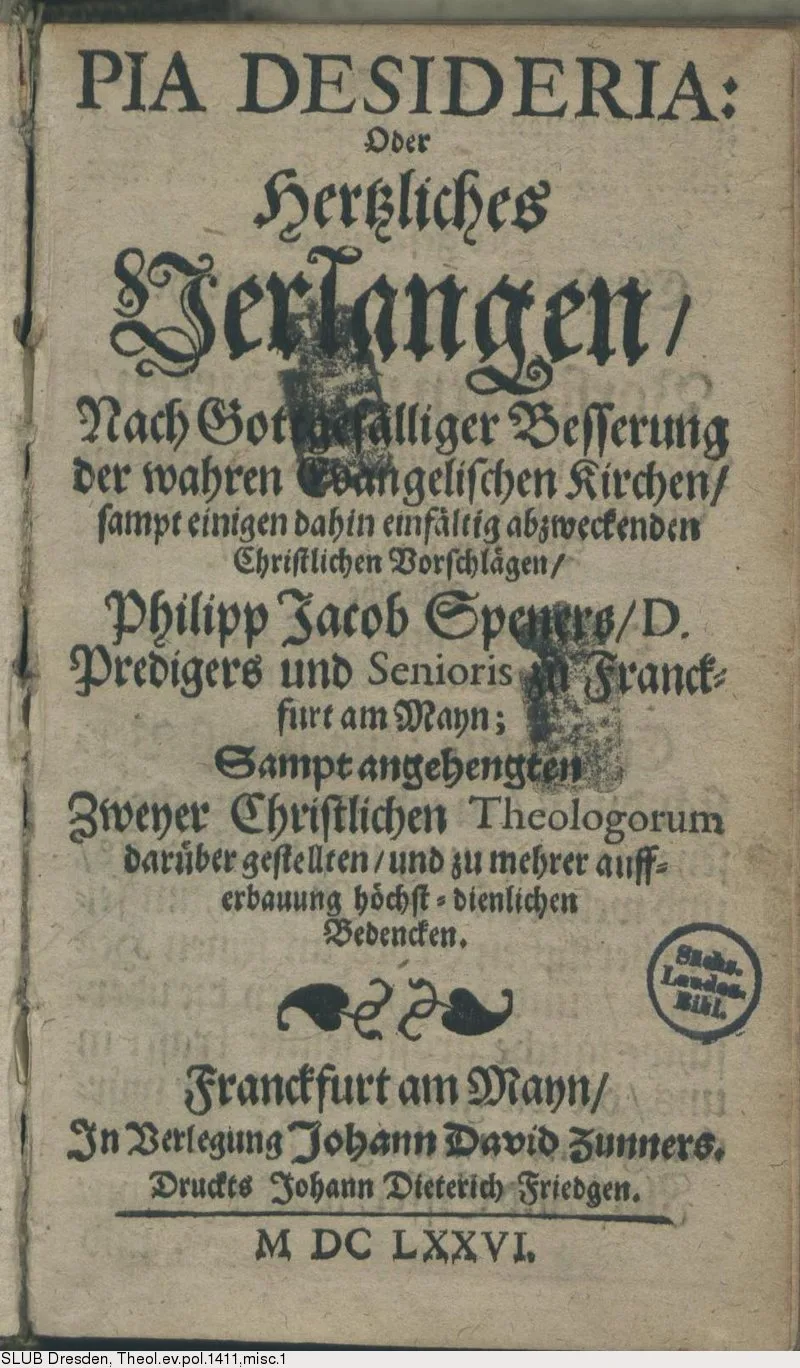 Title page, Pia Desideria (Frankfurt, 1676), Deutsches Textarchiv The title page of Spener's 1675/76 manifesto Pia Desideria, the founding document of Pietism, whose proposed reforms — lay Bible reading, the priesthood of all believers, devotion over doctrine — set the movement's programme in motion. Reform movement within Lutheranism that began in late-
seventeenth-century Germany and spread across Lutheran
Europe in the eighteenth and nineteenth centuries. Founded
by the pastor Philipp Jakob Spener — whose manifesto Pia
Desideria (1675) set its programme — and organised
institutionally by August Hermann Francke at the University
of Halle from the 1690s.
Where the established Lutheran church organised religious
life around right doctrine, the sacrament, and the parish,
Pietism placed its weight on personal conversion,
devotional reading at home, hymn-singing, the active role
of the laity, and the small lay gathering. Reached
Denmark-Norway under King Christian VI (r. 1730–1746) and
erupted as a popular lay movement at the turn of the
nineteenth century under Hans Nielsen Hauge.
Also discussed in Lutheran Norway and Pietism — a farmer named Hans Nielsen Hauge and a lay revival that could not be silencedJanteloven — no one is better than anyone else instinct in secular clothing. The ethic of work as a calling, which helped build Norwegian social democracy, runs back through the Haugean Movement
Title page, Pia Desideria (Frankfurt, 1676), Deutsches Textarchiv The title page of Spener's 1675/76 manifesto Pia Desideria, the founding document of Pietism, whose proposed reforms — lay Bible reading, the priesthood of all believers, devotion over doctrine — set the movement's programme in motion. Reform movement within Lutheranism that began in late-
seventeenth-century Germany and spread across Lutheran
Europe in the eighteenth and nineteenth centuries. Founded
by the pastor Philipp Jakob Spener — whose manifesto Pia
Desideria (1675) set its programme — and organised
institutionally by August Hermann Francke at the University
of Halle from the 1690s.
Where the established Lutheran church organised religious
life around right doctrine, the sacrament, and the parish,
Pietism placed its weight on personal conversion,
devotional reading at home, hymn-singing, the active role
of the laity, and the small lay gathering. Reached
Denmark-Norway under King Christian VI (r. 1730–1746) and
erupted as a popular lay movement at the turn of the
nineteenth century under Hans Nielsen Hauge.
Also discussed in Lutheran Norway and Pietism — a farmer named Hans Nielsen Hauge and a lay revival that could not be silencedJanteloven — no one is better than anyone else instinct in secular clothing. The ethic of work as a calling, which helped build Norwegian social democracy, runs back through the Haugean Movement 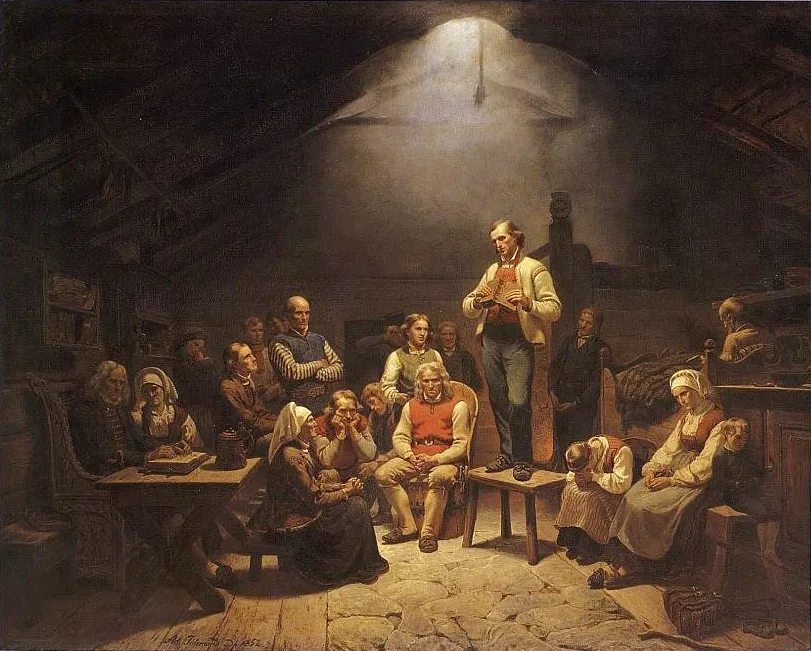 Adolph Tidemand, Haugianerne / Low Church Devotion (1852), Nasjonalmuseet Tidemand's Haugianerne — the lay preacher standing with open book in hand, a farm gathering pressed close under the loft's shaft of light — is the canonical image of the conventicle itself, the illegal farm-kitchen meeting form the movement was built from. The lay-Christian revival that emerged in Norway from Hans
Nielsen Hauge's preaching between 1796 and 1804 and
continued under his followers through the nineteenth
century. De vakte — the awakened — formed networks of
lay-led conventicles in farm kitchens, practising daily
devotional reading, household hymn-singing, and small-
group lay leadership. By Hauge's death (1824) the movement
had organised commercial undertakings — mills, paper-
works, salt-works, fisheries, shipyards, textile factories
— financed by capital pooled across the network. The
frugal, hard-working ethic that came out of this work fed
into Norway's cooperative and savings-bank traditions, and
the movement crossed the Atlantic with the emigrants.
Also discussed in Lutheran Norway and Pietism — a farmer named Hans Nielsen Hauge and a lay revival that could not be silenced800,000 Norwegians Leave — the century that built a Second Norway(*Draft)Dugnad — showing up to help of the 1790s and early 1800s. Even the secular Norwegian confidence in every individual conscience has a Lutheran shape behind it — the priesthood of all believers, quietly become the sovereignty of every citizen’s judgment.
Adolph Tidemand, Haugianerne / Low Church Devotion (1852), Nasjonalmuseet Tidemand's Haugianerne — the lay preacher standing with open book in hand, a farm gathering pressed close under the loft's shaft of light — is the canonical image of the conventicle itself, the illegal farm-kitchen meeting form the movement was built from. The lay-Christian revival that emerged in Norway from Hans
Nielsen Hauge's preaching between 1796 and 1804 and
continued under his followers through the nineteenth
century. De vakte — the awakened — formed networks of
lay-led conventicles in farm kitchens, practising daily
devotional reading, household hymn-singing, and small-
group lay leadership. By Hauge's death (1824) the movement
had organised commercial undertakings — mills, paper-
works, salt-works, fisheries, shipyards, textile factories
— financed by capital pooled across the network. The
frugal, hard-working ethic that came out of this work fed
into Norway's cooperative and savings-bank traditions, and
the movement crossed the Atlantic with the emigrants.
Also discussed in Lutheran Norway and Pietism — a farmer named Hans Nielsen Hauge and a lay revival that could not be silenced800,000 Norwegians Leave — the century that built a Second Norway(*Draft)Dugnad — showing up to help of the 1790s and early 1800s. Even the secular Norwegian confidence in every individual conscience has a Lutheran shape behind it — the priesthood of all believers, quietly become the sovereignty of every citizen’s judgment.
Modern Norwegians are not secretly religious. The instincts braided together with the Lutheran thread stayed; they are attributed differently now. The candle on the dark afternoon, once close to a devotional act, is now simply Kos 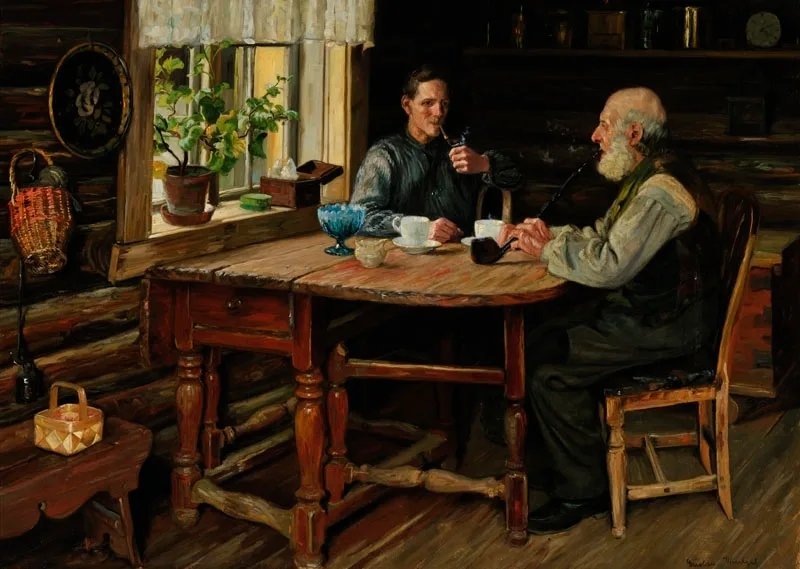 Gustav Wentzel, Øktakaffe (1900), Lillehammer Kunstmuseum Wentzel's Øktakaffe — the work-break coffee: two men, two cups, pipes lit, nobody going anywhere. The warmth sits in the company and the pause rather than any arranged scene — exactly the ground kos claims from hygge. Kos is the Norwegian word for a particular kind of unhurried warmth — company over decor. Its nearest English proxy arrived by way of the Danish cognate hygge, but Norwegians draw a real distinction: hygge leans toward the arranged setting (candles, wool socks, the composed scene), kos leans toward the people and the moment. The adjective is koselig, applied to an evening, a kitchen, a walk, a person — anything carrying the warmth. It is not the same as comfort or luxury; usually all it takes is a small number of people, no hurry, something warm to hold, and an unspoken permission to simply be where you are. In this article The candle lit against a dark Norwegian afternoon, once close to a devotional act, is now simply kos — one of several once-religious instincts a secular Norway kept after the doctrine behind them faded. On the trip The family meets kos most directly at the table — dinner together on the Oslo harbor near City Hall the first night, the unhurried meals through the Lillehammer reunion, the long light of a late-July evening that makes lingering easy. It is not a special occasion so much as what happens when nobody is trying to get anywhere. Also discussed in (*Draft)Kos — the warmth of being togetherFriluftsliv — the open-air lifeLanguage basics — just enough Norwegian to be polite . The Sunday that was the Lord’s is now the day for the long walk and the cabin. The discipline, the equality, and the seriousness about conscience are still there. The doctrine they grew up alongside is mostly gone.