Janteloven — No one is better than anyone else
The ten rules of Norwegian humility, named in a 1933 novel. Don't think you're better than us, don't think you know more than us, don't think you matter. Modern Norwegians push back on it as much as they live by it.
Janteloven — the Law of Jante — is a set of ten unwritten social rules formulated by the Danish-Norwegian novelist Aksel Sandemose  Leif Ørnelund, portrait of Aksel Sandemose (1963), Oslo Museum Leif Ørnelund's 1963 studio sitting — Sandemose three decades after *En flyktning krysser sitt spor*, by then known above all as the man who wrote down the rules Norway calls Janteloven. Danish-Norwegian novelist (19 March 1899 – 6 August 1965), born Axel Nielsen in the small Danish port town of Nykøbing Mors and a merchant sailor before he turned to writing. He settled in Norway around 1930 and wrote in Norwegian for the rest of his life. His 1933 novel En flyktning krysser sitt spor (A Fugitive Crosses His Tracks) — a fictionalized reckoning with the small-mindedness of his own childhood town, renamed Jante — formulated the ten rules that became known as Janteloven, the Law of Jante. Sandemose meant the rules as an indictment of one town's conformism; Norway and Denmark both adopted them as self-description instead. He was a Dobloug Prize winner (1959) and a Nobel Prize in Literature nominee (1963). Also discussed in Identitet — what it means to be Norwegian in 1933 as a satire of small-town conformism. Norway adopted them as a description of itself, and the reading has stuck for almost a century.
A Danish-Norwegian novelist, a fictional town
Aksel Sandemose was born in 1899 in Nykøbing on the Danish island of Mors — a small port town where everyone watches everyone — and he hated it. He went to sea as a teenager, jumped ship in Newfoundland, worked the lumber camps, came back to Denmark with stories shaped by Jack London and Joseph Conrad, and around 1930 moved to Norway, where he wrote in Norwegian for the rest of his life and died in 1965. Most of what he wrote was, one way or another, a long argument with the town he grew up in.
The argument peaked in 1933 with the novel En flyktning krysser sitt spor — A Fugitive Crosses His Tracks. The narrator returns in memory to a fictional Danish town called Jante, which is Nykøbing with the names changed, and tries to understand how a person becomes capable of violence. Most of the book is psychology and recollection. But a few pages of it formulate the unwritten social code Sandemose says governed his childhood — ten rules he sets out like commandments. He calls them the Janteloven. He meant them as an indictment of one small town. The country next door took them as a mirror.
The ten rules
All ten begin Du skal ikke — you shall not; eight continue tro, believe. The phrasing is deliberately biblical: ten commandments handed down not by God but by the neighbors.
- Du skal ikke tro at du er noe. — You shall not believe that you are someone.
- Du skal ikke tro at du er like meget som oss. — You shall not believe that you are as good as we are.
- Du skal ikke tro at du er klokere enn oss. — You shall not believe that you are wiser than we are.
- Du skal ikke innbille deg at du er bedre enn oss. — You shall not imagine that you are better than we are.
- Du skal ikke tro at du vet mere enn oss. — You shall not believe that you know more than we do.
- Du skal ikke tro at du er mere enn oss. — You shall not believe that you are more than we are.
- Du skal ikke tro at du duger til noe. — You shall not believe that you are good for anything.
- Du skal ikke le av oss. — You shall not laugh at us.
- Du skal ikke tro at noen bryr seg om deg. — You shall not believe that anyone cares about you.
- Du skal ikke tro at du kan lære oss noe. — You shall not believe that you can teach us anything.
Sandemose adds an unspoken eleventh, sometimes called the jantelovens straffelov — the penal code: Du tror kanskje ikke at vi vet noe om deg? — Perhaps you don’t think we know something about you? The small town watches.
From novel to national mirror
The novel sold, but the rules took their time. Through the 1940s and 1950s Janteloven lived mostly inside the book. It was postwar journalists and sociologists, reaching for a name for something they recognized, who pulled the phrase out of the novel and into general use — until a Norwegian could say that’s just Janteloven about a colleague and be understood without a footnote. The satire became a description, and then the description became a kind of confession.
What they were confessing to is measurable: in Norwegian workplaces, status is muted, salary differentials are narrower than almost anywhere else in the developed world, and the person who self-promotes pays a social cost the American hire often does not see coming. Geert Hofstede’s cross-cultural surveys pick this up: Norway sits near the bottom of the world on power distance and on his masculinity scale — his terms for how much hierarchy is tolerated and how much status is displayed. What they are measuring is largely Janteloven still doing its work.
Pushback
For most of the last twenty years some part of Norway has been trying to push the rules back into the book. The shove comes mostly from business and politics. Hotelier Petter Stordalen, one of the country’s richest people and probably its loudest, has said for years that Janteloven should have been buried long ago — that his entire advice for success is dare to be different. The most quoted push from the top came in prime minister Gro Harlem Brundtland’s 1992 New Year address — det er typisk norsk å være god, it is typically Norwegian to be good — a sentence that landed precisely because it broke the rule. A movement called Ja til Mer — Yes to More — argued through the 2010s for replacing the ten negatives with ten positives. Younger Norwegians increasingly say the reflex does the country more harm than good.
And yet, the prime minister still takes the tram. The executive still wears the same wool sweater as the postman, and would be embarrassed to do otherwise. The tall poppies who insist Janteloven is dead still tend to live in Oslo neighborhoods carefully calibrated to look unflashy. The rules are softer than they were and still operate; what has changed is that Norwegians now argue with them out loud.
The bad and the good
The bad is easier to see: pressure against ambition, a chill on the person who wants to try something the town has not done, a habit of cutting down the visible. Norwegians who leave for London or San Francisco often say they did not realize how much of the ceiling was internal until they were out from under it.
The good is harder to see because it is the water everyone swims in. Janteloven is the cultural engine of Likhet Norwegian for "sameness" or "equality" — the deeper social ideal behind Norway's reputation for egalitarianism, distinct from mere legal equality-before-the-law. Likhet describes a lived leveling: the instinct that no one, rich or poor, ought to be treated or to present themselves as fundamentally above anyone else. It shows up concretely in the compressed Norwegian wage scale — a janitor earns roughly 60% of what an executive does, against roughly 5% in the United States — a product of a century of centralized wage bargaining between labor and employers, not of any single law. Janteloven, the Law of Jante, is the cultural enforcement mechanism behind likhet: the same social pressure that discourages boasting also discourages ostentatious wealth or power. Also discussed in Identitet — what it means to be NorwegianPolitikk — the left, the right, and the Norwegian way(*Draft)Pålegg — Norwegian toppings — the reason the cleaner and the executive look each other in the eye, the reason wealth stays unflaunted, and the reason a politician caught arranging a private upgrade is finished. The same rule that flattens the ambitious also flattens the powerful.
Behind both is a Pietism 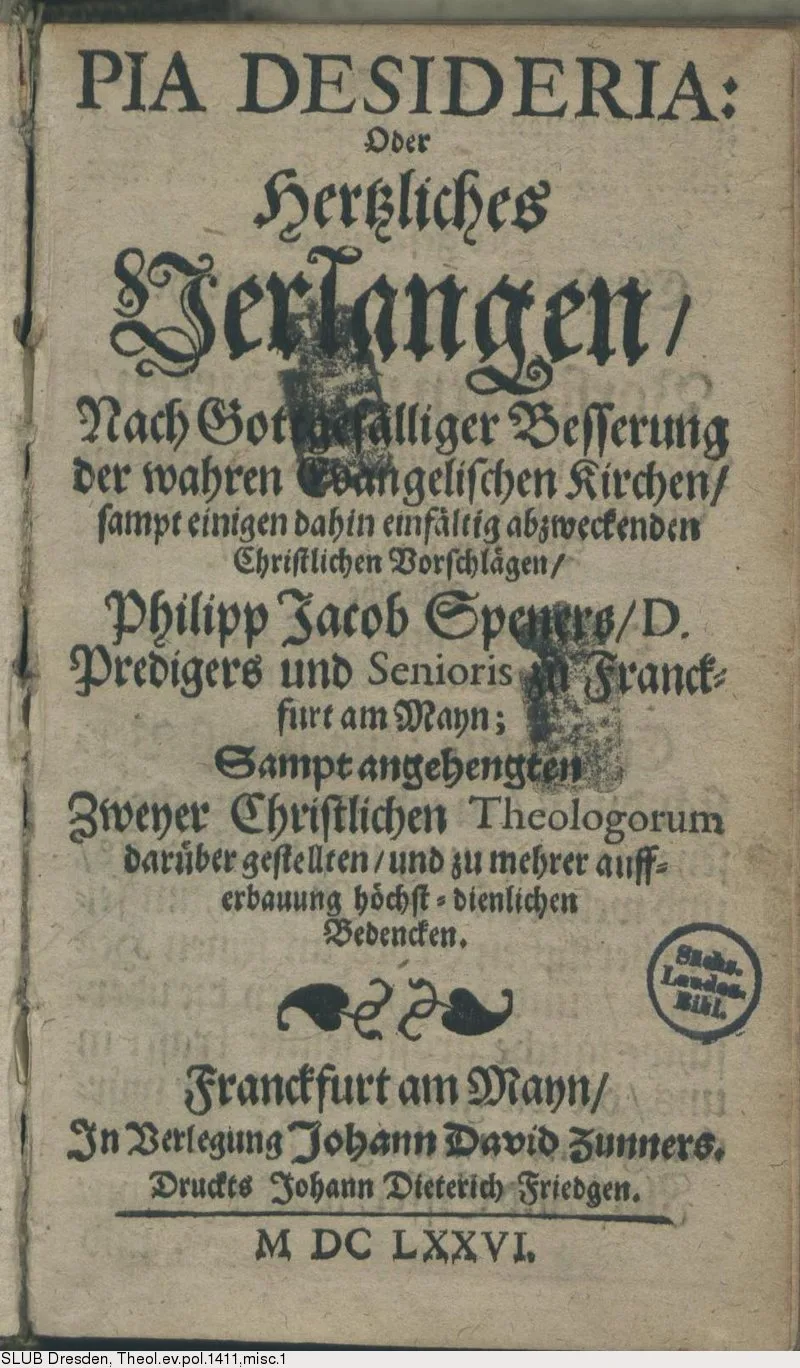 Title page, Pia Desideria (Frankfurt, 1676), Deutsches Textarchiv The title page of Spener's 1675/76 manifesto Pia Desideria — whose "priesthood of all believers" put every soul on the same footing, the leveling instinct Janteloven keeps running without the church. Reform movement within Lutheranism that began in late-
seventeenth-century Germany and spread across Lutheran
Europe in the eighteenth and nineteenth centuries. Founded
by the pastor Philipp Jakob Spener — whose manifesto Pia
Desideria (1675) set its programme — and organised
institutionally by August Hermann Francke at the University
of Halle from the 1690s.
Where the established Lutheran church organised religious
life around right doctrine, the sacrament, and the parish,
Pietism placed its weight on personal conversion,
devotional reading at home, hymn-singing, the active role
of the laity, and the small lay gathering. Reached
Denmark-Norway under King Christian VI (r. 1730–1746) and
erupted as a popular lay movement at the turn of the
nineteenth century under Hans Nielsen Hauge.
Also discussed in Lutheran Norway and Pietism — a farmer named Hans Nielsen Hauge and a lay revival that could not be silencedIdentitet — what it means to be Norwegian instinct that no one is to claim more than their portion — that the equal soul sits in the equal pew. Janteloven is that instinct stripped of the church and left to run on social pressure alone.
Title page, Pia Desideria (Frankfurt, 1676), Deutsches Textarchiv The title page of Spener's 1675/76 manifesto Pia Desideria — whose "priesthood of all believers" put every soul on the same footing, the leveling instinct Janteloven keeps running without the church. Reform movement within Lutheranism that began in late-
seventeenth-century Germany and spread across Lutheran
Europe in the eighteenth and nineteenth centuries. Founded
by the pastor Philipp Jakob Spener — whose manifesto Pia
Desideria (1675) set its programme — and organised
institutionally by August Hermann Francke at the University
of Halle from the 1690s.
Where the established Lutheran church organised religious
life around right doctrine, the sacrament, and the parish,
Pietism placed its weight on personal conversion,
devotional reading at home, hymn-singing, the active role
of the laity, and the small lay gathering. Reached
Denmark-Norway under King Christian VI (r. 1730–1746) and
erupted as a popular lay movement at the turn of the
nineteenth century under Hans Nielsen Hauge.
Also discussed in Lutheran Norway and Pietism — a farmer named Hans Nielsen Hauge and a lay revival that could not be silencedIdentitet — what it means to be Norwegian instinct that no one is to claim more than their portion — that the equal soul sits in the equal pew. Janteloven is that instinct stripped of the church and left to run on social pressure alone.