Mat og Drikke — Norwegian food and drink
A coastal-and-mountain cuisine built on preservation — fish dried, smoked, cured, fermented; lamb hung in salt; cheeses made from whey — plus the coffee culture that holds everything together, and the New Nordic generation that taught Norwegians to take their own food seriously.
Norwegian cuisine grew up in a country that was poor for a thousand years, with thin soil and a long winter. The dishes that mattered were the ones that could be preserved and eaten when needed — fish dried hard as wood, lamb hung in salt, milk turned into cheese, berries cooked into jam. What reads now like a national menu of curiosities was, in its origins, the food of a country that needed to eat through January.
Coffee is the social glue
Norway drinks more coffee per person than almost any country on earth — second only to Finland — and the reason is not the coffee. It is the kaffepause, the coffee pause, the small recurring pause the Norwegian social day is built around. Coffee is what you offer a guest the moment they are through the door. It is the frame for the conversation, the thing refilled until the conversation is finished. To be offered coffee in a Norwegian home is to be told stay a while.
Fish, in every form a coast can invent
Norway is one of the world’s great fishing nations and was one for a thousand years before it became an oil nation. The cuisine is shaped accordingly.
- Tørrfisk — Stockfish
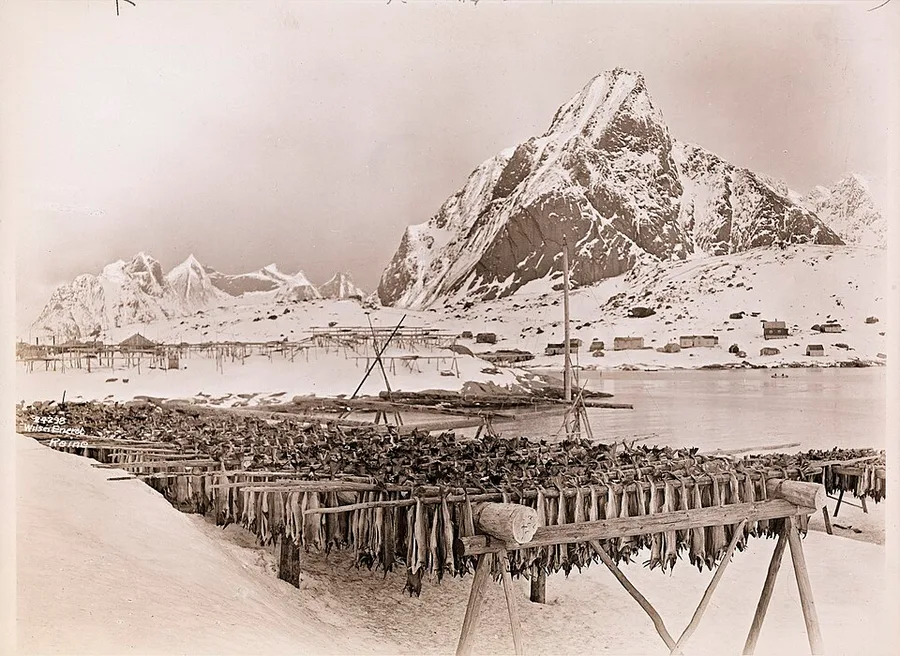 Anders Beer Wilse, Reine, Moskenes (1924), National Library of Norway Wilse's 1924 photograph shows Lofoten hjell racks doing the same job dried Norwegian cod has done since the Middle Ages -- turning the winter catch into the stockfish that built Bergen's Hanseatic trade. Air-dried cod, the principal Norwegian export through the
high and late Middle Ages and the commodity that built
Bergen. Whole gutted cod from the Lofoten winter fishery
are hung on wooden racks (hjell) in the open February
air; in three months the fish loses about three-quarters of
its weight and becomes a hard, lightweight, almost
indefinitely keeping protein source. The Catholic Church's
fast-day rules — meat forbidden on Fridays, during Lent,
and on the vigils of major feasts (roughly a third of the
days of the year) — created a continent-wide market. The Hanseatic
Bergen kontor controlled the export from the fourteenth
century onward. Norwegian stockfish (tørrfisk) is still
produced in Lofoten today.
Also discussed in The Golden Age — a North Atlantic empire … reaching farther than you thinkThe Germans Who "Ruled" Bergen — the Hanseatic merchants on Bryggen Wharf , cod air-dried on the open racks of Lofoten until it is stiff as a board, cured by nothing but winter wind. A trade as old as the Viking Age; the fish that built Bergen and that still ships south to Italy, where it becomes baccalà.
Anders Beer Wilse, Reine, Moskenes (1924), National Library of Norway Wilse's 1924 photograph shows Lofoten hjell racks doing the same job dried Norwegian cod has done since the Middle Ages -- turning the winter catch into the stockfish that built Bergen's Hanseatic trade. Air-dried cod, the principal Norwegian export through the
high and late Middle Ages and the commodity that built
Bergen. Whole gutted cod from the Lofoten winter fishery
are hung on wooden racks (hjell) in the open February
air; in three months the fish loses about three-quarters of
its weight and becomes a hard, lightweight, almost
indefinitely keeping protein source. The Catholic Church's
fast-day rules — meat forbidden on Fridays, during Lent,
and on the vigils of major feasts (roughly a third of the
days of the year) — created a continent-wide market. The Hanseatic
Bergen kontor controlled the export from the fourteenth
century onward. Norwegian stockfish (tørrfisk) is still
produced in Lofoten today.
Also discussed in The Golden Age — a North Atlantic empire … reaching farther than you thinkThe Germans Who "Ruled" Bergen — the Hanseatic merchants on Bryggen Wharf , cod air-dried on the open racks of Lofoten until it is stiff as a board, cured by nothing but winter wind. A trade as old as the Viking Age; the fish that built Bergen and that still ships south to Italy, where it becomes baccalà. - Klippfisk — cod salted before it is dried, the salt-cured cousin of stockfish. A later arrival than the Lofoten racks — from the late 17th century — it became the making of Kristiansund and Ålesund, whose whole economies were built on shipping it south to Portugal and Spain, where it becomes bacalhau.
- Sild — herring, the fish that fed coastal towns through the centuries when nothing else would, eaten pickled in a dozen variations on every Christmas table.
- Laks og ørret — salmon and trout, on every menu. Norwegian salmon is now a global industry, and the world’s modern salmon aquaculture was largely invented here in the 1970s.
- Reker — the cold-water shrimp the summer coast lives on. Eaten directly on newspaper with bread, mayonnaise, and lemon at a harbor table in July — the simplest and one of the best meals the country offers.
- Lutefisk
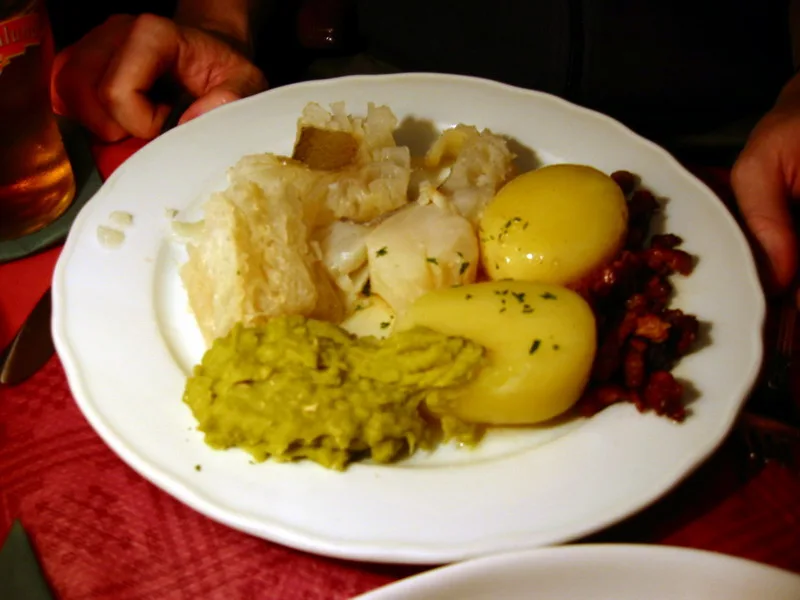 Photo by Ennorehling (2005), public domain, via Wikimedia Commons The rehydrated, lye-treated cod plated with the classic accompaniments — the dish still served every December at the church-basement lutefisk suppers the upper-Midwest Norwegian-American Lutheran congregations keep going, parish by parish. Traditional Norwegian dried-cod preparation, made by
rehydrating air-dried stockfish in lye (the modern process
uses caustic soda; the older process used wood-ash lye),
then rinsing repeatedly in fresh water and serving the
resulting gelatinous flesh poached or baked with butter,
cream sauce, bacon, mashed peas, and potatoes. A holiday
dish in modern Norway, eaten in modest quantities at
Christmas; vastly more important to the Norwegian-American
community of the upper Midwest, where Lutheran
congregations descended from the Norwegian-American synods
still hold annual lutefisk suppers in their church
basements in the weeks before Christmas. The participating
congregations are graying and shrinking but the tradition
is kept up parish by parish, year by year.
Also discussed in 800,000 Norwegians Leave — the century that built a Second Norway — dried cod rehydrated in lye, traditionally a Christmas dish. The food Norwegians most love to laugh about, and most insist a foreigner try at least once.
Photo by Ennorehling (2005), public domain, via Wikimedia Commons The rehydrated, lye-treated cod plated with the classic accompaniments — the dish still served every December at the church-basement lutefisk suppers the upper-Midwest Norwegian-American Lutheran congregations keep going, parish by parish. Traditional Norwegian dried-cod preparation, made by
rehydrating air-dried stockfish in lye (the modern process
uses caustic soda; the older process used wood-ash lye),
then rinsing repeatedly in fresh water and serving the
resulting gelatinous flesh poached or baked with butter,
cream sauce, bacon, mashed peas, and potatoes. A holiday
dish in modern Norway, eaten in modest quantities at
Christmas; vastly more important to the Norwegian-American
community of the upper Midwest, where Lutheran
congregations descended from the Norwegian-American synods
still hold annual lutefisk suppers in their church
basements in the weeks before Christmas. The participating
congregations are graying and shrinking but the tradition
is kept up parish by parish, year by year.
Also discussed in 800,000 Norwegians Leave — the century that built a Second Norway — dried cod rehydrated in lye, traditionally a Christmas dish. The food Norwegians most love to laugh about, and most insist a foreigner try at least once. - Fiskesuppe — fish soup, creamy and thick with fish and vegetables — the coastal kitchen’s standing answer to a cold afternoon.
Lamb, salt, and the high country
The other half of the larder is the mountain. Sheep have grazed Norwegian summer pastures for a thousand years; preserving the autumn slaughter through winter produced an entire grammar of cured meat.
- Fårikål — mutton and cabbage layered in a pot with whole peppercorns and simmered for hours. Voted the national dish in a 1972 NRK radio poll — and again, when the vote was re-run, in 2014. Autumn, not July, but the meal Norwegians name when asked what Norwegian food is.
- Pinnekjøtt — salted and dried — in some districts also smoked — lamb ribs, steamed over birch sticks (pinner) until they fall from the bone. The Christmas dish of the western coast.
- Smalahove — half a sheep’s head, salted, smoked, and boiled. A western specialty; the last one of the season was traditionally eaten on skoltesøndag, the last Sunday before Christmas, in some districts. Foreign visitors find it confronting; western Norwegians find it the taste of home.
- Rakfisk — fermented trout. The country’s most divisive food. An acquired taste honestly acquired only by Norwegians from the inland valleys, and even then.
- Fenalår — cured leg of lamb, sliced thin like prosciutto.
Salt, smoke, dry, ferment — four moves applied to whatever the autumn brought down.
The cheeses
Norwegian cheese means brunost first. Brunost — the brown, faintly sweet, caramelized whey cheese — was invented by Anne Hov in 1863 at the Solbråsetra mountain dairy in Gudbrandsdalen, by adding cream to whey and reducing it until the milk sugars caramelized. TINE, the national dairy cooperative, still sells the original recipe as Gudbrandsdalsost Anno 1863. The thin curl sliced from a brick with the ostehøvel — the cheese plane a Lillehammer carpenter, Thor Bjørklund, patented in 1925 — is the standard form on bread and on a waffle.
Other cheeses follow the same instinct toward preservation: gjetost (goat-milk whey cheese), Jarlsberg (the Norwegian challenger to Swiss Emmental, now sold worldwide), Norvegia (the everyday yellow cheese on most matpakker).
Cloudberries and the foraging instinct
Norwegian dessert culture is light, and built on what the country grows wild. Cloudberries — multer, the amber berry of the high bogs — are scarce, briefly in season, and prized; eaten with cream as a delicacy. Blueberries and lingonberries are everywhere; Allemannsretten 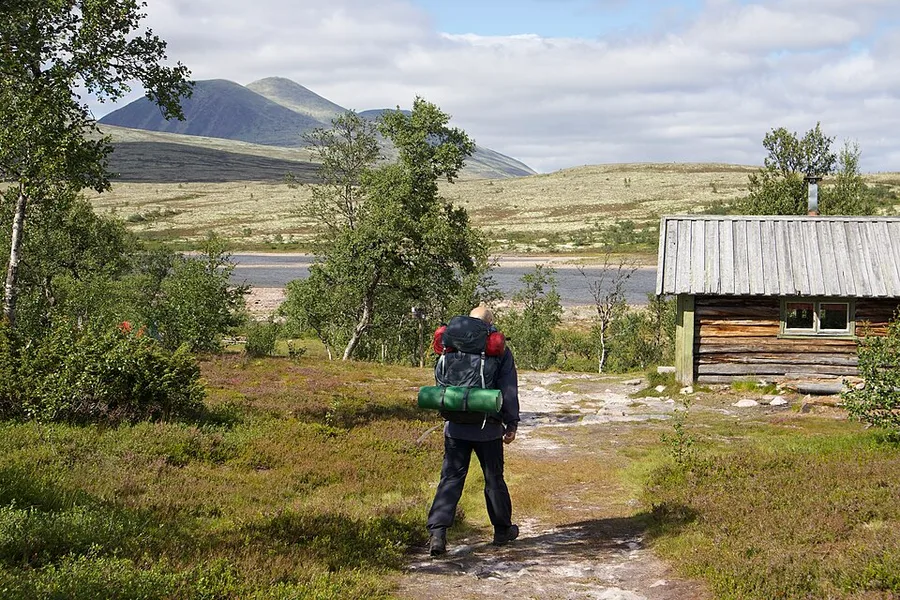 Photo by Anne Sande (2022), CC BY-SA 4.0, via Wikimedia Commons A hiker with a full pack walks across open, unfenced mountain heath toward a hut with no gate, ticket booth, or landowner in sight — the everyday, unticketed access to uncultivated land that allemannsretten protects. Norwegian right of public access to uncultivated land — literally "every-man's right." On anyone's forest, mountain, or shoreline, a person may walk, ski, swim, camp a night, forage, and pick berries without the landowner's permission, subject to limits (a 150-metre tent distance from inhabited houses, seasonal fire bans, and rules on what may be picked). Existed for centuries as customary law traceable to Magnus Lagabøte's Landslov of 1274 before being codified in the Outdoor Recreation Act of 1957 (friluftsloven), among the first laws of its kind anywhere. The statute divides all land into cultivated innmark (private in the ordinary sense) and uncultivated utmark (shared) — and because most of Norway is mountain, forest, bog, and rough coast, most of the country counts as utmark. In this article The berry-picking right under allemannsretten is what turns cloudberries, blueberries, and lingonberries into a national foraging habit rather than a landowner's private crop — July and August become open season on wild fruit growing on anyone's land. On the trip No single stop on the itinerary is built around the right to roam, but the family moves through the kind of open, unfenced ground it protects — the walked-over grass of the emptied Kylloplass farm-place, the open slopes around the Stegastein platform above Flåm — without a ticket, a permit, or a landowner's permission ever entering into it. Also discussed in Allemannsretten — the right to roamFriluftsliv — the open-air lifeRespecting nature — why you can roam and camp on private land ’s berry-picking right turns July and August into a national foraging season. Most Norwegian kitchens still keep a jar of last summer’s lingonberry jam, spread under the Matpakke
 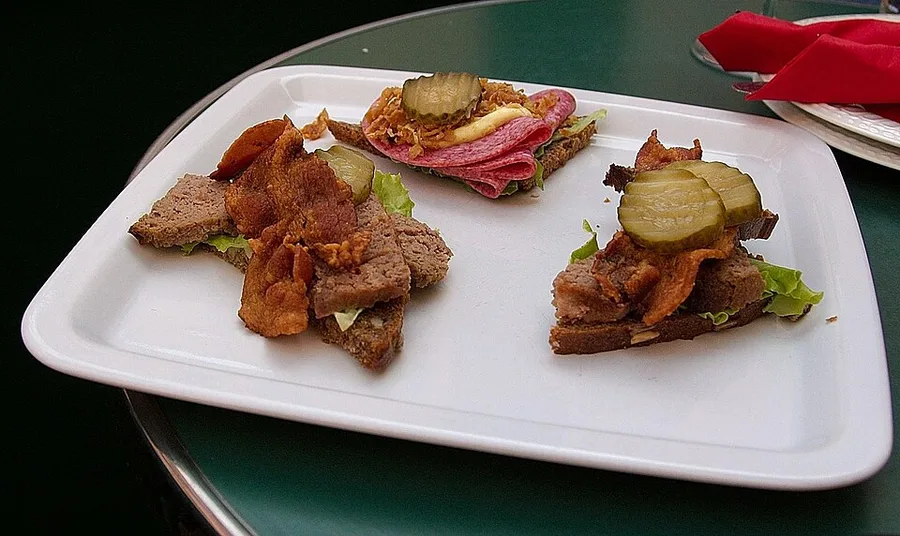 Photo by Anne-Sophie Ofrim (2009), CC BY-SA 4.0, via Wikimedia Commons Open-faced slices in their dressed-up café form — restaurant smørbrød rather than a packed lunch, but built on the same open-faced, nothing-on-top principle the matpakke carries to school and work. Norway's packed lunch — literally food-pack. Four or five open-faced sandwiches, one topping (pålegg) per slice, never stacked or closed, separated by squares of mellomleggspapir (waxed interleaving paper) and stacked flat into a box or wrapped in matpapir. Carried to school and work by nearly everyone regardless of rank — a schoolchild, a bus driver, and a government minister eat the same shape of lunch. The modern habit traces to 1932, when the Oslo school health authority under the physician Carl Schiøtz introduced the Oslofrokost (Oslo Breakfast), a free daily meal for undernourished city schoolchildren; within two decades the model migrated into the home-packed lunchbox, prized by some as an egalitarian habit and criticized by others for keeping Norwegian lunch culture flat. In this article Named in passing as the everyday resting place for leftover lingonberry jam and the everyday yellow cheese, Norvegia — background texture for the larger food culture this article surveys. On the trip The matpakke shows up constantly on travel days. Norwegian hotel breakfast buffets are built for it — bread, cheese, cold cuts, and a stack of mellomleggspapir at the end of the table for anyone assembling a lunch to carry out the door. On the long legs — the Nutshell train and ferry for the Ungdommene (the Youngsters), the Slektsreisen drive north for the Gråhårsklubben (the Oldsters) — a matpakke wrapped at breakfast is the practical way to eat lunch without hunting down a restaurant between train platforms and fjord crossings. Also discussed in (*Draft)Hverdagsliv — Norway on an ordinary Tuesday(*Draft)Pålegg — Norwegian toppingsSøndagstur — the Sunday walk cheese.
The New Nordic generation
For most of the twentieth century Norwegians believed the reputation — that the cuisine was small, plain, and not worth a destination meal. That changed in 2004, when twelve Nordic chefs signed the New Nordic Kitchen Manifesto. René Redzepi of Noma in Copenhagen was its public face, but Norwegian cooks were core signatories, and the movement built a new restaurant language from foraged moss, pine shoots, lichen, sea buckthorn, fermented cabbage, and the same dried-and-cured fish their grandparents ate. The result includes Maaemo in Oslo (three Michelin stars), Re-Naa in Stavanger (three), and Kontrast in Oslo (two). The larder did not change — the dried fish, the whey cheese, the mountain berries were all already there. What changed is that Norwegians stopped apologizing for it.