Statskirken — The state church and what's left of it
Most Norwegians are on the church rolls, a few percent attend on Sundays, and the country runs largely without religion in any active sense — but a recognizable Lutheran shape stays under the surface of how Norwegians treat work, conscience, and one another.
A Norwegian parish church on an ordinary Sunday morning is, often enough, mostly empty. The building is old and carefully kept, the churchyard outside is tended, the bells still ring across the valley. The few still in the pews are mostly past sixty, familiar to one another, and well aware they are the minority. Weekly attendance at the Church of Norway runs at something like two or three percent of the population. By that measure the country has emptied its churches about as thoroughly as any society in human history.
Yet by almost every other measure the country is thriving — and the way it thrives still rests on foundations laid by the church Norwegians no longer step inside.
Norway sits at or near the top of the world’s rankings for social trust, income equality, low corruption, life expectancy, reported happiness, and the health of its democracy. It is one of the most peaceful and humane societies the modern world has produced — and it became so, very largely, across the same three generations in which it stopped going to church.
What religion in Norway actually is now
Roughly 61% of Norwegians are still, as of the mid-2020s, registered members of the Church of Norway — Den norske kirke 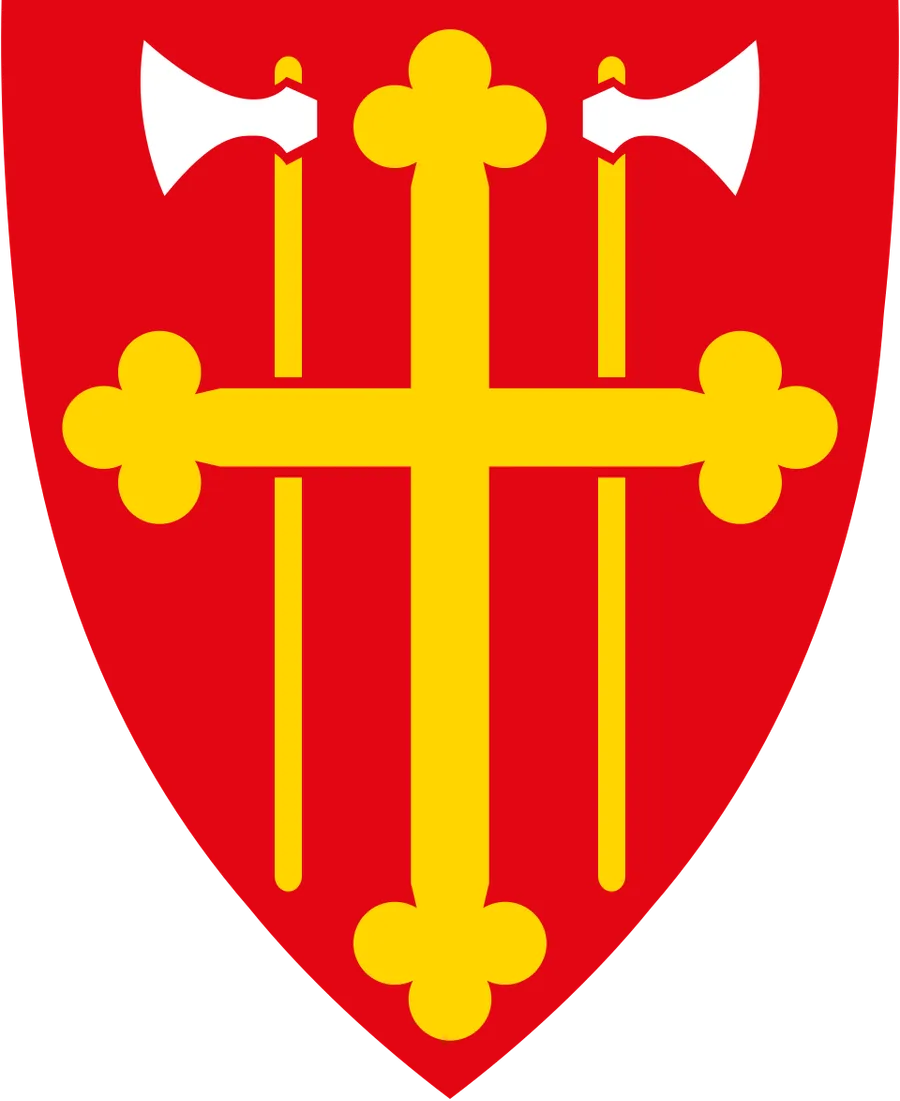 Church of Norway official coat of arms (kirken.no) Saint Olav's axes still on the letterhead — the emblem of a church separated from the state in stages between 2012 and 2017, still the venue for Norwegian life-cycle events even as the Sunday pews stand mostly empty. The Church of Norway — the Lutheran state church
established by the Kirkeordinansen of 1537 as the religious
arm of the Danish-Norwegian crown. From 1537 every
Norwegian parish was administered by a state-appointed
Lutheran pastor financed through royal taxation; the
bishops (initially called superintendents) were appointed
by the king and their offices were branches of the royal
government. The arrangement operated essentially unchanged
for four hundred and eighty years through Danish rule, the
1814 constitutional transition, and the personal union with
Sweden, into the modern Norwegian state. A 2012
constitutional amendment ended the state religion, and on
1 January 2017 the church became a separate legal entity —
no longer the state church, still the national folk
church.
Also discussed in The Reformation, 1537 — one church eradicated and another imposedLutheran Norway and Pietism — a farmer named Hans Nielsen Hauge and a lay revival that could not be silencedWorld War II — the King’s “No” and the Nazis in Norway . The figure sounds high until set against the trend line: it was over 90% in 1980, and it falls every year. The church was formally separated from the state in stages between 2012 and 2017, closing an establishment that had stood since The Reformation
Church of Norway official coat of arms (kirken.no) Saint Olav's axes still on the letterhead — the emblem of a church separated from the state in stages between 2012 and 2017, still the venue for Norwegian life-cycle events even as the Sunday pews stand mostly empty. The Church of Norway — the Lutheran state church
established by the Kirkeordinansen of 1537 as the religious
arm of the Danish-Norwegian crown. From 1537 every
Norwegian parish was administered by a state-appointed
Lutheran pastor financed through royal taxation; the
bishops (initially called superintendents) were appointed
by the king and their offices were branches of the royal
government. The arrangement operated essentially unchanged
for four hundred and eighty years through Danish rule, the
1814 constitutional transition, and the personal union with
Sweden, into the modern Norwegian state. A 2012
constitutional amendment ended the state religion, and on
1 January 2017 the church became a separate legal entity —
no longer the state church, still the national folk
church.
Also discussed in The Reformation, 1537 — one church eradicated and another imposedLutheran Norway and Pietism — a farmer named Hans Nielsen Hauge and a lay revival that could not be silencedWorld War II — the King’s “No” and the Nazis in Norway . The figure sounds high until set against the trend line: it was over 90% in 1980, and it falls every year. The church was formally separated from the state in stages between 2012 and 2017, closing an establishment that had stood since The Reformation 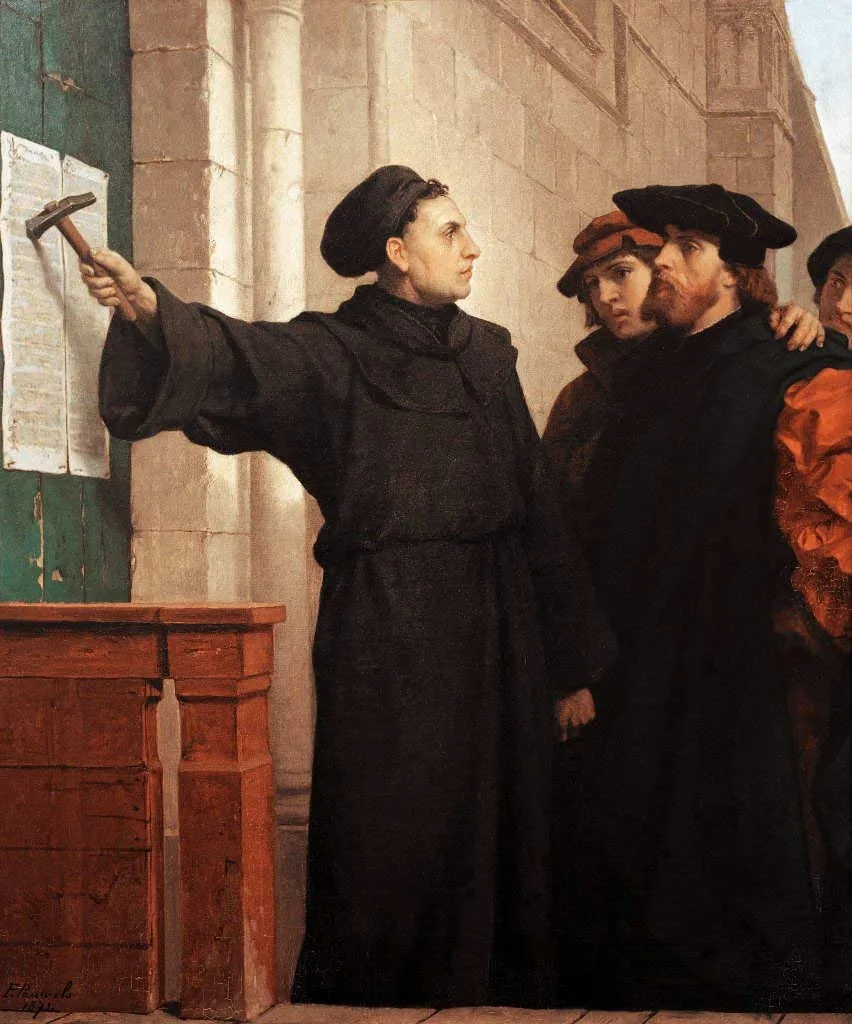 Ferdinand Pauwels, Luther hammers his 95 theses to the door (1872) Pauwels's 1872 history painting stages the 1517 act that began the Lutheran Reformation — the settlement Christian III of Denmark imposed on Norway by royal decree twenty years later, with no Norwegian reformer or domestic movement behind it. The Lutheran religious settlement imposed on Norway in 1537 by
royal decree from Copenhagen. Christian III of Denmark abolished
the Catholic ecclesiastical structure, dissolved the monasteries,
ordered the saints' relics destroyed, and replaced the Latin
liturgy with Danish-language Lutheran services. Unlike the
Reformation elsewhere in northern Europe, Norway's arrived from
outside — no Norwegian Luther, no Norwegian reformers, no
domestic religious movement behind it. The country changed
denomination because the king in Copenhagen ordered it.
In this article The establishment whose long tail the modern statistics measure
— imposed top-down in 1537, administered by the crown for
nearly five centuries, and unwound in stages between the 2012
constitutional amendment and the legal separation of
1 January 2017.
Also discussed in The Reformation, 1537 — one church eradicated and another imposedThe King Who Became a Saint — how the Nordmen came to ChristA Catholic Norway — the faith that gave the kingdom its first institutions and the stave churchesThe Germans Who "Ruled" Bergen — the Hanseatic merchants on Bryggen WharfThe 400-Year Night — when the Northern Lion lay dormantLutheran Norway and Pietism — a farmer named Hans Nielsen Hauge and a lay revival that could not be silencedThe Long Fall — the sudden loss of Norwegian nobility, the end of the kings, and half of Norway gone forever imposed it top-down in 1537 on a country that had been wholly Catholic, and ran it from the king’s chancery more tightly than Rome ever had.
Ferdinand Pauwels, Luther hammers his 95 theses to the door (1872) Pauwels's 1872 history painting stages the 1517 act that began the Lutheran Reformation — the settlement Christian III of Denmark imposed on Norway by royal decree twenty years later, with no Norwegian reformer or domestic movement behind it. The Lutheran religious settlement imposed on Norway in 1537 by
royal decree from Copenhagen. Christian III of Denmark abolished
the Catholic ecclesiastical structure, dissolved the monasteries,
ordered the saints' relics destroyed, and replaced the Latin
liturgy with Danish-language Lutheran services. Unlike the
Reformation elsewhere in northern Europe, Norway's arrived from
outside — no Norwegian Luther, no Norwegian reformers, no
domestic religious movement behind it. The country changed
denomination because the king in Copenhagen ordered it.
In this article The establishment whose long tail the modern statistics measure
— imposed top-down in 1537, administered by the crown for
nearly five centuries, and unwound in stages between the 2012
constitutional amendment and the legal separation of
1 January 2017.
Also discussed in The Reformation, 1537 — one church eradicated and another imposedThe King Who Became a Saint — how the Nordmen came to ChristA Catholic Norway — the faith that gave the kingdom its first institutions and the stave churchesThe Germans Who "Ruled" Bergen — the Hanseatic merchants on Bryggen WharfThe 400-Year Night — when the Northern Lion lay dormantLutheran Norway and Pietism — a farmer named Hans Nielsen Hauge and a lay revival that could not be silencedThe Long Fall — the sudden loss of Norwegian nobility, the end of the kings, and half of Norway gone forever imposed it top-down in 1537 on a country that had been wholly Catholic, and ran it from the king’s chancery more tightly than Rome ever had.
But today, belief has thinned alongside membership: roughly a third of Norwegians say they believe in God in some sense, a third say they do not, and a third sit uncertain or hold a vaguer spirituality. Firm belief in a personal God is now a minority position.
And yet most Norwegians are still, in a specific and limited sense, Lutheran. A Norwegian who has not attended a service in years will very likely still be baptized as an infant, confirmed at fourteen, married in a church if married at all, and buried by a pastor. The Church of Norway remains the venue for the Norwegian life-cycle even for Norwegians with no Christian belief to speak of. It is a church that has reorganized itself, over a couple of generations, from a structure of personal conviction into a Folkekirke 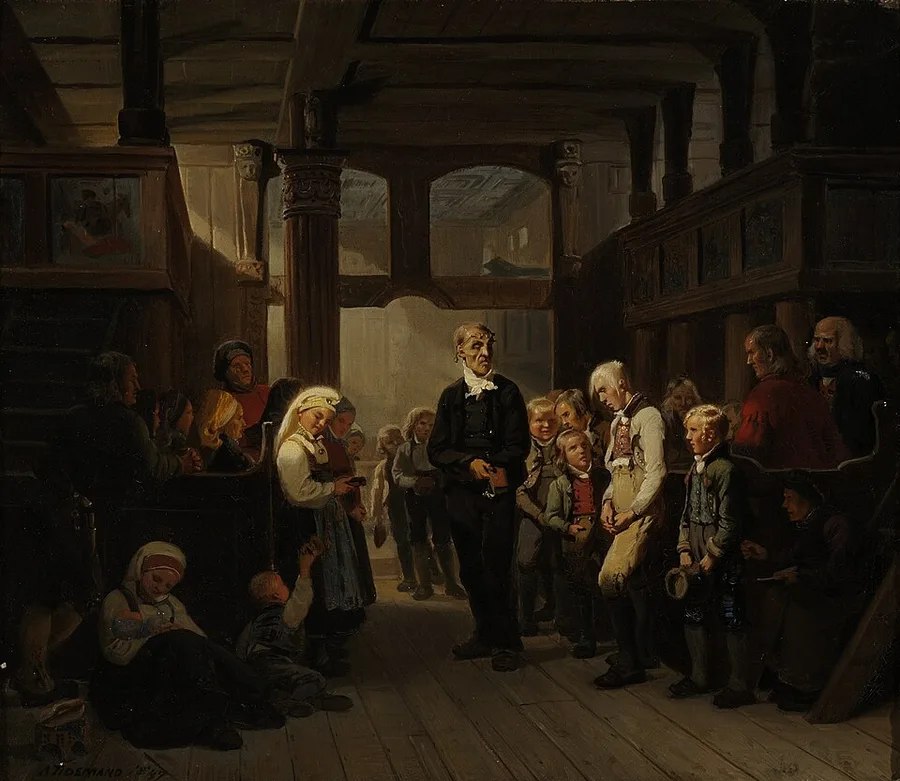 Adolph Tidemand, Overhøring i en bygdekirke (1847), Lillehammer Kunstmuseum Tidemand's 1847 catechism examination — children answering the pastor before the parish — is the direct ancestor of the confirmation season Norwegian families still keep, the clearest surviving piece of the life-cycle church. Folk church — the modern sociological category Norwegian
scholars use to describe the dominant religious pattern in
twenty-first-century Norway: a Lutheran church to which
roughly six in ten Norwegians remain registered members,
whose buildings and ministry mark the central life-cycle
events of most families (baptism, confirmation, marriage,
funeral), but in which weekly active practice is low.
Sociologists of religion describe the pattern as belonging
without believing — the church as a cultural-life-cycle
institution most Norwegians keep at arm's length and take
for granted at once. A 2012 constitutional
amendment ended the state religion; a Church Act amendment
in force 1 January 2017 completed it, making the Church of
Norway a folkekirke in law as well as sociology.
Also discussed in Lutheran Norway and Pietism — a farmer named Hans Nielsen Hauge and a lay revival that could not be silenced (a folk church) — a piece of shared cultural infrastructure, something closer to a national institution than to a faith.
Adolph Tidemand, Overhøring i en bygdekirke (1847), Lillehammer Kunstmuseum Tidemand's 1847 catechism examination — children answering the pastor before the parish — is the direct ancestor of the confirmation season Norwegian families still keep, the clearest surviving piece of the life-cycle church. Folk church — the modern sociological category Norwegian
scholars use to describe the dominant religious pattern in
twenty-first-century Norway: a Lutheran church to which
roughly six in ten Norwegians remain registered members,
whose buildings and ministry mark the central life-cycle
events of most families (baptism, confirmation, marriage,
funeral), but in which weekly active practice is low.
Sociologists of religion describe the pattern as belonging
without believing — the church as a cultural-life-cycle
institution most Norwegians keep at arm's length and take
for granted at once. A 2012 constitutional
amendment ended the state religion; a Church Act amendment
in force 1 January 2017 completed it, making the Church of
Norway a folkekirke in law as well as sociology.
Also discussed in Lutheran Norway and Pietism — a farmer named Hans Nielsen Hauge and a lay revival that could not be silenced (a folk church) — a piece of shared cultural infrastructure, something closer to a national institution than to a faith.
The clearest example is Konfirmasjon 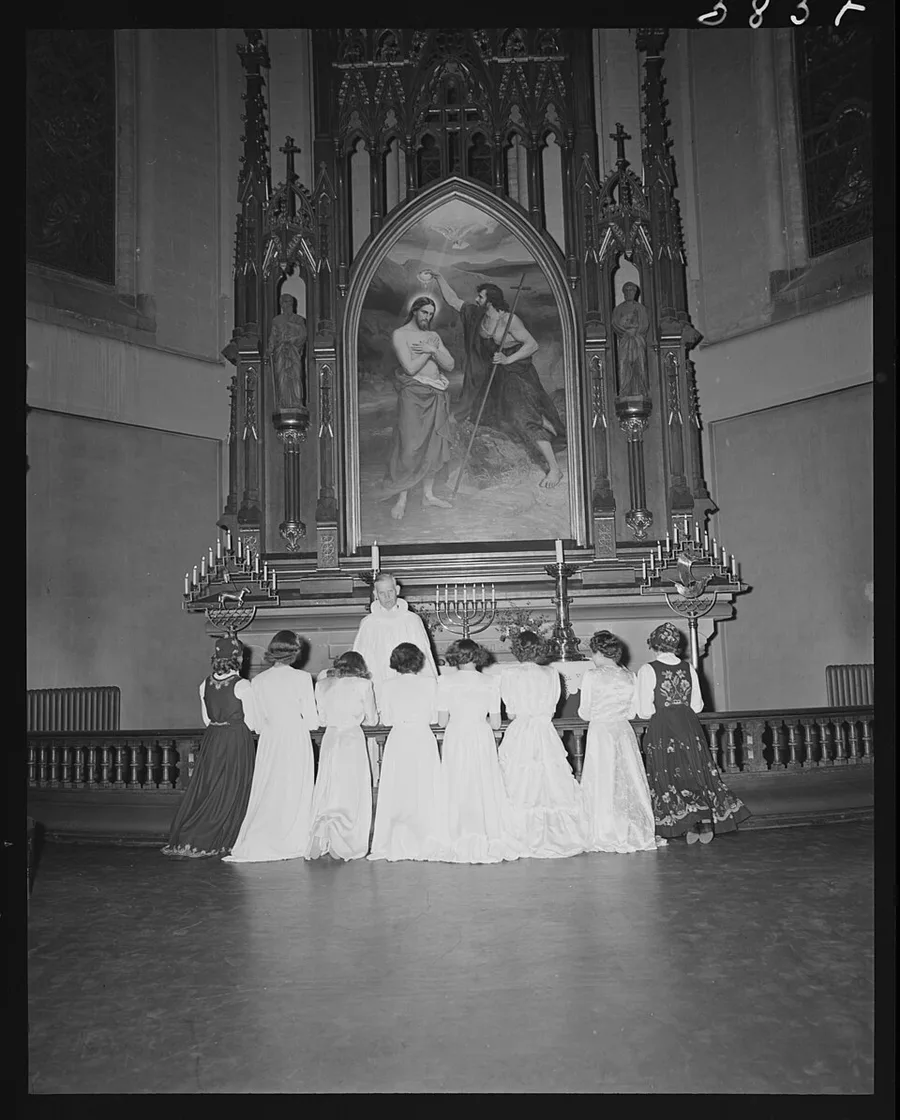 Unknown photographer, Konfirmasjon, Trefoldighetskirken, Oslo (1948), Nasjonalbiblioteket A 1948 photograph at the altar of Oslo's Trefoldighetskirken, taken three years before the first secular confirmation course existed — the near-universal church rite the card opens with, before the borgerlig alternative split the tradition in two. Lutheran confirmation, historically the near-universal rite of passage for Norwegian fourteen-year-olds — months of weekly instruction, a weekend away, a family celebration, and often substantial gifts. Since 1951, when the lay reformer Kristian Horn ran the first non-religious confirmation course — formalized in 1956 as the Human-Etisk Forbund (Norwegian Humanist Association) — teenagers have split between the church rite and the secular borgerlig or humanistisk konfirmasjon, the Humanist Confirmation. Roughly a fifth of each cohort now takes the secular course, a higher share in Oslo. Teenagers tend to frame the choice less as belief versus unbelief than as "the church one" or "the secular one," with friend-group dynamics often outweighing theology. . For Norwegian fourteen-year-olds it is still a major event — months of weekly classes, a weekend away, a family celebration, often substantial gifts. It now comes in two versions: the church confirmation and the Humanist Confirmation — borgerlig or humanistisk konfirmasjon — a fully secular coming-of-age program run by the Norwegian Humanist Association, taken by about a fifth of Norwegian teenagers and a higher share in Oslo. The teenagers themselves rarely frame the choice as believer versus atheist. They frame it as “the church one” or “the secular one,” and friend-group dynamics often weigh more than theology.
The same doubleness shows at Christmas. Many Norwegians who never otherwise enter a church go to the julegudstjeneste, the short Christmas Eve service, before the family meal. Nobody asks what anyone else privately believes; everyone shows up just the same. And it shows in the buildings: the medieval stave churches and white wooden parish churches are loved, visited, photographed, and chosen for weddings by couples with no religious practice at all. Norwegians hold the building dear without holding the doctrine.
Norway is also no longer religiously homogeneous. Catholicism has grown to about 3% of the population, carried by Polish, Filipino, and other immigrant labor. Islam is roughly the same size, concentrated in Oslo. The Norwegian sociologist Inger Furseth makes the sharp observation that Norway has secularized in some dimensions — belief, attendance — while de-secularizing in others, as immigration makes religion more publicly visible and more contested than it was a generation ago.
The irony of the Norwegian-American
There is a quiet irony for Norwegian-Americans visiting Norway. The Norwegians who emigrated in the great wave of 1825–1925 carried with them a religion still deeply held — the devout, revival-inflected Lutheranism of nineteenth-century rural Norway, shaped by the lay-preacher Hans Nielsen Hauge 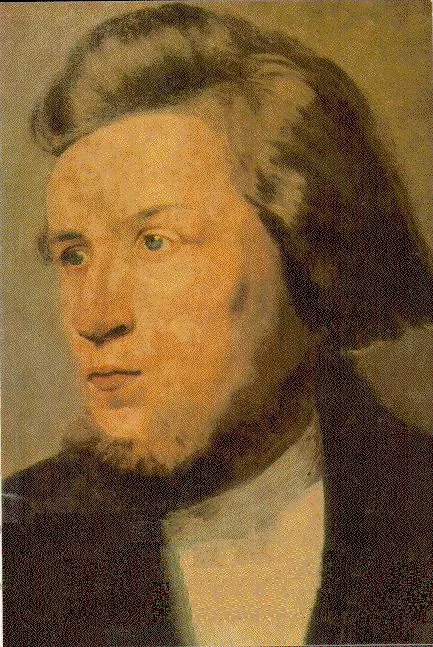 Unknown artist, Portrait of Hans Nielsen Hauge (Copenhagen, c. 1800) The only known original life portrait of Hauge, painted in Copenhagen around 1800 — the farmer's son in his late twenties, midway through the eight walking years in which he preached across Norway and was arrested again and again under the Konventikkelplakaten. Norwegian lay preacher, entrepreneur, and farmer (1771–
1824). The single most influential Norwegian religious
figure of the modern period. Underwent a conversion
experience on his family farm at Rolvsøy in Østfold on 5
April 1796 and spent the next eight years walking across
Norway, preaching and organising lay Christian gatherings
outside the official state church — illegal under the
Konventikkelplakaten of 1741. Arrested fourteen times
across his career; held in prison for roughly nine years
cumulatively — the long final detention, in the Christiania
town prison from 1804 to 1811, was settled at last in 1814
by a judgment reduced to a fine. His followers,
the Haugianere, founded businesses, mills, schools, and
printing presses across nineteenth-century Norway.
Also discussed in The Reformation, 1537 — one church eradicated and another imposedLutheran Norway and Pietism — a farmer named Hans Nielsen Hauge and a lay revival that could not be silenced800,000 Norwegians Leave — the century that built a Second Norway (1771–1824), whose revival built habits of self-organized effort that long outlived his theology. It is this religion that the American Midwest came to preserve: the Norwegian-American Lutheran synods, Sons of Norway
Unknown artist, Portrait of Hans Nielsen Hauge (Copenhagen, c. 1800) The only known original life portrait of Hauge, painted in Copenhagen around 1800 — the farmer's son in his late twenties, midway through the eight walking years in which he preached across Norway and was arrested again and again under the Konventikkelplakaten. Norwegian lay preacher, entrepreneur, and farmer (1771–
1824). The single most influential Norwegian religious
figure of the modern period. Underwent a conversion
experience on his family farm at Rolvsøy in Østfold on 5
April 1796 and spent the next eight years walking across
Norway, preaching and organising lay Christian gatherings
outside the official state church — illegal under the
Konventikkelplakaten of 1741. Arrested fourteen times
across his career; held in prison for roughly nine years
cumulatively — the long final detention, in the Christiania
town prison from 1804 to 1811, was settled at last in 1814
by a judgment reduced to a fine. His followers,
the Haugianere, founded businesses, mills, schools, and
printing presses across nineteenth-century Norway.
Also discussed in The Reformation, 1537 — one church eradicated and another imposedLutheran Norway and Pietism — a farmer named Hans Nielsen Hauge and a lay revival that could not be silenced800,000 Norwegians Leave — the century that built a Second Norway (1771–1824), whose revival built habits of self-organized effort that long outlived his theology. It is this religion that the American Midwest came to preserve: the Norwegian-American Lutheran synods, Sons of Norway 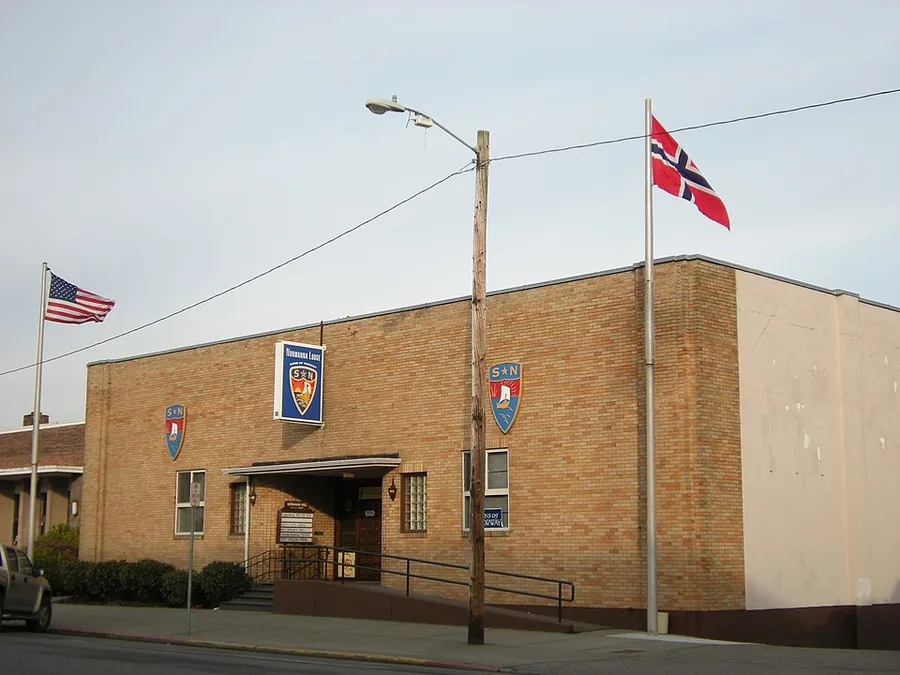 Photo by Joe Mabel (2009), CC BY-SA 3.0, via Wikimedia Commons Normanna Lodge in Everett, Washington — one of the hundreds of local Sons of Norway halls that gave Norwegian-American communities their meeting rooms, choirs, and Syttende mai gatherings at the fraternal order's mid-century peak. Norwegian-American fraternal benefit society founded on 16
January 1895 in Minneapolis by eighteen Norwegian
immigrants who pooled their resources to provide death
benefits, sick relief, and burial insurance to members of
the rapidly growing Norwegian-American community. Across
its first half-century the organisation also served as the
principal social and cultural infrastructure of Norwegian-
America — Norwegian-language meetings, choirs, dance
troupes, and Syttende mai parades. At its mid-twentieth-
century peak Sons of Norway ran more than four hundred
local lodges across the United States and Canada with
roughly seventy thousand members. Headquartered in
Minneapolis; still operating in 2026 as the largest
Norwegian-American fraternal organisation.
Also discussed in 800,000 Norwegians Leave — the century that built a Second Norway , the church suppers, the grace before the meal, the Bible verse on the Christmas card. It was held onto across four and five generations as a load-bearing part of what it meant to be Norwegian-American.
Photo by Joe Mabel (2009), CC BY-SA 3.0, via Wikimedia Commons Normanna Lodge in Everett, Washington — one of the hundreds of local Sons of Norway halls that gave Norwegian-American communities their meeting rooms, choirs, and Syttende mai gatherings at the fraternal order's mid-century peak. Norwegian-American fraternal benefit society founded on 16
January 1895 in Minneapolis by eighteen Norwegian
immigrants who pooled their resources to provide death
benefits, sick relief, and burial insurance to members of
the rapidly growing Norwegian-American community. Across
its first half-century the organisation also served as the
principal social and cultural infrastructure of Norwegian-
America — Norwegian-language meetings, choirs, dance
troupes, and Syttende mai parades. At its mid-twentieth-
century peak Sons of Norway ran more than four hundred
local lodges across the United States and Canada with
roughly seventy thousand members. Headquartered in
Minneapolis; still operating in 2026 as the largest
Norwegian-American fraternal organisation.
Also discussed in 800,000 Norwegians Leave — the century that built a Second Norway , the church suppers, the grace before the meal, the Bible verse on the Christmas card. It was held onto across four and five generations as a load-bearing part of what it meant to be Norwegian-American.
The homeland meanwhile moved on. The American descendants are, very often, more religious in any ordinary practicing sense than their Norwegian cousins. The emigrants kept the old country’s faith more faithfully than the old country did.
Culturally Lutheran
The Norwegian academic conversation about all this is less polemical than the Anglo-American one. It mostly does not ask “is secularization good or bad” — it asks “what kind of secularization is this, and what is actually changing.” Pål Repstad reads the Norwegian case as religious change rather than religious decline — fewer doctrinal believers, but a persistent cultural Lutheranism and a durable attachment to the rituals, a low-intensity religion, real even when it is faint.
What does the Lutheran shape look like, after the doctrine has thinned? It looks like a country where work-as-calling, conscience-over-tribe, the equality of souls carried into the equality of citizens, and an unembarrassed seriousness about the neighbor’s well-being all run quietly under modern life. None of these are obviously Christian anymore; all of them carry a recognizable Christian fingerprint. The church has become something like a grandparent — loved, visited at Christmas, and no longer obeyed.
It can jar an American traveler raised on churchgoing: a culture humanist in its convictions and still faintly Lutheran in its outlines.
An old parish church, mostly empty and still beautiful; a rural churchyard whose stones are tended even where the church is not attended; a Norwegian table where the people are kind and decent and largely untroubled by the religious questions an American visitor might expect such decency to rest on. In modern Norway, none of the three requires the doctrine still to be running underneath.