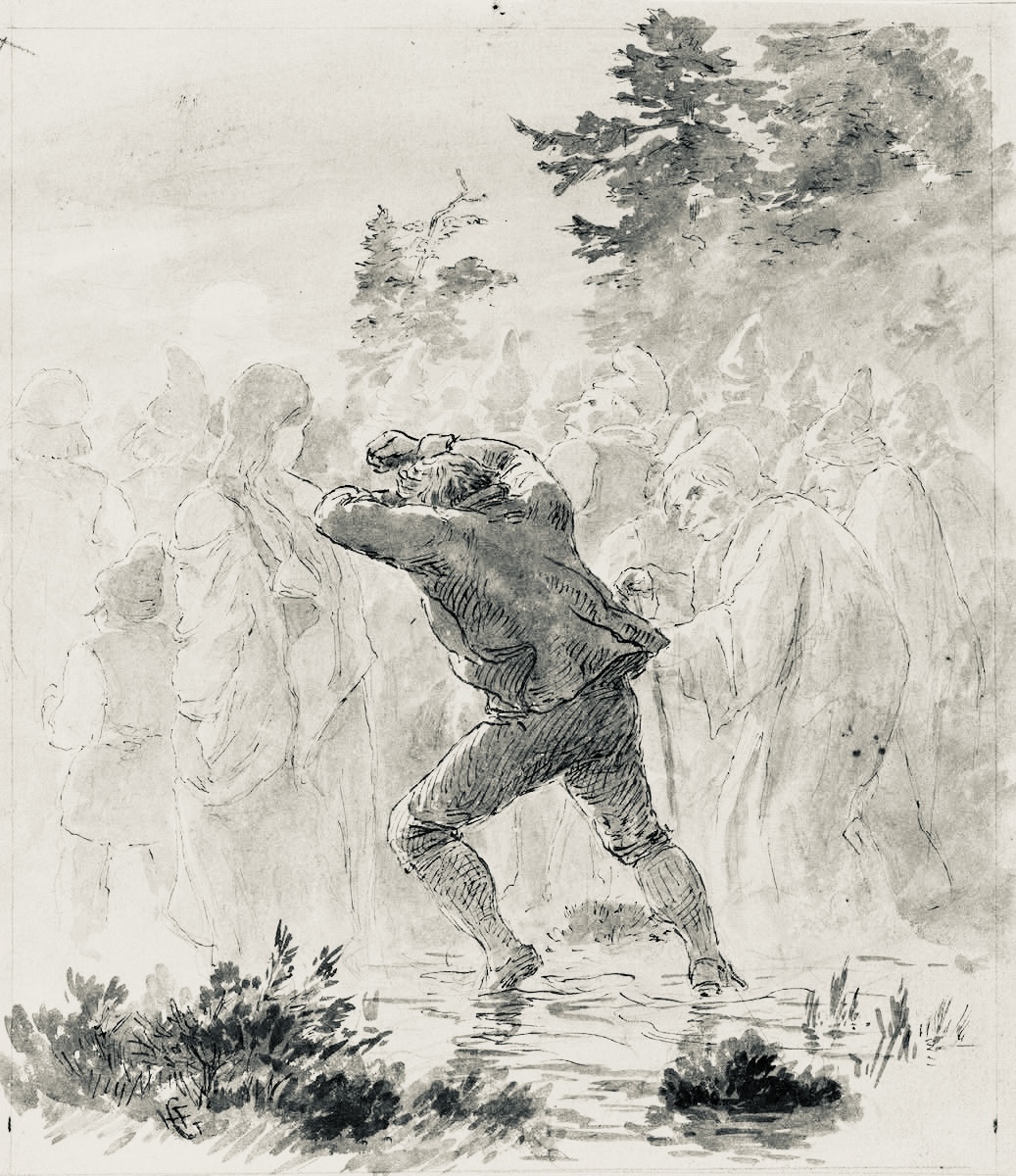
De underjordiske — the neighbors living under your hill
The hidden folk who live under the farm — under the mound, the rocks, the floor — running a whole parallel neighborhood beneath the visible one. Offend them by accident and a child sickens. Huldra is the famous one; the gardvord under the mound is the oldest.
Dig a new well, throw your dishwater the wrong way, or set a barn post a foot too far north, and you might be living on top of someone. The Norwegians called them de underjordiske — the ones below — and the danger they posed was mostly the offence you could give without meaning to: a whole neighbourhood ran underneath your own, and you could trespass on it without knowing.
The oldest of them was the Gardvord 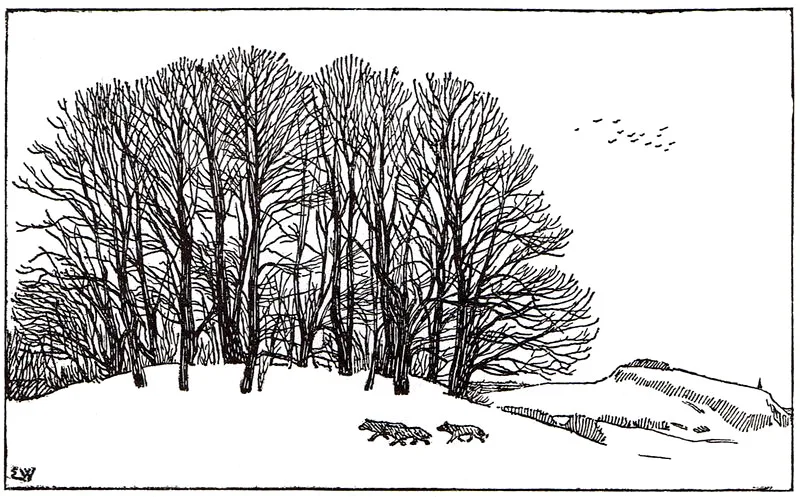 Erik Werenskiold, Farmannshaugen (c. 1899), from the 1899 Heimskringla edition Werenskiold's great burial mound rising from winter fields — the kind of ancient grave-mound at a farm's edge where tradition seated the gardvord, the dead first-clearer of the land still keeping watch over the farm his labour had made. The farm's guardian spirit in Norwegian tradition — also
tunkall, tomtegubbe, and, in the mound-form,
haugebonde. The recorded lore identified him with the
first man who cleared the land — the rudkall — dead in
the burial mound at the farmyard's edge and still keeping
watch over the farm his clearing made. A household on good
terms with him kept his dues: the mound stayed unploughed,
and the first beer from every new barrel was poured at the
mound or at the roots of the tuntre, the farm's guardian
tree. Andreas Faye set the tradition in print in Norske
Sagn (1833); folklorists have read the gardvord as the
plainest survival of the pre-Christian ancestor cult, and
as the figure that later shrank into the porridge-fed
nisse.
, the farm’s guardian — the first man who ever cleared that ground, dead in the mound at its edge and still watching over the buildings his clearing made possible. You did not plough the mound. You poured him the first beer from every new barrel. Others lived in the old burial cairns, or under the rocks — the same folk under other names: tusser, haugfolk, huldrefolk, or just vetter, the beings. The Huldra
Erik Werenskiold, Farmannshaugen (c. 1899), from the 1899 Heimskringla edition Werenskiold's great burial mound rising from winter fields — the kind of ancient grave-mound at a farm's edge where tradition seated the gardvord, the dead first-clearer of the land still keeping watch over the farm his labour had made. The farm's guardian spirit in Norwegian tradition — also
tunkall, tomtegubbe, and, in the mound-form,
haugebonde. The recorded lore identified him with the
first man who cleared the land — the rudkall — dead in
the burial mound at the farmyard's edge and still keeping
watch over the farm his clearing made. A household on good
terms with him kept his dues: the mound stayed unploughed,
and the first beer from every new barrel was poured at the
mound or at the roots of the tuntre, the farm's guardian
tree. Andreas Faye set the tradition in print in Norske
Sagn (1833); folklorists have read the gardvord as the
plainest survival of the pre-Christian ancestor cult, and
as the figure that later shrank into the porridge-fed
nisse.
, the farm’s guardian — the first man who ever cleared that ground, dead in the mound at its edge and still watching over the buildings his clearing made possible. You did not plough the mound. You poured him the first beer from every new barrel. Others lived in the old burial cairns, or under the rocks — the same folk under other names: tusser, haugfolk, huldrefolk, or just vetter, the beings. The Huldra 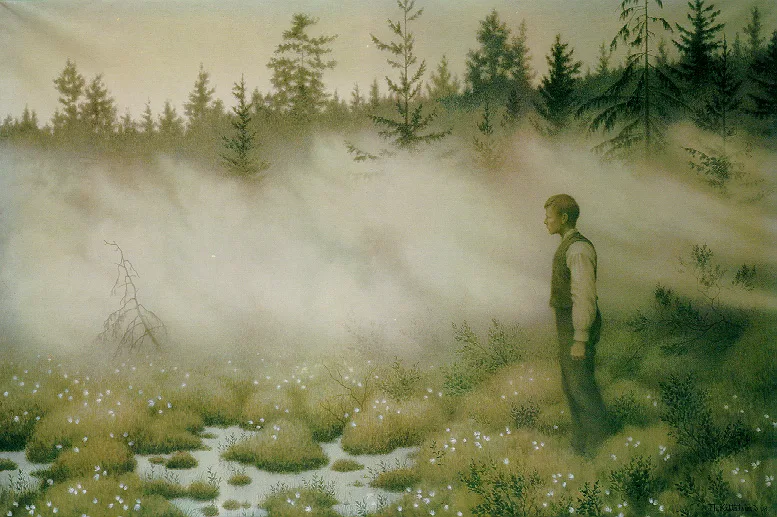 Theodor Kittelsen, Da Huldra forsvant (1908), private collection Kittelsen's 1908 'Da Huldra forsvant' — a man frozen at the edge of a flowering bog, staring into the mist where the beautiful, cow-tailed huldra of the summer pastures has just slipped out of sight. The hulder (definite huldra; from Old Norse hylja, 'to
hide') is a supernatural female being of Norwegian legend: a
beautiful young woman from the front, marked from behind by a
cow's tail and, in many tellings, a hollow back. She haunts
summer pastures and logging camps, lures men with her
herding-call, and belongs to the huldrefolk, the hidden
people also called de underjordiske. A hulder who marries
a man loses her tail at the church blessing — and her beauty,
though not her strength; legend holds that seven such tails
hang in Seljord church. Andreas Faye first collected the
tradition in Norske Sagn (1833); Asbjørnsen's Norske
Huldreeventyr og Folkesagn (1845–48) lent the genre its
name; Theodor Kittelsen painted her vanishing in Da Huldra
forsvant (1908).
On the trip On Day 3 the Ungdommene (the Youngsters) ride the Flåm
Railway down toward the fjord, and the train slows at the
Kjosfossen waterfall. In the summer season the railway
sometimes stages a performance of the huldra legend there —
a costumed dancer in a red dress moving through the spray
to a folk tune. The performance runs on some departures and
not others, so it is one to watch for rather than count on: if something moves in the mist above
the falls, the Ungdommene (the Youngsters) will know what
they are looking at.
Also discussed in Huldra — the girl in the forest with a secretThe Flåmsbana railway between Myrdal and FlåmThe Nutshell day — Oslo to Bergen by rail, bus, fjord, rail of the forest was their one famous face; most of the underjordiske kept out of sight.
Theodor Kittelsen, Da Huldra forsvant (1908), private collection Kittelsen's 1908 'Da Huldra forsvant' — a man frozen at the edge of a flowering bog, staring into the mist where the beautiful, cow-tailed huldra of the summer pastures has just slipped out of sight. The hulder (definite huldra; from Old Norse hylja, 'to
hide') is a supernatural female being of Norwegian legend: a
beautiful young woman from the front, marked from behind by a
cow's tail and, in many tellings, a hollow back. She haunts
summer pastures and logging camps, lures men with her
herding-call, and belongs to the huldrefolk, the hidden
people also called de underjordiske. A hulder who marries
a man loses her tail at the church blessing — and her beauty,
though not her strength; legend holds that seven such tails
hang in Seljord church. Andreas Faye first collected the
tradition in Norske Sagn (1833); Asbjørnsen's Norske
Huldreeventyr og Folkesagn (1845–48) lent the genre its
name; Theodor Kittelsen painted her vanishing in Da Huldra
forsvant (1908).
On the trip On Day 3 the Ungdommene (the Youngsters) ride the Flåm
Railway down toward the fjord, and the train slows at the
Kjosfossen waterfall. In the summer season the railway
sometimes stages a performance of the huldra legend there —
a costumed dancer in a red dress moving through the spray
to a folk tune. The performance runs on some departures and
not others, so it is one to watch for rather than count on: if something moves in the mist above
the falls, the Ungdommene (the Youngsters) will know what
they are looking at.
Also discussed in Huldra — the girl in the forest with a secretThe Flåmsbana railway between Myrdal and FlåmThe Nutshell day — Oslo to Bergen by rail, bus, fjord, rail of the forest was their one famous face; most of the underjordiske kept out of sight.
They lived a life parallel to the one above — cattle, weddings, quarrels, music. The music of an underground wedding could carry up through the floorboards at night, and a household that heard it did not say so. Tools left out were borrowed and came back blunt. A child or animal that sickened for no reason had probably crossed them. The commonest offence was scalding: dishwater or hot grease thrown onto the ground splashed invisibly onto the family below, and within days a child took ill — so you shouted a warning before you threw. The bluntest punishment in the lore fell on the farmer who built his new byre over the underjordiske’s sitting room: their ceiling ran with muck from his cattle until they made his life unlivable, and he pulled the building down and moved it.
Their origin was told as a footnote to scripture. Eve was washing her children when God came to visit, and she hid the ones she had not finished washing. God said: then let what is hidden stay hidden — and they have been under the ground ever since, neither damned nor blessed, between angels and humans, kin to the family upstairs and not to be feared the way demons were.
At Mollestad in Birkenes, in southern Norway, an oak nine metres around still stands over a burial mound. Every old Norwegian farm once had a tree like it: people poured the first beer from a new barrel at its roots, set out bread and milk, and would not break a twig. It is called the Vetteika, the spirits’ oak — and the instinct outlived the belief that explained it: into the twentieth century, road crews still bent a new road around a particular boulder rather than blast a stone someone’s grandfather had called occupied.