Huldra — The girl in the forest with a secret
A young woman, beautiful from the front and hollow as a rotted tree-trunk from behind, who waits in the summer pastures and the logging camps. Marry her and she loses her beauty but keeps a troll's strength — enough to straighten a glowing horseshoe in her bare hands.
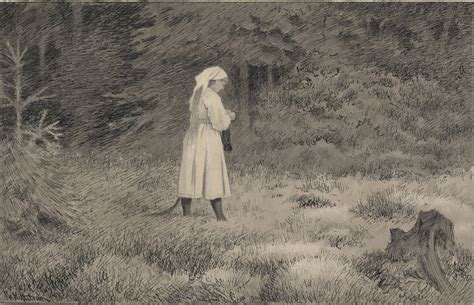
From the front she is a young woman in skirts — handsome, calm, often willing. From behind she carries a cow’s tail, and in some tellings a back that is hollow and bark-stripped like a rotted tree-trunk. That is the whole danger of the huldra: she keeps her back to a wall or a spruce and does not turn, and the man talking to her in the clearing does not see what he is talking to until she walks away.
She belongs to the lonely working places: the high summer pasture, the charcoal-burner’s kiln in the slow dusk, the edge of the winter logging camps where men spent weeks without women. She drives a small herd of fine cows and calls them with the lokk, the high herding-song that carries across a valley, and a man who followed the song could walk into the forest after her and never come out. The crueller stories were about the ones who did come out — slow, listless, hard for their families to recognise as the men who had left.
The name descends from the Old Norse hylja, to hide, and a same-sounding word, huld, could also mean gracious or gentle — a fitting double sense for beings one did not name aloud carelessly. It named her whole people: the huldrefolk, who hold dances inside the hollow hills. A man who joined one came home to find that a single night underground had cost him years above it.
Marry her, and her tail drops off at the altar the moment she is churched into a Christian congregation — but she loses her beauty with it and keeps a Troll 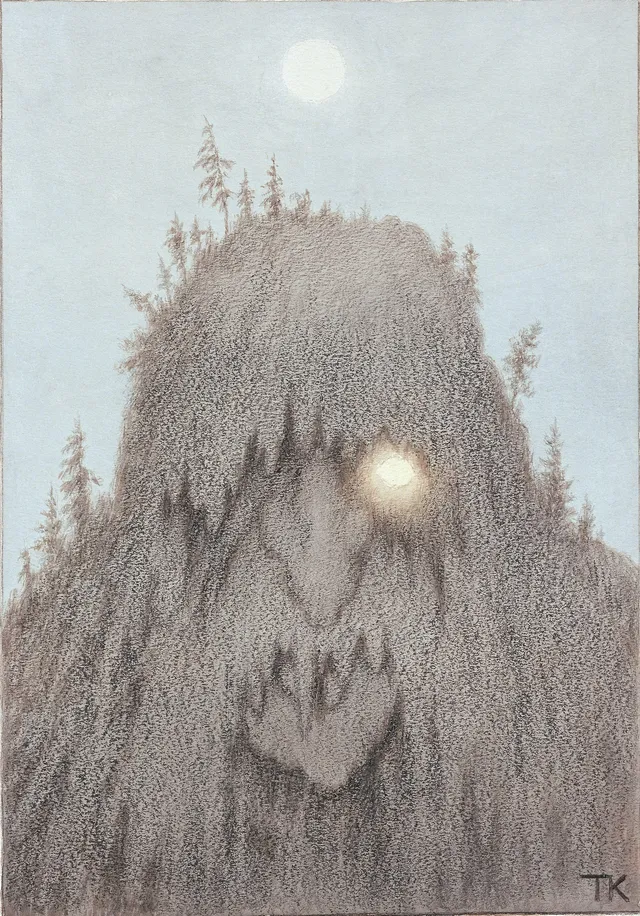 Theodor Kittelsen, Skogtroll (1906), Nasjonalmuseet The huldra's dowry is a troll's strength — enough to straighten a glowing horseshoe bare-handed. Kittelsen's forest troll shows the scale that word carries: a being so big the hillside is its body, spruce for hair and scree for a face, strength worn as landscape. The supernatural mountain-dweller of Norwegian folketro —
sometimes gigantic, like the valley-striding jutul, sometimes
small — living inside mountains and deep forest. Legends set
the troll against the church: it hurls boulders at church
buildings and flees the sound of church bells. Sunlight turns
a troll caught above ground to stone. Andreas Faye's Norske
Sagn (1833, expanded as Norske Folke-Sagn in 1844), Norway's
first legend collection, put the tradition on paper; Asbjørnsen
and Moe's Norske Folkeeventyr (1841–44) fixed the man-eating
troll of the tales in print — "De tre bukkene Bruse" was first
printed in 1843. Theodor Kittelsen (1857–1914) gave the troll
its modern visual form; his Skogtroll (1906) is in the
Nasjonalmuseet.
Also discussed in Troll — the monsters of the mountainsStedssagn — local legends, told as warningsSoria Moria — the shining castle always out of reachNorske eventyr — the folk tales almost lost foreverBytting — the changeling left in the cradleVardøger — your double, arriving a few minutes before youTradisjoner — celebrations across the Norwegian year ’s strength. A husband who treats her badly learns this the way the stories tell it: she takes up a horseshoe glowing from the forge and straightens it in her bare hands, without changing her face.
Theodor Kittelsen, Skogtroll (1906), Nasjonalmuseet The huldra's dowry is a troll's strength — enough to straighten a glowing horseshoe bare-handed. Kittelsen's forest troll shows the scale that word carries: a being so big the hillside is its body, spruce for hair and scree for a face, strength worn as landscape. The supernatural mountain-dweller of Norwegian folketro —
sometimes gigantic, like the valley-striding jutul, sometimes
small — living inside mountains and deep forest. Legends set
the troll against the church: it hurls boulders at church
buildings and flees the sound of church bells. Sunlight turns
a troll caught above ground to stone. Andreas Faye's Norske
Sagn (1833, expanded as Norske Folke-Sagn in 1844), Norway's
first legend collection, put the tradition on paper; Asbjørnsen
and Moe's Norske Folkeeventyr (1841–44) fixed the man-eating
troll of the tales in print — "De tre bukkene Bruse" was first
printed in 1843. Theodor Kittelsen (1857–1914) gave the troll
its modern visual form; his Skogtroll (1906) is in the
Nasjonalmuseet.
Also discussed in Troll — the monsters of the mountainsStedssagn — local legends, told as warningsSoria Moria — the shining castle always out of reachNorske eventyr — the folk tales almost lost foreverBytting — the changeling left in the cradleVardøger — your double, arriving a few minutes before youTradisjoner — celebrations across the Norwegian year ’s strength. A husband who treats her badly learns this the way the stories tell it: she takes up a horseshoe glowing from the forge and straightens it in her bare hands, without changing her face.
Theodor Kittelsen 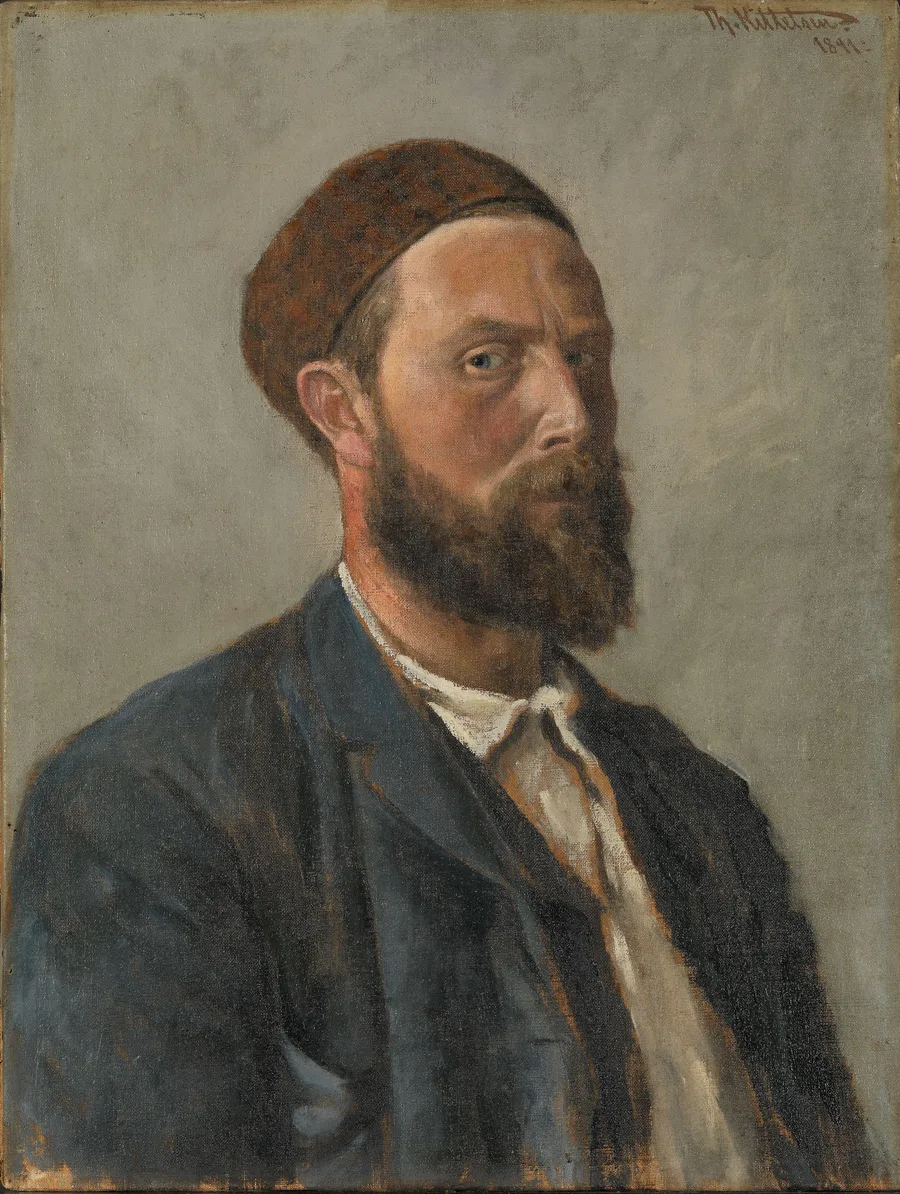 Theodor Kittelsen, Selvportrett (1891), Nasjonalmuseet Kittelsen at thirty-four, in the round cap and blue jacket of his 1891 self-portrait — the level gaze of the man who, more than any other artist, gave Norway's folklore beings their faces. Norwegian painter and illustrator (1857–1914), born in
Kragerø, who more than any other artist fixed the visual
identity of the country's folklore beings. Erik Werenskiold
brought him into the illustrated Asbjørnsen folktale editions
in the early 1880s. A stay at the Skomvær lighthouse on outer
Lofoten (1887–89), where his brother-in-law served as
assistant keeper, fed Troldskab (1892). His plague-hag
drawings, begun after an encounter with an old woman on the
island of Skåtøy, were published as the book Svartedauen in
1900. The same year, at Lauvlia in Sigdal, he painted his
Soria Moria pictures; the national collection bought them at
once. Nøkken (1904) — two pale eyes in a black lily-pool —
is held by the Nasjonalmuseet; Da Huldra forsvant (1908)
paints her vanishing.
Also discussed in Pesta — an old woman walking from farm to farmDraugen — the drowned man who never came homeNøkken — the water-spirit who pulls you underNorske eventyr — the folk tales almost lost foreverSoria Moria — the shining castle always out of reach painted her vanishing into the fog in 1908, in Da Huldra forsvant. But the country people did not keep her in a painting; they kept her in the church at Seljord
Theodor Kittelsen, Selvportrett (1891), Nasjonalmuseet Kittelsen at thirty-four, in the round cap and blue jacket of his 1891 self-portrait — the level gaze of the man who, more than any other artist, gave Norway's folklore beings their faces. Norwegian painter and illustrator (1857–1914), born in
Kragerø, who more than any other artist fixed the visual
identity of the country's folklore beings. Erik Werenskiold
brought him into the illustrated Asbjørnsen folktale editions
in the early 1880s. A stay at the Skomvær lighthouse on outer
Lofoten (1887–89), where his brother-in-law served as
assistant keeper, fed Troldskab (1892). His plague-hag
drawings, begun after an encounter with an old woman on the
island of Skåtøy, were published as the book Svartedauen in
1900. The same year, at Lauvlia in Sigdal, he painted his
Soria Moria pictures; the national collection bought them at
once. Nøkken (1904) — two pale eyes in a black lily-pool —
is held by the Nasjonalmuseet; Da Huldra forsvant (1908)
paints her vanishing.
Also discussed in Pesta — an old woman walking from farm to farmDraugen — the drowned man who never came homeNøkken — the water-spirit who pulls you underNorske eventyr — the folk tales almost lost foreverSoria Moria — the shining castle always out of reach painted her vanishing into the fog in 1908, in Da Huldra forsvant. But the country people did not keep her in a painting; they kept her in the church at Seljord 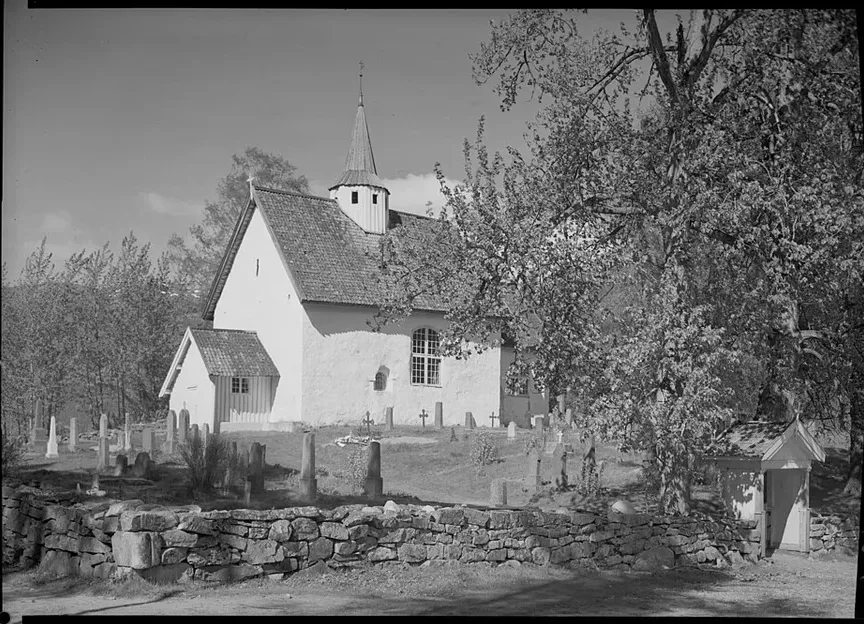 Unknown photographer, Seljord kirke (c. 1935–1950), Mittet collection, National Library of Norway The medieval stone church of this unusually folklore-rich Telemark parish, where legend hangs seven huldra tails inside — invisible to Christian eyes — fallen from huldra brides wed at its altar. Village and municipality in Telemark, on lake
Seljordsvatnet — a parish unusually rich in recorded
folklore. The lake serpent, Seljordsormen, entered the
written record in 1750, when Gunleik Andersson Verpe of Bø
reported it overturned one of his boats; the priest Hans
Jacob Wille described it in his 1786 Beskrivelse over
Sillejords Præstegield. In 1989 the municipality took the
serpent, gold on red, as its coat of arms; a sonar
expedition in August 2000 found nothing it could identify.
The medieval stone church (c. 1150–1180) carries the legend
that seven huldra tails — invisible to a Christian eye —
hang inside, fallen from huldra brides wed there. Magnus
Brostrup Landstad, parish priest 1839–1848, and Olea Crøger
gathered most of the ballads in Norske Folkeviser (1853)
here.
Seljord, Telemark Also discussed in Sjøormer — the serpents in the deep lakes and fjordsÅsgårdsreien — the storm that rides through the winter sky in Telemark
Unknown photographer, Seljord kirke (c. 1935–1950), Mittet collection, National Library of Norway The medieval stone church of this unusually folklore-rich Telemark parish, where legend hangs seven huldra tails inside — invisible to Christian eyes — fallen from huldra brides wed at its altar. Village and municipality in Telemark, on lake
Seljordsvatnet — a parish unusually rich in recorded
folklore. The lake serpent, Seljordsormen, entered the
written record in 1750, when Gunleik Andersson Verpe of Bø
reported it overturned one of his boats; the priest Hans
Jacob Wille described it in his 1786 Beskrivelse over
Sillejords Præstegield. In 1989 the municipality took the
serpent, gold on red, as its coat of arms; a sonar
expedition in August 2000 found nothing it could identify.
The medieval stone church (c. 1150–1180) carries the legend
that seven huldra tails — invisible to a Christian eye —
hang inside, fallen from huldra brides wed there. Magnus
Brostrup Landstad, parish priest 1839–1848, and Olea Crøger
gathered most of the ballads in Norske Folkeviser (1853)
here.
Seljord, Telemark Also discussed in Sjøormer — the serpents in the deep lakes and fjordsÅsgårdsreien — the storm that rides through the winter sky in Telemark 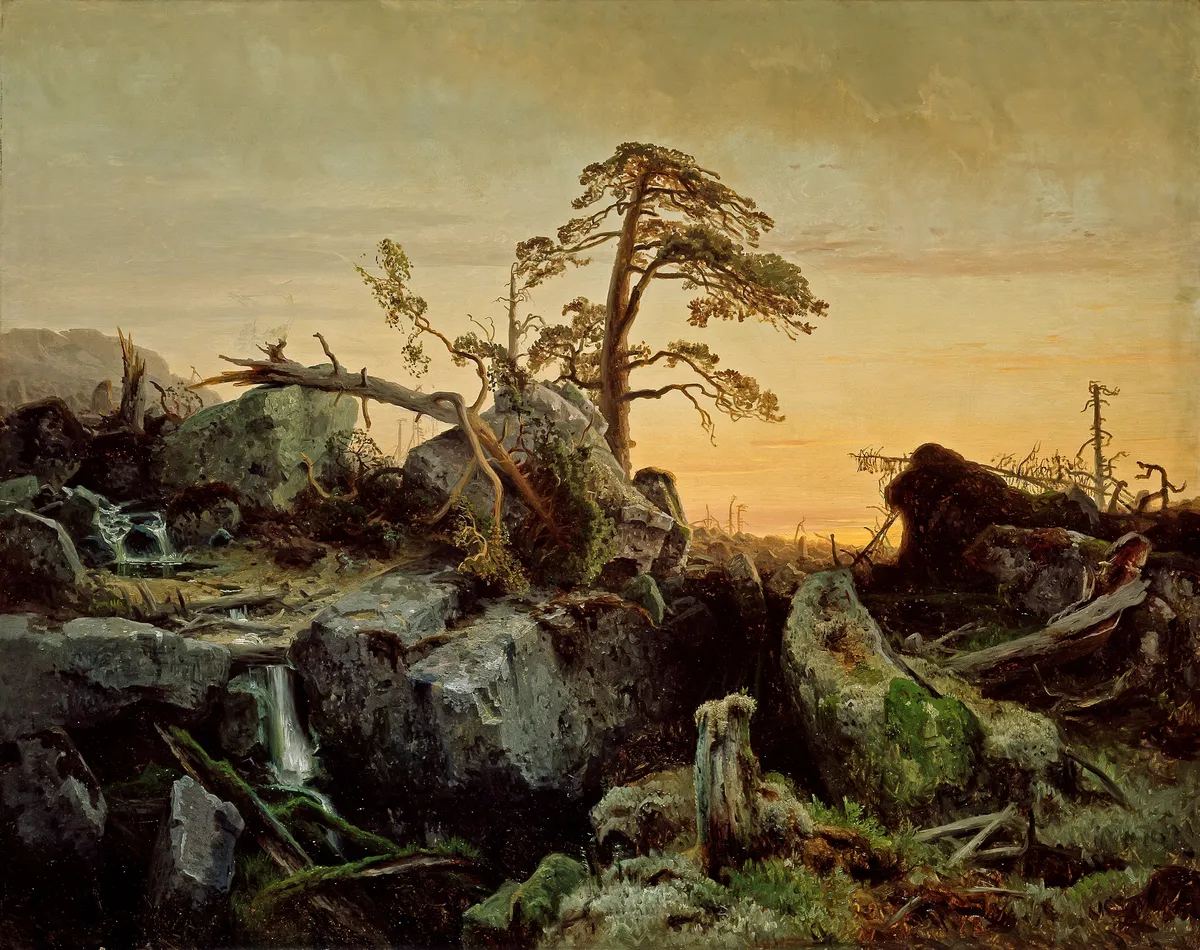 August Cappelen, Utdøende urskog (1852), National Museum of Art, Architecture and Design August Cappelen's *Utdøende urskog* — dying primeval forest, painted in 1852 out of his sketching years in the lower Telemark woods. This is the deep untouched timber of the huldra's country: seter and cattle-path at its edge, and behind them the old forest dark she steps out of and vanishes back into. Historic region and county in the inland-southern part of
Norway, between the southeastern coast and the central
Hardangervidda plateau. Home to Heddal Stave Church — the
largest of the twenty-eight surviving Norwegian stave churches,
standing nearly thirty metres tall — and to the heavy-water
production facility at Vemork whose sabotage by Norwegian
commandos in February 1943 disrupted the German atomic-weapons
programme. The name Telemark also gives the world the modern
ski-turn technique developed there in the nineteenth century.
In the folklore record Telemark is the deepest vein of all —
the landscape of the ballad collectors, the hardingfele
legends, and the lake serpent of Seljord.
Telemark Also discussed in A Catholic Norway — the faith that gave the kingdom its first institutions and the stave churchesWorld War II — the King’s “No” and the Nazis in NorwayThe Long Fall — the sudden loss of Norwegian nobility, the end of the kings, and half of Norway gone foreverFossegrimen — the waterfall fiddler who teaches you to playTroll — the monsters of the mountainsUtburd — the unbaptized child that will not restÅsgårdsreien — the storm that rides through the winter skySjøormer — the serpents in the deep lakes and fjords , where seven cow-tails are said to hang from the rafters — one for each huldra who married a local man and was baptized out of the woods.
August Cappelen, Utdøende urskog (1852), National Museum of Art, Architecture and Design August Cappelen's *Utdøende urskog* — dying primeval forest, painted in 1852 out of his sketching years in the lower Telemark woods. This is the deep untouched timber of the huldra's country: seter and cattle-path at its edge, and behind them the old forest dark she steps out of and vanishes back into. Historic region and county in the inland-southern part of
Norway, between the southeastern coast and the central
Hardangervidda plateau. Home to Heddal Stave Church — the
largest of the twenty-eight surviving Norwegian stave churches,
standing nearly thirty metres tall — and to the heavy-water
production facility at Vemork whose sabotage by Norwegian
commandos in February 1943 disrupted the German atomic-weapons
programme. The name Telemark also gives the world the modern
ski-turn technique developed there in the nineteenth century.
In the folklore record Telemark is the deepest vein of all —
the landscape of the ballad collectors, the hardingfele
legends, and the lake serpent of Seljord.
Telemark Also discussed in A Catholic Norway — the faith that gave the kingdom its first institutions and the stave churchesWorld War II — the King’s “No” and the Nazis in NorwayThe Long Fall — the sudden loss of Norwegian nobility, the end of the kings, and half of Norway gone foreverFossegrimen — the waterfall fiddler who teaches you to playTroll — the monsters of the mountainsUtburd — the unbaptized child that will not restÅsgårdsreien — the storm that rides through the winter skySjøormer — the serpents in the deep lakes and fjords , where seven cow-tails are said to hang from the rafters — one for each huldra who married a local man and was baptized out of the woods.
She still makes appearances. In summer, some departures of the Flåm Day 3 sends the Ungdommene (the Youngsters) down the Flåm valley past Kjosfossen — the performance runs on some summer departures and not others. Go to page → pause at the Kjosfossen falls while a dancer in a red dress performs the huldra legend in the waterfall spray, to a folk tune played over speakers. Worth keeping an eye on the mist.