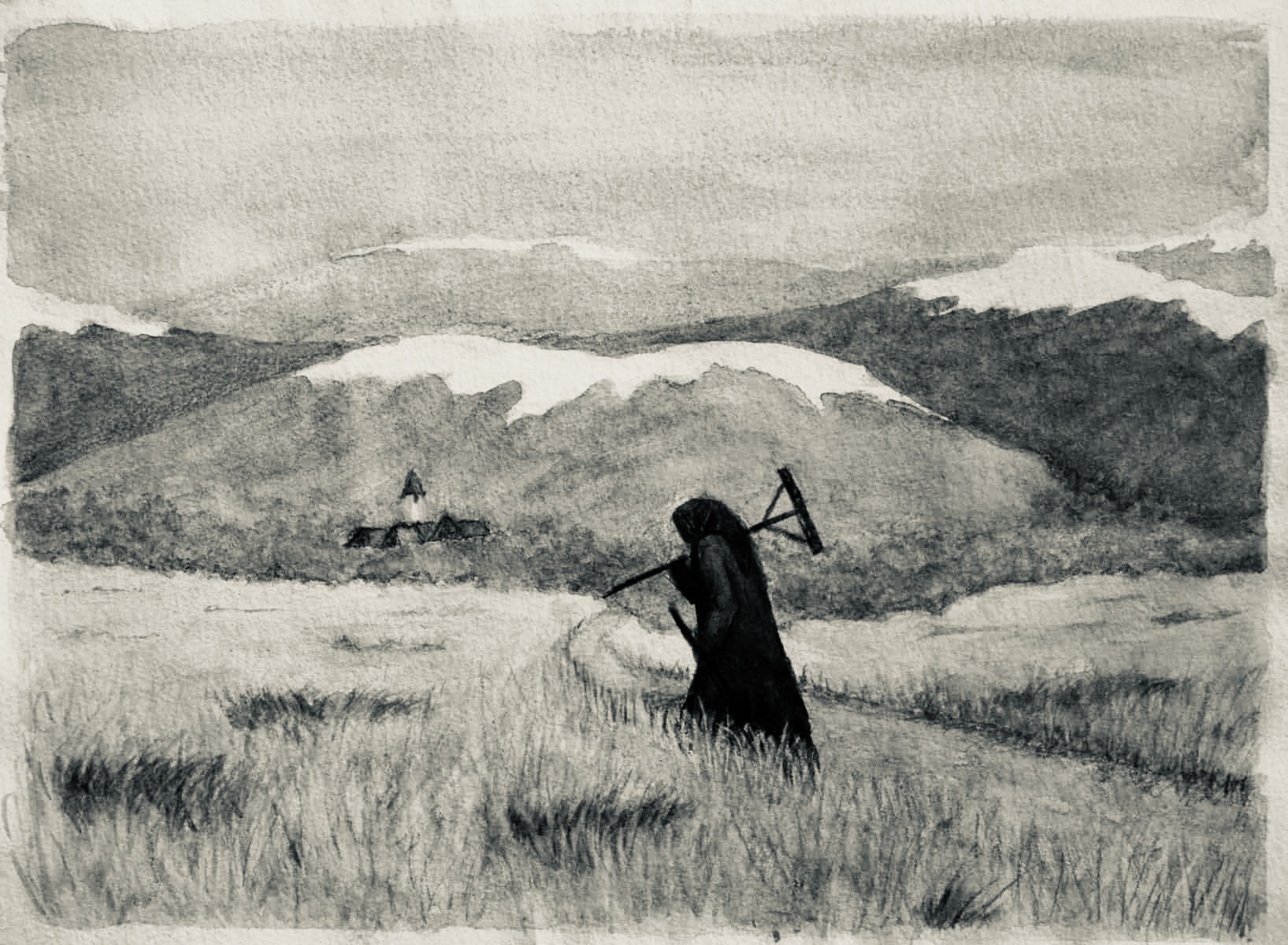
Pesta — An old woman walking from farm to farm
An old woman walking the roads with a broom and a rake. If she brings the broom to the door, everyone on the farm is soon to die; if it is the rake, she plans to let a few survive.
There is record of an old woman appearing on the roads and farmsteads of Norway at some point in the mid 1300s. Every parish knew her: whole households died within a week of her visit. And people learned to read her: which farms died, and which were spared, followed the tool she carried — by her side or over her back — as she walked from farm to farm.
She looked like somebody’s grandmother — bent-backed, ash-skinned, hooded, in a red skirt or sometimes a blue one. She did not announce herself; she arrived at the ordinary hour of an ordinary visitor, and the countryside, terrified, unknowingly treated her with the courtesy due an old woman. She carried two things: a broom and a rake. The broom meant the farm she entered would be “swept clean” and no one survive the visit. The rake meant a few would fall between the teeth and live.
She walked Norway hardest in the years 1349 and 1350.
An English ship that docked at Bergen 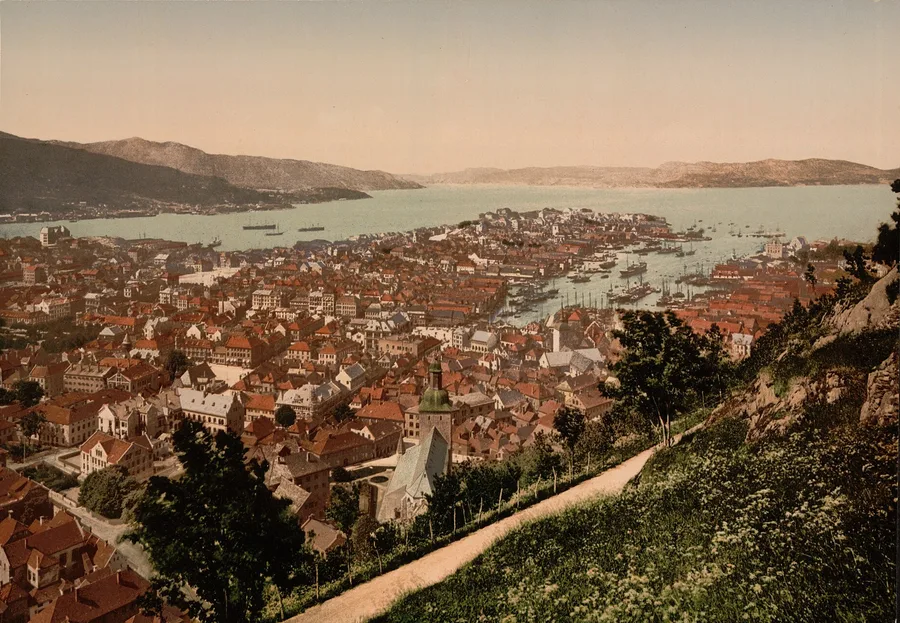 Photochrom print, General view from Fjeldveien, Bergen (c. 1890–1900), Library of Congress Bergen in the 1890s from the Fjellveien path on Fløyfjellet — the whole city between its mountains, Vågen harbour still crowded with sailing ships at its heart. For four centuries Norway's largest city, and the wharf through which the entire western export economy ran. Norway's western trading capital, founded around 1070 on the
inner Byfjorden. For four centuries the largest city in the
country and the wharf through which the entire western export
economy ran — dried cod from the Lofoten fisheries, stockpiled
and traded by the Hanseatic merchants at Bryggen from 1360 to
1754. Norway's commercial and intellectual heart through the
Hanseatic period; overtaken in size by Christiania (Oslo) in the
1830s. The painted wooden Bryggen wharf is on the UNESCO World
Heritage list and substantially what it was in the late
seventeenth century.
In this article The 1349 landfall — an English ship made fast at the wharves of
Bergen in late summer, and the longshoremen who unloaded its
cargo were sick within days. The port where the plague Pesta
personifies first came ashore in Norway.
On the trip The Ungdommene (the Youngsters) reach Bergen late on Day 3
via the Norway-in-a-Nutshell train-and-ferry route from
Oslo. On the Day 4 morning they walk Bryggen and ride the
funicular up Mount Fløyen before flying back to Oslo and driving
on to Lillehammer that evening — a day ahead of the Gråhårsklubben
(the Oldsters), who spend the split days north in Trondheim and
the heritage country of Stjørdal, Hegra, and Kylloplass and come
south on Day 5.
Bergen Also discussed in The Germans Who "Ruled" Bergen — the Hanseatic merchants on Bryggen WharfBefore There Was Norway — petty kingdoms at the edge of the worldThe King Who Became a Saint — how the Nordmen came to ChristA Catholic Norway — the faith that gave the kingdom its first institutions and the stave churchesThe Long Fall — the sudden loss of Norwegian nobility, the end of the kings, and half of Norway gone foreverThe Golden Age — a North Atlantic empire … reaching farther than you thinkThe 400-Year Night — when the Northern Lion lay dormantThe Crusades?!!!! — sixty ships from Bergen, bound for the Holy LandThe Reformation, 1537 — one church eradicated and another imposedWorld War II — the King’s “No” and the Nazis in NorwayKraken — the island-sized beast, logged as factSjøormer — the serpents in the deep lakes and fjordsFossegrimen — the waterfall fiddler who teaches you to playAlcohol and Vinmonopolet — when and where to buy a drinkEveryday etiquette — quiet voices, wide space, no smilingFood and dining customs — having patience, free water, brunost on everything🚨 Emergencies - important numbers, hospitals, and what you can doLanguage basics — just enough Norwegian to be politeWhat to wear — the layering system, on the ground in the late summer of 1349 brought this old woman to the Norwegian kingdom for the first time, and within two years more than half the country had died by her hands — by some counts three in five Norwegians. The dying did not stop at individuals. Norway had some 60,000 farms at its medieval height, and roughly 36,000 of them — the Ødegårder
Photochrom print, General view from Fjeldveien, Bergen (c. 1890–1900), Library of Congress Bergen in the 1890s from the Fjellveien path on Fløyfjellet — the whole city between its mountains, Vågen harbour still crowded with sailing ships at its heart. For four centuries Norway's largest city, and the wharf through which the entire western export economy ran. Norway's western trading capital, founded around 1070 on the
inner Byfjorden. For four centuries the largest city in the
country and the wharf through which the entire western export
economy ran — dried cod from the Lofoten fisheries, stockpiled
and traded by the Hanseatic merchants at Bryggen from 1360 to
1754. Norway's commercial and intellectual heart through the
Hanseatic period; overtaken in size by Christiania (Oslo) in the
1830s. The painted wooden Bryggen wharf is on the UNESCO World
Heritage list and substantially what it was in the late
seventeenth century.
In this article The 1349 landfall — an English ship made fast at the wharves of
Bergen in late summer, and the longshoremen who unloaded its
cargo were sick within days. The port where the plague Pesta
personifies first came ashore in Norway.
On the trip The Ungdommene (the Youngsters) reach Bergen late on Day 3
via the Norway-in-a-Nutshell train-and-ferry route from
Oslo. On the Day 4 morning they walk Bryggen and ride the
funicular up Mount Fløyen before flying back to Oslo and driving
on to Lillehammer that evening — a day ahead of the Gråhårsklubben
(the Oldsters), who spend the split days north in Trondheim and
the heritage country of Stjørdal, Hegra, and Kylloplass and come
south on Day 5.
Bergen Also discussed in The Germans Who "Ruled" Bergen — the Hanseatic merchants on Bryggen WharfBefore There Was Norway — petty kingdoms at the edge of the worldThe King Who Became a Saint — how the Nordmen came to ChristA Catholic Norway — the faith that gave the kingdom its first institutions and the stave churchesThe Long Fall — the sudden loss of Norwegian nobility, the end of the kings, and half of Norway gone foreverThe Golden Age — a North Atlantic empire … reaching farther than you thinkThe 400-Year Night — when the Northern Lion lay dormantThe Crusades?!!!! — sixty ships from Bergen, bound for the Holy LandThe Reformation, 1537 — one church eradicated and another imposedWorld War II — the King’s “No” and the Nazis in NorwayKraken — the island-sized beast, logged as factSjøormer — the serpents in the deep lakes and fjordsFossegrimen — the waterfall fiddler who teaches you to playAlcohol and Vinmonopolet — when and where to buy a drinkEveryday etiquette — quiet voices, wide space, no smilingFood and dining customs — having patience, free water, brunost on everything🚨 Emergencies - important numbers, hospitals, and what you can doLanguage basics — just enough Norwegian to be politeWhat to wear — the layering system, on the ground in the late summer of 1349 brought this old woman to the Norwegian kingdom for the first time, and within two years more than half the country had died by her hands — by some counts three in five Norwegians. The dying did not stop at individuals. Norway had some 60,000 farms at its medieval height, and roughly 36,000 of them — the Ødegårder 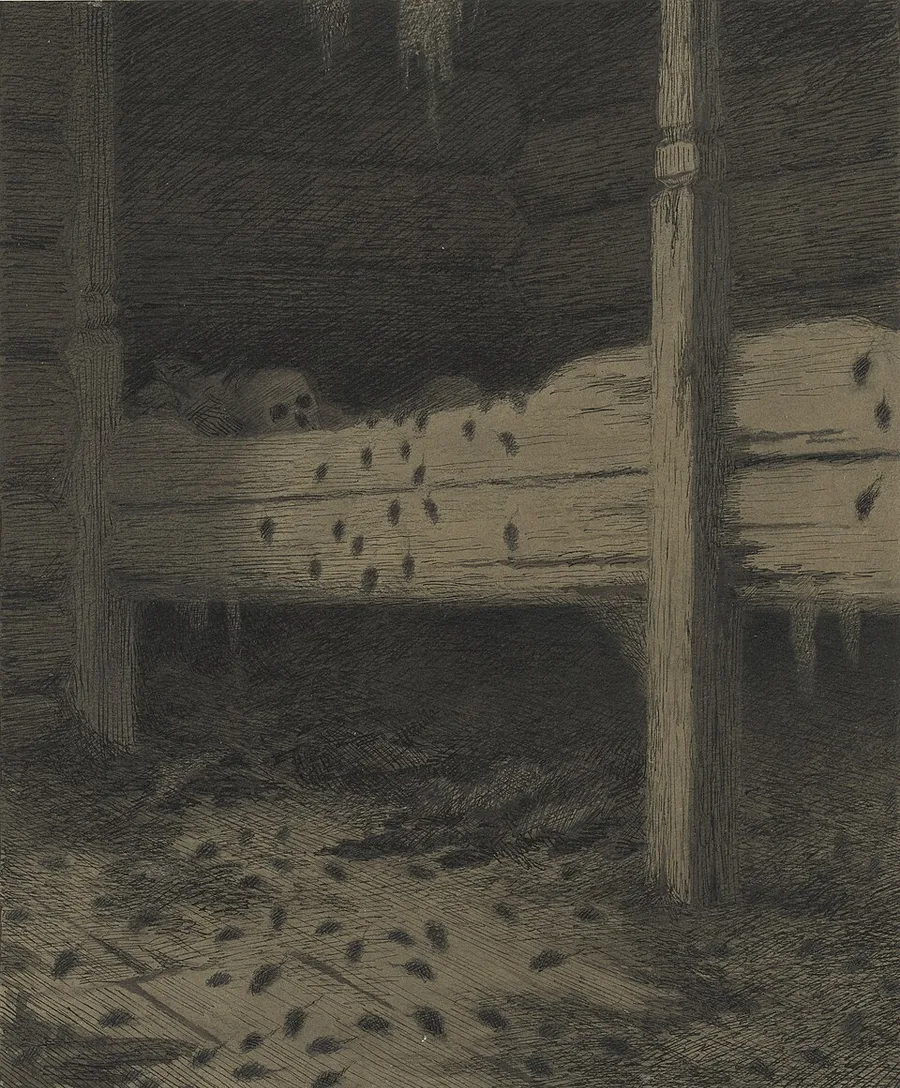 Theodor Kittelsen, Musstad (1894–96), Nasjonalmuseet, Oslo (NG.K&H.1982.0029) Kittelsen's mice swarm the abandoned bed of a plague-emptied farmhouse — the human end of the ødegårder, the deserted farmsteads that vanished from the tax rolls after the Black Death carried off a third to three-fifths of Norway's farms. Deserted farms — the standard Norwegian historiographical
term for the abandoned farmsteads documented in the long
series of cathedral and royal registers compiled in the
centuries after the Black Death. Comparison of pre-plague
surveys against later compilations shows that between a third
and three-fifths of pre-plague Norwegian farmsteads
disappeared from the rolls. Some were repopulated within a
generation. Many were not. Birch and pine returned to fields
that had been worked for a thousand years. The ghost-farm
pattern in the registers — especially in upland Setesdal,
Telemark, and the upper Gudbrandsdalen — is one of the most
visible long-term traces of the demographic catastrophe.
Also discussed in The Long Fall — the sudden loss of Norwegian nobility, the end of the kings, and half of Norway gone forever800,000 Norwegians Leave — the century that built a Second Norway — lay deserted a century later; whole valleys stood truly empty for generations, the names of the dead farms surviving only as the names of fields. The farms were not this woman’s only victims. The church lost all but one of its bishops, and the men who ran the country — with almost everyone literate enough to replace them — were swept entirely.
Theodor Kittelsen, Musstad (1894–96), Nasjonalmuseet, Oslo (NG.K&H.1982.0029) Kittelsen's mice swarm the abandoned bed of a plague-emptied farmhouse — the human end of the ødegårder, the deserted farmsteads that vanished from the tax rolls after the Black Death carried off a third to three-fifths of Norway's farms. Deserted farms — the standard Norwegian historiographical
term for the abandoned farmsteads documented in the long
series of cathedral and royal registers compiled in the
centuries after the Black Death. Comparison of pre-plague
surveys against later compilations shows that between a third
and three-fifths of pre-plague Norwegian farmsteads
disappeared from the rolls. Some were repopulated within a
generation. Many were not. Birch and pine returned to fields
that had been worked for a thousand years. The ghost-farm
pattern in the registers — especially in upland Setesdal,
Telemark, and the upper Gudbrandsdalen — is one of the most
visible long-term traces of the demographic catastrophe.
Also discussed in The Long Fall — the sudden loss of Norwegian nobility, the end of the kings, and half of Norway gone forever800,000 Norwegians Leave — the century that built a Second Norway — lay deserted a century later; whole valleys stood truly empty for generations, the names of the dead farms surviving only as the names of fields. The farms were not this woman’s only victims. The church lost all but one of its bishops, and the men who ran the country — with almost everyone literate enough to replace them — were swept entirely.
The rake-and-broom Pesta was first written down by the folklorist Andreas Faye 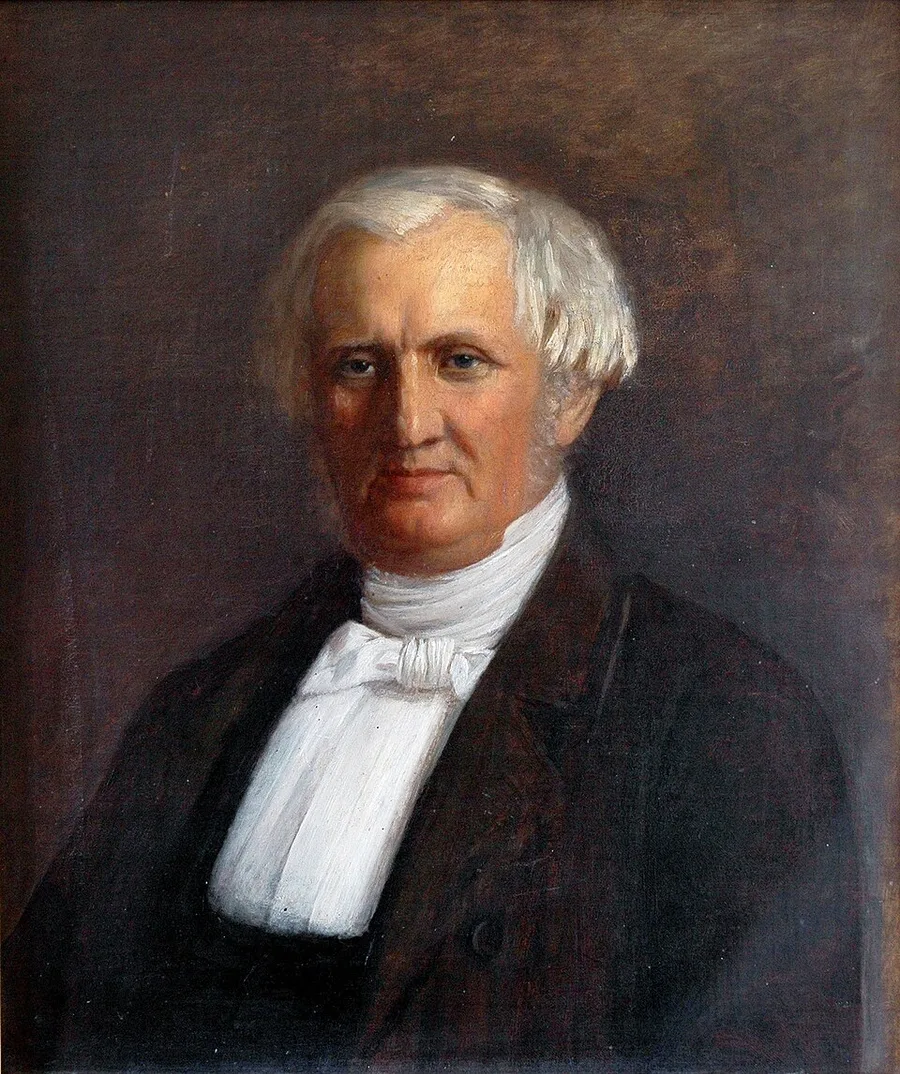 Christiane Schreiber, Portrait of Andreas Faye (1861), Rektorgalleriet, Universitetet i Agder Christiane Schreiber's 1861 portrait of Andreas Faye, the Holt parson-collector whose *Norske Sagn* (1833), enlarged in 1844 as *Norske Folke-Sagn*, first set Norway's legends in print — the draug of the coast, the nøkken of the fresh waters, and the Black Death lore Kittelsen later drew his Pesta from. Norwegian parson, historian and folklore collector
(1802–1869), a teacher in Arendal and from 1833 parish
priest at nearby Holt. His Norske Sagn (Arendal, 1833)
was the first published collection of Norwegian legends
and is counted as the beginning of folklore study in
Norway; a revised, expanded second edition appeared in
1844 as Norske Folke-Sagn. Faye recorded rather than
retold — a documentary register that drew a scathing
anonymous review from the historian P. A. Munch. But the
collection awakened the interest that Asbjørnsen and
Moe's folktale volumes of 1841–44 built on, and it became
Theodor Kittelsen's sourcebook: Kittelsen drew Pesta from
Faye's Black Death chapter for Svartedauen (1900).
Also discussed in Nøkken — the water-spirit who pulls you underDraugen — the drowned man who never came home in 1833, in Norway’s first legend collection — expanded in 1844 as Norske Folke-Sagn — gathering legends that the valleys had carried for five centuries. In one, from the south of the country, a ferryman rowing Pesta across the water at Gjerstad recognised her and begged for his life; she answered in the line the parish has kept ever since — Ditt liv kan jeg ikke spare, men en lett død skal du få, “I cannot spare your life, but an easy death you shall have” — and the man went home, lay down, and was gone before morning.
Christiane Schreiber, Portrait of Andreas Faye (1861), Rektorgalleriet, Universitetet i Agder Christiane Schreiber's 1861 portrait of Andreas Faye, the Holt parson-collector whose *Norske Sagn* (1833), enlarged in 1844 as *Norske Folke-Sagn*, first set Norway's legends in print — the draug of the coast, the nøkken of the fresh waters, and the Black Death lore Kittelsen later drew his Pesta from. Norwegian parson, historian and folklore collector
(1802–1869), a teacher in Arendal and from 1833 parish
priest at nearby Holt. His Norske Sagn (Arendal, 1833)
was the first published collection of Norwegian legends
and is counted as the beginning of folklore study in
Norway; a revised, expanded second edition appeared in
1844 as Norske Folke-Sagn. Faye recorded rather than
retold — a documentary register that drew a scathing
anonymous review from the historian P. A. Munch. But the
collection awakened the interest that Asbjørnsen and
Moe's folktale volumes of 1841–44 built on, and it became
Theodor Kittelsen's sourcebook: Kittelsen drew Pesta from
Faye's Black Death chapter for Svartedauen (1900).
Also discussed in Nøkken — the water-spirit who pulls you underDraugen — the drowned man who never came home in 1833, in Norway’s first legend collection — expanded in 1844 as Norske Folke-Sagn — gathering legends that the valleys had carried for five centuries. In one, from the south of the country, a ferryman rowing Pesta across the water at Gjerstad recognised her and begged for his life; she answered in the line the parish has kept ever since — Ditt liv kan jeg ikke spare, men en lett død skal du få, “I cannot spare your life, but an easy death you shall have” — and the man went home, lay down, and was gone before morning.
Faye’s book was where Theodor Kittelsen 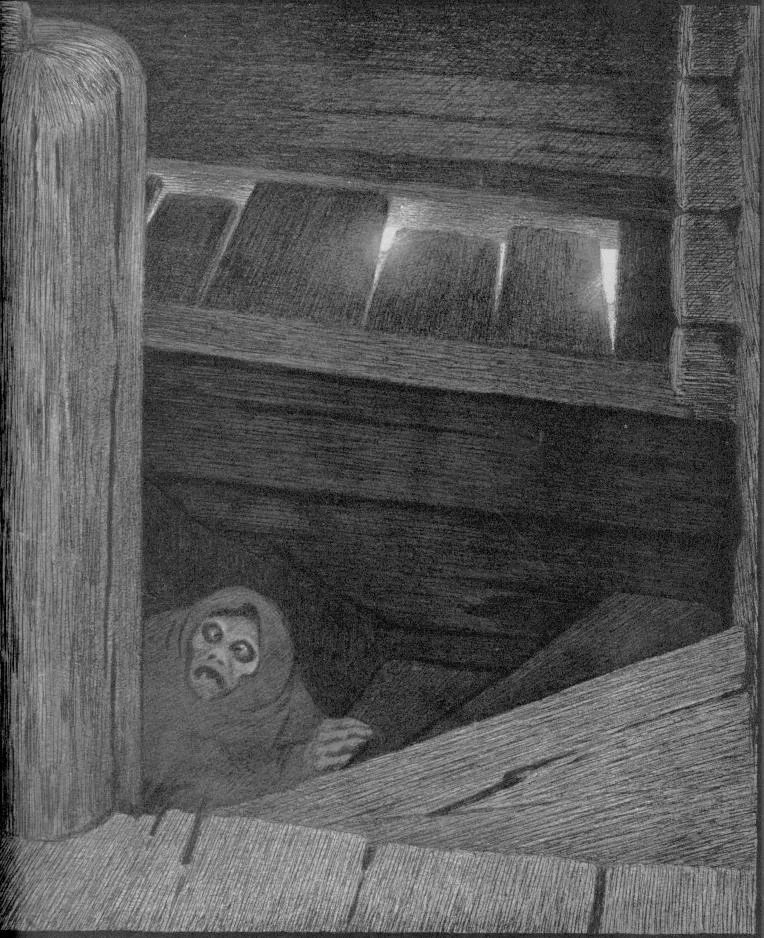 Theodor Kittelsen, Pesta i trappen (1894–96), Nasjonalmuseet *Pesta i trappen* — the plague-hag on the farmhouse stair, from the drawings Kittelsen began after the Skåtøy meeting he called "worse than the plague itself." Norwegian painter and illustrator (1857–1914), born in
Kragerø, who more than any other artist fixed the visual
identity of the country's folklore beings. Erik Werenskiold
brought him into the illustrated Asbjørnsen folktale editions
in the early 1880s. A stay at the Skomvær lighthouse on outer
Lofoten (1887–89), where his brother-in-law served as
assistant keeper, fed Troldskab (1892). His plague-hag
drawings, begun after an encounter with an old woman on the
island of Skåtøy, were published as the book Svartedauen in
1900. The same year, at Lauvlia in Sigdal, he painted his
Soria Moria pictures; the national collection bought them at
once. Nøkken (1904) — two pale eyes in a black lily-pool —
is held by the Nasjonalmuseet; Da Huldra forsvant (1908)
paints her vanishing.
Also discussed in Draugen — the drowned man who never came homeHuldra — the girl in the forest with a secretNøkken — the water-spirit who pulls you underNorske eventyr — the folk tales almost lost foreverSoria Moria — the shining castle always out of reach found her. Living on the island of Skåtøy near Kragerø in the 1890s, Kittelsen wrote that he had passed an old woman on a coastal path — small, thin, crooked, greenish in the face, and with black spots, worse than the plague itself — and he drew her from that meeting: climbing a wooden staircase inside an ordinary house, one clawed hand on the stair-edge, her pale eyes catching the light. The drawings went into the book Svartedauden
Theodor Kittelsen, Pesta i trappen (1894–96), Nasjonalmuseet *Pesta i trappen* — the plague-hag on the farmhouse stair, from the drawings Kittelsen began after the Skåtøy meeting he called "worse than the plague itself." Norwegian painter and illustrator (1857–1914), born in
Kragerø, who more than any other artist fixed the visual
identity of the country's folklore beings. Erik Werenskiold
brought him into the illustrated Asbjørnsen folktale editions
in the early 1880s. A stay at the Skomvær lighthouse on outer
Lofoten (1887–89), where his brother-in-law served as
assistant keeper, fed Troldskab (1892). His plague-hag
drawings, begun after an encounter with an old woman on the
island of Skåtøy, were published as the book Svartedauen in
1900. The same year, at Lauvlia in Sigdal, he painted his
Soria Moria pictures; the national collection bought them at
once. Nøkken (1904) — two pale eyes in a black lily-pool —
is held by the Nasjonalmuseet; Da Huldra forsvant (1908)
paints her vanishing.
Also discussed in Draugen — the drowned man who never came homeHuldra — the girl in the forest with a secretNøkken — the water-spirit who pulls you underNorske eventyr — the folk tales almost lost foreverSoria Moria — the shining castle always out of reach found her. Living on the island of Skåtøy near Kragerø in the 1890s, Kittelsen wrote that he had passed an old woman on a coastal path — small, thin, crooked, greenish in the face, and with black spots, worse than the plague itself — and he drew her from that meeting: climbing a wooden staircase inside an ordinary house, one clawed hand on the stair-edge, her pale eyes catching the light. The drawings went into the book Svartedauden 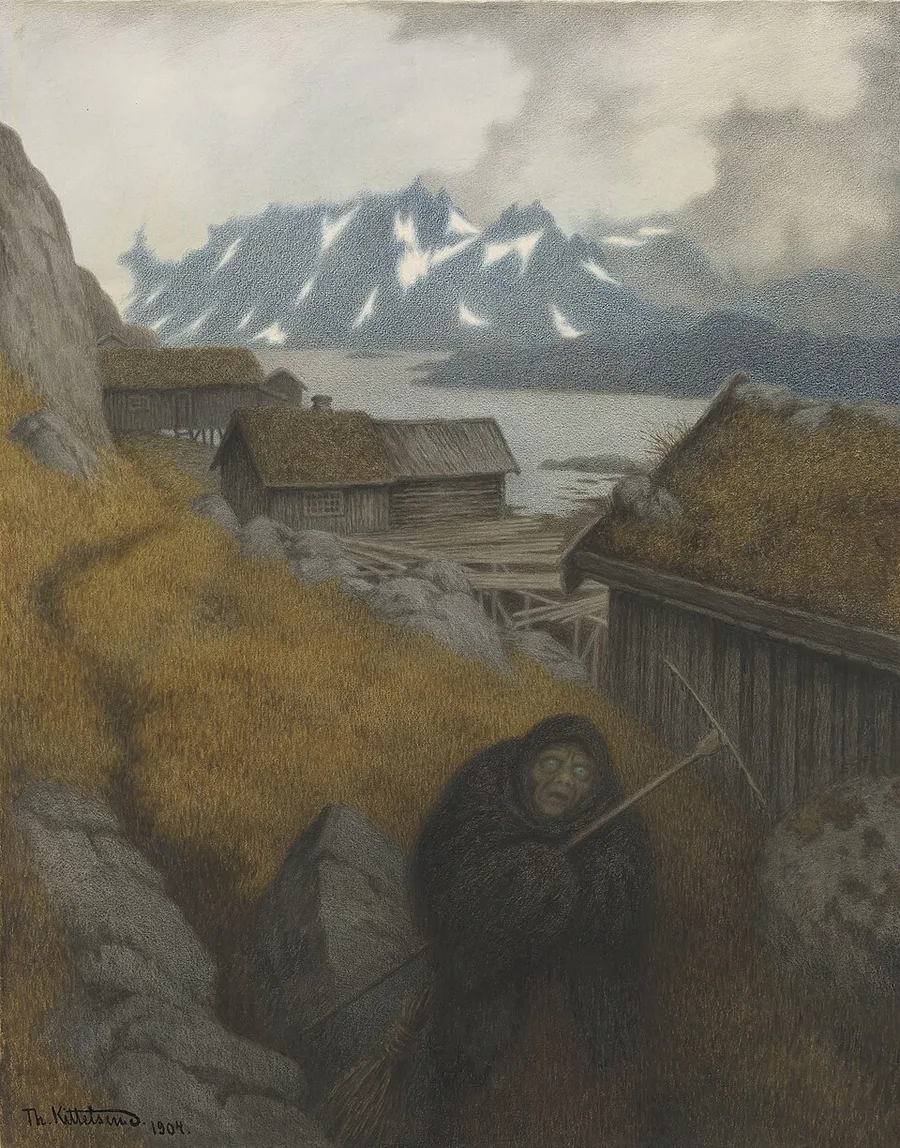 Theodor Kittelsen, Pesta farer landet rundt (1904), Nasjonalmuseet, Oslo (NG.K&H.B.00061) Kittelsen gives the plague a face: Pesta, the folk figure of the Black Death, walking the country with the rake and broom that spared a few farms and swept the rest clean — the 1349 pandemic that killed half to three-fifths of Norway. The Black Death — the pandemic of Yersinia pestis
(bubonic and pneumonic plague) that swept Europe between
1346 and 1353, killing perhaps a third to half of the
continent's population. The plague reached Norway in the
late summer of 1349 through Bergen, on a ship from England,
and spread north to Trøndelag, south through Oslo, and
inland through the great valleys within a year. Norway lost
between half and three-fifths of its population in two
years. The Norwegian medieval term was manndauden; the
term svartedauden became common only in the early modern
period and is the standard modern name for the catastrophe.
In this article When Theodor Kittelsen collected his plague-hag drawings into
a picture-book in 1900, he took the pandemic's modern name for
its title — Svartedauen. The name is younger than the horror
it covers: to the Norwegians who lived through 1349 the
catastrophe was manndauden, the man-death, and only the
early modern period settled on the black name Kittelsen's book
turned into an image.
Also discussed in The Long Fall — the sudden loss of Norwegian nobility, the end of the kings, and half of Norway gone forever in 1900 and into the visual memory of every Norwegian who has heard her name since.
Theodor Kittelsen, Pesta farer landet rundt (1904), Nasjonalmuseet, Oslo (NG.K&H.B.00061) Kittelsen gives the plague a face: Pesta, the folk figure of the Black Death, walking the country with the rake and broom that spared a few farms and swept the rest clean — the 1349 pandemic that killed half to three-fifths of Norway. The Black Death — the pandemic of Yersinia pestis
(bubonic and pneumonic plague) that swept Europe between
1346 and 1353, killing perhaps a third to half of the
continent's population. The plague reached Norway in the
late summer of 1349 through Bergen, on a ship from England,
and spread north to Trøndelag, south through Oslo, and
inland through the great valleys within a year. Norway lost
between half and three-fifths of its population in two
years. The Norwegian medieval term was manndauden; the
term svartedauden became common only in the early modern
period and is the standard modern name for the catastrophe.
In this article When Theodor Kittelsen collected his plague-hag drawings into
a picture-book in 1900, he took the pandemic's modern name for
its title — Svartedauen. The name is younger than the horror
it covers: to the Norwegians who lived through 1349 the
catastrophe was manndauden, the man-death, and only the
early modern period settled on the black name Kittelsen's book
turned into an image.
Also discussed in The Long Fall — the sudden loss of Norwegian nobility, the end of the kings, and half of Norway gone forever in 1900 and into the visual memory of every Norwegian who has heard her name since.
What the legend never settled is the part that mattered most to the people who told it: not that she came, but why she raked one house and swept the next.