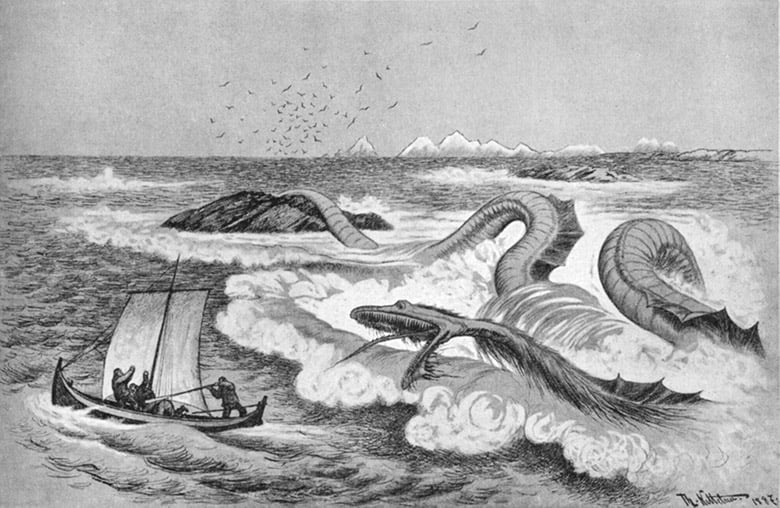
Sjøormer — The serpents in the deep lakes and fjords
Norway's lake and fjord serpents — black, humped, surfacing under a fishing boat and gone again. Seljord's Selma has reported sightings going back to 1750 and a place on the municipal coat of arms. The kraken is the same fear scaled up to the open ocean.
In the deep water off Seljord, in Lake Mjøsa 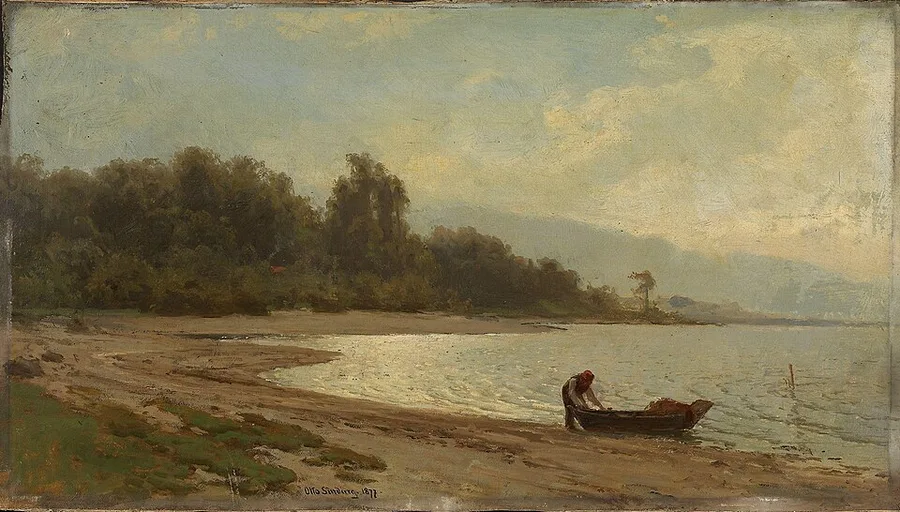 Otto Sinding, Landskap ved Mjøsa (1877), National Museum of Art, Architecture and Design Otto Sinding's calm 1877 shore of Lake Mjøsa. The lake carries one of Norway's oldest recorded sjøorm traditions — the 16th-century Hamarkrøniken tells of a huge serpent off Helgøya, shot with a crossbow and its stranded carcass burned. Norway's largest lake — 369 km², 117 km long, up to 449 m deep
— with Hamar, Gjøvik, and Lillehammer on its shores. Its
serpent legend is among the oldest documented sjøorm
traditions in Norway: the Hamarkrøniken, an anonymous
16th-century town chronicle, records a huge serpent off
Helgøya, shot with a crossbow by one of the bishop's men, its
stranded carcass burned. Olaus Magnus (1555) independently
records a serpent seen in Mjøsa in 1522 as a portent of King
Christian II's banishment. The lake also holds the
søsterklokkene (sister bells) legend of Ringebu Stave Church
— the votive bell that broke through the ice on its way to
Christiania and sank; a later raising nearly succeeded, but
the rope broke, and the bell is said to lie there still.
On the trip Lake Mjøsa is the water of the reunion. The Gråhårsklubben
(the Oldsters) drive south down the Gudbrandsdalen on Day 5 to
Lillehammer on the lake's shore, where the Ungdommene (the
Youngsters) have already arrived a day ahead and spend Day 5
on Storgata and at the Olympic Park. Day 5 ends with the
reunion dinner, and the reunited family spends Days 6–7 beside
the lake — Øyer Church up the valley, old-town Storgata, and
Maihaugen — before the drive south.
Lake Mjøsa Also discussed in Stedssagn — local legends, told as warnings , and down the long western fjords lives the worst thing in the cold country: a black coil that surfaces under a fishing boat and is gone again before anyone can name it. Norwegians call them sjøormer — sea-worms — and they have been reported, in writing, since the fifteen-hundreds.
Otto Sinding, Landskap ved Mjøsa (1877), National Museum of Art, Architecture and Design Otto Sinding's calm 1877 shore of Lake Mjøsa. The lake carries one of Norway's oldest recorded sjøorm traditions — the 16th-century Hamarkrøniken tells of a huge serpent off Helgøya, shot with a crossbow and its stranded carcass burned. Norway's largest lake — 369 km², 117 km long, up to 449 m deep
— with Hamar, Gjøvik, and Lillehammer on its shores. Its
serpent legend is among the oldest documented sjøorm
traditions in Norway: the Hamarkrøniken, an anonymous
16th-century town chronicle, records a huge serpent off
Helgøya, shot with a crossbow by one of the bishop's men, its
stranded carcass burned. Olaus Magnus (1555) independently
records a serpent seen in Mjøsa in 1522 as a portent of King
Christian II's banishment. The lake also holds the
søsterklokkene (sister bells) legend of Ringebu Stave Church
— the votive bell that broke through the ice on its way to
Christiania and sank; a later raising nearly succeeded, but
the rope broke, and the bell is said to lie there still.
On the trip Lake Mjøsa is the water of the reunion. The Gråhårsklubben
(the Oldsters) drive south down the Gudbrandsdalen on Day 5 to
Lillehammer on the lake's shore, where the Ungdommene (the
Youngsters) have already arrived a day ahead and spend Day 5
on Storgata and at the Olympic Park. Day 5 ends with the
reunion dinner, and the reunited family spends Days 6–7 beside
the lake — Øyer Church up the valley, old-town Storgata, and
Maihaugen — before the drive south.
Lake Mjøsa Also discussed in Stedssagn — local legends, told as warnings , and down the long western fjords lives the worst thing in the cold country: a black coil that surfaces under a fishing boat and is gone again before anyone can name it. Norwegians call them sjøormer — sea-worms — and they have been reported, in writing, since the fifteen-hundreds.
The descriptions never agree, which is half the fear. On one lake, in one century, one witness gives it a horse’s head with a mane down to the water, the next a dragon’s head, the next a black eel as long as a barn. Seljord 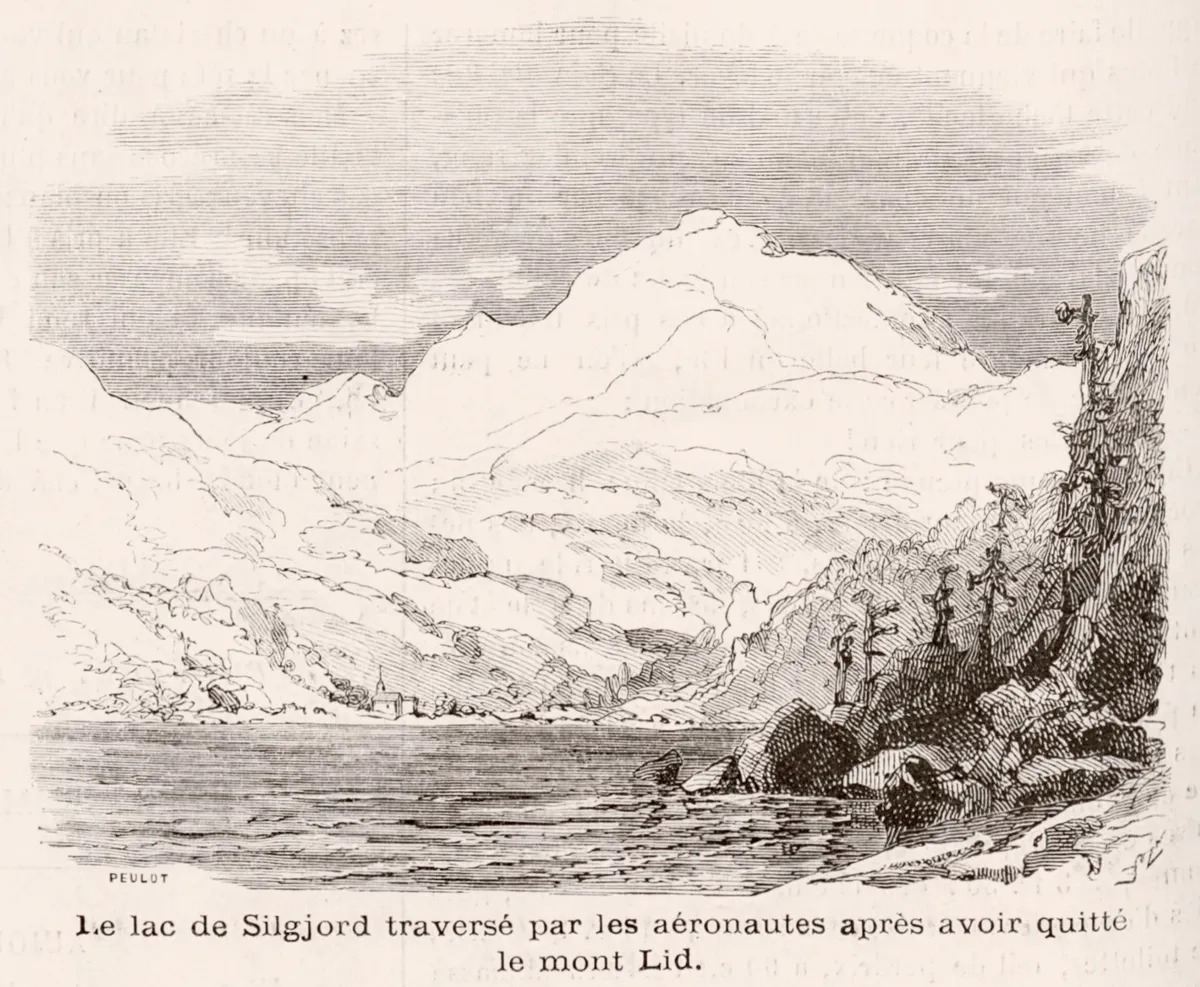 Wood engraving after Morten Müller, Le Monde illustré (8 February 1873), via Gallica / Wikimedia Commons Seljordsvatnet under Lifjell, in an 1873 wood engraving after Morten Müller. This is Selma's water: in 1750 something large circled a rowboat crossing the lake, and of the hundred-plus sightings recorded since 1900, nearly all fall in the bright summer months. Village and municipality in Telemark, on lake
Seljordsvatnet — a parish unusually rich in recorded
folklore. The lake serpent, Seljordsormen, entered the
written record in 1750, when Gunleik Andersson Verpe of Bø
reported it overturned one of his boats; the priest Hans
Jacob Wille described it in his 1786 Beskrivelse over
Sillejords Præstegield. In 1989 the municipality took the
serpent, gold on red, as its coat of arms; a sonar
expedition in August 2000 found nothing it could identify.
The medieval stone church (c. 1150–1180) carries the legend
that seven huldra tails — invisible to a Christian eye —
hang inside, fallen from huldra brides wed there. Magnus
Brostrup Landstad, parish priest 1839–1848, and Olea Crøger
gathered most of the ballads in Norske Folkeviser (1853)
here.
Seljord, Telemark Also discussed in Huldra — the girl in the forest with a secretÅsgårdsreien — the storm that rides through the winter sky in Telemark
Wood engraving after Morten Müller, Le Monde illustré (8 February 1873), via Gallica / Wikimedia Commons Seljordsvatnet under Lifjell, in an 1873 wood engraving after Morten Müller. This is Selma's water: in 1750 something large circled a rowboat crossing the lake, and of the hundred-plus sightings recorded since 1900, nearly all fall in the bright summer months. Village and municipality in Telemark, on lake
Seljordsvatnet — a parish unusually rich in recorded
folklore. The lake serpent, Seljordsormen, entered the
written record in 1750, when Gunleik Andersson Verpe of Bø
reported it overturned one of his boats; the priest Hans
Jacob Wille described it in his 1786 Beskrivelse over
Sillejords Præstegield. In 1989 the municipality took the
serpent, gold on red, as its coat of arms; a sonar
expedition in August 2000 found nothing it could identify.
The medieval stone church (c. 1150–1180) carries the legend
that seven huldra tails — invisible to a Christian eye —
hang inside, fallen from huldra brides wed there. Magnus
Brostrup Landstad, parish priest 1839–1848, and Olea Crøger
gathered most of the ballads in Norske Folkeviser (1853)
here.
Seljord, Telemark Also discussed in Huldra — the girl in the forest with a secretÅsgårdsreien — the storm that rides through the winter sky in Telemark 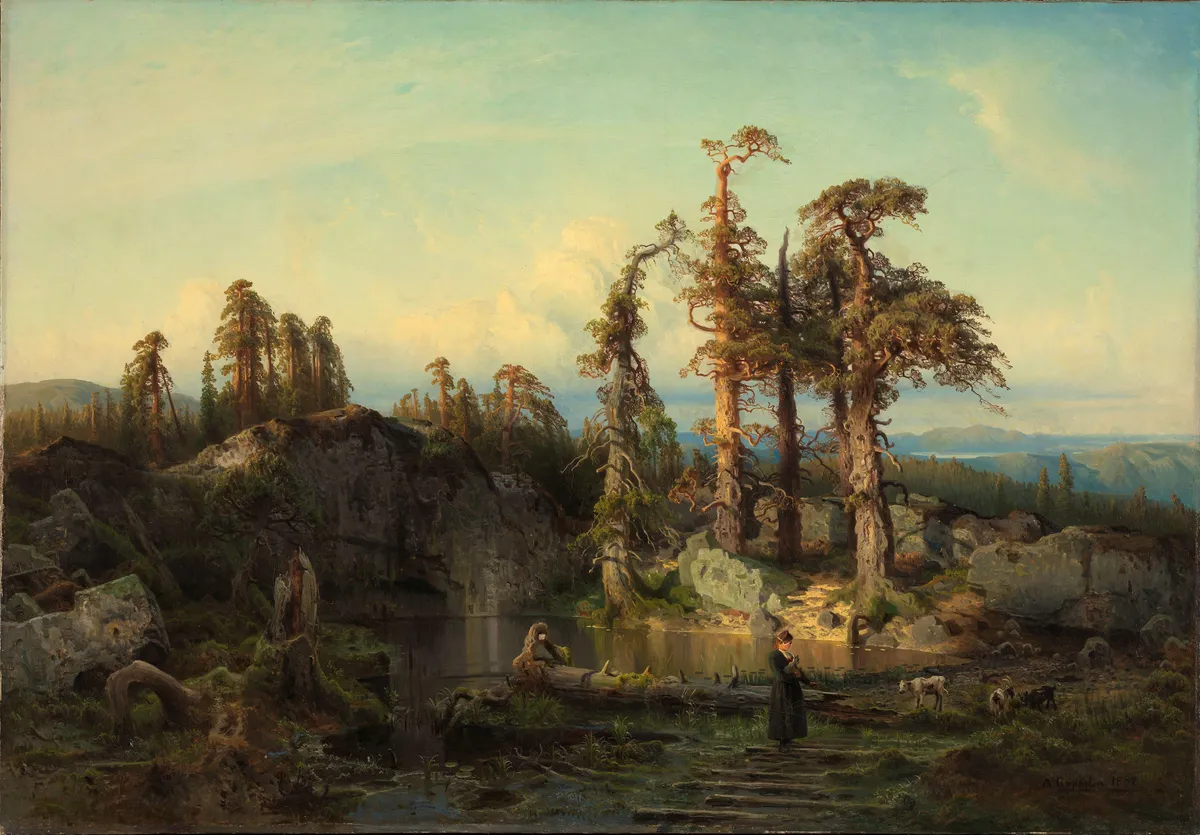 August Cappelen, Skogtjern i nedre Telemark (1852), National Museum of Art, Architecture and Design Cappelen's *Skogtjern i nedre Telemark* (1852) — a forest tarn held in rock and centuries-old pine, its water dark and still. This is the register the serpent tradition lives in: deep, quiet, inland water that keeps whatever it holds out of sight. Historic region and county in the inland-southern part of
Norway, between the southeastern coast and the central
Hardangervidda plateau. Home to Heddal Stave Church — the
largest of the twenty-eight surviving Norwegian stave churches,
standing nearly thirty metres tall — and to the heavy-water
production facility at Vemork whose sabotage by Norwegian
commandos in February 1943 disrupted the German atomic-weapons
programme. The name Telemark also gives the world the modern
ski-turn technique developed there in the nineteenth century.
In the folklore record Telemark is the deepest vein of all —
the landscape of the ballad collectors, the hardingfele
legends, and the lake serpent of Seljord.
Telemark Also discussed in A Catholic Norway — the faith that gave the kingdom its first institutions and the stave churchesWorld War II — the King’s “No” and the Nazis in NorwayThe Long Fall — the sudden loss of Norwegian nobility, the end of the kings, and half of Norway gone foreverFossegrimen — the waterfall fiddler who teaches you to playTroll — the monsters of the mountainsUtburd — the unbaptized child that will not restÅsgårdsreien — the storm that rides through the winter skyHuldra — the girl in the forest with a secret has the most famous of them — the Seljordsormen, called Selma — with accounts reaching back to 1750, when something large struck a rowboat crossing the lake; more than a hundred sightings followed after 1900, clustered almost entirely in the tourist months. Lake Mjøsa, the largest in the country, has a serpent that lies on the surface like a thick black log until it moves.
August Cappelen, Skogtjern i nedre Telemark (1852), National Museum of Art, Architecture and Design Cappelen's *Skogtjern i nedre Telemark* (1852) — a forest tarn held in rock and centuries-old pine, its water dark and still. This is the register the serpent tradition lives in: deep, quiet, inland water that keeps whatever it holds out of sight. Historic region and county in the inland-southern part of
Norway, between the southeastern coast and the central
Hardangervidda plateau. Home to Heddal Stave Church — the
largest of the twenty-eight surviving Norwegian stave churches,
standing nearly thirty metres tall — and to the heavy-water
production facility at Vemork whose sabotage by Norwegian
commandos in February 1943 disrupted the German atomic-weapons
programme. The name Telemark also gives the world the modern
ski-turn technique developed there in the nineteenth century.
In the folklore record Telemark is the deepest vein of all —
the landscape of the ballad collectors, the hardingfele
legends, and the lake serpent of Seljord.
Telemark Also discussed in A Catholic Norway — the faith that gave the kingdom its first institutions and the stave churchesWorld War II — the King’s “No” and the Nazis in NorwayThe Long Fall — the sudden loss of Norwegian nobility, the end of the kings, and half of Norway gone foreverFossegrimen — the waterfall fiddler who teaches you to playTroll — the monsters of the mountainsUtburd — the unbaptized child that will not restÅsgårdsreien — the storm that rides through the winter skyHuldra — the girl in the forest with a secret has the most famous of them — the Seljordsormen, called Selma — with accounts reaching back to 1750, when something large struck a rowboat crossing the lake; more than a hundred sightings followed after 1900, clustered almost entirely in the tourist months. Lake Mjøsa, the largest in the country, has a serpent that lies on the surface like a thick black log until it moves.
Some of the oldest accounts read like official records, because they were. The parish priest Hans Jacob Wille wrote in 1786 that the Seljordsormen had once bitten a man on the toe at Lakshøl. The Hamarkrøniken says one of the bishop’s men shot a serpent that stranded out in Mjøsa, near Helgøya, with a crossbow in 1522, and the carcass was later burned. In August 1746 Lawrence de Ferry — the naval commander and pilot-master of Bergen 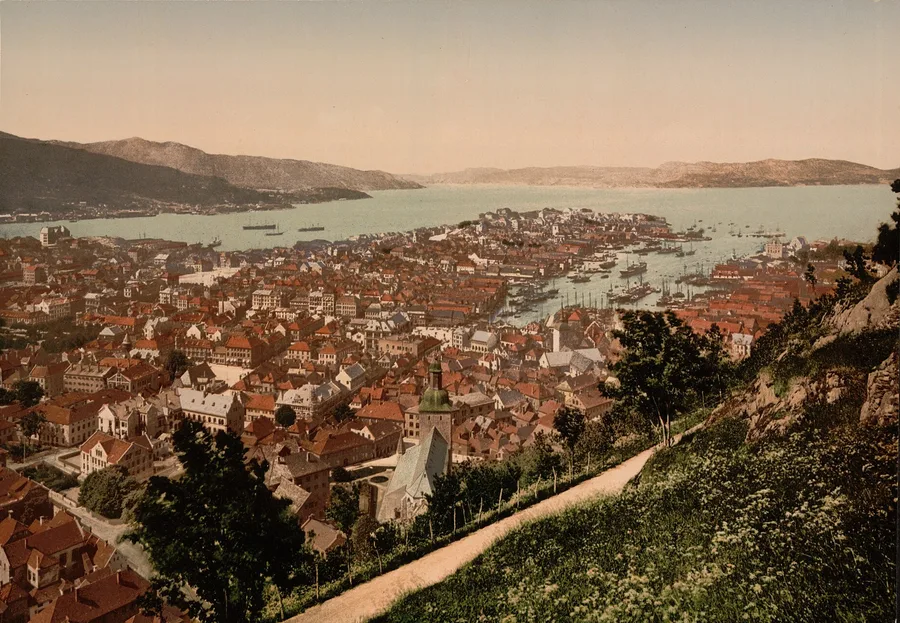 Photochrom print, General view from Fjeldveien, Bergen (c. 1890–1900), Library of Congress The city where the serpent went on record — de Ferry's oarsmen swore their deposition in court at Bergen, and Bishop Pontoppidan filed it as natural history. The photochrom shows the harbour town of the 1890s between its mountains. Norway's western trading capital, founded around 1070 on the
inner Byfjorden. For four centuries the largest city in the
country and the wharf through which the entire western export
economy ran — dried cod from the Lofoten fisheries, stockpiled
and traded by the Hanseatic merchants at Bryggen from 1360 to
1754. Norway's commercial and intellectual heart through the
Hanseatic period; overtaken in size by Christiania (Oslo) in the
1830s. The painted wooden Bryggen wharf is on the UNESCO World
Heritage list and substantially what it was in the late
seventeenth century.
On the trip The Ungdommene (the Youngsters) reach Bergen late on Day 3
via the Norway-in-a-Nutshell train-and-ferry route from
Oslo. On the Day 4 morning they walk Bryggen and ride the
funicular up Mount Fløyen before flying back to Oslo and driving
on to Lillehammer that evening — a day ahead of the Gråhårsklubben
(the Oldsters), who spend the split days north in Trondheim and
the heritage country of Stjørdal, Hegra, and Kylloplass and come
south on Day 5.
Bergen Also discussed in The Germans Who "Ruled" Bergen — the Hanseatic merchants on Bryggen WharfBefore There Was Norway — petty kingdoms at the edge of the worldThe King Who Became a Saint — how the Nordmen came to ChristA Catholic Norway — the faith that gave the kingdom its first institutions and the stave churchesThe Long Fall — the sudden loss of Norwegian nobility, the end of the kings, and half of Norway gone foreverThe Golden Age — a North Atlantic empire … reaching farther than you thinkThe 400-Year Night — when the Northern Lion lay dormantThe Crusades?!!!! — sixty ships from Bergen, bound for the Holy LandThe Reformation, 1537 — one church eradicated and another imposedWorld War II — the King’s “No” and the Nazis in NorwayKraken — the island-sized beast, logged as factPesta — an old woman walking from farm to farmFossegrimen — the waterfall fiddler who teaches you to playAlcohol and Vinmonopolet — when and where to buy a drinkEveryday etiquette — quiet voices, wide space, no smilingFood and dining customs — having patience, free water, brunost on everything🚨 Emergencies - important numbers, hospitals, and what you can doLanguage basics — just enough Norwegian to be politeWhat to wear — the layering system, on the ground — fired his musket at a long horse-headed serpent off Molde and watched the water redden; two of his oarsmen swore to it afterwards in court at Bergen, and Bishop Erik Pontoppidan
Photochrom print, General view from Fjeldveien, Bergen (c. 1890–1900), Library of Congress The city where the serpent went on record — de Ferry's oarsmen swore their deposition in court at Bergen, and Bishop Pontoppidan filed it as natural history. The photochrom shows the harbour town of the 1890s between its mountains. Norway's western trading capital, founded around 1070 on the
inner Byfjorden. For four centuries the largest city in the
country and the wharf through which the entire western export
economy ran — dried cod from the Lofoten fisheries, stockpiled
and traded by the Hanseatic merchants at Bryggen from 1360 to
1754. Norway's commercial and intellectual heart through the
Hanseatic period; overtaken in size by Christiania (Oslo) in the
1830s. The painted wooden Bryggen wharf is on the UNESCO World
Heritage list and substantially what it was in the late
seventeenth century.
On the trip The Ungdommene (the Youngsters) reach Bergen late on Day 3
via the Norway-in-a-Nutshell train-and-ferry route from
Oslo. On the Day 4 morning they walk Bryggen and ride the
funicular up Mount Fløyen before flying back to Oslo and driving
on to Lillehammer that evening — a day ahead of the Gråhårsklubben
(the Oldsters), who spend the split days north in Trondheim and
the heritage country of Stjørdal, Hegra, and Kylloplass and come
south on Day 5.
Bergen Also discussed in The Germans Who "Ruled" Bergen — the Hanseatic merchants on Bryggen WharfBefore There Was Norway — petty kingdoms at the edge of the worldThe King Who Became a Saint — how the Nordmen came to ChristA Catholic Norway — the faith that gave the kingdom its first institutions and the stave churchesThe Long Fall — the sudden loss of Norwegian nobility, the end of the kings, and half of Norway gone foreverThe Golden Age — a North Atlantic empire … reaching farther than you thinkThe 400-Year Night — when the Northern Lion lay dormantThe Crusades?!!!! — sixty ships from Bergen, bound for the Holy LandThe Reformation, 1537 — one church eradicated and another imposedWorld War II — the King’s “No” and the Nazis in NorwayKraken — the island-sized beast, logged as factPesta — an old woman walking from farm to farmFossegrimen — the waterfall fiddler who teaches you to playAlcohol and Vinmonopolet — when and where to buy a drinkEveryday etiquette — quiet voices, wide space, no smilingFood and dining customs — having patience, free water, brunost on everything🚨 Emergencies - important numbers, hospitals, and what you can doLanguage basics — just enough Norwegian to be politeWhat to wear — the layering system, on the ground — fired his musket at a long horse-headed serpent off Molde and watched the water redden; two of his oarsmen swore to it afterwards in court at Bergen, and Bishop Erik Pontoppidan 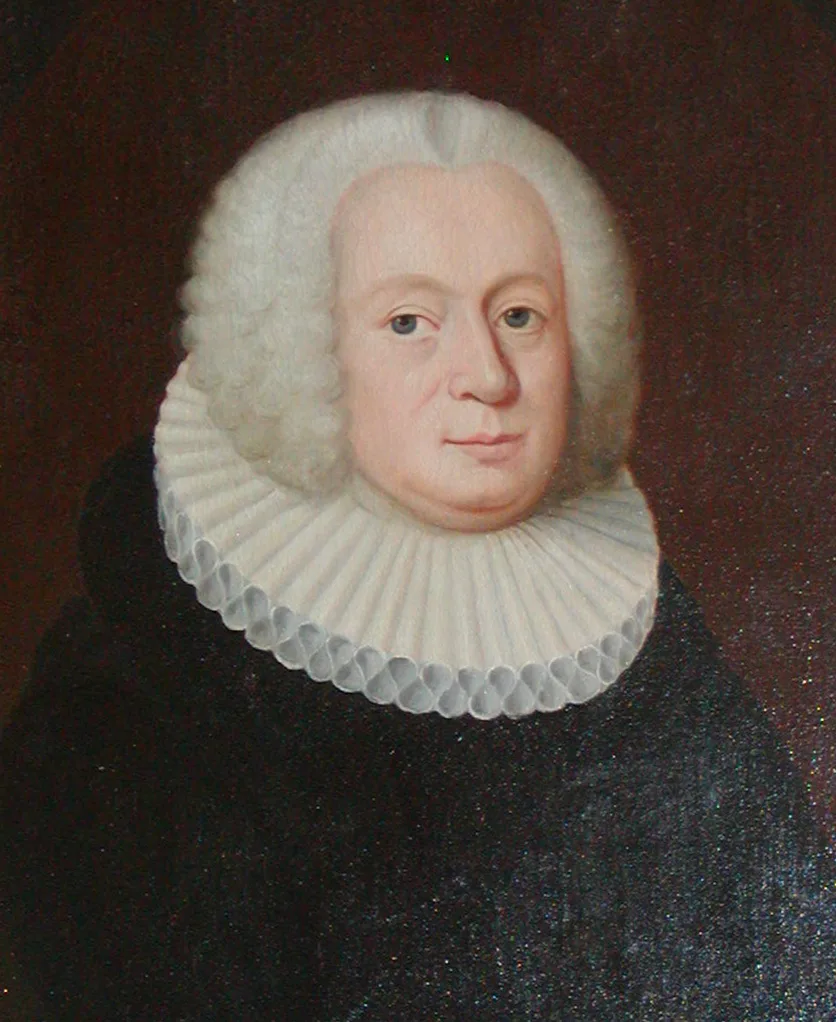 Unknown artist, portrait of Erik Pontoppidan (first half of the 1700s) The Bishop of Bergen who took the serpent into the record — when de Ferry's oarsmen swore their deposition in court at Bergen, Pontoppidan filed it in his 1753 *Natural History*, between entries on fjord birds and the weather. Danish-Norwegian Lutheran theologian, bishop, and natural
historian (1698–1764). Court preacher and personal chaplain
to King Christian VI from 1735, who commissioned him to
write the standard catechism that would accompany the new
compulsory confirmation: Sandhed til Gudfrygtighed —
Truth unto Godliness — published 1737 and the principal
instrument of Norwegian Lutheran religious education for
well over a century, into the late 1800s. Appointed Bishop
of Bergen 1747; in that
capacity wrote his two-volume Det første Forsøg paa
Norges naturlige Historie (1752–53), the standard
eighteenth-century natural history of Norway and the work
that first describes the kraken under that name. Later
vice-chancellor of the University of Copenhagen.
Also discussed in The Reformation, 1537 — one church eradicated and another imposedLutheran Norway and Pietism — a farmer named Hans Nielsen Hauge and a lay revival that could not be silencedKraken — the island-sized beast, logged as fact filed the deposition in his 1753 The Natural History of Norway
Unknown artist, portrait of Erik Pontoppidan (first half of the 1700s) The Bishop of Bergen who took the serpent into the record — when de Ferry's oarsmen swore their deposition in court at Bergen, Pontoppidan filed it in his 1753 *Natural History*, between entries on fjord birds and the weather. Danish-Norwegian Lutheran theologian, bishop, and natural
historian (1698–1764). Court preacher and personal chaplain
to King Christian VI from 1735, who commissioned him to
write the standard catechism that would accompany the new
compulsory confirmation: Sandhed til Gudfrygtighed —
Truth unto Godliness — published 1737 and the principal
instrument of Norwegian Lutheran religious education for
well over a century, into the late 1800s. Appointed Bishop
of Bergen 1747; in that
capacity wrote his two-volume Det første Forsøg paa
Norges naturlige Historie (1752–53), the standard
eighteenth-century natural history of Norway and the work
that first describes the kraken under that name. Later
vice-chancellor of the University of Copenhagen.
Also discussed in The Reformation, 1537 — one church eradicated and another imposedLutheran Norway and Pietism — a farmer named Hans Nielsen Hauge and a lay revival that could not be silencedKraken — the island-sized beast, logged as fact filed the deposition in his 1753 The Natural History of Norway 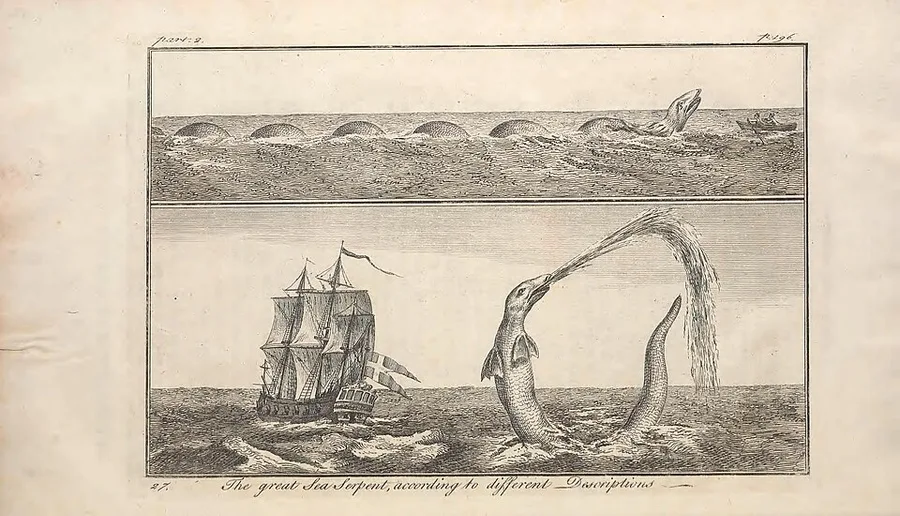 Plate 27, Erik Pontoppidan, The Natural History of Norway (London, 1755), Biodiversity Heritage Library Plate 27 from the book itself — the great sea serpent in humped coils passing ships — one of the sea-creatures Bishop Pontoppidan catalogued, alongside the first printed account of the kraken, in Norway's first natural history. Erik Pontoppidan's two-volume Det første Forsøg paa
Norges naturlige Historie — the first attempt at a
natural history of Norway — published in Copenhagen in
1752 and 1753 while its author held the bishopric of
Bergen, and translated into English in London in 1755 as
The Natural History of Norway. It catalogued the
country's air, mountains, waters, plants, minerals,
animals, birds, and fish — and, in the second volume, in
the same sober register, its sea-creatures: the havmann,
the sea serpent, and the first detailed printed description
of the kraken, a beast said by witnesses to be
mistaken for a chain of islands. Among the evidence stood
the sworn Bergen court testimony of pilot-master Lawrence
de Ferry, who fired on a serpent off Molde in August 1746.
Also discussed in Kraken — the island-sized beast, logged as fact , between entries on seabirds and the weather.
Plate 27, Erik Pontoppidan, The Natural History of Norway (London, 1755), Biodiversity Heritage Library Plate 27 from the book itself — the great sea serpent in humped coils passing ships — one of the sea-creatures Bishop Pontoppidan catalogued, alongside the first printed account of the kraken, in Norway's first natural history. Erik Pontoppidan's two-volume Det første Forsøg paa
Norges naturlige Historie — the first attempt at a
natural history of Norway — published in Copenhagen in
1752 and 1753 while its author held the bishopric of
Bergen, and translated into English in London in 1755 as
The Natural History of Norway. It catalogued the
country's air, mountains, waters, plants, minerals,
animals, birds, and fish — and, in the second volume, in
the same sober register, its sea-creatures: the havmann,
the sea serpent, and the first detailed printed description
of the kraken, a beast said by witnesses to be
mistaken for a chain of islands. Among the evidence stood
the sworn Bergen court testimony of pilot-master Lawrence
de Ferry, who fired on a serpent off Molde in August 1746.
Also discussed in Kraken — the island-sized beast, logged as fact , between entries on seabirds and the weather.
The open ocean had its own version, scaled up — the kraken Pontoppidan catalogued in the same book, which turned out to be the giant squid.
The lake serpents were never resolved. In August 2000 a team led by Jan-Ove Sundberg lowered a trap baited with live fish into the lake and reported sonar contacts they could not identify; the net came up empty. By then the serpent had already been made official — Selma swims, gold on red, on the coat of arms Seljord adopted for itself in 1989.