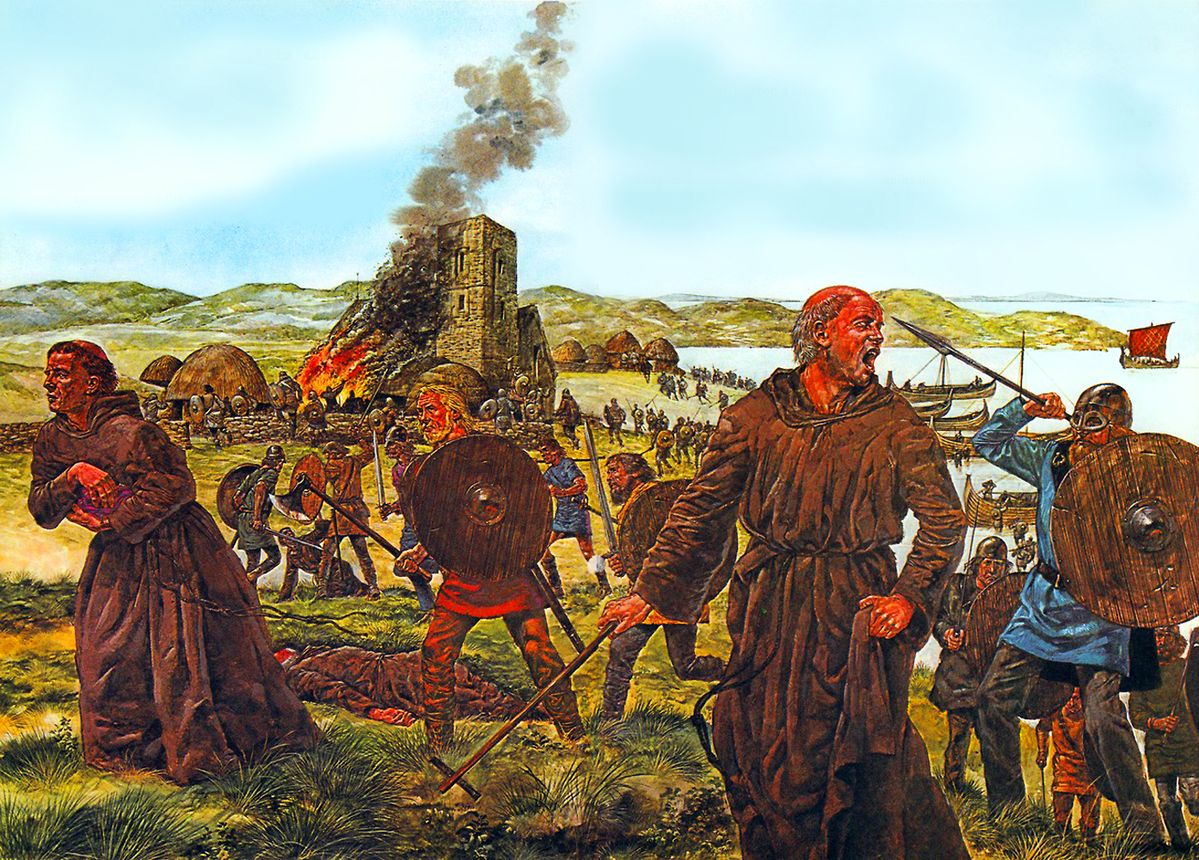
The Viking Age — Longships, legends, and the first "Norway"
From 793 to 1066, three centuries in which a thinly-populated coast at the edge of the known world reached Baghdad and Newfoundland, gave Europe a new word in five languages, and put a country named Russia on the map.
On the eighth of June 793, The longship 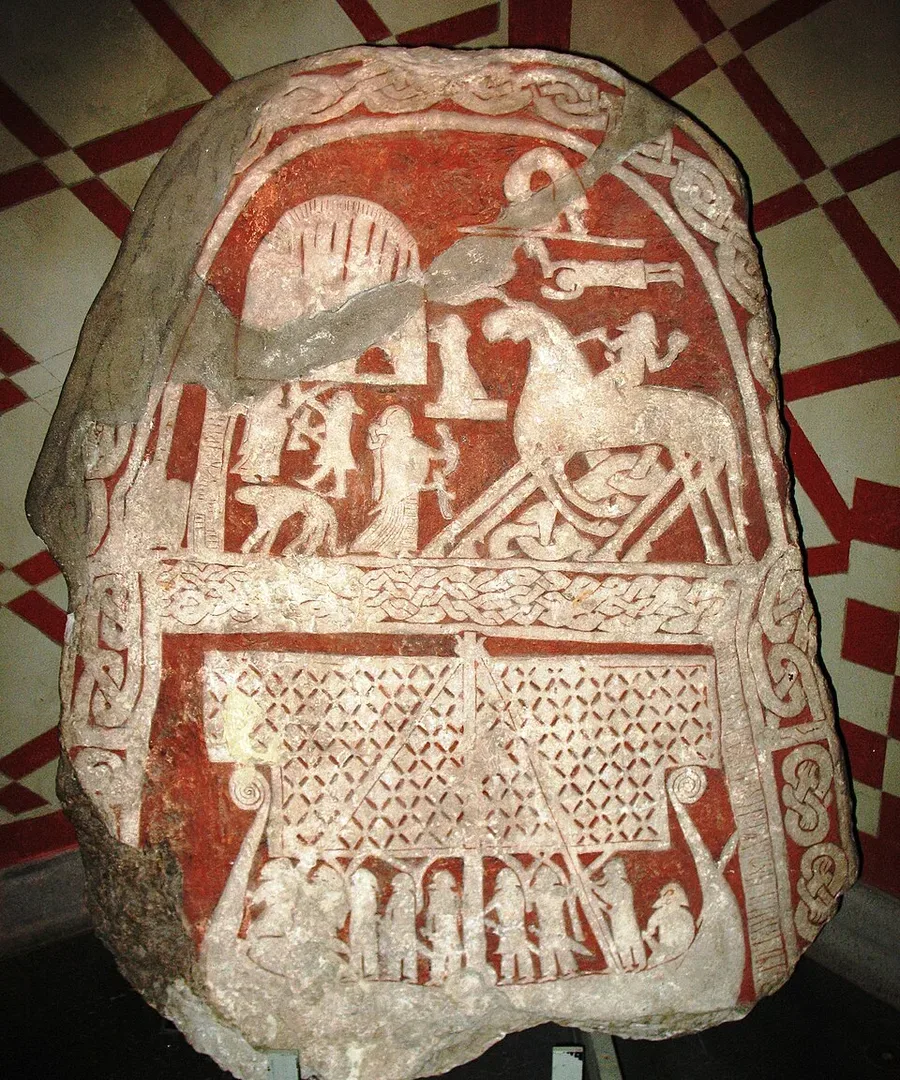 Photo by Berig, Tjängvide image stone (G 110), Alskog, Gotland, 8th–9th c., Swedish History Museum (CC BY-SA 4.0) The lower register carves the Viking Age’s defining machine: a longship under one broad sail, crew along the hull, prow and stern curving up. Gotland’s 8th–9th-century picture stones give us some of the earliest images of the ships that carried the Norse across the known world. The Viking-Age Norse ocean-going vessel — clinker-built (overlapping
hull planks), with a true keel deep enough to brace a mast, a square
sail for wind propulsion, and rowing benches running the length of
both sides. Light enough to be portaged between rivers and beached
on a tidal flat, strong enough to take the open Atlantic. Typical
lengths ran twenty to thirty metres, with crew capacities of thirty
to sixty men. The longship made possible everything else about the
Viking Age: the raiding economy reaching from Newfoundland to
Constantinople; the settler colonies in Iceland, Greenland, and
briefly North America; the river trade through Slavic country to
the Caspian; the eventual conquest of England.
from somewhere along the western Norwegian coast pull up on the tidal flat of Lindisfarne
Photo by Berig, Tjängvide image stone (G 110), Alskog, Gotland, 8th–9th c., Swedish History Museum (CC BY-SA 4.0) The lower register carves the Viking Age’s defining machine: a longship under one broad sail, crew along the hull, prow and stern curving up. Gotland’s 8th–9th-century picture stones give us some of the earliest images of the ships that carried the Norse across the known world. The Viking-Age Norse ocean-going vessel — clinker-built (overlapping
hull planks), with a true keel deep enough to brace a mast, a square
sail for wind propulsion, and rowing benches running the length of
both sides. Light enough to be portaged between rivers and beached
on a tidal flat, strong enough to take the open Atlantic. Typical
lengths ran twenty to thirty metres, with crew capacities of thirty
to sixty men. The longship made possible everything else about the
Viking Age: the raiding economy reaching from Newfoundland to
Constantinople; the settler colonies in Iceland, Greenland, and
briefly North America; the river trade through Slavic country to
the Caspian; the eventual conquest of England.
from somewhere along the western Norwegian coast pull up on the tidal flat of Lindisfarne 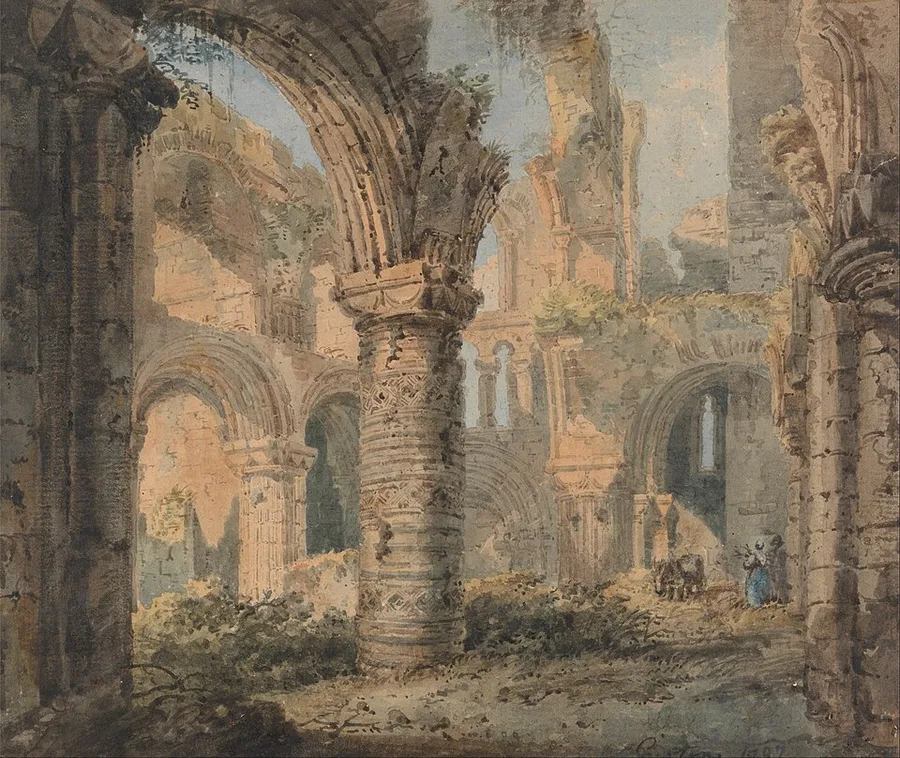 Thomas Girtin, Saint Cuthbert's Holy Island (1797), via Google Art Project Girtin painted the roofless nave of Lindisfarne priory in 1797 — the medieval church raised on the ground of the monastery the Norse struck in 793, after the monks had fled with Saint Cuthbert's relics. Its carved piers copy Durham Cathedral, the mother house that rebuilt the island priory. Tidal island off the Northumbrian coast of northeast England (now
often called Holy Island), about three miles (five kilometres)
long, accessible on foot at low tide. Site of one of the most prestigious Anglo-Saxon
monasteries — founded by Saint Aidan in 635 and famous for the
illuminated Lindisfarne Gospels (c. 700) — until Norse raiders
attacked on 8 June 793. The raid was not the first by Norsemen on
the British Isles, but its vividness in the Anglo-Saxon Chronicle
and in Alcuin of York's letters made it the conventional starting
date of the Viking Age in European historiography.
off the Northumbria
Thomas Girtin, Saint Cuthbert's Holy Island (1797), via Google Art Project Girtin painted the roofless nave of Lindisfarne priory in 1797 — the medieval church raised on the ground of the monastery the Norse struck in 793, after the monks had fled with Saint Cuthbert's relics. Its carved piers copy Durham Cathedral, the mother house that rebuilt the island priory. Tidal island off the Northumbrian coast of northeast England (now
often called Holy Island), about three miles (five kilometres)
long, accessible on foot at low tide. Site of one of the most prestigious Anglo-Saxon
monasteries — founded by Saint Aidan in 635 and famous for the
illuminated Lindisfarne Gospels (c. 700) — until Norse raiders
attacked on 8 June 793. The raid was not the first by Norsemen on
the British Isles, but its vividness in the Anglo-Saxon Chronicle
and in Alcuin of York's letters made it the conventional starting
date of the Viking Age in European historiography.
off the Northumbria 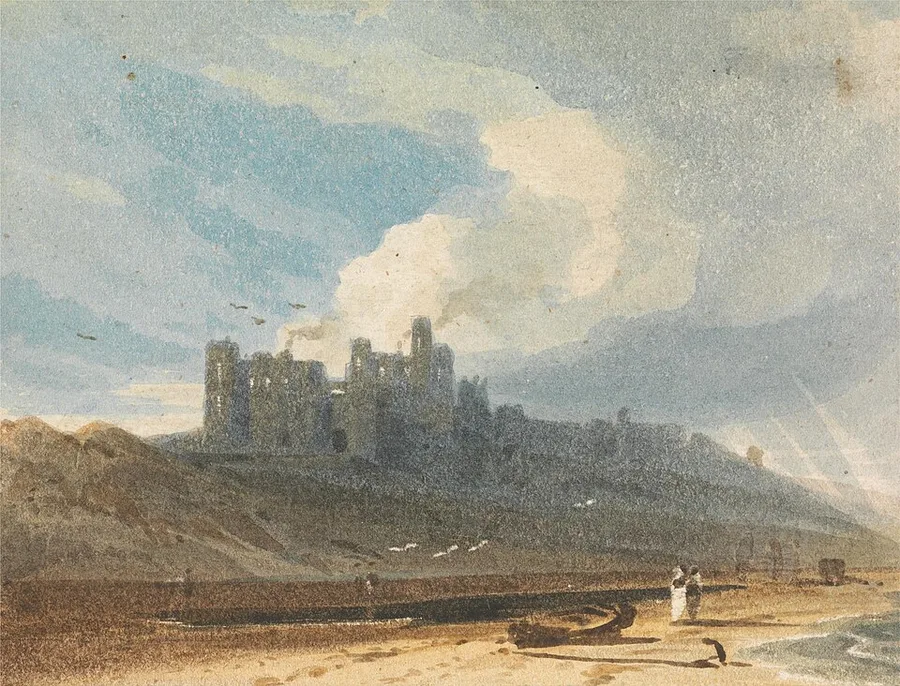 John Varley, Bamburgh Castle, Northumberland (watercolour), Yale Center for British Art John Varley's watercolour of Bamburgh Castle on its coastal crag — the ancient seat of Northumbria's kings, a few miles down the shore from Lindisfarne. This coastline of royal fortress and rich, unguarded monasteries is where the longships strike first. Anglo-Saxon kingdom of north-central and northeastern England, at its
height stretching from the Humber to the Firth of Forth. Christianised
in the early seventh century, Northumbria produced the Lindisfarne
monastery, the Venerable Bede, and the Northumbrian Renaissance of
illuminated manuscripts and Latin learning. Repeatedly raided and
eventually largely conquered by Norse forces across the late ninth
and tenth centuries; absorbed into the unified English kingdom by
the eleventh.
shore (in modern-day northeast England). The men who get out of them break into the wealthiest undefended monastery in the The Anglo-Saxons
John Varley, Bamburgh Castle, Northumberland (watercolour), Yale Center for British Art John Varley's watercolour of Bamburgh Castle on its coastal crag — the ancient seat of Northumbria's kings, a few miles down the shore from Lindisfarne. This coastline of royal fortress and rich, unguarded monasteries is where the longships strike first. Anglo-Saxon kingdom of north-central and northeastern England, at its
height stretching from the Humber to the Firth of Forth. Christianised
in the early seventh century, Northumbria produced the Lindisfarne
monastery, the Venerable Bede, and the Northumbrian Renaissance of
illuminated manuscripts and Latin learning. Repeatedly raided and
eventually largely conquered by Norse forces across the late ninth
and tenth centuries; absorbed into the unified English kingdom by
the eleventh.
shore (in modern-day northeast England). The men who get out of them break into the wealthiest undefended monastery in the The Anglo-Saxons 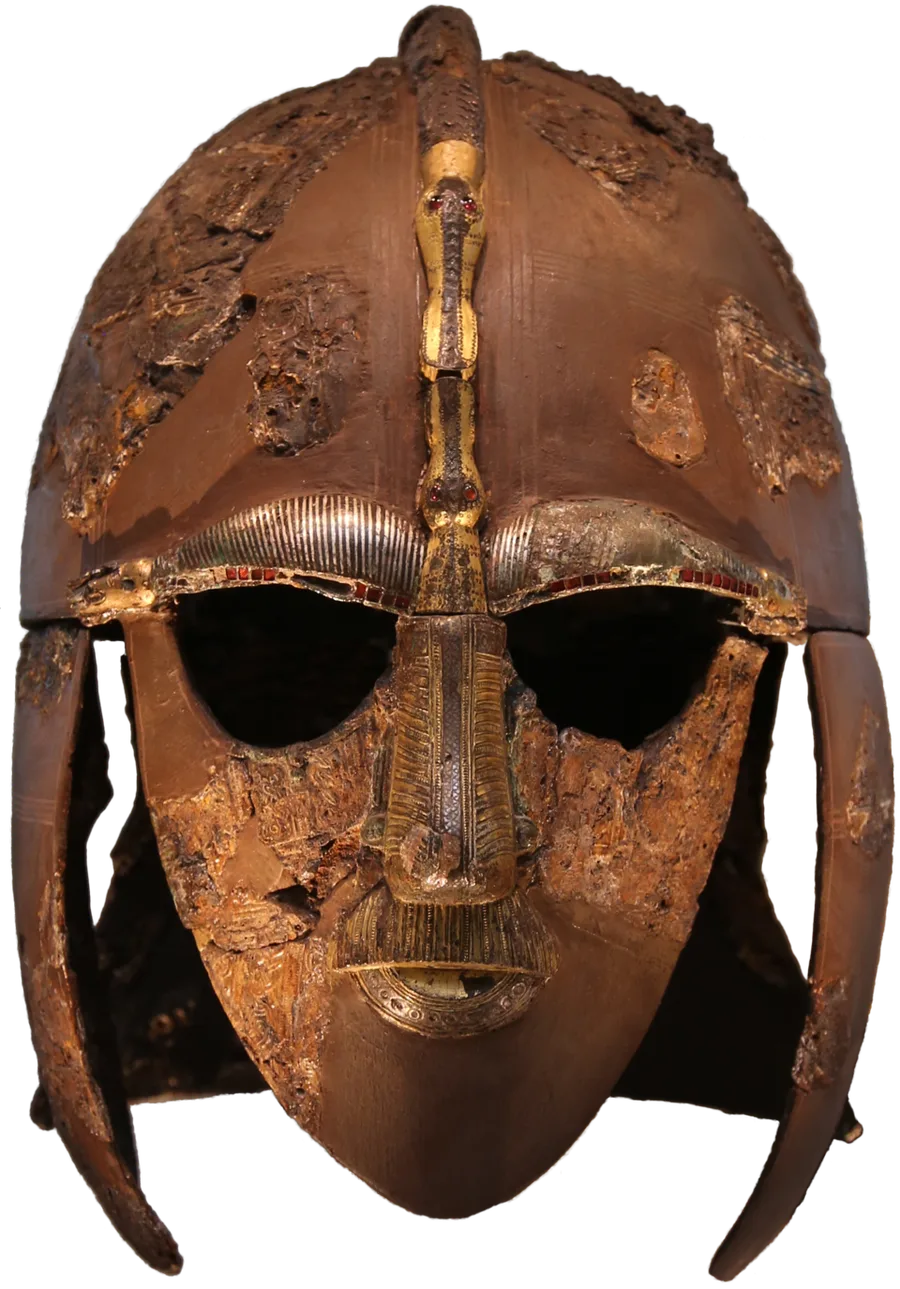 Unknown maker, the Sutton Hoo helmet (c. 600–650 CE), British Museum; photograph by Wikimedia contributor Geni (2016) The Sutton Hoo helmet (c. 600–650), its corroded iron reassembled from excavated fragments around the gilt face-mask — the most famous single object of Anglo-Saxon England. This is the world the longships arrived into: the kingdoms whose monasteries and river towns became the raiders' first targets. Germanic peoples — Angles, Saxons, Jutes — who migrated into Britain
from the continental coast of the North Sea in the fifth and sixth
centuries CE, displacing or absorbing the native Britons across most
of what became England. By the seventh century the Anglo-Saxons had
organised into the Heptarchy of seven kingdoms; by the late ninth
century the surviving kingdoms (chiefly Wessex under Alfred the
Great) had begun consolidating under sustained Norse pressure. The
Anglo-Saxon kingdom of England — formed by the conquests of Alfred's
successors across the tenth century — was the country the Norse
raided, settled, and finally invaded under Harald Hardrada in 1066,
with the Norman Conquest ending Anglo-Saxon rule the same year.
north. They kill some of the monks, drown others in the sea, drag a number off as slaves, and carry the gold and silver of the church back to the ships. The chroniclers record the year with omens — sheets of light in the air, whirlwinds, fiery dragons flying in the firmament — and then the pitiless raiding of the heathen men. The dragons are a literary flourish. The longships are not.
Unknown maker, the Sutton Hoo helmet (c. 600–650 CE), British Museum; photograph by Wikimedia contributor Geni (2016) The Sutton Hoo helmet (c. 600–650), its corroded iron reassembled from excavated fragments around the gilt face-mask — the most famous single object of Anglo-Saxon England. This is the world the longships arrived into: the kingdoms whose monasteries and river towns became the raiders' first targets. Germanic peoples — Angles, Saxons, Jutes — who migrated into Britain
from the continental coast of the North Sea in the fifth and sixth
centuries CE, displacing or absorbing the native Britons across most
of what became England. By the seventh century the Anglo-Saxons had
organised into the Heptarchy of seven kingdoms; by the late ninth
century the surviving kingdoms (chiefly Wessex under Alfred the
Great) had begun consolidating under sustained Norse pressure. The
Anglo-Saxon kingdom of England — formed by the conquests of Alfred's
successors across the tenth century — was the country the Norse
raided, settled, and finally invaded under Harald Hardrada in 1066,
with the Norman Conquest ending Anglo-Saxon rule the same year.
north. They kill some of the monks, drown others in the sea, drag a number off as slaves, and carry the gold and silver of the church back to the ships. The chroniclers record the year with omens — sheets of light in the air, whirlwinds, fiery dragons flying in the firmament — and then the pitiless raiding of the heathen men. The dragons are a literary flourish. The longships are not.
The English scholar Alcuin of York 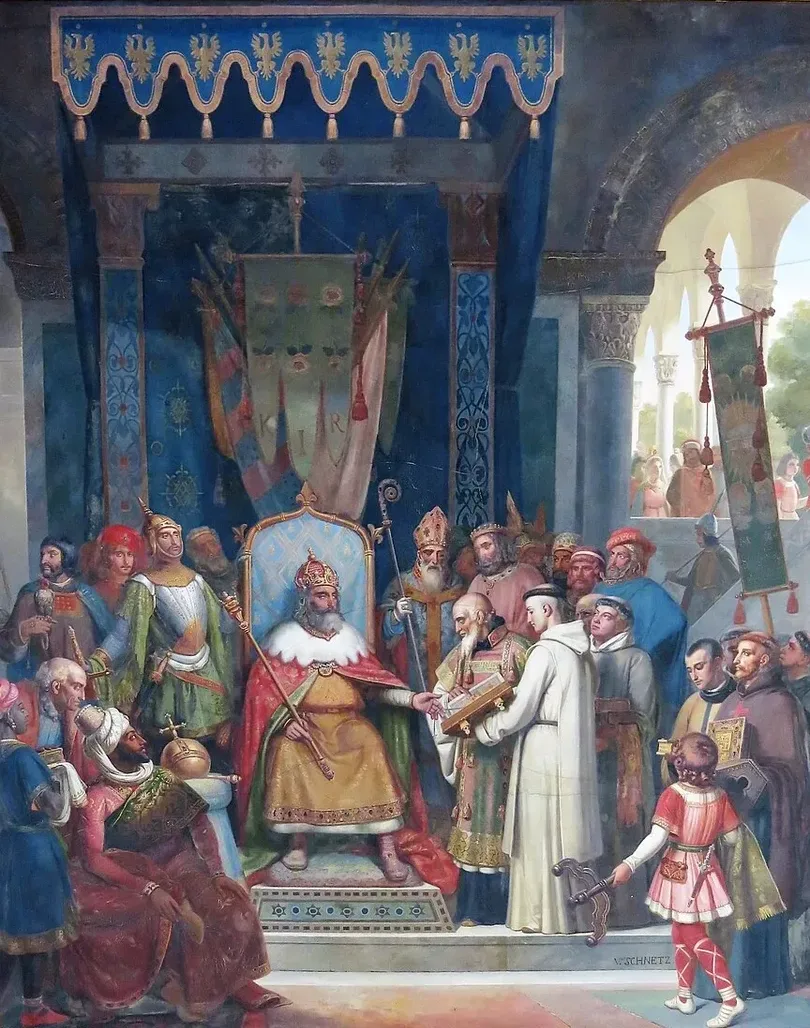 Jean-Victor Schnetz, Charlemagne Receives Alcuin (1833), Musée du Louvre Jean-Victor Schnetz's 1833 history painting imagines the scene at Charlemagne's court where Alcuin, the York-trained scholar who ran the palace school, presents manuscripts copied by his monks — the same court he was serving at when news of the Lindisfarne raid reached him in 793. English scholar, theologian, and Latin poet (c. 735–804), born in
Northumbria and educated at the cathedral school of York. From the
780s he served as the leading scholar at the court of Charlemagne in
Aachen, where he organised the palace school and led the Carolingian
educational and liturgical reforms. His letter home to Bishop Higbald
of Lindisfarne in 793, written from Charlemagne's court when the
news of the Lindisfarne raid arrived, is one of the most quoted
contemporary witnesses to the start of the Viking Age.
, in residence at Charlemagne
Jean-Victor Schnetz, Charlemagne Receives Alcuin (1833), Musée du Louvre Jean-Victor Schnetz's 1833 history painting imagines the scene at Charlemagne's court where Alcuin, the York-trained scholar who ran the palace school, presents manuscripts copied by his monks — the same court he was serving at when news of the Lindisfarne raid reached him in 793. English scholar, theologian, and Latin poet (c. 735–804), born in
Northumbria and educated at the cathedral school of York. From the
780s he served as the leading scholar at the court of Charlemagne in
Aachen, where he organised the palace school and led the Carolingian
educational and liturgical reforms. His letter home to Bishop Higbald
of Lindisfarne in 793, written from Charlemagne's court when the
news of the Lindisfarne raid arrived, is one of the most quoted
contemporary witnesses to the start of the Viking Age.
, in residence at Charlemagne 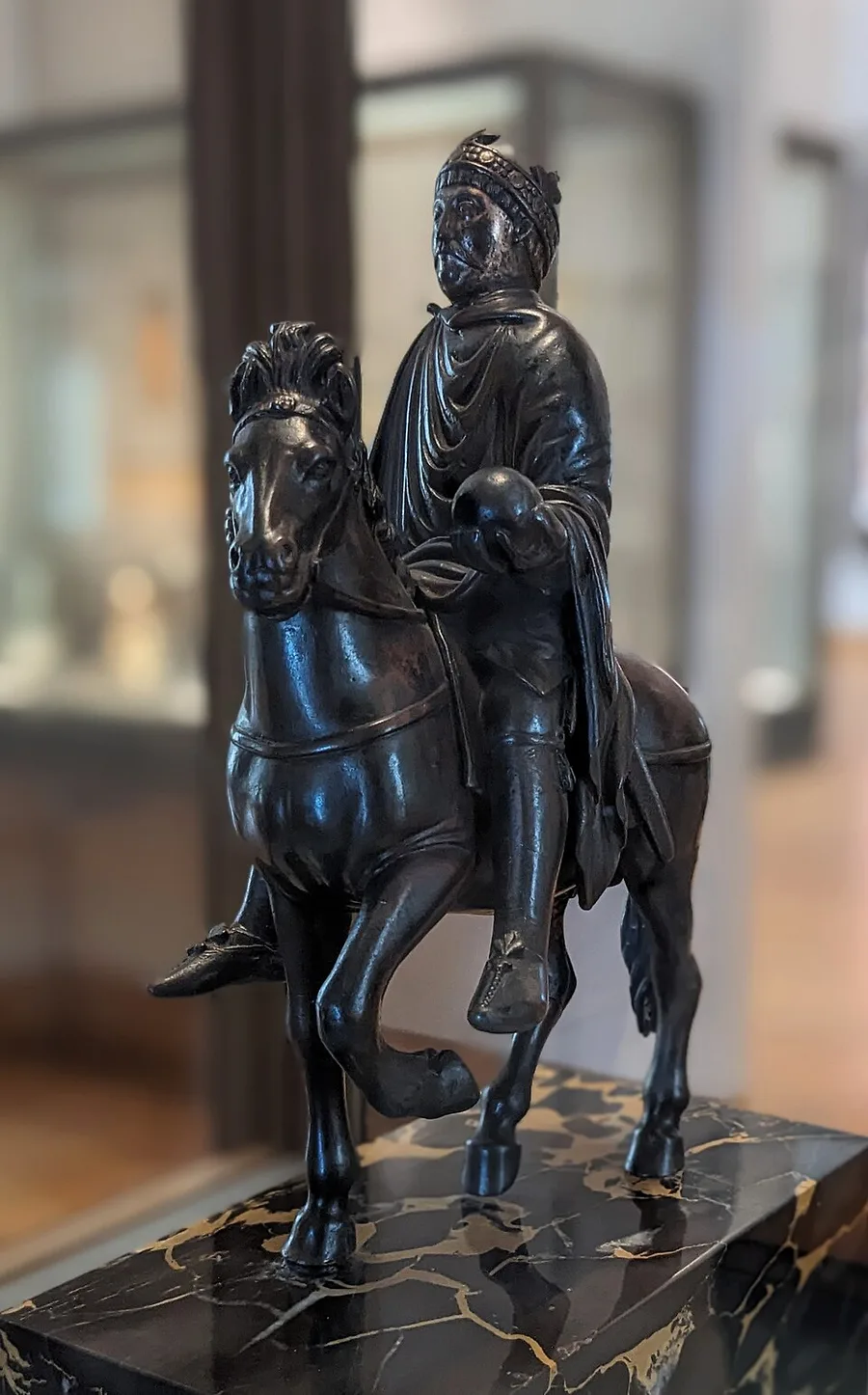 Carolingian workshop, Equestrian statuette of Charlemagne or Charles the Bald (c. 870), Musée du Louvre, OA 8260; photo: Shonagon (CC0) A Carolingian bronze of a crowned rider with an orb, cast within decades of Charlemagne's death and long identified as the emperor himself. Alcuin was serving at his court when the news of Lindisfarne arrived; the empire he built became the raiders' richest continental target. King of the Franks from 768 and the first Holy Roman Emperor from
Christmas Day 800, when Pope Leo III crowned him in Rome.
Consolidated most of western and central continental Europe under
Frankish rule across four decades of campaigns and built a court
and administrative system that became the model for medieval
European kingship. Died at Aachen on the twenty-eighth of January
814. His court was the leading scholarly centre north of the Alps
and the post Alcuin of York held when the news of Lindisfarne arrived.
’s court when the news arrives, writes home in grief: never before has such terror appeared in Britain, and no one had thought such an inroad from the sea could be made. The defining feature of the new threat is that it has come from a direction no one was watching.
Carolingian workshop, Equestrian statuette of Charlemagne or Charles the Bald (c. 870), Musée du Louvre, OA 8260; photo: Shonagon (CC0) A Carolingian bronze of a crowned rider with an orb, cast within decades of Charlemagne's death and long identified as the emperor himself. Alcuin was serving at his court when the news of Lindisfarne arrived; the empire he built became the raiders' richest continental target. King of the Franks from 768 and the first Holy Roman Emperor from
Christmas Day 800, when Pope Leo III crowned him in Rome.
Consolidated most of western and central continental Europe under
Frankish rule across four decades of campaigns and built a court
and administrative system that became the model for medieval
European kingship. Died at Aachen on the twenty-eighth of January
814. His court was the leading scholarly centre north of the Alps
and the post Alcuin of York held when the news of Lindisfarne arrived.
’s court when the news arrives, writes home in grief: never before has such terror appeared in Britain, and no one had thought such an inroad from the sea could be made. The defining feature of the new threat is that it has come from a direction no one was watching.
It is not, strictly, the first raid. Four years earlier, three Norse ships had landed at Portland 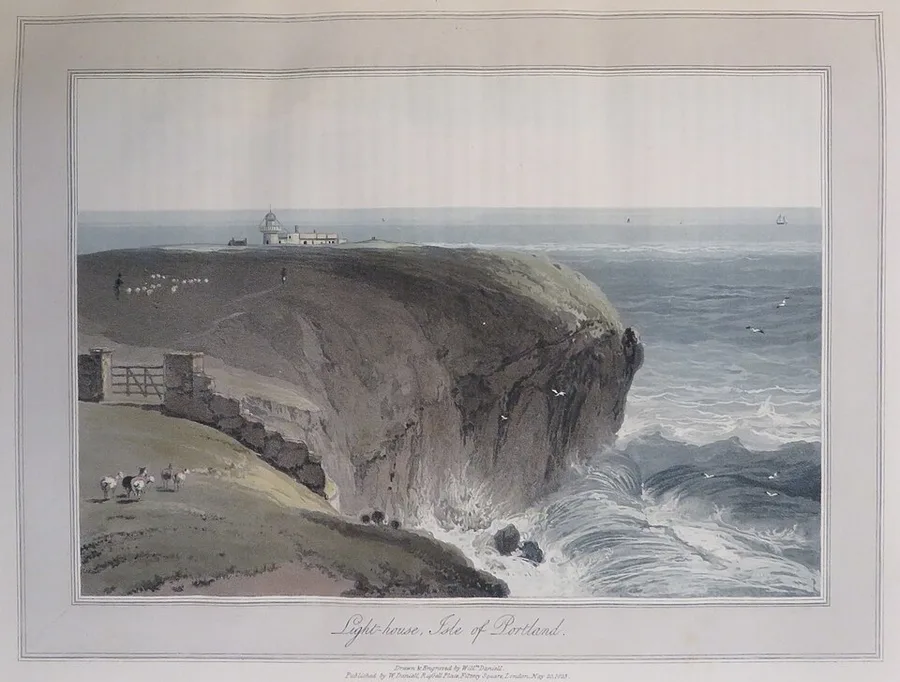 William Daniell, Light-house, Isle of Portland, from A Voyage Round Great Britain vol. VIII (1825) William Daniell's aquatint of Portland's wave-beaten limestone headland. On this Dorset shore, around 789, three ships landed and the royal reeve rode out expecting merchants — the first recorded Norse raid on England, four years before Lindisfarne. Tied island and headland on the south coast of England (modern
Dorset), connected to the mainland by the long shingle bar of Chesil
Beach. Site of one of the very earliest recorded Norse raids on
Britain — usually dated 789 — when three ships landed and killed
the local reeve who rode out to meet them, believing them to be
merchants. The Anglo-Saxon Chronicle dates the raid four years
before Lindisfarne; modern scholarship treats Portland rather than
Lindisfarne as the historical opening of the Viking Age in England,
though Lindisfarne remains the symbolic one.
on the south coast of England, killed the king’s reeve who rode out to direct them to the king’s town, and disappeared again. Lindisfarne opens the era in popular memory because the chronicler who wrote about it wrote vividly. Portland is where the era really begins. The men come from Hordaland
William Daniell, Light-house, Isle of Portland, from A Voyage Round Great Britain vol. VIII (1825) William Daniell's aquatint of Portland's wave-beaten limestone headland. On this Dorset shore, around 789, three ships landed and the royal reeve rode out expecting merchants — the first recorded Norse raid on England, four years before Lindisfarne. Tied island and headland on the south coast of England (modern
Dorset), connected to the mainland by the long shingle bar of Chesil
Beach. Site of one of the very earliest recorded Norse raids on
Britain — usually dated 789 — when three ships landed and killed
the local reeve who rode out to meet them, believing them to be
merchants. The Anglo-Saxon Chronicle dates the raid four years
before Lindisfarne; modern scholarship treats Portland rather than
Lindisfarne as the historical opening of the Viking Age in England,
though Lindisfarne remains the symbolic one.
on the south coast of England, killed the king’s reeve who rode out to direct them to the king’s town, and disappeared again. Lindisfarne opens the era in popular memory because the chronicler who wrote about it wrote vividly. Portland is where the era really begins. The men come from Hordaland 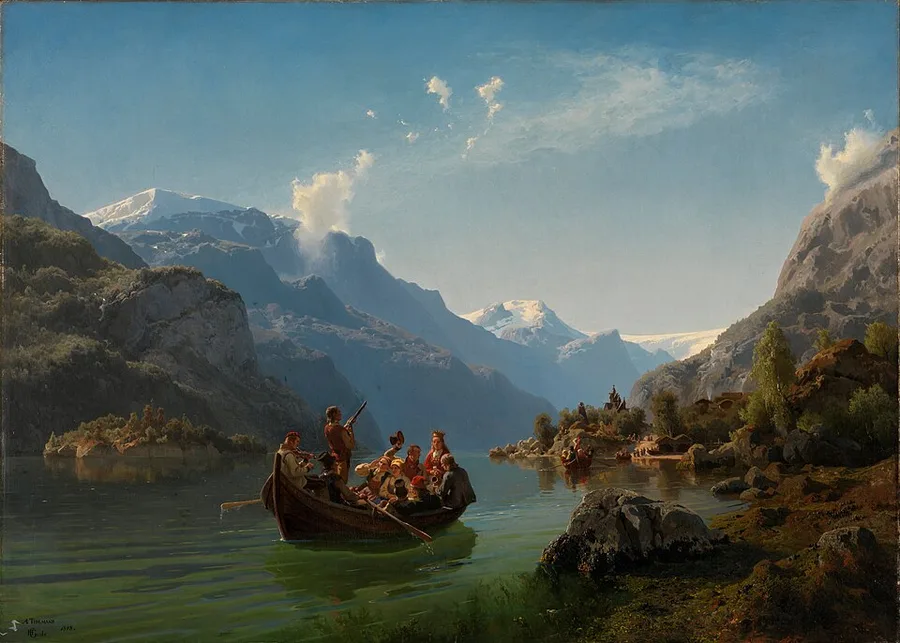 Adolph Tidemand & Hans Gude, Brudeferd i Hardanger (1848), Nasjonalmuseet / Google Art Project Tidemand and Gude's celebrated 1848 Brudeferd i Hardanger — a bridal party rowed across the still Hardangerfjord in festive dress — became the defining image of the fjord country of Hordaland, the region centred on Bergen. Region on the western coast of Norway centred on what is now Bergen.
In the petty-kingdom era a smaller maritime kingdom; from the high
medieval period the dominant Norwegian commercial region through
the Hanseatic period at Bryggen. Folded with adjacent Sogn og
Fjordane into the modern county of Vestland in 2020.
Hordaland (Bergen region) Also discussed in Before There Was Norway — petty kingdoms at the edge of the world on the western Norwegian coast.
Adolph Tidemand & Hans Gude, Brudeferd i Hardanger (1848), Nasjonalmuseet / Google Art Project Tidemand and Gude's celebrated 1848 Brudeferd i Hardanger — a bridal party rowed across the still Hardangerfjord in festive dress — became the defining image of the fjord country of Hordaland, the region centred on Bergen. Region on the western coast of Norway centred on what is now Bergen.
In the petty-kingdom era a smaller maritime kingdom; from the high
medieval period the dominant Norwegian commercial region through
the Hanseatic period at Bryggen. Folded with adjacent Sogn og
Fjordane into the modern county of Vestland in 2020.
Hordaland (Bergen region) Also discussed in Before There Was Norway — petty kingdoms at the edge of the world on the western Norwegian coast.
The men who appear there become, in time, among the most recognizable figures in the world. The era they begin will redraw the trading routes of Europe, settle Iceland 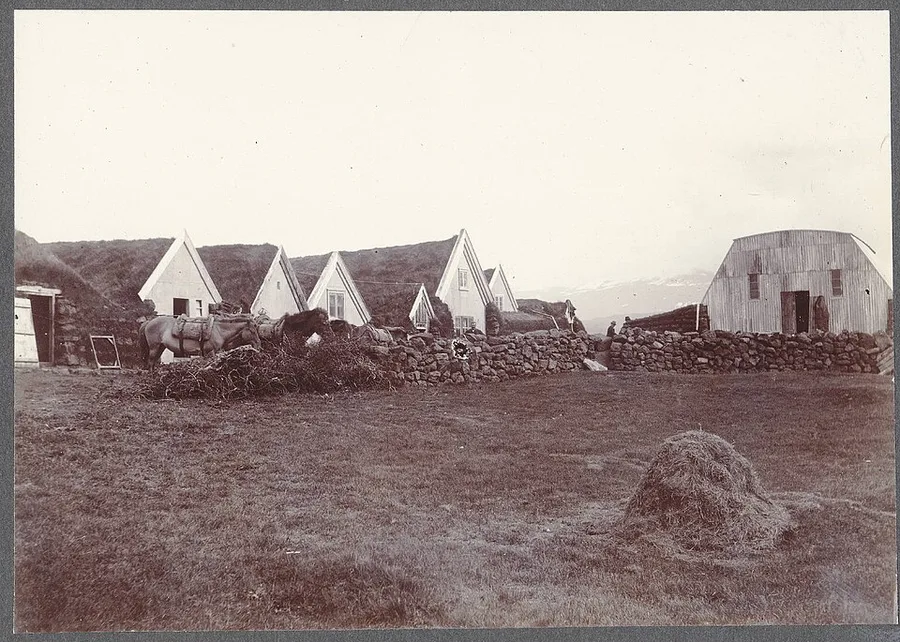 Frederick W. W. Howell, Galtalækur and Hekla (c. 1900), Fiske Icelandic Collection, Cornell University Library A turf-walled farm under Hekla, photographed about 1900 — Iceland as the settlers from Norway made it: a country of farms without a king or towns, governed by the annual open-air Alþing and remembered in the sagas their descendants wrote. The North Atlantic island settled from Norway in the ninth and
tenth centuries by chieftains and their followings who refused to
accept Harald Fairhair's authority on the Norwegian mainland and
emigrated rather than submit. They built a country without a king,
governed by an annual open-air assembly at Þingvellir called the
Alþing — the oldest parliament in the world by date of founding. Three centuries after the migration, their descendants
(notably Snorri Sturluson) composed the prose sagas that became
almost the only literary memory of the Norwegian petty kingdoms.
Also discussed in Before There Was Norway — petty kingdoms at the edge of the worldWorshiping Odin and Thor — the lived religion of pre-Christian NorwayThe King Who Became a Saint — how the Nordmen came to ChristA Catholic Norway — the faith that gave the kingdom its first institutions and the stave churchesThe Golden Age — a North Atlantic empire … reaching farther than you thinkThe 400-Year Night — when the Northern Lion lay dormant and Greenland
Frederick W. W. Howell, Galtalækur and Hekla (c. 1900), Fiske Icelandic Collection, Cornell University Library A turf-walled farm under Hekla, photographed about 1900 — Iceland as the settlers from Norway made it: a country of farms without a king or towns, governed by the annual open-air Alþing and remembered in the sagas their descendants wrote. The North Atlantic island settled from Norway in the ninth and
tenth centuries by chieftains and their followings who refused to
accept Harald Fairhair's authority on the Norwegian mainland and
emigrated rather than submit. They built a country without a king,
governed by an annual open-air assembly at Þingvellir called the
Alþing — the oldest parliament in the world by date of founding. Three centuries after the migration, their descendants
(notably Snorri Sturluson) composed the prose sagas that became
almost the only literary memory of the Norwegian petty kingdoms.
Also discussed in Before There Was Norway — petty kingdoms at the edge of the worldWorshiping Odin and Thor — the lived religion of pre-Christian NorwayThe King Who Became a Saint — how the Nordmen came to ChristA Catholic Norway — the faith that gave the kingdom its first institutions and the stave churchesThe Golden Age — a North Atlantic empire … reaching farther than you thinkThe 400-Year Night — when the Northern Lion lay dormant and Greenland 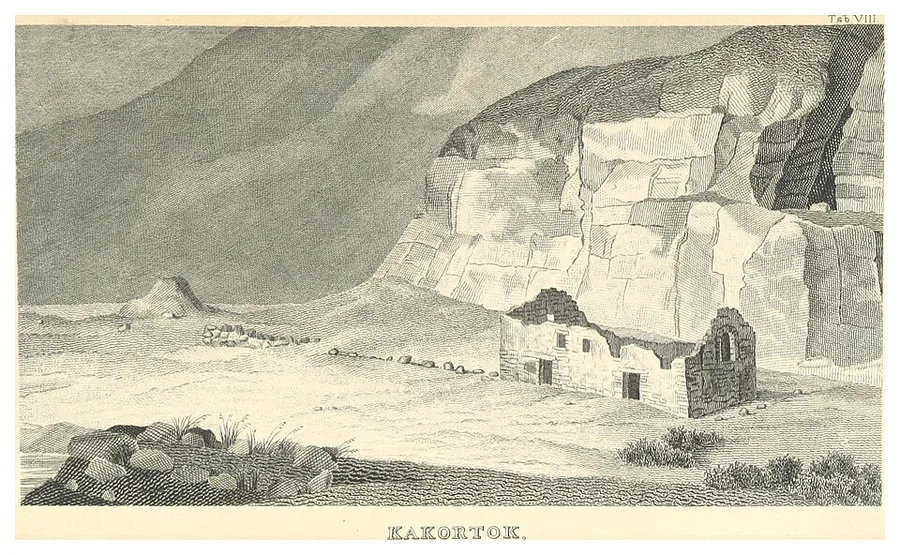 Grønlands historiske Mindesmærker vol. 3 (1845), plate VIII, British Library The stone church at Hvalsey, the best-preserved building of Norse Greenland — drawn in 1845 for the Danish survey that went looking for the lost colony. A wedding held here in 1408 is the last event anyone recorded before the settlements Erik the Red founded fell silent. The world's largest island, lying between the Arctic and Atlantic
Oceans west of Iceland. Colonised by Norse settlers led by Erik the
Red beginning in 985 — the name "Greenland" was Erik's marketing,
chosen to attract colonists to a marginally agricultural land. The
Norse Eastern and Western Settlements on the southwestern coast
sustained perhaps two or three thousand people at peak across four
centuries before steadily diminishing in the cooling climate of the
Little Ice Age and disappearing by around 1450. Today a self-
governing territory within the Kingdom of Denmark.
Also discussed in The King Who Became a Saint — how the Nordmen came to ChristA Catholic Norway — the faith that gave the kingdom its first institutions and the stave churchesThe Golden Age — a North Atlantic empire … reaching farther than you thinkThe Long Fall — the sudden loss of Norwegian nobility, the end of the kings, and half of Norway gone foreverThe 400-Year Night — when the Northern Lion lay dormant and the eastern coast of North America, put a country named Russia on the map, and end three centuries later with a Norwegian king dead at a small river crossing in Yorkshire
Grønlands historiske Mindesmærker vol. 3 (1845), plate VIII, British Library The stone church at Hvalsey, the best-preserved building of Norse Greenland — drawn in 1845 for the Danish survey that went looking for the lost colony. A wedding held here in 1408 is the last event anyone recorded before the settlements Erik the Red founded fell silent. The world's largest island, lying between the Arctic and Atlantic
Oceans west of Iceland. Colonised by Norse settlers led by Erik the
Red beginning in 985 — the name "Greenland" was Erik's marketing,
chosen to attract colonists to a marginally agricultural land. The
Norse Eastern and Western Settlements on the southwestern coast
sustained perhaps two or three thousand people at peak across four
centuries before steadily diminishing in the cooling climate of the
Little Ice Age and disappearing by around 1450. Today a self-
governing territory within the Kingdom of Denmark.
Also discussed in The King Who Became a Saint — how the Nordmen came to ChristA Catholic Norway — the faith that gave the kingdom its first institutions and the stave churchesThe Golden Age — a North Atlantic empire … reaching farther than you thinkThe Long Fall — the sudden loss of Norwegian nobility, the end of the kings, and half of Norway gone foreverThe 400-Year Night — when the Northern Lion lay dormant and the eastern coast of North America, put a country named Russia on the map, and end three centuries later with a Norwegian king dead at a small river crossing in Yorkshire 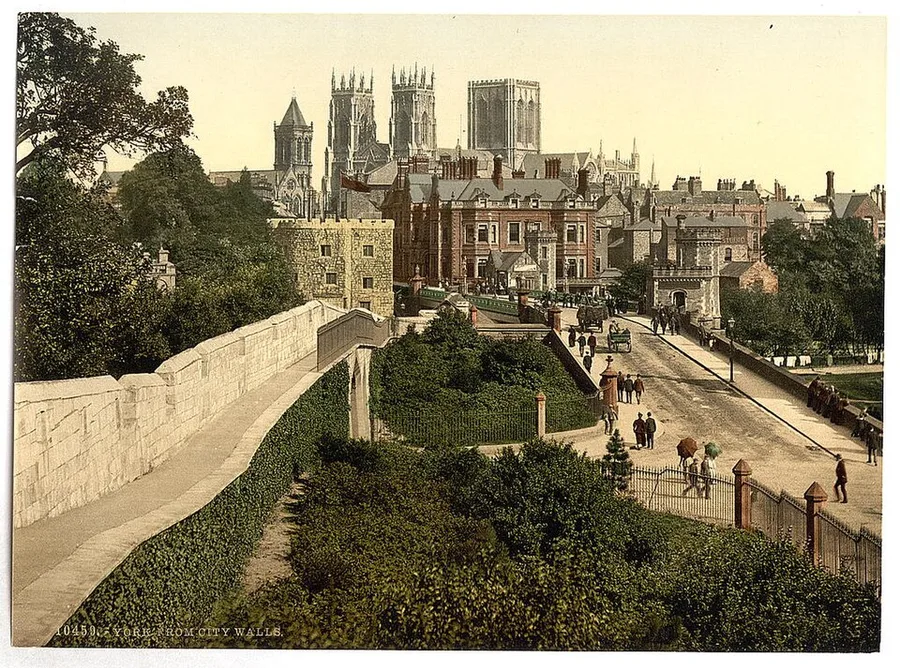 Detroit Publishing Co. photochrom, York from City Walls (c. 1890–1900), Library of Congress York from its medieval walls, the Minster rising over the rooftops in an 1890s photochrom. The city was Norse Jórvík, capital of the Danelaw, and the church metropolis of England's north — the Yorkshire of Norse place-names and of the great abbeys whose monks reached Norway. Historic county of northern England, the largest of the traditional
English counties. Under heavy Norse settlement and rule from the
late ninth century onward — the Norse-founded kingdom of York
(Jórvík) was the centre of the Danelaw — until reabsorbed into the
English kingdom in 954. Norse place-names ending in -by, -thorpe,
and -thwaite still mark Yorkshire's villages and fields. Site of
the Battle of Stamford Bridge (1066), where Harald Hardrada's last
Norse invasion of England ended.
Also discussed in A Catholic Norway — the faith that gave the kingdom its first institutions and the stave churches .
Detroit Publishing Co. photochrom, York from City Walls (c. 1890–1900), Library of Congress York from its medieval walls, the Minster rising over the rooftops in an 1890s photochrom. The city was Norse Jórvík, capital of the Danelaw, and the church metropolis of England's north — the Yorkshire of Norse place-names and of the great abbeys whose monks reached Norway. Historic county of northern England, the largest of the traditional
English counties. Under heavy Norse settlement and rule from the
late ninth century onward — the Norse-founded kingdom of York
(Jórvík) was the centre of the Danelaw — until reabsorbed into the
English kingdom in 954. Norse place-names ending in -by, -thorpe,
and -thwaite still mark Yorkshire's villages and fields. Site of
the Battle of Stamford Bridge (1066), where Harald Hardrada's last
Norse invasion of England ended.
Also discussed in A Catholic Norway — the faith that gave the kingdom its first institutions and the stave churches .
The names the world gave them
There is no country yet called Norway. Norway, Denmark, and Sweden as modern nations are centuries in the future. The raiders are a population spread thin along the coasts of all three, organized into Petty kings 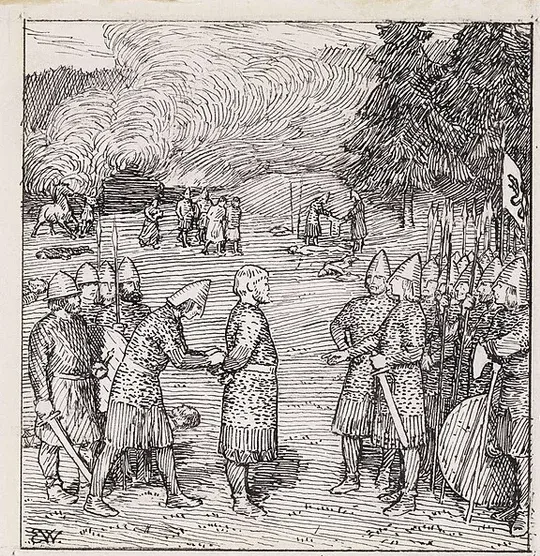 Erik Werenskiold, Den fangne kong Gryting føres fram for kong Harald (1899), Nasjonalmuseet Werenskiold drew a captured petty king — Gryting led bound before Harald Fairhair, a farm burning across the field — the moment the small fjord-and-valley kingdoms fell to unification. The small-kingdom rulers of pre-unification Norway, smákonungar
in Old Norse. From roughly the sixth century through the late ninth,
the Norwegian coast was organised not as one country but as perhaps
a dozen small thrones, each controlling a fjord or valley district.
A petty king was a war leader and religious officiant who led men
into battle, performed seasonal sacrifices, arbitrated disputes
among his chieftains, and collected tribute in commodity from the
farmsteads under his authority — but who governed alongside the
regional thing, the assembly of free men. Harald Fairhair's
consolidation around 880 broke the petty-kingdom system in the
west and south; the inland and northern remnants persisted longer.
Also discussed in Before There Was Norway — petty kingdoms at the edge of the world and unified by little more than a shared language and a shared ship. The Old Norse word for what they do is Víkingr
Erik Werenskiold, Den fangne kong Gryting føres fram for kong Harald (1899), Nasjonalmuseet Werenskiold drew a captured petty king — Gryting led bound before Harald Fairhair, a farm burning across the field — the moment the small fjord-and-valley kingdoms fell to unification. The small-kingdom rulers of pre-unification Norway, smákonungar
in Old Norse. From roughly the sixth century through the late ninth,
the Norwegian coast was organised not as one country but as perhaps
a dozen small thrones, each controlling a fjord or valley district.
A petty king was a war leader and religious officiant who led men
into battle, performed seasonal sacrifices, arbitrated disputes
among his chieftains, and collected tribute in commodity from the
farmsteads under his authority — but who governed alongside the
regional thing, the assembly of free men. Harald Fairhair's
consolidation around 880 broke the petty-kingdom system in the
west and south; the inland and northern remnants persisted longer.
Also discussed in Before There Was Norway — petty kingdoms at the edge of the world and unified by little more than a shared language and a shared ship. The Old Norse word for what they do is Víkingr 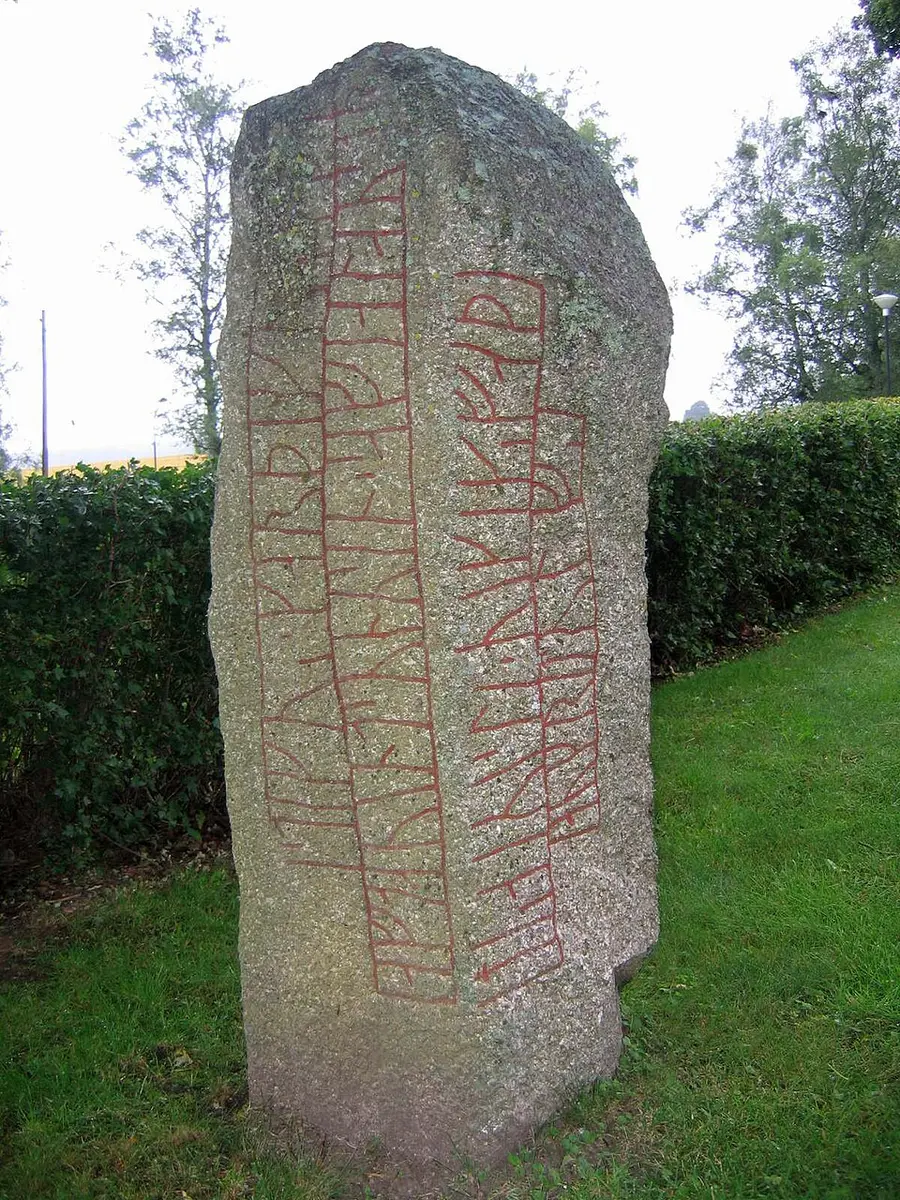 Runestone Ög 8 (the Kälvesten stone), 9th century, Västra Stenby church, Motala, Östergötland. Photograph by Berig (2007), CC BY 2.5 The 9th-century Kälvesten stone is Scandinavia's earliest known monument naming an eastward expedition, and its inscription — carved in part by a man named Víkingr — carries the very word-root this card explains, centuries before 'Viking' became the modern catch-all English label. Old Norse word for the activity of raiding rather than for a
people — að fara í víking meant "to go on a raid." The English
word "Viking," derived from it, is a nineteenth-century
retrofitting: medieval Scandinavians did not call themselves
Vikings as an ethnic or national identity. Most Norse of the
Viking Age never went raiding. The English use of "Viking" for
the entire Norse population is the standard one today but is
historically a category mistake — useful shorthand that conceals
what the Norse themselves meant by the word.
— the activity of the raid, not a name for a people. Most Scandinavians of the period never go on one in their lives.
Runestone Ög 8 (the Kälvesten stone), 9th century, Västra Stenby church, Motala, Östergötland. Photograph by Berig (2007), CC BY 2.5 The 9th-century Kälvesten stone is Scandinavia's earliest known monument naming an eastward expedition, and its inscription — carved in part by a man named Víkingr — carries the very word-root this card explains, centuries before 'Viking' became the modern catch-all English label. Old Norse word for the activity of raiding rather than for a
people — að fara í víking meant "to go on a raid." The English
word "Viking," derived from it, is a nineteenth-century
retrofitting: medieval Scandinavians did not call themselves
Vikings as an ethnic or national identity. Most Norse of the
Viking Age never went raiding. The English use of "Viking" for
the entire Norse population is the standard one today but is
historically a category mistake — useful shorthand that conceals
what the Norse themselves meant by the word.
— the activity of the raid, not a name for a people. Most Scandinavians of the period never go on one in their lives.
The men who do, however, give Europe a new vocabulary.
To the The Franks 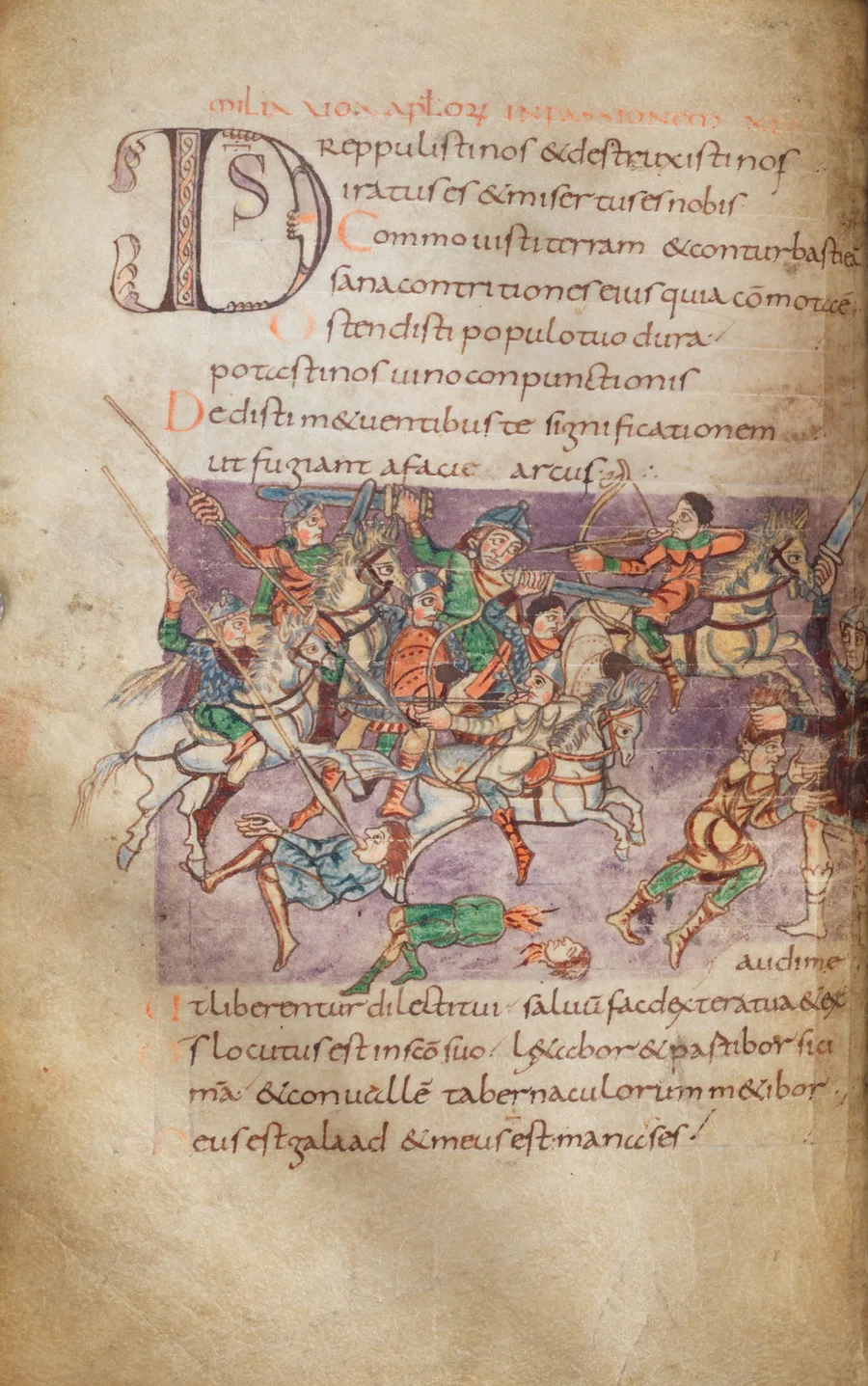 Stuttgart Psalter (Württembergische Landesbibliothek, Cod.bibl.fol.23), Frankish riders (c. 820–830) Frankish horsemen ride down their enemies in the Stuttgart Psalter, painted near Paris around 820–830 — the Franks as they drew themselves, at almost the exact moment Norse fleets began probing the empire's rivers. Germanic people who established the Frankish kingdom in Roman Gaul
from the late fifth century and dominated continental western
Europe for the next four centuries. Under Charlemagne (r. 768–814)
the Carolingian Frankish Empire stretched from the Pyrenees to the
Elbe and from the Atlantic to central Italy. By the mid-ninth
century the empire had divided into West Frankia (the kernel of
modern France) and East Frankia (the kernel of modern Germany);
the boundary settled at the Treaty of Verdun in 843. The Franks
were the Norse raiders' principal continental target across the
ninth century.
(in modern-day France and Germany) they are Normanni
Stuttgart Psalter (Württembergische Landesbibliothek, Cod.bibl.fol.23), Frankish riders (c. 820–830) Frankish horsemen ride down their enemies in the Stuttgart Psalter, painted near Paris around 820–830 — the Franks as they drew themselves, at almost the exact moment Norse fleets began probing the empire's rivers. Germanic people who established the Frankish kingdom in Roman Gaul
from the late fifth century and dominated continental western
Europe for the next four centuries. Under Charlemagne (r. 768–814)
the Carolingian Frankish Empire stretched from the Pyrenees to the
Elbe and from the Atlantic to central Italy. By the mid-ninth
century the empire had divided into West Frankia (the kernel of
modern France) and East Frankia (the kernel of modern Germany);
the boundary settled at the Treaty of Verdun in 843. The Franks
were the Norse raiders' principal continental target across the
ninth century.
(in modern-day France and Germany) they are Normanni 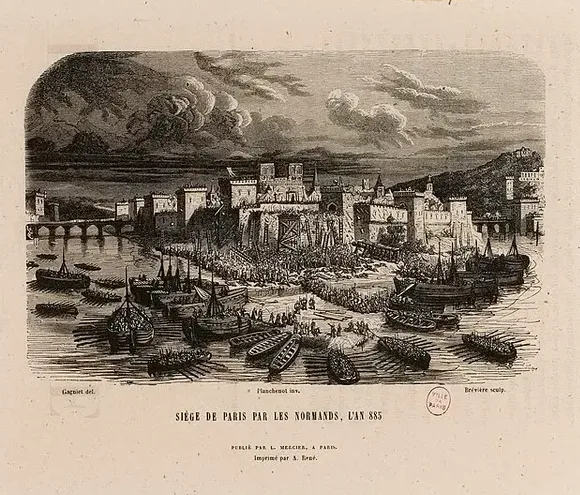 Louis-Henri Brévière (engraver), Siège de Paris par les Normands, l'an 885, Musée Carnavalet, Paris (inv. G.30880) Titled literally 'the Normans' in French, this 19th-century Paris Museums print puts the exact word this card explains into a picture — the Franks' name for the Norse besiegers of 885, the same name France still uses for them today. Medieval Latin word for "Northmen," used by the Franks for the Norse
raiders and settlers who came down out of Scandinavia from the late
eighth century onward. The word survives in the modern name
"Normandy" — the territory ceded to the Norse warrior Rollo by
Charles the Simple in 911 — and in "Norman," used both for the
Norse-descended ruling class of medieval Normandy and for the
related French-speaking aristocracy that William the Conqueror put
on the English throne in 1066.
, the Northmen — a word that, three generations later, will give Normandy
Louis-Henri Brévière (engraver), Siège de Paris par les Normands, l'an 885, Musée Carnavalet, Paris (inv. G.30880) Titled literally 'the Normans' in French, this 19th-century Paris Museums print puts the exact word this card explains into a picture — the Franks' name for the Norse besiegers of 885, the same name France still uses for them today. Medieval Latin word for "Northmen," used by the Franks for the Norse
raiders and settlers who came down out of Scandinavia from the late
eighth century onward. The word survives in the modern name
"Normandy" — the territory ceded to the Norse warrior Rollo by
Charles the Simple in 911 — and in "Norman," used both for the
Norse-descended ruling class of medieval Normandy and for the
related French-speaking aristocracy that William the Conqueror put
on the English throne in 1066.
, the Northmen — a word that, three generations later, will give Normandy 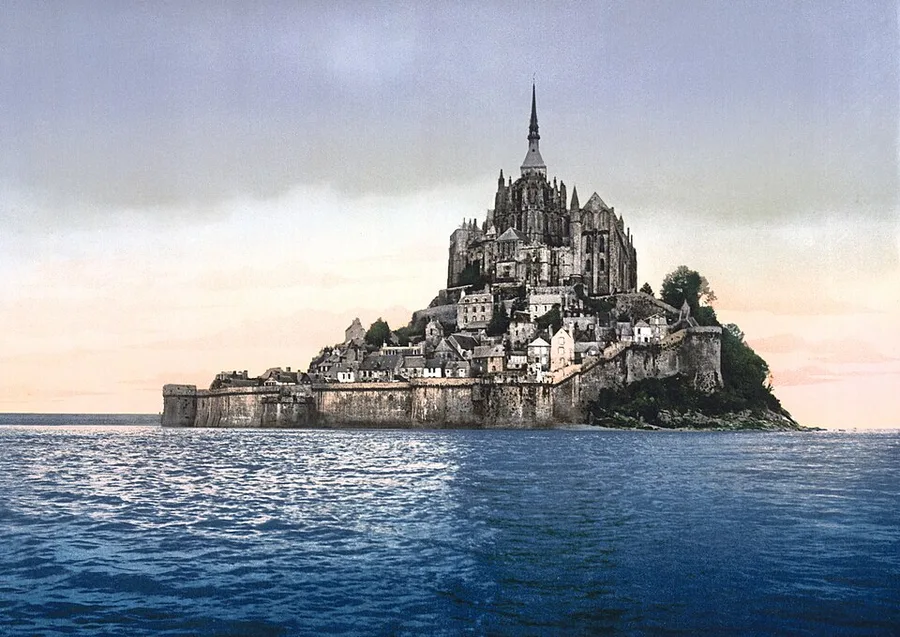 Photochrom print, Mont St. Michel at high water (c. 1900), Library of Congress Mont-Saint-Michel, the abbey-island off Normandy's coast, photographed at high tide around 1900. The land around it began as Norse country: Charles the Simple ceded the lower Seine to Rollo's Northmen in 911, and their name — Normanni — became Normandy's own. Historical region of northwestern France along the lower Seine and
the Channel coast. The territory was ceded to the Norse warrior
Rollo and his followers by the West Frankish king Charles the Simple
in the Treaty of Saint-Clair-sur-Epte (911), in exchange for nominal
vassalage and defence against further Norse raiding. The name comes
from Normanni, "Northmen." Rollo's descendants ruled as Dukes of
Normandy; his great-great-great-grandson William the Conqueror
invaded England in 1066, putting a Norse-descended Norman dynasty
on the English throne.
Also discussed in The King Who Became a Saint — how the Nordmen came to Christ (modern-day northern France) its name when the French king cedes the lower Seine
Photochrom print, Mont St. Michel at high water (c. 1900), Library of Congress Mont-Saint-Michel, the abbey-island off Normandy's coast, photographed at high tide around 1900. The land around it began as Norse country: Charles the Simple ceded the lower Seine to Rollo's Northmen in 911, and their name — Normanni — became Normandy's own. Historical region of northwestern France along the lower Seine and
the Channel coast. The territory was ceded to the Norse warrior
Rollo and his followers by the West Frankish king Charles the Simple
in the Treaty of Saint-Clair-sur-Epte (911), in exchange for nominal
vassalage and defence against further Norse raiding. The name comes
from Normanni, "Northmen." Rollo's descendants ruled as Dukes of
Normandy; his great-great-great-grandson William the Conqueror
invaded England in 1066, putting a Norse-descended Norman dynasty
on the English throne.
Also discussed in The King Who Became a Saint — how the Nordmen came to Christ (modern-day northern France) its name when the French king cedes the lower Seine 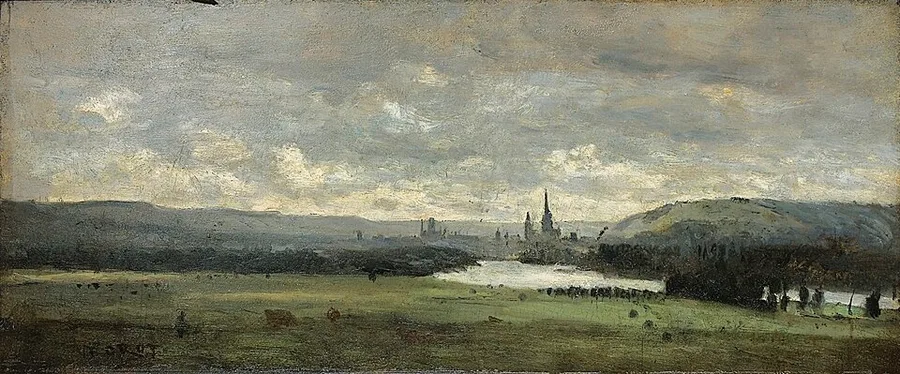 Jean-Baptiste-Camille Corot, Rouen — une vue panoramique de la Seine au premier plan (19th c.) Corot's panorama of the lower Seine winding toward Rouen's spires — the broad navigable water that made the river a highway into Francia. Norse fleets row up this valley again and again across the ninth century, until the land at its mouth is ceded to Rollo in 911. The principal river of northern France, rising in Burgundy and flowing
about seven hundred and seventy-five kilometres northwest through
Paris to the English Channel at Le Havre. The lower Seine and its
estuary were the principal Norse penetration route into the Frankish
interior across the ninth century; the territory at its mouth was
the area Charles the Simple ceded to Rollo in 911 to become Normandy.
valley in 911 to a Norse settler named Rollo
Jean-Baptiste-Camille Corot, Rouen — une vue panoramique de la Seine au premier plan (19th c.) Corot's panorama of the lower Seine winding toward Rouen's spires — the broad navigable water that made the river a highway into Francia. Norse fleets row up this valley again and again across the ninth century, until the land at its mouth is ceded to Rollo in 911. The principal river of northern France, rising in Burgundy and flowing
about seven hundred and seventy-five kilometres northwest through
Paris to the English Channel at Le Havre. The lower Seine and its
estuary were the principal Norse penetration route into the Frankish
interior across the ninth century; the territory at its mouth was
the area Charles the Simple ceded to Rollo in 911 to become Normandy.
valley in 911 to a Norse settler named Rollo 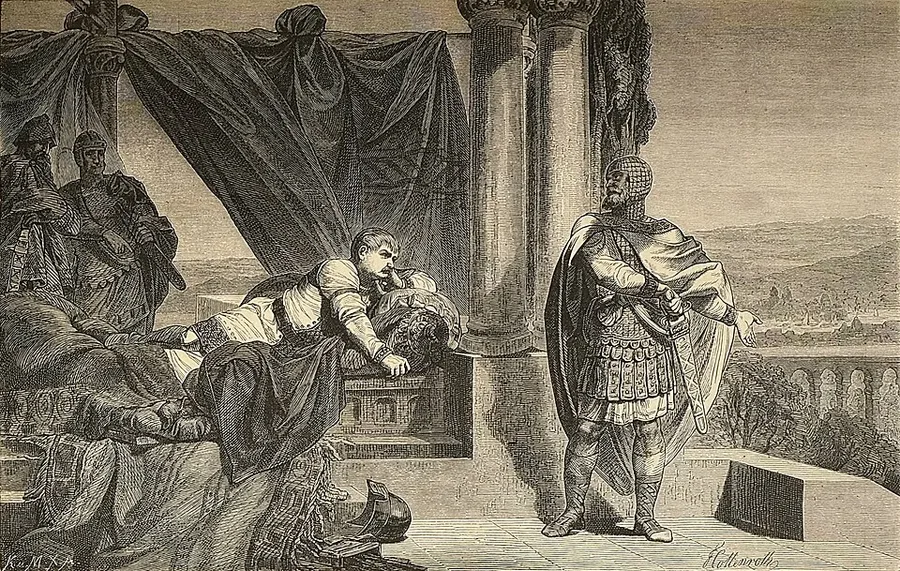 Friedrich Hottenroth, Charles the Fat and Rollo at the siege of Paris, Illustrirte Geschichte des deutschen Volkes (Stuttgart, 1873) An 1873 engraving imagines Rollo standing armed before Charles the Fat during the 885 siege of Paris. No portrait of Rollo exists, and his lasting bargain came a generation after this scene — in 911, when a different Charles (the Simple) ceded him the lower Seine at Saint-Clair-sur-Epte. Norse warrior and chieftain (c. 860–c. 930) who led a Norse warband
that settled in the lower Seine valley of northern France in the late
ninth century. In 911 the West Frankish king Charles the Simple
formalised the settlement in the Treaty of Saint-Clair-sur-Epte,
granting Rollo and his followers the territory that would soon be
called Normandy ("land of the Northmen") in exchange for nominal
vassalage and defence against further Norse raiding. Rollo's
descendants became the Dukes of Normandy; his great-great-great-
grandson William the Conqueror invaded England in 1066.
.
Friedrich Hottenroth, Charles the Fat and Rollo at the siege of Paris, Illustrirte Geschichte des deutschen Volkes (Stuttgart, 1873) An 1873 engraving imagines Rollo standing armed before Charles the Fat during the 885 siege of Paris. No portrait of Rollo exists, and his lasting bargain came a generation after this scene — in 911, when a different Charles (the Simple) ceded him the lower Seine at Saint-Clair-sur-Epte. Norse warrior and chieftain (c. 860–c. 930) who led a Norse warband
that settled in the lower Seine valley of northern France in the late
ninth century. In 911 the West Frankish king Charles the Simple
formalised the settlement in the Treaty of Saint-Clair-sur-Epte,
granting Rollo and his followers the territory that would soon be
called Normandy ("land of the Northmen") in exchange for nominal
vassalage and defence against further Norse raiding. Rollo's
descendants became the Dukes of Normandy; his great-great-great-
grandson William the Conqueror invaded England in 1066.
.
To the Anglo-Saxons they are Danes, generically, even when the raiders are Norwegian.
To the Irish they are Lochlannach 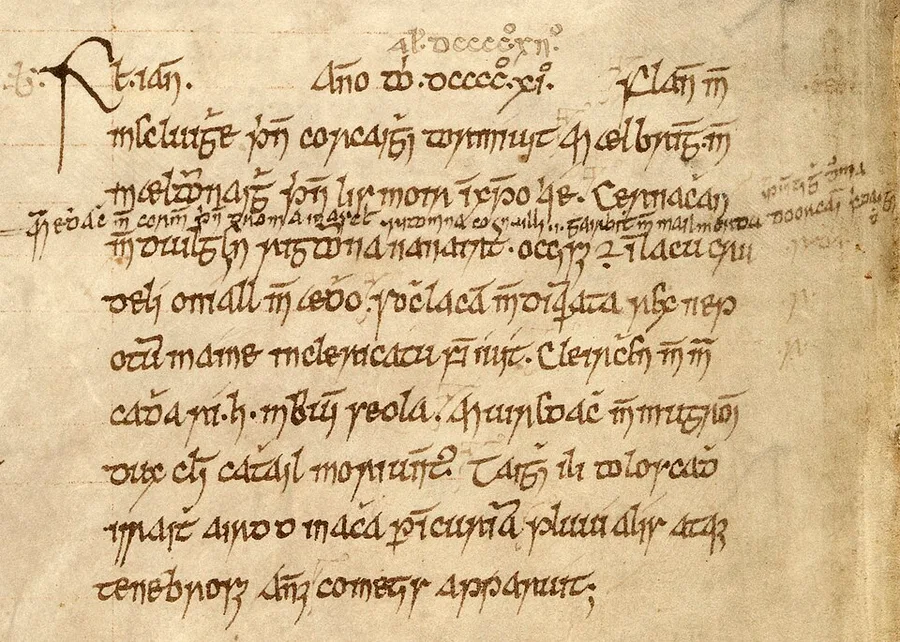 Annals of Ulster, Trinity College Dublin MS 1282, entry for the year 912 (compiled late 15th century by Ruaidhrí Ó Luinín) A page from the Annals of Ulster, the Irish chronicle that records the Lochlannach — Norse raiders and settlers the Irish distinguished from Danes — founding Dublin and other coastal strongholds. The Irish-Gaelic word for the Norse — "the people of the lochs"
(lakes/fjords). Used in the medieval Irish annals to distinguish
the Norwegians from the Danes (the latter called
Dubgaill, "dark foreigners," in contrast to Finngaill, "fair
foreigners," typically the Norwegians, though the precise
application varies by source). The Lochlannach in Ireland founded
Dublin and several other coastal trading towns and were a major
political force across two centuries.
, the people of the lochs.
Annals of Ulster, Trinity College Dublin MS 1282, entry for the year 912 (compiled late 15th century by Ruaidhrí Ó Luinín) A page from the Annals of Ulster, the Irish chronicle that records the Lochlannach — Norse raiders and settlers the Irish distinguished from Danes — founding Dublin and other coastal strongholds. The Irish-Gaelic word for the Norse — "the people of the lochs"
(lakes/fjords). Used in the medieval Irish annals to distinguish
the Norwegians from the Danes (the latter called
Dubgaill, "dark foreigners," in contrast to Finngaill, "fair
foreigners," typically the Norwegians, though the precise
application varies by source). The Lochlannach in Ireland founded
Dublin and several other coastal trading towns and were a major
political force across two centuries.
, the people of the lochs.
To the Slavs and Arabs of the eastern river-routes they are Rūs 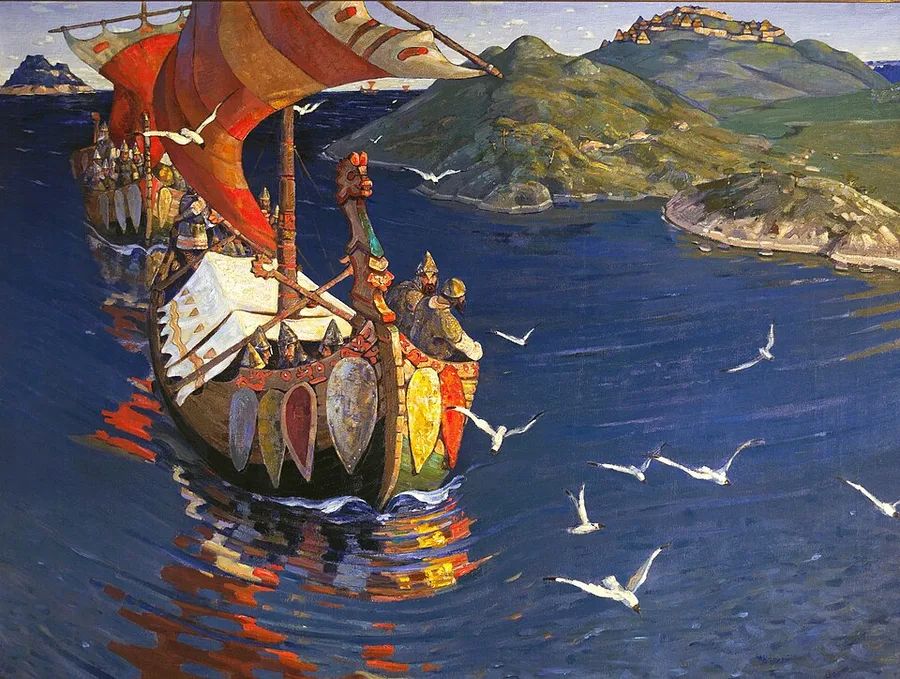 Nicholas Roerich, Guests from Overseas (1901), Tretyakov Gallery, Moscow Roerich painted a fleet of carved, brightly sailed ships gliding up a river 'from the Varangians to the Greeks' — the very river-route trade network that turned Norse traders into the people the Slavs and Arabs called the Rus. Slavic and Arabic word for the eastern Norse — the Swedish and
later mixed Slavic-Norse population that moved down the Volga and
Dnieper river-routes through the Slavic interior to reach the
Black Sea and the Caspian. The name probably derives from Old Norse
róðr ("rowing"), via the Finnish Ruotsi (Sweden) and the
Slavic adaptation. Over generations the name attached not to the
Norse traders themselves but to the country forming around the
Norse-Slavic trading towns — the Kievan Rus and eventually Russia.
— a word that will eventually name a country: Russia.
Nicholas Roerich, Guests from Overseas (1901), Tretyakov Gallery, Moscow Roerich painted a fleet of carved, brightly sailed ships gliding up a river 'from the Varangians to the Greeks' — the very river-route trade network that turned Norse traders into the people the Slavs and Arabs called the Rus. Slavic and Arabic word for the eastern Norse — the Swedish and
later mixed Slavic-Norse population that moved down the Volga and
Dnieper river-routes through the Slavic interior to reach the
Black Sea and the Caspian. The name probably derives from Old Norse
róðr ("rowing"), via the Finnish Ruotsi (Sweden) and the
Slavic adaptation. Over generations the name attached not to the
Norse traders themselves but to the country forming around the
Norse-Slavic trading towns — the Kievan Rus and eventually Russia.
— a word that will eventually name a country: Russia.
To the Byzantine Empire 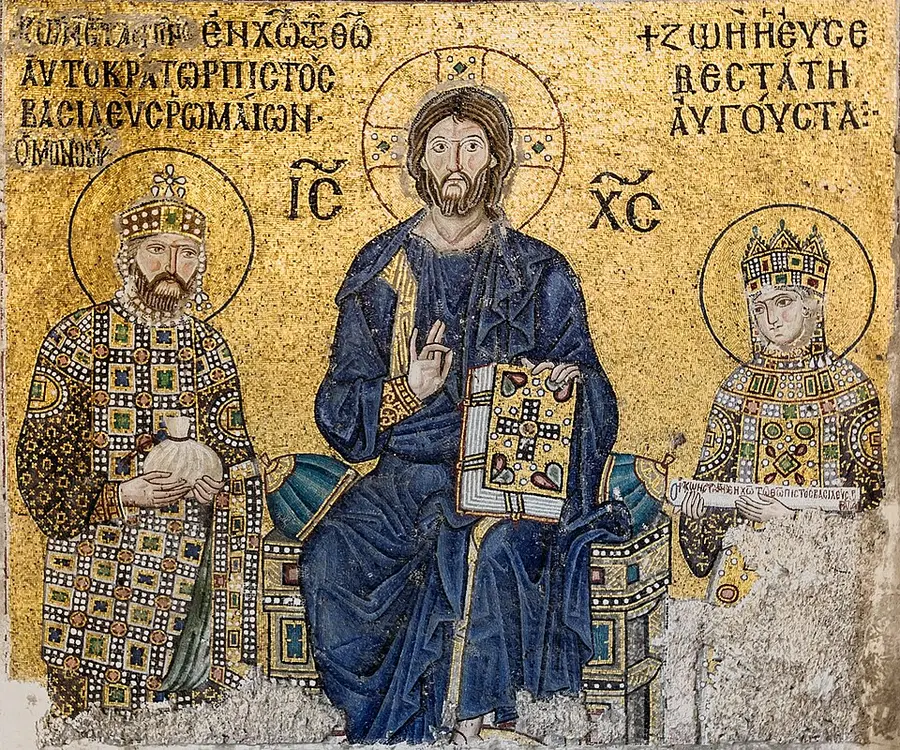 Byzantine mosaicist, Christ Pantocrator with Constantine IX Monomachos and Zoe (Hagia Sophia, c. 1042); photo: Myrabella Christ enthroned between Constantine IX Monomachos and the empress Zoe, in gold mosaic in Hagia Sophia — the very sovereigns Harald Hardrada served as a Varangian commander before leaving Constantinople around 1042 to go claim the Norwegian crown. The continuation of the Eastern Roman Empire after the fall of the
western half in 476, with its capital at Constantinople until the
Ottoman conquest in 1453. The Greek-speaking, Eastern-Christian
Byzantine state was the wealthiest and most institutionally
sophisticated polity of the medieval Mediterranean. The Byzantine
emperors maintained the Varangian Guard — an elite imperial
bodyguard of Norse warriors — from the late tenth century onward;
Harald Hardrada served in it for a decade in his twenties before
returning to claim the Norwegian throne.
Also discussed in The Crusades?!!!! — sixty ships from Bergen, bound for the Holy Land the Norse mercenaries in the imperial bodyguard are the Varangians
Byzantine mosaicist, Christ Pantocrator with Constantine IX Monomachos and Zoe (Hagia Sophia, c. 1042); photo: Myrabella Christ enthroned between Constantine IX Monomachos and the empress Zoe, in gold mosaic in Hagia Sophia — the very sovereigns Harald Hardrada served as a Varangian commander before leaving Constantinople around 1042 to go claim the Norwegian crown. The continuation of the Eastern Roman Empire after the fall of the
western half in 476, with its capital at Constantinople until the
Ottoman conquest in 1453. The Greek-speaking, Eastern-Christian
Byzantine state was the wealthiest and most institutionally
sophisticated polity of the medieval Mediterranean. The Byzantine
emperors maintained the Varangian Guard — an elite imperial
bodyguard of Norse warriors — from the late tenth century onward;
Harald Hardrada served in it for a decade in his twenties before
returning to claim the Norwegian throne.
Also discussed in The Crusades?!!!! — sixty ships from Bergen, bound for the Holy Land the Norse mercenaries in the imperial bodyguard are the Varangians 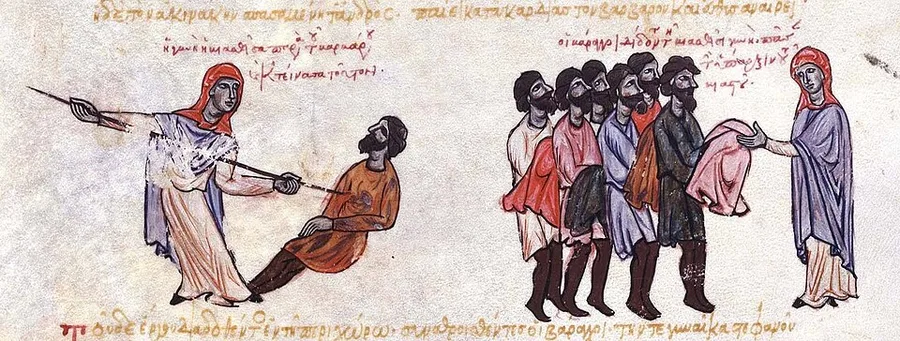 Madrid Skylitzes (Synopsis Historion of John Skylitzes), 12th-century illuminated manuscript, Biblioteca Nacional de España A folio of the Madrid Skylitzes, the illustrated Byzantine chronicle: a Thracesian woman kills a Varangian who had assaulted her, and his comrades hand her his goods in penalty. One of the very few period images of the Norse guardsmen in the emperor's service. Byzantine Greek Várangoi — the Norse warriors who served as the
Byzantine emperor's elite imperial bodyguard from c. 988 onward,
initially recruited under an agreement between Emperor Basil II
and the Kievan Rus prince Vladimir of Kiev. The Varangian Guard
was the most prestigious military service available to a Norse
warrior of the eleventh century; service paid extraordinarily
well and Norse sources speak of returning Varangians as the
wealthy men of their generation. Harald Hardrada commanded
Varangian forces in Sicily, North Africa, and the Holy Land for
a decade before returning north to claim the Norwegian throne.
Also discussed in The Crusades?!!!! — sixty ships from Bergen, bound for the Holy Land , the Varangians.
Madrid Skylitzes (Synopsis Historion of John Skylitzes), 12th-century illuminated manuscript, Biblioteca Nacional de España A folio of the Madrid Skylitzes, the illustrated Byzantine chronicle: a Thracesian woman kills a Varangian who had assaulted her, and his comrades hand her his goods in penalty. One of the very few period images of the Norse guardsmen in the emperor's service. Byzantine Greek Várangoi — the Norse warriors who served as the
Byzantine emperor's elite imperial bodyguard from c. 988 onward,
initially recruited under an agreement between Emperor Basil II
and the Kievan Rus prince Vladimir of Kiev. The Varangian Guard
was the most prestigious military service available to a Norse
warrior of the eleventh century; service paid extraordinarily
well and Norse sources speak of returning Varangians as the
wealthy men of their generation. Harald Hardrada commanded
Varangian forces in Sicily, North Africa, and the Holy Land for
a decade before returning north to claim the Norwegian throne.
Also discussed in The Crusades?!!!! — sixty ships from Bergen, bound for the Holy Land , the Varangians.
To the Arabs of al-Andalus 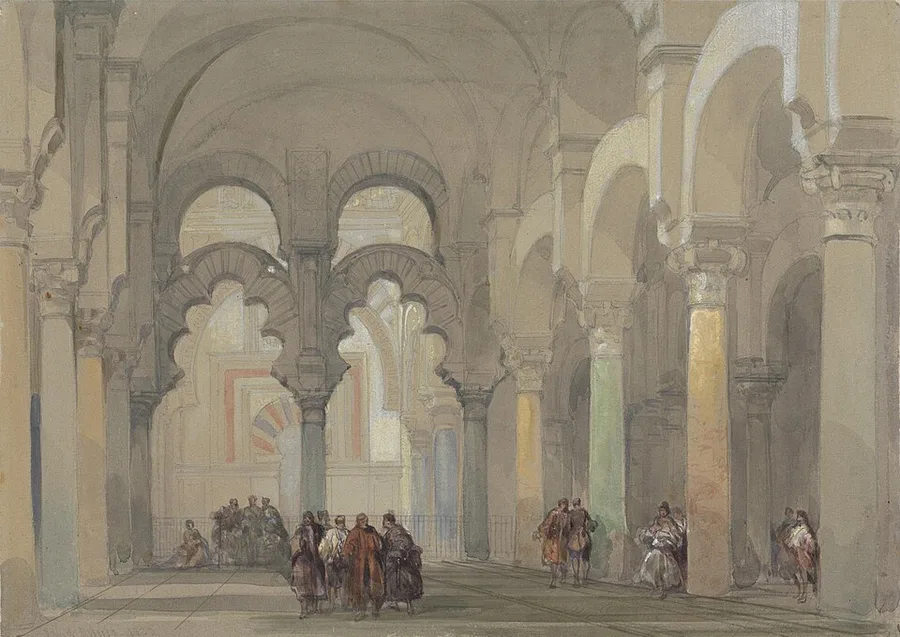 David Roberts, The Mosque at Cordova (1833), Yale Center for British Art The arcaded prayer hall of Córdoba's Great Mosque, painted by David Roberts in 1833 — the seat of the Umayyad rulers of al-Andalus. This is the wealthy, learned Muslim Iberia whose chroniclers called the Norse raiders *Majūs* — and whose forces handed them some of their few decisive defeats. The Arabic name for the parts of the Iberian peninsula under Muslim
rule between 711 (the Umayyad conquest) and 1492 (the fall of
Granada to Christian Castile). At its early-medieval height al-
Andalus covered most of modern Spain and Portugal and was the
wealthiest, most urban, and most learned region of western Europe.
Norse fleets that rounded the Iberian peninsula raided into
al-Andalus from the mid-ninth century; the Andalusian Umayyads
called the raiders Majūs and inflicted some of the few decisive
defeats on Norse forces in the Viking-Age west.
they are Majus
David Roberts, The Mosque at Cordova (1833), Yale Center for British Art The arcaded prayer hall of Córdoba's Great Mosque, painted by David Roberts in 1833 — the seat of the Umayyad rulers of al-Andalus. This is the wealthy, learned Muslim Iberia whose chroniclers called the Norse raiders *Majūs* — and whose forces handed them some of their few decisive defeats. The Arabic name for the parts of the Iberian peninsula under Muslim
rule between 711 (the Umayyad conquest) and 1492 (the fall of
Granada to Christian Castile). At its early-medieval height al-
Andalus covered most of modern Spain and Portugal and was the
wealthiest, most urban, and most learned region of western Europe.
Norse fleets that rounded the Iberian peninsula raided into
al-Andalus from the mid-ninth century; the Andalusian Umayyads
called the raiders Majūs and inflicted some of the few decisive
defeats on Norse forces in the Viking-Age west.
they are Majus 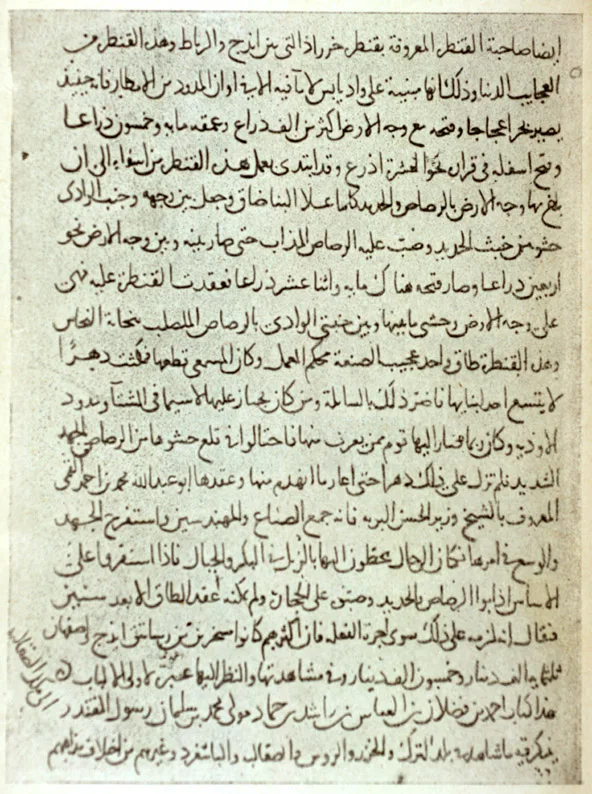 Unknown scribe, Ibn Fadlan's Risala, Ridawiya (Razavi) Library MS 5229, fol. 196v (13th-century copy of a 921-922 account) A page from a thirteenth-century copy of Ibn Fadlan's Risala, his report of an embassy that met Rūs traders on the Volga in 921–22 — the fullest eyewitness account of the Norse by any outside observer, written in the Arabic scholarly world that filed the pagan northerners under majūs. Arabic word — majūs — used by the medieval Muslims of al-Andalus
(Islamic Spain) and North Africa for the Norse raiders who reached
the western Mediterranean in the ninth century. The word originally
meant "Zoroastrian" or "fire-worshipper" and was applied as the
catch-all category for non-People-of-the-Book pagans. The
application to the Norse — who were neither Zoroastrian nor
particularly fire-worshipping — reflects the limits of medieval
Islamic religious classification for an unfamiliar pagan people
more than any specific theological observation.
, most likely fire-worshippers — the category the medieval Muslim world reserved for non-People-of-the-Book pagans.
Unknown scribe, Ibn Fadlan's Risala, Ridawiya (Razavi) Library MS 5229, fol. 196v (13th-century copy of a 921-922 account) A page from a thirteenth-century copy of Ibn Fadlan's Risala, his report of an embassy that met Rūs traders on the Volga in 921–22 — the fullest eyewitness account of the Norse by any outside observer, written in the Arabic scholarly world that filed the pagan northerners under majūs. Arabic word — majūs — used by the medieval Muslims of al-Andalus
(Islamic Spain) and North Africa for the Norse raiders who reached
the western Mediterranean in the ninth century. The word originally
meant "Zoroastrian" or "fire-worshipper" and was applied as the
catch-all category for non-People-of-the-Book pagans. The
application to the Norse — who were neither Zoroastrian nor
particularly fire-worshipping — reflects the limits of medieval
Islamic religious classification for an unfamiliar pagan people
more than any specific theological observation.
, most likely fire-worshippers — the category the medieval Muslim world reserved for non-People-of-the-Book pagans.
A line of medieval Latin from a Frankish antiphony catches the period mood: de gente fera Normannica nos libera, quae nostra vastat, Deus, regna — deliver us, God, from the cruel race of Northmen who lay waste our realms. By the time the longships have been at it for half a century, no defensive system in Christian Europe has been built to expect what is coming.
A coastal society
The country that produces them is small. Norway in the late eighth century has a total population of perhaps two hundred thousand, overwhelmingly rural — farmers and fishermen working small holdings along the coast and in the southern lowlands. The raiding population is a minority within that, doing the work seasonally and returning each autumn to the farms they had left in spring. The ships sail in May and June. The grain ripens in August and September. The men come back for the harvest because the alternative is hunger over the long northern winter.
The arithmetic of the raid is therefore tight. A summer in open water has to bring back enough silver and slaves and movable goods to feed a household through to the next planting, with a margin left over for the chieftain who organized the expedition. The men who go raiding are not unemployed warriors. They are younger sons of farms that cannot support them at home, or men whose chieftain has called in service, or, increasingly through the ninth century, men whose home community has organized a larger expedition under a single ambitious lord. The lord takes the largest share; the men take a portion that depends on rank and contribution; the widows of those who do not return take a small fixed compensation from the chieftain’s hall. In everything but its mortality rate, it is recognizable as a trading venture.
Women run the farms in the men’s absence. By the standards of the medieval Christian Europe the raiders visit, the Norse woman’s legal position is unusually strong. She can own property in her own right, inherit when the male heirs are exhausted, hold the keys that mark the mistress of a household, and — under the regional law codes — initiate divorce if her husband proves unworthy. The The Oseberg ship 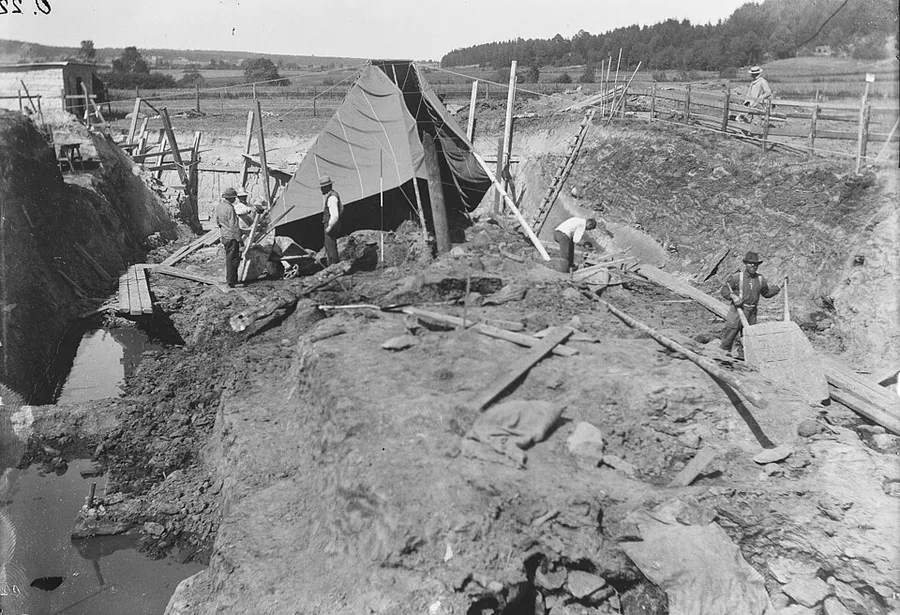 Museum of Cultural History, University of Oslo, Oseberg ship excavation (21 July 1904), inv. CfO0022 The Oseberg dig in July 1904 — the mound cut open and the find sheltered under canvas as workmen dig: the excavation that recovered the richest Viking-Age ship burial ever found, two women and all. Ninth-century Viking longship preserved nearly complete in a burial
mound in Vestfold, Norway, and excavated in 1904. Built around 820,
the ship was placed in the mound around 834 as the funerary vessel
for two very high-ranking women — one in her seventies, one perhaps
in her fifties — along with horses, dogs, an ox, a four-wheeled
carved wooden cart, ornamented sledges, the richest collection of
Viking-Age textiles, and a small wooden bucket of red apples
preserved by the heavy blue clay. The most ornate Norse ship
recovered. Held at the Museum of the Viking Age on Bygdøy, Oslo
(closed for rebuild until 2027).
burial in Vestfold
Museum of Cultural History, University of Oslo, Oseberg ship excavation (21 July 1904), inv. CfO0022 The Oseberg dig in July 1904 — the mound cut open and the find sheltered under canvas as workmen dig: the excavation that recovered the richest Viking-Age ship burial ever found, two women and all. Ninth-century Viking longship preserved nearly complete in a burial
mound in Vestfold, Norway, and excavated in 1904. Built around 820,
the ship was placed in the mound around 834 as the funerary vessel
for two very high-ranking women — one in her seventies, one perhaps
in her fifties — along with horses, dogs, an ox, a four-wheeled
carved wooden cart, ornamented sledges, the richest collection of
Viking-Age textiles, and a small wooden bucket of red apples
preserved by the heavy blue clay. The most ornate Norse ship
recovered. Held at the Museum of the Viking Age on Bygdøy, Oslo
(closed for rebuild until 2027).
burial in Vestfold 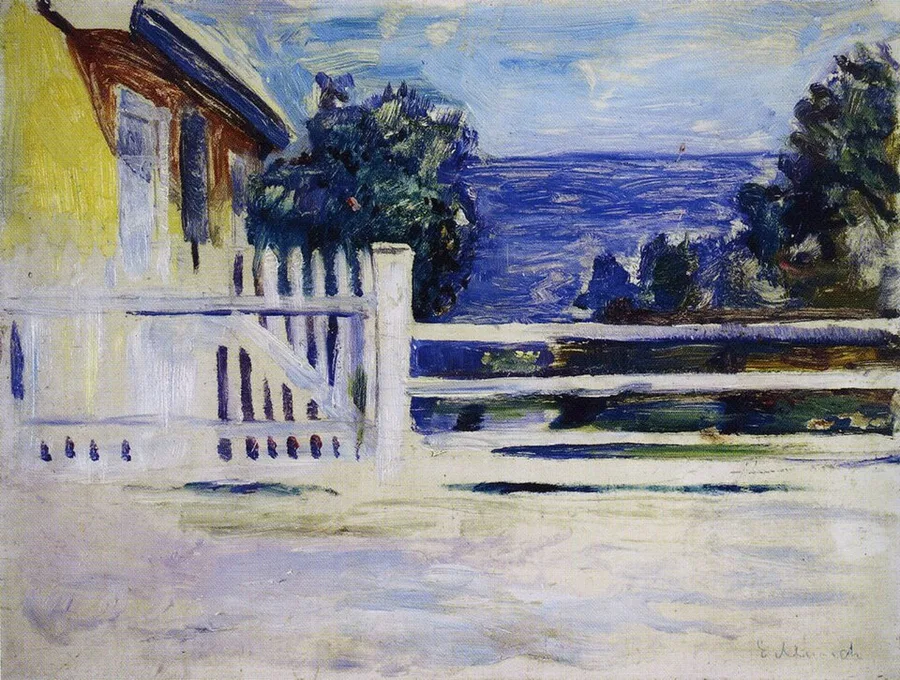 Edvard Munch, Summer in Asgardstrand (1889), Woll 185, private collection Edvard Munch's summer shore at Åsgårdstrand, a thousand years after the Oseberg burial — the same quiet Vestfold coast where the richest Viking-Age grave ever found lay under its mound until 1904. Coastal region on the western shore of the Oslofjord in southeastern
Norway, the richest of the petty-kingdom-era Norwegian polities.
Controlled the trade routes through the Skagerrak between the North
Sea and the Baltic; the wealth in its royal mounds at Borre marks it
as the dominant southern Norwegian power of the seventh through
ninth centuries. The Yngling dynasty held the throne here. Modern
Vestfold is the county containing Tønsberg, Sandefjord, and the
Borre Mound Cemetery archaeological site.
Vestfold Also discussed in Before There Was Norway — petty kingdoms at the edge of the worldThe King Who Became a Saint — how the Nordmen came to ChristA Catholic Norway — the faith that gave the kingdom its first institutions and the stave churches holds two of the highest-ranking women of their generation. The world that produced that burial is a world that had room for women of that standing.
Edvard Munch, Summer in Asgardstrand (1889), Woll 185, private collection Edvard Munch's summer shore at Åsgårdstrand, a thousand years after the Oseberg burial — the same quiet Vestfold coast where the richest Viking-Age grave ever found lay under its mound until 1904. Coastal region on the western shore of the Oslofjord in southeastern
Norway, the richest of the petty-kingdom-era Norwegian polities.
Controlled the trade routes through the Skagerrak between the North
Sea and the Baltic; the wealth in its royal mounds at Borre marks it
as the dominant southern Norwegian power of the seventh through
ninth centuries. The Yngling dynasty held the throne here. Modern
Vestfold is the county containing Tønsberg, Sandefjord, and the
Borre Mound Cemetery archaeological site.
Vestfold Also discussed in Before There Was Norway — petty kingdoms at the edge of the worldThe King Who Became a Saint — how the Nordmen came to ChristA Catholic Norway — the faith that gave the kingdom its first institutions and the stave churches holds two of the highest-ranking women of their generation. The world that produced that burial is a world that had room for women of that standing.
The economy also runs on Thrall 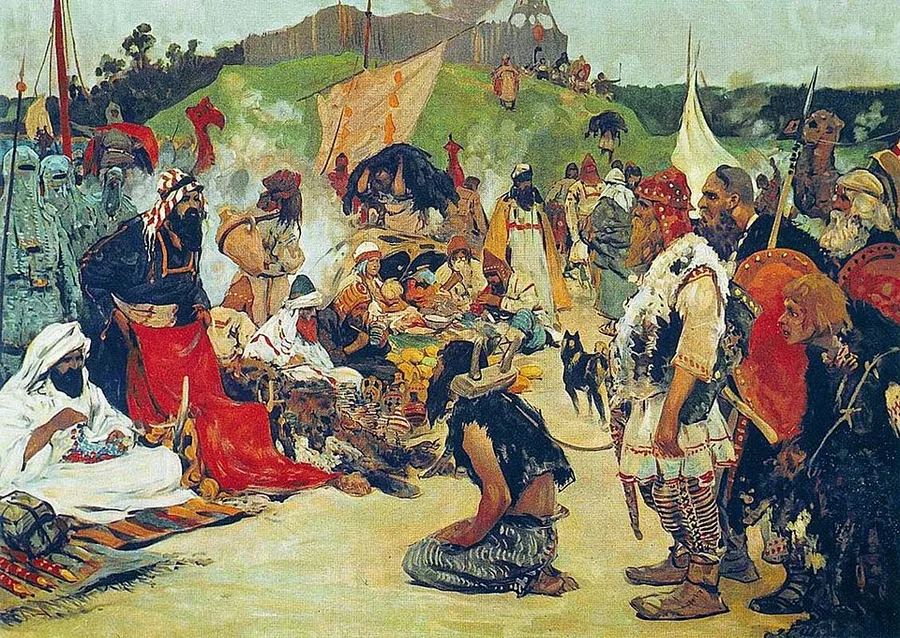 Sergey Ivanov, Trade Negotiations in the Country of the Eastern Slavs (1909) Ivanov's 1909 history painting shows the eastern river trade at work: southern merchants by their wares, Rus traders opposite — and a bound captive kneeling between them. Thralls moved along the same routes as the furs and dirhams, from Dublin's market in the west to the Volga towns in the east. Old Norse þræll — slave. Slavery was a foundational institution
of the Viking-Age Norse economy. Norse fleets captured along every
shore they touched — Christian monks bound for Islamic markets,
Slavic captives bound for Dublin and the Mediterranean — and
Dublin and the eastern river-trade towns became major medieval
slave-trading hubs. A thrall could be bought, sold, given, freed,
and put to death by his owner under regional law codes. The
abolition of slavery in Scandinavia is a process of the twelfth
through fourteenth centuries, completed under Christian and
royal-administrative pressure rather than from any moral movement
inside Norse society itself. The English word thrall descends
directly from the Old Norse.
. Norse fleets capture along every shore they touch — Christian monks bound for Islamic markets, Slavic captives bound for Dublin
Sergey Ivanov, Trade Negotiations in the Country of the Eastern Slavs (1909) Ivanov's 1909 history painting shows the eastern river trade at work: southern merchants by their wares, Rus traders opposite — and a bound captive kneeling between them. Thralls moved along the same routes as the furs and dirhams, from Dublin's market in the west to the Volga towns in the east. Old Norse þræll — slave. Slavery was a foundational institution
of the Viking-Age Norse economy. Norse fleets captured along every
shore they touched — Christian monks bound for Islamic markets,
Slavic captives bound for Dublin and the Mediterranean — and
Dublin and the eastern river-trade towns became major medieval
slave-trading hubs. A thrall could be bought, sold, given, freed,
and put to death by his owner under regional law codes. The
abolition of slavery in Scandinavia is a process of the twelfth
through fourteenth centuries, completed under Christian and
royal-administrative pressure rather than from any moral movement
inside Norse society itself. The English word thrall descends
directly from the Old Norse.
. Norse fleets capture along every shore they touch — Christian monks bound for Islamic markets, Slavic captives bound for Dublin 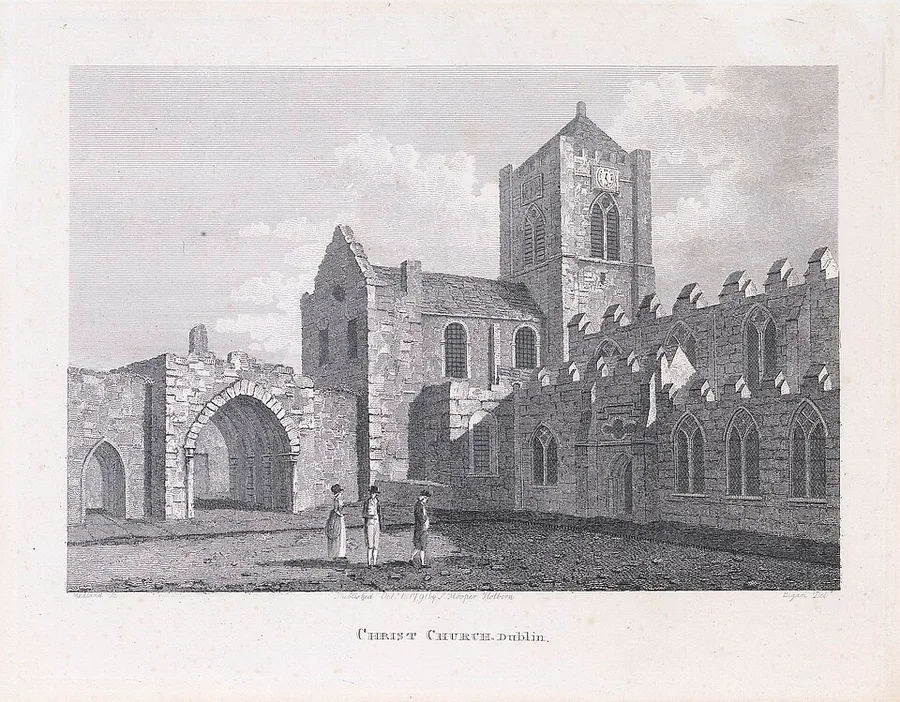 Thomas Medland after Angelo Maria Bigari, Christchurch Cathedral, Dublin (1790s), National Gallery of Ireland Christ Church Cathedral before its Victorian rebuilding, in a 1790s engraving. The Norse city built it: king Sitric Silkbeard founded the church around 1030, at the heart of the slave-trading town of Dyflin the longships had planted on the Liffey two centuries earlier. Modern capital of Ireland; founded as a Norse trading and slaving
town (Dyflin) on the south bank of the River Liffey around 841.
The Norse Kingdom of Dublin became one of the great commercial
centres of the Viking-Age west, the principal slave market for
captives taken across the British Isles and the Frankish coast,
and a base for further raiding. Under intermittent Norse rule until
the High King Brian Boru's victory at Clontarf in 1014 (where Brian
himself was killed) broke Norse political dominance in Ireland,
though the city's Hiberno-Norse population persisted into the
Anglo-Norman period.
and the Mediterranean — and Dublin under Norse rule becomes one of the great slave ports of the medieval west. The chieftains’ halls, the imported wine, the Dirhams
Thomas Medland after Angelo Maria Bigari, Christchurch Cathedral, Dublin (1790s), National Gallery of Ireland Christ Church Cathedral before its Victorian rebuilding, in a 1790s engraving. The Norse city built it: king Sitric Silkbeard founded the church around 1030, at the heart of the slave-trading town of Dyflin the longships had planted on the Liffey two centuries earlier. Modern capital of Ireland; founded as a Norse trading and slaving
town (Dyflin) on the south bank of the River Liffey around 841.
The Norse Kingdom of Dublin became one of the great commercial
centres of the Viking-Age west, the principal slave market for
captives taken across the British Isles and the Frankish coast,
and a base for further raiding. Under intermittent Norse rule until
the High King Brian Boru's victory at Clontarf in 1014 (where Brian
himself was killed) broke Norse political dominance in Ireland,
though the city's Hiberno-Norse population persisted into the
Anglo-Norman period.
and the Mediterranean — and Dublin under Norse rule becomes one of the great slave ports of the medieval west. The chieftains’ halls, the imported wine, the Dirhams 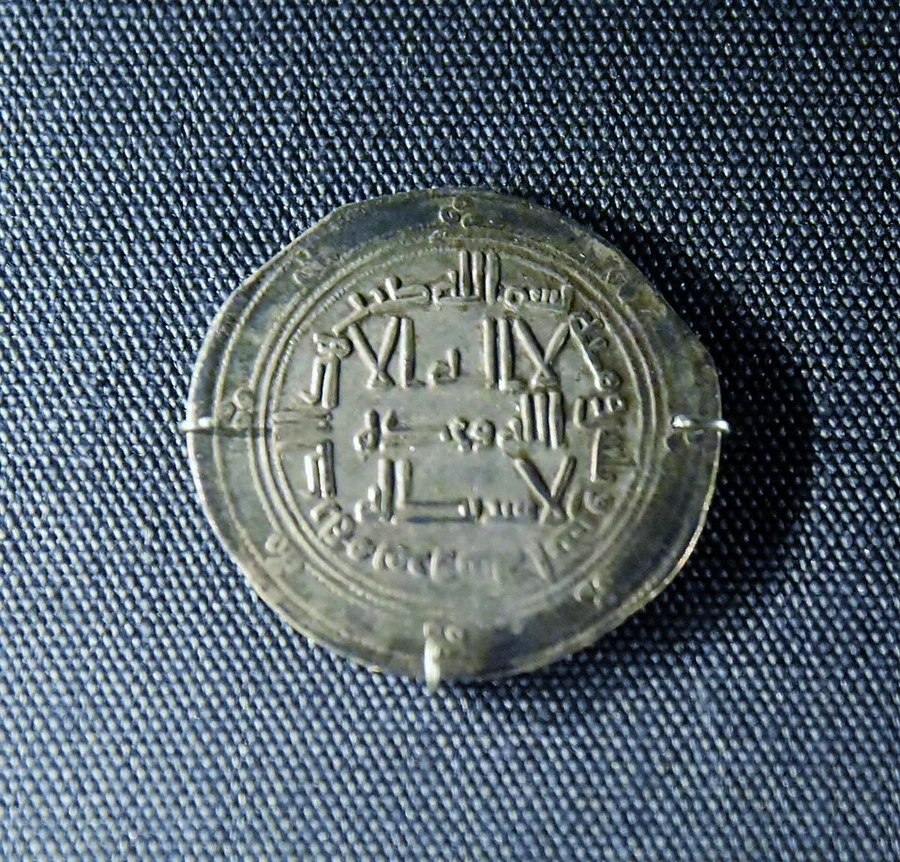 Abbasid silver dirham of Abu Muslim, Marv mint (AH 132/749-50), The David Collection, Copenhagen; photo Richard Mortel (CC BY 2.0) An Abbasid dirham struck at Marv in 749–50 — no portrait, just Kufic script naming God, date, and mint. Coins like this travelled thousands of river-kilometres north in payment for furs and slaves; Scandinavian hoards hold tens of thousands of them. Silver coins minted across the Islamic world from the late seventh
century onward, the standard medium of high-value exchange in the
Abbasid Caliphate and successor states. Approximately three grams
of silver per coin; minted at Baghdad, Samarkand, and dozens of
other centres across the Islamic east. Vast quantities of dirhams
flowed north through the Volga and Caspian trade into Norse-
controlled Scandinavia from the late eighth through the early
tenth centuries; the surviving Viking-Age silver hoards of
Scandinavia contain tens of thousands of dirhams, the largest
collection of Islamic coinage outside the Islamic world itself.
in the silver hoards — all of it is built on the backs of human chattel. The longship trade is a slave trade as much as it is a silver one.
Abbasid silver dirham of Abu Muslim, Marv mint (AH 132/749-50), The David Collection, Copenhagen; photo Richard Mortel (CC BY 2.0) An Abbasid dirham struck at Marv in 749–50 — no portrait, just Kufic script naming God, date, and mint. Coins like this travelled thousands of river-kilometres north in payment for furs and slaves; Scandinavian hoards hold tens of thousands of them. Silver coins minted across the Islamic world from the late seventh
century onward, the standard medium of high-value exchange in the
Abbasid Caliphate and successor states. Approximately three grams
of silver per coin; minted at Baghdad, Samarkand, and dozens of
other centres across the Islamic east. Vast quantities of dirhams
flowed north through the Volga and Caspian trade into Norse-
controlled Scandinavia from the late eighth through the early
tenth centuries; the surviving Viking-Age silver hoards of
Scandinavia contain tens of thousands of dirhams, the largest
collection of Islamic coinage outside the Islamic world itself.
in the silver hoards — all of it is built on the backs of human chattel. The longship trade is a slave trade as much as it is a silver one.
Glory and the skalds
The men in the longships do not see what they are doing the way the Christian monasteries they raid see it. The worldview they carry comes out of a religion whose central story is a final battle the gods themselves are going to lose, and whose afterlife sorts men by the manner of their death rather than the merit of their life. There is no salvation to earn and no damnation to fear. Courage in the longship is, under this logic, the rational choice. So is the willingness to take the smaller share of a raid in exchange for the larger share of being remembered.
The Skald 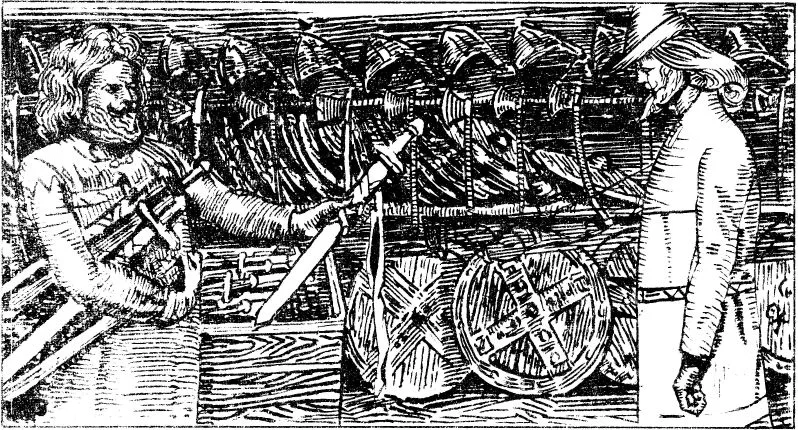 Christian Krohg, illustration for Óláfs saga helga, in Snorri Sturluson's Heimskringla (J.M. Stenersen & Co, 1899 edition) Krohg drew King Olav rewarding the skald Sigvatr Þórðarson with a sword — the kind of royal patronage, gift, and personal proximity to the throne that made court poetry the most prestigious literary craft of the Viking Age. Old Norse court poet. Skalds composed verse on behalf of kings and
earls — praise-poems (drápur), genealogies (like Þjóðólfr's
Ynglingatal), and memorial verse for the dead — and the most
prized were attached to royal courts. The skaldic tradition is
metrically intricate (the dróttkvætt metre is one of the most
technically demanding in any European literary tradition) and the
poems preserved alongside the prose sagas are some of the very few
contemporary sources for Viking-age and pre-Viking-age Norwegian
political history.
Also discussed in Before There Was Norway — petty kingdoms at the edge of the world are the bookkeepers of all of this. Every chieftain of standing carries his own court poet, sometimes more than one, and the skald’s job is to compose, in dense layered verse, the praise-poems that name what the chieftain has done and how his men have behaved. The verses run on figures called Kennings
Christian Krohg, illustration for Óláfs saga helga, in Snorri Sturluson's Heimskringla (J.M. Stenersen & Co, 1899 edition) Krohg drew King Olav rewarding the skald Sigvatr Þórðarson with a sword — the kind of royal patronage, gift, and personal proximity to the throne that made court poetry the most prestigious literary craft of the Viking Age. Old Norse court poet. Skalds composed verse on behalf of kings and
earls — praise-poems (drápur), genealogies (like Þjóðólfr's
Ynglingatal), and memorial verse for the dead — and the most
prized were attached to royal courts. The skaldic tradition is
metrically intricate (the dróttkvætt metre is one of the most
technically demanding in any European literary tradition) and the
poems preserved alongside the prose sagas are some of the very few
contemporary sources for Viking-age and pre-Viking-age Norwegian
political history.
Also discussed in Before There Was Norway — petty kingdoms at the edge of the world are the bookkeepers of all of this. Every chieftain of standing carries his own court poet, sometimes more than one, and the skald’s job is to compose, in dense layered verse, the praise-poems that name what the chieftain has done and how his men have behaved. The verses run on figures called Kennings 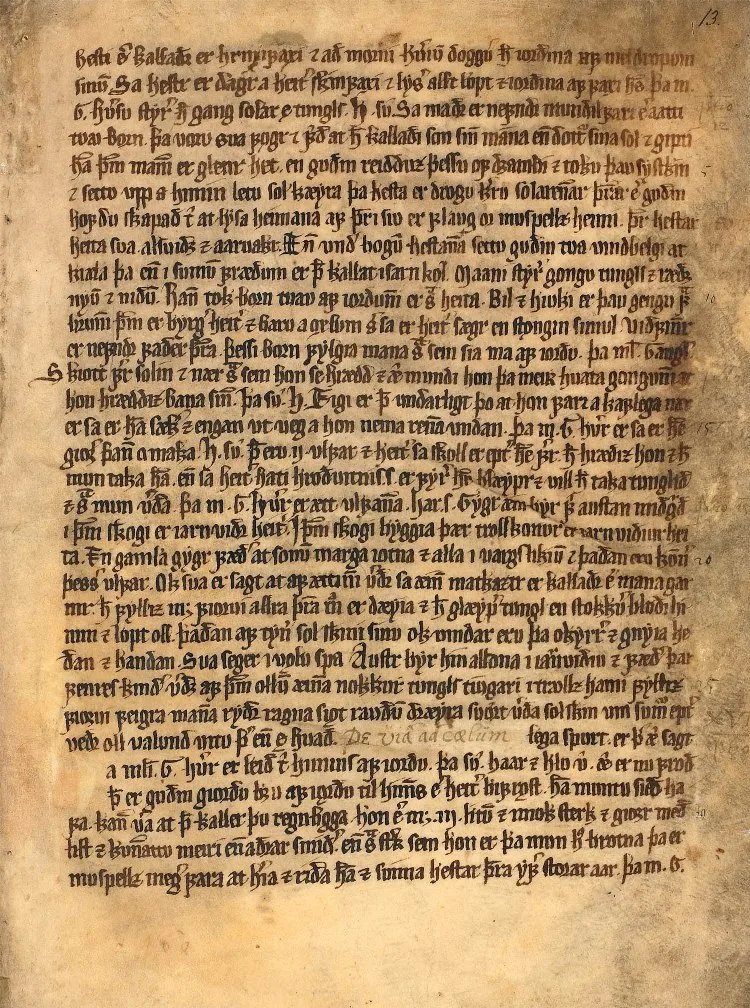 Codex Wormianus (AM 242 fol.), bl. 13r, 14th century — via Handbok i norrøn filologi, University of Bergen A page from the Codex Wormianus copy of Snorri's Prose Edda, which contains Skáldskaparmál — the section that catalogues kennings like 'whale-road' and 'Sif's hair' for skalds composing verse. Compressed metaphorical compounds — typically of two elements — that
are the central poetic device of skaldic verse. Whale-road for
the sea, swan-road for the same, dragon's bed for gold,
wolf-feeder for a warrior, spear-din for battle. Many kennings
required a listener familiar with Norse mythology to decode: Sif's
hair for gold (because the gods cut off Thor's wife's hair and
replaced it with strands of gold), Odin's wife's burden for the
earth. The skalds layered kennings into stanzas of remarkable
density; the surviving skaldic corpus is one of the most technically
intricate bodies of poetry in any European tradition.
— the sea is the road of the sea-kings, gold is the dragon’s bed, a man who kills in battle reddens the wolf’s jaws and feeds the raven. A warrior hearing such a verse in his chieftain’s hall hears, folded inside the imagery, the names of his uncles and his neighbors who have died in particular fights. Being named in a skald’s verse is the nearest thing the pre-Christian Norse have to immortality, and it is the reward the whole system is built around.
Codex Wormianus (AM 242 fol.), bl. 13r, 14th century — via Handbok i norrøn filologi, University of Bergen A page from the Codex Wormianus copy of Snorri's Prose Edda, which contains Skáldskaparmál — the section that catalogues kennings like 'whale-road' and 'Sif's hair' for skalds composing verse. Compressed metaphorical compounds — typically of two elements — that
are the central poetic device of skaldic verse. Whale-road for
the sea, swan-road for the same, dragon's bed for gold,
wolf-feeder for a warrior, spear-din for battle. Many kennings
required a listener familiar with Norse mythology to decode: Sif's
hair for gold (because the gods cut off Thor's wife's hair and
replaced it with strands of gold), Odin's wife's burden for the
earth. The skalds layered kennings into stanzas of remarkable
density; the surviving skaldic corpus is one of the most technically
intricate bodies of poetry in any European tradition.
— the sea is the road of the sea-kings, gold is the dragon’s bed, a man who kills in battle reddens the wolf’s jaws and feeds the raven. A warrior hearing such a verse in his chieftain’s hall hears, folded inside the imagery, the names of his uncles and his neighbors who have died in particular fights. Being named in a skald’s verse is the nearest thing the pre-Christian Norse have to immortality, and it is the reward the whole system is built around.
The bonds inside this world are as strong as the death-cult that shaped them. A chieftain’s Hird 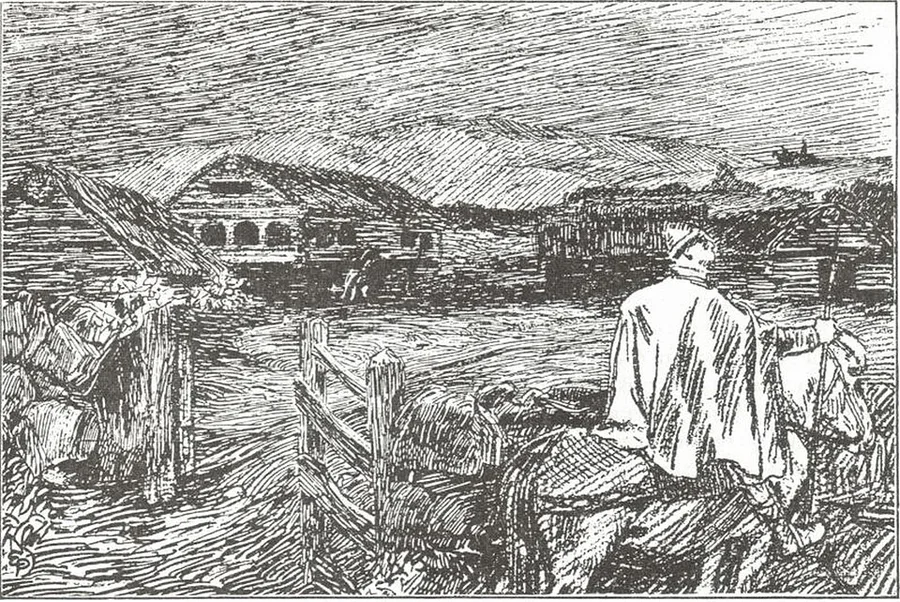 Eilif Peterssen, illustration for Magnus Blindes og Harald Gilles saga, Heimskringla (J.M. Stenersen & Co, 1899 edition) Eilif Peterssen's plate from the 1899 Heimskringla folk edition — the king's mounted watchmen (hestevakt) on the farm roads at dusk. The household retinue at its everyday work of guarding the king's ground: the unglamorous side of the sworn warband that lived at his hall. Old Norse hirð — the personal armed retinue of a king or jarl,
the household warriors who lived at the king's hall, ate at his
table, and fought as his core force in war. The size and quality
of a king's hird was a direct measure of his political power.
The Norwegian hird formalised across the medieval period; by the
thirteenth century it had acquired continental-style subdivisions
(kertilsveinr squires, hirðmenn men-at-arms, skutilsveinr
knights). The Old English cognate húscarl enters English as
housecarl.
Also discussed in Before There Was Norway — petty kingdoms at the edge of the world , his sworn warband, swears oaths to the chieftain’s death and sometimes beyond it — to die beside their lord rather than survive him. The warband eats at his table, sleeps in his hall through the winter, and rows his ship in the summer. The men who come ashore at Lindisfarne in 793 carry that worldview with them. They have been sworn to a chieftain, paid in silver and the prospect of remembrance, and they have no reason to fear an unarmed Anglo-Saxon monk who could not hurt them and whose god, in their understanding, would not save him.
Eilif Peterssen, illustration for Magnus Blindes og Harald Gilles saga, Heimskringla (J.M. Stenersen & Co, 1899 edition) Eilif Peterssen's plate from the 1899 Heimskringla folk edition — the king's mounted watchmen (hestevakt) on the farm roads at dusk. The household retinue at its everyday work of guarding the king's ground: the unglamorous side of the sworn warband that lived at his hall. Old Norse hirð — the personal armed retinue of a king or jarl,
the household warriors who lived at the king's hall, ate at his
table, and fought as his core force in war. The size and quality
of a king's hird was a direct measure of his political power.
The Norwegian hird formalised across the medieval period; by the
thirteenth century it had acquired continental-style subdivisions
(kertilsveinr squires, hirðmenn men-at-arms, skutilsveinr
knights). The Old English cognate húscarl enters English as
housecarl.
Also discussed in Before There Was Norway — petty kingdoms at the edge of the world , his sworn warband, swears oaths to the chieftain’s death and sometimes beyond it — to die beside their lord rather than survive him. The warband eats at his table, sleeps in his hall through the winter, and rows his ship in the summer. The men who come ashore at Lindisfarne in 793 carry that worldview with them. They have been sworn to a chieftain, paid in silver and the prospect of remembrance, and they have no reason to fear an unarmed Anglo-Saxon monk who could not hurt them and whose god, in their understanding, would not save him.
The longship
What makes the raids possible is the ship.
The longship that puts to sea in the late eighth century is the end product of more than two thousand years of experimentation along the Scandinavian coast. The version that reaches Lindisfarne has crossed a technological threshold: a true keel deep enough to brace a mast, a square sail capable of driving the ship under wind power, and a clinker-built hull strong enough to take the open Atlantic and light enough to be portaged between rivers and beached on a tidal flat without breaking apart. A typical longship carries thirty to sixty men with their gear. Under favorable conditions it can cross from the western Norwegian coast to the English shore in three to four days.
A longship has no cabin and no deck to crawl beneath. A man crossing open water lives the whole passage in the open — perched on his sea-chest at the oar, or lying between the benches in a greased leather bag that keeps out some of the wet and none of the cold. The freeboard is low. The sea comes aboard with every swell, and someone is always bailing. There is no fire, which means no hot food and no drying out; a man who is wet on the second morning stays wet until landfall. He sleeps in snatches. He steers by things he has memorized — the height of the midday sun, the run of the swell, the shape of a coastline learned from a father who learned it from his — because there is no chart, no compass, no instrument of any kind aboard. For three or four days the only fixed thing in the world is the hull and the men bailing along its length, and everything the voyage depends on rides in the bilge under their feet.
No defensive system in late-eighth-century Europe has been built to expect a fast amphibious force coming out of the sea. Monasteries in particular — wealthy, coastal, prohibited by their own rule from keeping armed guards — are undefended targets. The whole shape of European Christian wealth in the late eighth century is, from a Norse perspective, an inventory of bullion stored in lightly-defended waterfront buildings at the edge of the sea. The longship simply makes that inventory accessible.
The reach — west and south
After Lindisfarne the longships come back. The next summer, and the summer after that, and the summer after that — sometimes the same chieftain and the same men, sometimes a new chieftain who has heard about the take and built a warband around the rumor of it. A summer in open water can bring back silver enough to feed a household for a year and glory enough to put a man’s name in a skald’s verse for the rest of his life. Nothing in Christian Europe is built to stop it.
On Iona 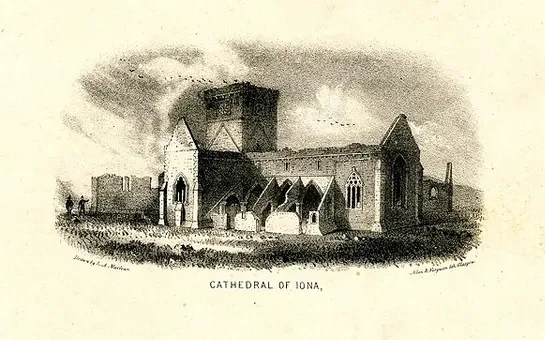 L.A. Maclean (artist) / Allan & Ferguson (printers), Cathedral of Iona, lithograph, c. 1835–1875 — British Museum A nineteenth-century lithograph of Iona's ruined abbey. Columba's island monastery, the holiest ground in the Gaelic north, learned to watch the sea: Norse fleets struck in 795, 802, and 806 — the last raid killing sixty-eight monks — until the community withdrew to Kells. Small island in the Inner Hebrides off the western coast of Scotland.
Site of the monastery founded by the Irish saint Columba (Colum
Cille) in 563, the most important religious centre in early-medieval
Gaelic Christendom and the source of much of the missionary
Christianisation of northern Britain. Repeatedly raided by Norse
fleets across the late eighth and ninth centuries; in 806 a single
attack killed sixty-eight monks. The community eventually retreated
to Kells in Ireland, taking the Book of Kells with it.
in the Hebrides
L.A. Maclean (artist) / Allan & Ferguson (printers), Cathedral of Iona, lithograph, c. 1835–1875 — British Museum A nineteenth-century lithograph of Iona's ruined abbey. Columba's island monastery, the holiest ground in the Gaelic north, learned to watch the sea: Norse fleets struck in 795, 802, and 806 — the last raid killing sixty-eight monks — until the community withdrew to Kells. Small island in the Inner Hebrides off the western coast of Scotland.
Site of the monastery founded by the Irish saint Columba (Colum
Cille) in 563, the most important religious centre in early-medieval
Gaelic Christendom and the source of much of the missionary
Christianisation of northern Britain. Repeatedly raided by Norse
fleets across the late eighth and ninth centuries; in 806 a single
attack killed sixty-eight monks. The community eventually retreated
to Kells in Ireland, taking the Book of Kells with it.
in the Hebrides 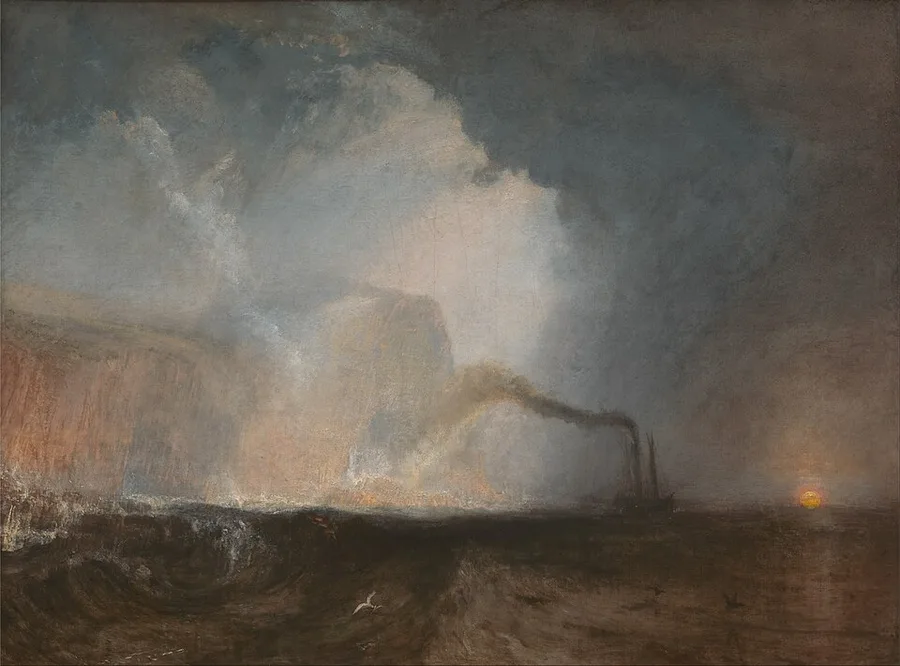 J. M. W. Turner, Staffa, Fingal's Cave (1831–32), Yale Center for British Art Turner's storm-lit Staffa, painted after his own rough Hebridean crossing in 1831 — island weather at full strength. The chain was Norse country for four centuries, settled from the late 700s and under the Norwegian crown until 1266; its place-names still read half Old Norse. Archipelago of more than five hundred islands off the western coast
of Scotland, divided into the Inner and Outer Hebrides. Settled by
Celts and later substantially colonised by Norse from the late
eighth century onward; the islands were under Norwegian sovereignty
from c. 900 until the Treaty of Perth (1266) transferred them to
the Scottish crown. Norse place-names persist densely across the
islands today.
the monks learn to watch the sea. They are raided once, and again, and again, knowing each time exactly what is coming and knowing too that their own rule forbids them the weapons to answer. In 806 sixty-eight of them die in a single morning. Eleven years of warning have bought them nothing.
J. M. W. Turner, Staffa, Fingal's Cave (1831–32), Yale Center for British Art Turner's storm-lit Staffa, painted after his own rough Hebridean crossing in 1831 — island weather at full strength. The chain was Norse country for four centuries, settled from the late 700s and under the Norwegian crown until 1266; its place-names still read half Old Norse. Archipelago of more than five hundred islands off the western coast
of Scotland, divided into the Inner and Outer Hebrides. Settled by
Celts and later substantially colonised by Norse from the late
eighth century onward; the islands were under Norwegian sovereignty
from c. 900 until the Treaty of Perth (1266) transferred them to
the Scottish crown. Norse place-names persist densely across the
islands today.
the monks learn to watch the sea. They are raided once, and again, and again, knowing each time exactly what is coming and knowing too that their own rule forbids them the weapons to answer. In 806 sixty-eight of them die in a single morning. Eleven years of warning have bought them nothing.
Further south the same arithmetic runs on a larger scale. By 845 a Norse fleet has pushed up the Seine to Paris 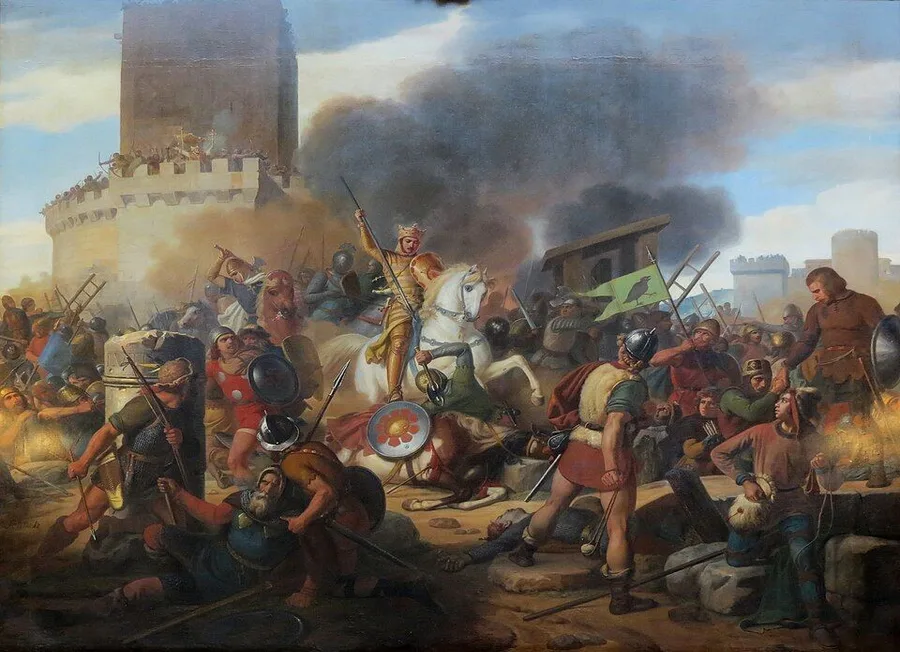 Jean-Victor Schnetz, Le comte Eudes défend Paris contre les Normands (1837), Galerie des Batailles, Versailles Count Eudes rallies the defenders during the 885–886 siege — the year-long Norse investment of Paris that ended only when Charles the Fat paid the fleet to move on, painted for the Galerie des Batailles at Versailles. Capital of medieval West Frankia and modern France, on the Seine. By
the mid-ninth century already the chief commercial and ecclesiastical
centre of the Frankish realm. Norse fleets ascended the Seine and
besieged the city repeatedly across the ninth century — in 845 a
fleet under the chieftain Ragnar (saga's Ragnar Lothbrok) extorted
a payment of seven thousand pounds of silver, and in 885–886 a much
larger fleet of perhaps seven hundred ships sat before the city for
the better part of a year before the Emperor Charles the Fat paid
them to move on.
, and the Frankish king buys it off with seven thousand pounds of silver — the first of the ransoms the kings of Frankia (modern-day France) will keep paying, because paying is cheaper than fighting and never works for long. Forty years on, the fleets no longer leave for silver. In 885 some seven hundred ships come up the river and sit before the city for the better part of a year. Paris holds, barely. The emperor arrives. He pays them to go too.
Jean-Victor Schnetz, Le comte Eudes défend Paris contre les Normands (1837), Galerie des Batailles, Versailles Count Eudes rallies the defenders during the 885–886 siege — the year-long Norse investment of Paris that ended only when Charles the Fat paid the fleet to move on, painted for the Galerie des Batailles at Versailles. Capital of medieval West Frankia and modern France, on the Seine. By
the mid-ninth century already the chief commercial and ecclesiastical
centre of the Frankish realm. Norse fleets ascended the Seine and
besieged the city repeatedly across the ninth century — in 845 a
fleet under the chieftain Ragnar (saga's Ragnar Lothbrok) extorted
a payment of seven thousand pounds of silver, and in 885–886 a much
larger fleet of perhaps seven hundred ships sat before the city for
the better part of a year before the Emperor Charles the Fat paid
them to move on.
, and the Frankish king buys it off with seven thousand pounds of silver — the first of the ransoms the kings of Frankia (modern-day France) will keep paying, because paying is cheaper than fighting and never works for long. Forty years on, the fleets no longer leave for silver. In 885 some seven hundred ships come up the river and sit before the city for the better part of a year. Paris holds, barely. The emperor arrives. He pays them to go too.
The longships go south until there is no obvious south left. A fleet sacks Seville  Frans Hogenberg after Joris Hoefnagel (pub. Georg Braun), Sevilla / Hispalis, from Civitates Orbis Terrarum (1593), Rijksmuseum, Amsterdam A 1593 engraved panorama of Seville from the Civitates Orbis Terrarum, the Giralda tower over the walls. Seven centuries earlier the city on the Guadalquivir was Islamic Išbīliya, sacked by a Norse fleet in 844 — before the emir's forces destroyed much of that fleet on the river. City on the Guadalquivir River in southwestern Spain. Under
Andalusian Muslim rule in the mid-ninth century (al-Andalus, under
the Umayyad emirate of Córdoba). A Norse fleet that had rounded the
Iberian peninsula sacked the city in 844; the response — the emir
Abd al-Rahman II's cavalry caught and destroyed much of the fleet
before it could escape down the river — was one of the few decisive
defeats inflicted on a Norse force in the field during the early
Viking Age.
Also discussed in The Golden Age — a North Atlantic empire … reaching farther than you think in 844 and is caught and cut to pieces by the emir’s cavalry before it can get clear. Another rounds Gibraltar
Frans Hogenberg after Joris Hoefnagel (pub. Georg Braun), Sevilla / Hispalis, from Civitates Orbis Terrarum (1593), Rijksmuseum, Amsterdam A 1593 engraved panorama of Seville from the Civitates Orbis Terrarum, the Giralda tower over the walls. Seven centuries earlier the city on the Guadalquivir was Islamic Išbīliya, sacked by a Norse fleet in 844 — before the emir's forces destroyed much of that fleet on the river. City on the Guadalquivir River in southwestern Spain. Under
Andalusian Muslim rule in the mid-ninth century (al-Andalus, under
the Umayyad emirate of Córdoba). A Norse fleet that had rounded the
Iberian peninsula sacked the city in 844; the response — the emir
Abd al-Rahman II's cavalry caught and destroyed much of the fleet
before it could escape down the river — was one of the few decisive
defeats inflicted on a Norse force in the field during the early
Viking Age.
Also discussed in The Golden Age — a North Atlantic empire … reaching farther than you think in 844 and is caught and cut to pieces by the emir’s cavalry before it can get clear. Another rounds Gibraltar  Gabriel Bodenehr, Bay of Gibraltar (c. 1704) A 1704 engraved view of Gibraltar and its bay from the water, ships riding the roads beneath the Rock. Norse fleets passed this strait in both directions — the raiders of 859–62 bound for the Mediterranean, and, centuries later, King Sigurd's crusader fleet on its way east. The narrow strait between the southern tip of Spain and Morocco
connecting the Atlantic Ocean to the Mediterranean Sea, about
thirteen kilometres at its narrowest. The Norse fleet that had
ravaged the Atlantic coast of Iberia in 859–862 passed through
Gibraltar in both directions, raiding into the western Mediterranean
and harrying the Moroccan and southern French coasts before returning
north — the deepest reach south of any Viking-Age expedition.
Also discussed in The Crusades?!!!! — sixty ships from Bergen, bound for the Holy Land to burn a trading town on the Moroccan coast. And in 860 a fleet comes out of the eastern rivers and appears, without warning, beneath the walls of Constantinople
Gabriel Bodenehr, Bay of Gibraltar (c. 1704) A 1704 engraved view of Gibraltar and its bay from the water, ships riding the roads beneath the Rock. Norse fleets passed this strait in both directions — the raiders of 859–62 bound for the Mediterranean, and, centuries later, King Sigurd's crusader fleet on its way east. The narrow strait between the southern tip of Spain and Morocco
connecting the Atlantic Ocean to the Mediterranean Sea, about
thirteen kilometres at its narrowest. The Norse fleet that had
ravaged the Atlantic coast of Iberia in 859–862 passed through
Gibraltar in both directions, raiding into the western Mediterranean
and harrying the Moroccan and southern French coasts before returning
north — the deepest reach south of any Viking-Age expedition.
Also discussed in The Crusades?!!!! — sixty ships from Bergen, bound for the Holy Land to burn a trading town on the Moroccan coast. And in 860 a fleet comes out of the eastern rivers and appears, without warning, beneath the walls of Constantinople  Cristoforo Buondelmonti, Map of Constantinople from the Liber Insularum Archipelagi (before 1430), Bibliothèque nationale de France A fifteenth-century map of the walled city on the Bosphorus, drawn with Hagia Sophia and the Hippodrome among its towers — the Byzantine capital where the Gothic historian Jordanes wrote the first account of the Norwegian petty-kingdom world. Capital of the Eastern Roman (later Byzantine) Empire, on the
Bosphorus where the Black Sea meets the Mediterranean. Founded by
the Roman emperor Constantine in 324 CE on the site of the older
Greek colony of Byzantion and dedicated as the city of Constantinople
on 11 May 330. Capital of the Eastern empire from 395 until its fall
to the Ottoman Turks in 1453; officially renamed Istanbul under
the Turkish Republic in 1930. The Gothic historian Jordanes wrote
the Getica, the first written account of the Norwegian
petty-kingdom world, while working in the city in 551 CE. Norse
mercenaries (the Varangians) later served there as the Byzantine
emperor's elite imperial guard.
Also discussed in Before There Was Norway — petty kingdoms at the edge of the worldThe Crusades?!!!! — sixty ships from Bergen, bound for the Holy Land (modern-day Istanbul, in Turkey), the richest city in the Christian world. The city does not know what it is looking at. The men whose trade is named víkingr at home have reached the greatest city on earth, and arrived as strangers without a name.
Cristoforo Buondelmonti, Map of Constantinople from the Liber Insularum Archipelagi (before 1430), Bibliothèque nationale de France A fifteenth-century map of the walled city on the Bosphorus, drawn with Hagia Sophia and the Hippodrome among its towers — the Byzantine capital where the Gothic historian Jordanes wrote the first account of the Norwegian petty-kingdom world. Capital of the Eastern Roman (later Byzantine) Empire, on the
Bosphorus where the Black Sea meets the Mediterranean. Founded by
the Roman emperor Constantine in 324 CE on the site of the older
Greek colony of Byzantion and dedicated as the city of Constantinople
on 11 May 330. Capital of the Eastern empire from 395 until its fall
to the Ottoman Turks in 1453; officially renamed Istanbul under
the Turkish Republic in 1930. The Gothic historian Jordanes wrote
the Getica, the first written account of the Norwegian
petty-kingdom world, while working in the city in 551 CE. Norse
mercenaries (the Varangians) later served there as the Byzantine
emperor's elite imperial guard.
Also discussed in Before There Was Norway — petty kingdoms at the edge of the worldThe Crusades?!!!! — sixty ships from Bergen, bound for the Holy Land (modern-day Istanbul, in Turkey), the richest city in the Christian world. The city does not know what it is looking at. The men whose trade is named víkingr at home have reached the greatest city on earth, and arrived as strangers without a name.
Silver from the east
The eastern Norse live in a different world from the men who raid Lindisfarne. They travel by river — the Volga  Isaac Levitan, Volga (1889), House-Museum of Isaac Levitan, Plyos Isaac Levitan's 1889 view of the Volga, the river the eastern Norse used alongside the Dnieper to move silver, slaves, furs, and amber between the Baltic and the Islamic markets of the Caspian and Black Sea trade. The longest river in Europe, about three thousand five hundred and
thirty kilometres, rising in the Valdai Hills northwest of Moscow
and flowing south through the Russian heartland to the Caspian Sea.
The Volga was one of the two great north-south river routes (with
the Dnieper) that the eastern Norse used to move silver, slaves,
furs, and amber between the Baltic and the Islamic markets of the
Caspian and Black Sea trade.
and the Dnieper
Isaac Levitan, Volga (1889), House-Museum of Isaac Levitan, Plyos Isaac Levitan's 1889 view of the Volga, the river the eastern Norse used alongside the Dnieper to move silver, slaves, furs, and amber between the Baltic and the Islamic markets of the Caspian and Black Sea trade. The longest river in Europe, about three thousand five hundred and
thirty kilometres, rising in the Valdai Hills northwest of Moscow
and flowing south through the Russian heartland to the Caspian Sea.
The Volga was one of the two great north-south river routes (with
the Dnieper) that the eastern Norse used to move silver, slaves,
furs, and amber between the Baltic and the Islamic markets of the
Caspian and Black Sea trade.
and the Dnieper  Arkhip Kuindzhi, Moonlit Night on the Dnieper (1880), State Russian Museum, St Petersburg Kuindzhi's 1880 painting of the Dnieper under a full moon — the broad, slow river the eastern Norse rowed and portaged on the run between the Baltic and the Byzantine south, here simply itself in the dark. The fourth-longest river in Europe, about two thousand two hundred
kilometres, rising in western Russia and flowing south through
Belarus and Ukraine to the Black Sea. Together with the Volga it
formed the principal north-south river system through which the
eastern Norse moved goods, mercenaries, and silver between the
Baltic and the Byzantine south. The trading towns of Kievan Rus —
Smolensk, Kiev, and the Black Sea outlets — were strung along the
Dnieper route.
— through Slavic country to the Black Sea
Arkhip Kuindzhi, Moonlit Night on the Dnieper (1880), State Russian Museum, St Petersburg Kuindzhi's 1880 painting of the Dnieper under a full moon — the broad, slow river the eastern Norse rowed and portaged on the run between the Baltic and the Byzantine south, here simply itself in the dark. The fourth-longest river in Europe, about two thousand two hundred
kilometres, rising in western Russia and flowing south through
Belarus and Ukraine to the Black Sea. Together with the Volga it
formed the principal north-south river system through which the
eastern Norse moved goods, mercenaries, and silver between the
Baltic and the Byzantine south. The trading towns of Kievan Rus —
Smolensk, Kiev, and the Black Sea outlets — were strung along the
Dnieper route.
— through Slavic country to the Black Sea  Ivan Aivazovsky, The Black Sea (1881), Tretyakov Gallery, Moscow Aivazovsky's 1881 seascape, titled simply The Black Sea — open water beginning to stir, no shore in sight. For the Rūs this was the last water of the eastern road: down the Dnieper, out onto this sea, and south along its western coast to Constantinople. Large inland sea bordered by modern Turkey, Bulgaria, Romania,
Ukraine, Russia, and Georgia, connected to the Mediterranean through
the Bosphorus and Dardanelles. The southern outlet of the Dnieper
river-route the eastern Norse (Rūs) used to reach Constantinople and
the Byzantine markets. From the perspective of a ninth-century
Norseman, the Black Sea was the southernmost reach of the river
trade that ran two thousand kilometres up from Novgorod and Staraja
Ladoga in the north.
and the Caspian Sea
Ivan Aivazovsky, The Black Sea (1881), Tretyakov Gallery, Moscow Aivazovsky's 1881 seascape, titled simply The Black Sea — open water beginning to stir, no shore in sight. For the Rūs this was the last water of the eastern road: down the Dnieper, out onto this sea, and south along its western coast to Constantinople. Large inland sea bordered by modern Turkey, Bulgaria, Romania,
Ukraine, Russia, and Georgia, connected to the Mediterranean through
the Bosphorus and Dardanelles. The southern outlet of the Dnieper
river-route the eastern Norse (Rūs) used to reach Constantinople and
the Byzantine markets. From the perspective of a ninth-century
Norseman, the Black Sea was the southernmost reach of the river
trade that ran two thousand kilometres up from Novgorod and Staraja
Ladoga in the north.
and the Caspian Sea  Taras Shevchenko, The Caspian Sea (c. 1850s), National Museum in Warsaw The poet-painter Taras Shevchenko, exiled to the Caspian's eastern shore in the 1850s, painted the sea he lived beside. This calm water was the far end of the Volga route — where Norse traders met the Islamic south, and the silver that built Scandinavia's halls began its journey north. The world's largest inland body of water, bordered today by Russia,
Kazakhstan, Turkmenistan, Iran, and Azerbaijan. The southern outlet
of the Volga river-route and the body of water through which the
eastern Norse reached the Islamic markets of Persia and the Abbasid
Caliphate. The silver that paid the Norse warbands and built the
chieftains' halls of Scandinavia — minted at Baghdad, Samarkand, and
the other Abbasid centres — moved north through the Caspian and up
the Volga.
, and the men they meet on the way are Pechenegs
Taras Shevchenko, The Caspian Sea (c. 1850s), National Museum in Warsaw The poet-painter Taras Shevchenko, exiled to the Caspian's eastern shore in the 1850s, painted the sea he lived beside. This calm water was the far end of the Volga route — where Norse traders met the Islamic south, and the silver that built Scandinavia's halls began its journey north. The world's largest inland body of water, bordered today by Russia,
Kazakhstan, Turkmenistan, Iran, and Azerbaijan. The southern outlet
of the Volga river-route and the body of water through which the
eastern Norse reached the Islamic markets of Persia and the Abbasid
Caliphate. The silver that paid the Norse warbands and built the
chieftains' halls of Scandinavia — minted at Baghdad, Samarkand, and
the other Abbasid centres — moved north through the Caspian and up
the Volga.
, and the men they meet on the way are Pechenegs 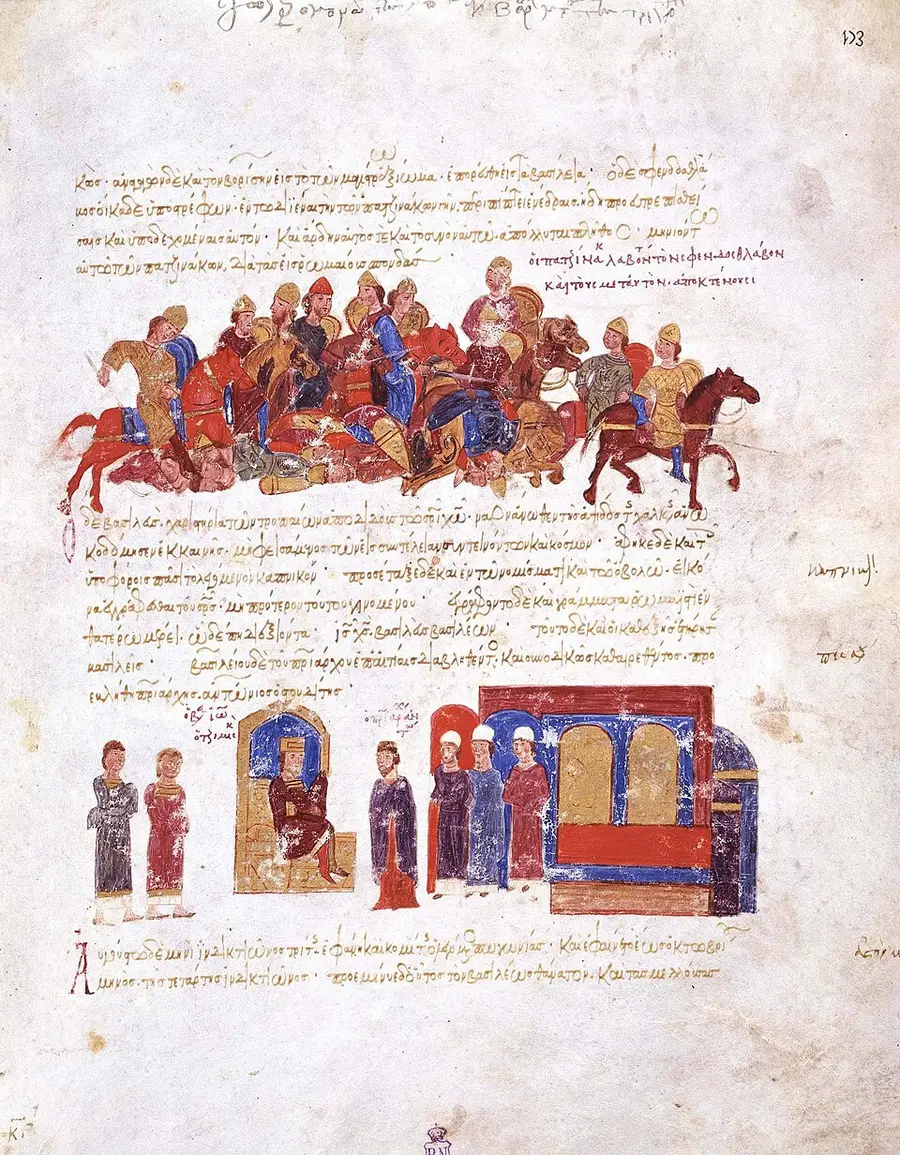 Unknown miniaturist, Madrid Skylitzes (Skyllitzes Matritensis), fol. 173r, Biblioteca Nacional de España This miniature shows Pecheneg horsemen killing the Rus prince Sviatoslav's men at the Dnieper rapids in 972 — the single best-documented instance of exactly the river-passage ambushes this card describes as the deadliest stretch of the Norse trade route south. Turkic semi-nomadic people who dominated the Pontic-Caspian steppe
(the grasslands north of the Black Sea) from the late ninth century
through the mid-eleventh. The Pechenegs controlled the rapids of
the lower Dnieper through which the Norse Rūs traders had to pass
on their way to the Black Sea and Constantinople — Byzantine and
Norse accounts both record the Pecheneg ambushes that made the
river-passage one of the most dangerous parts of the eastern
trade route. Defeated and dispersed by the Byzantine emperor
Alexios Komnenos at the Battle of Levounion in 1091.
and Khazars
Unknown miniaturist, Madrid Skylitzes (Skyllitzes Matritensis), fol. 173r, Biblioteca Nacional de España This miniature shows Pecheneg horsemen killing the Rus prince Sviatoslav's men at the Dnieper rapids in 972 — the single best-documented instance of exactly the river-passage ambushes this card describes as the deadliest stretch of the Norse trade route south. Turkic semi-nomadic people who dominated the Pontic-Caspian steppe
(the grasslands north of the Black Sea) from the late ninth century
through the mid-eleventh. The Pechenegs controlled the rapids of
the lower Dnieper through which the Norse Rūs traders had to pass
on their way to the Black Sea and Constantinople — Byzantine and
Norse accounts both record the Pecheneg ambushes that made the
river-passage one of the most dangerous parts of the eastern
trade route. Defeated and dispersed by the Byzantine emperor
Alexios Komnenos at the Battle of Levounion in 1091.
and Khazars 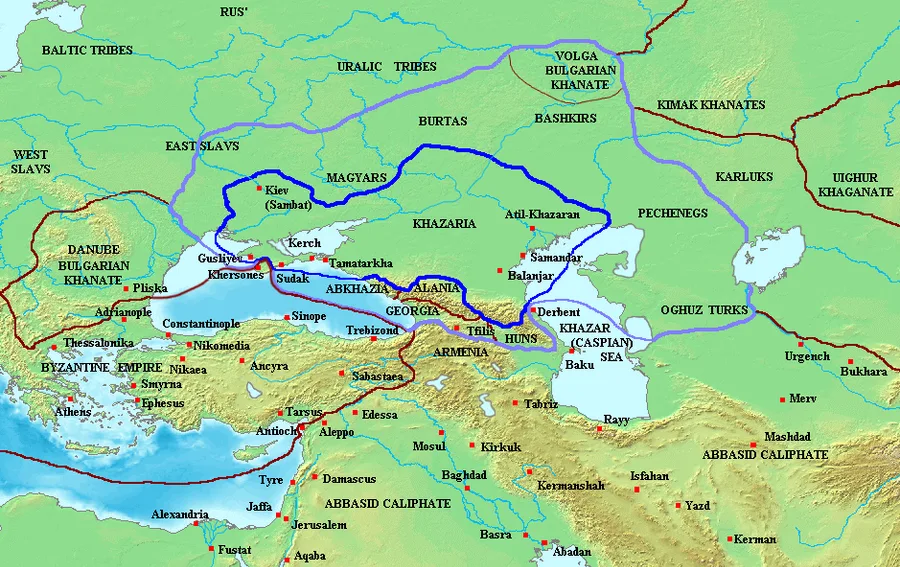 Briangotts, map of the Khazar Khaganate, Wikimedia Commons, CC BY-SA 3.0 A modern map of the Khazar Khaganate astride the lower Volga and Caspian steppe. Nothing of Khazaria itself survives to picture — no capital, no monuments — so a map stands in for the steppe power that taxed and brokered the river trade between the Norse north and the Islamic south. Turkic people who ruled a major steppe empire across the lower
Volga, Caucasus, and northern Caspian region from the seventh
century until their effective destruction by the Kievan Rus prince
Sviatoslav in the 960s. The Khazars controlled the southern Volga
trade and were a principal intermediary between the Norse Rūs
traders of the north and the Islamic world of the Caspian and
Persia. Unusually for a medieval polity, the Khazar ruling elite
converted to Judaism in the eighth or ninth century — a fact
attested in both Arabic and Hebrew sources.
and Bulgars
Briangotts, map of the Khazar Khaganate, Wikimedia Commons, CC BY-SA 3.0 A modern map of the Khazar Khaganate astride the lower Volga and Caspian steppe. Nothing of Khazaria itself survives to picture — no capital, no monuments — so a map stands in for the steppe power that taxed and brokered the river trade between the Norse north and the Islamic south. Turkic people who ruled a major steppe empire across the lower
Volga, Caucasus, and northern Caspian region from the seventh
century until their effective destruction by the Kievan Rus prince
Sviatoslav in the 960s. The Khazars controlled the southern Volga
trade and were a principal intermediary between the Norse Rūs
traders of the north and the Islamic world of the Caspian and
Persia. Unusually for a medieval polity, the Khazar ruling elite
converted to Judaism in the eighth or ninth century — a fact
attested in both Arabic and Hebrew sources.
and Bulgars 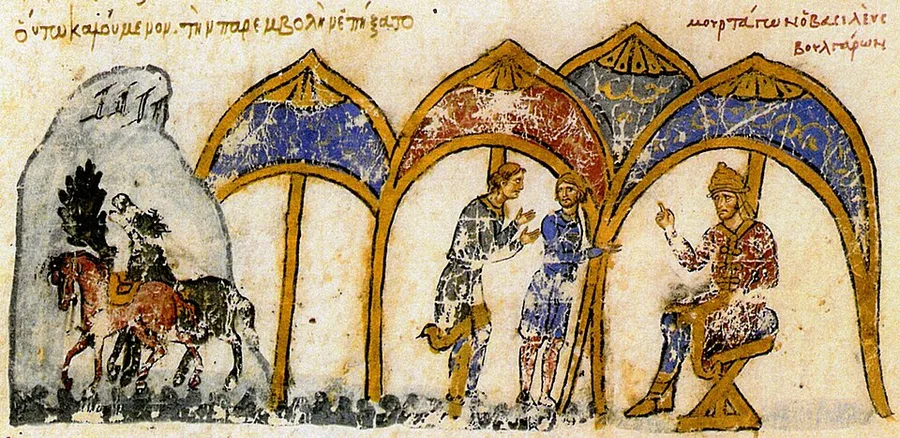 Madrid Skylitzes, fol. 35r detail (c. 1150s), Biblioteca Nacional de España A Madrid Skylitzes miniature of envoys before Omurtag, ruler of the Danube Bulgars. Their Volga cousins mattered more to the Norse: the Bulgar market towns on the middle Volga were where Rūs traders met the Islamic silver economy — and where Ibn Fadlan watched them in 921–22. Turkic semi-nomadic peoples in the medieval Volga and Black Sea
regions. The Volga Bulgars established a state along the middle
Volga in the seventh century and converted to Islam in the early
tenth — Ibn Fadlan's famous early-tenth-century account of the
Rūs Norse on the Volga was written during a Bulgar diplomatic
mission. A separate Bulgar group migrated into the Balkans in the
seventh century and founded the First Bulgarian Empire south of
the Danube, gradually adopting Slavic language and Eastern
Christian religion.
and Arabs rather than Christian monks. The economy that pays them is silver. Dirhams minted in the Abbasid Caliphate
Madrid Skylitzes, fol. 35r detail (c. 1150s), Biblioteca Nacional de España A Madrid Skylitzes miniature of envoys before Omurtag, ruler of the Danube Bulgars. Their Volga cousins mattered more to the Norse: the Bulgar market towns on the middle Volga were where Rūs traders met the Islamic silver economy — and where Ibn Fadlan watched them in 921–22. Turkic semi-nomadic peoples in the medieval Volga and Black Sea
regions. The Volga Bulgars established a state along the middle
Volga in the seventh century and converted to Islam in the early
tenth — Ibn Fadlan's famous early-tenth-century account of the
Rūs Norse on the Volga was written during a Bulgar diplomatic
mission. A separate Bulgar group migrated into the Balkans in the
seventh century and founded the First Bulgarian Empire south of
the Danube, gradually adopting Slavic language and Eastern
Christian religion.
and Arabs rather than Christian monks. The economy that pays them is silver. Dirhams minted in the Abbasid Caliphate 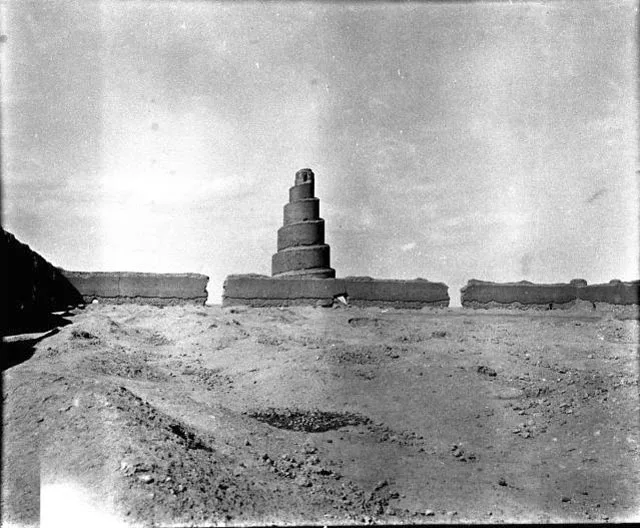 Gertrude Bell, Great Mosque of Samarra and the Malwiya minaret (1909), Gertrude Bell Archive, Newcastle University The Great Mosque at Samarra, with its spiral minaret, was built by the Abbasid caliph al-Mutawakkil in the 850s — physical testimony to the empire whose silver, minted at Baghdad, financed much of the Viking Age's eastern trade. Islamic empire ruling much of the Middle East, North Africa, and
Central Asia from 750 (when the Abbasid dynasty overthrew the
Umayyads) through 1258 (when the Mongols sacked Baghdad). At its
height in the ninth century the Abbasid empire was the wealthiest
and most culturally productive state in the medieval world — the
centre of the Islamic Golden Age. The Abbasid economy minted the
silver dirhams that flowed north through the Volga-Caspian Norse
trade route and bankrolled, indirectly, much of the Viking Age in
Scandinavia.
at Baghdad
Gertrude Bell, Great Mosque of Samarra and the Malwiya minaret (1909), Gertrude Bell Archive, Newcastle University The Great Mosque at Samarra, with its spiral minaret, was built by the Abbasid caliph al-Mutawakkil in the 850s — physical testimony to the empire whose silver, minted at Baghdad, financed much of the Viking Age's eastern trade. Islamic empire ruling much of the Middle East, North Africa, and
Central Asia from 750 (when the Abbasid dynasty overthrew the
Umayyads) through 1258 (when the Mongols sacked Baghdad). At its
height in the ninth century the Abbasid empire was the wealthiest
and most culturally productive state in the medieval world — the
centre of the Islamic Golden Age. The Abbasid economy minted the
silver dirhams that flowed north through the Volga-Caspian Norse
trade route and bankrolled, indirectly, much of the Viking Age in
Scandinavia.
at Baghdad 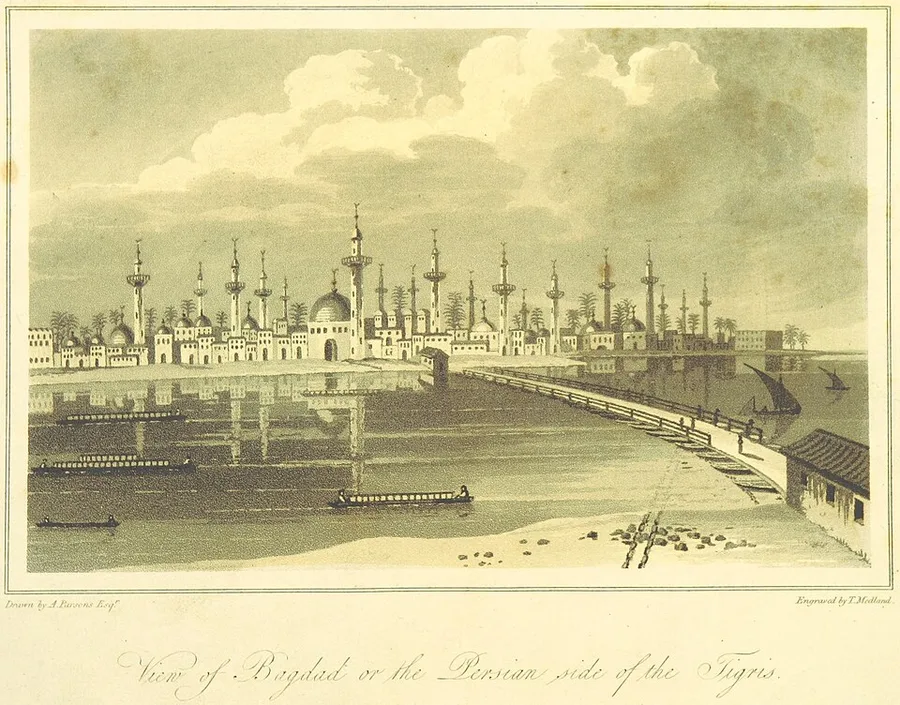 A. Parsons (drawing) / T. Medland (engraving), View of Bagdad or the Persian side of the Tigris (1808) An English traveller's engraved view of Baghdad from the Tigris — minarets and domes doubled in the river that carried the city's trade. Centuries after the Abbasid heyday, but the closest a reader gets to looking at the dirham-minting city whose silver ended up in Scandinavian hoards. Capital of the Abbasid Caliphate from its founding by the caliph
al-Mansur in 762. By the ninth century the largest city in the
Islamic world and one of the wealthiest in the medieval world,
centre of the Islamic Golden Age and the most prolific minter of
silver dirhams. Vast quantities of those dirhams flowed north from
Baghdad through the Caspian-Volga trade and into the silver hoards
of Viking-Age Scandinavia, where they are recovered today by the
tens of thousands.
(modern-day Iraq) and Samarkand
A. Parsons (drawing) / T. Medland (engraving), View of Bagdad or the Persian side of the Tigris (1808) An English traveller's engraved view of Baghdad from the Tigris — minarets and domes doubled in the river that carried the city's trade. Centuries after the Abbasid heyday, but the closest a reader gets to looking at the dirham-minting city whose silver ended up in Scandinavian hoards. Capital of the Abbasid Caliphate from its founding by the caliph
al-Mansur in 762. By the ninth century the largest city in the
Islamic world and one of the wealthiest in the medieval world,
centre of the Islamic Golden Age and the most prolific minter of
silver dirhams. Vast quantities of those dirhams flowed north from
Baghdad through the Caspian-Volga trade and into the silver hoards
of Viking-Age Scandinavia, where they are recovered today by the
tens of thousands.
(modern-day Iraq) and Samarkand  Sergei Prokudin-Gorskii, Bibi-Khanym Mosque, Samarkand (1907), U.S. Library of Congress Prokudin-Gorskii's 1907 colour photograph of the ruined Bibi-Khanym Mosque. The building is centuries younger than the Viking Age, but this is Samarkand — one of the Silk-Road mint cities whose stamped silver rode the river roads north into Scandinavian hoards. Ancient city on the Silk Road in modern Uzbekistan, in the late
ninth and tenth centuries one of the principal eastern minting
centres of the Abbasid and Samanid silver economies. Silver
dirhams minted at Samarkand and the other Transoxanian mints made
up a substantial share of the bullion that flowed north through
the Volga-Caspian Norse trade route and ended in the Viking-Age
hoards of Scandinavia.
(modern-day Uzbekistan) flow north up the rivers through Norse-controlled trading towns at Staraja Ladoga
Sergei Prokudin-Gorskii, Bibi-Khanym Mosque, Samarkand (1907), U.S. Library of Congress Prokudin-Gorskii's 1907 colour photograph of the ruined Bibi-Khanym Mosque. The building is centuries younger than the Viking Age, but this is Samarkand — one of the Silk-Road mint cities whose stamped silver rode the river roads north into Scandinavian hoards. Ancient city on the Silk Road in modern Uzbekistan, in the late
ninth and tenth centuries one of the principal eastern minting
centres of the Abbasid and Samanid silver economies. Silver
dirhams minted at Samarkand and the other Transoxanian mints made
up a substantial share of the bullion that flowed north through
the Volga-Caspian Norse trade route and ended in the Viking-Age
hoards of Scandinavia.
(modern-day Uzbekistan) flow north up the rivers through Norse-controlled trading towns at Staraja Ladoga  Sergei Prokudin-Gorskii, Rurik fortress and the Church of St George, Staraya Ladoga (1909), Library of Congress Prokudin-Gorskii's 1909 colour photograph of the ruined fortress walls at Staraya Ladoga — the stronghold on the Volkhov that tradition names for Rurik, whose Varangian landing here around 862 is the founding legend Russian historiography still traces the state to. Trading town on the Volkhov River south of Lake Ladoga in
northwestern Russia, founded by Norse traders around 750 — one of
the very earliest Norse settlements on the eastern river-routes
and a key transit point on the Volga trade. Modern Russian
historiography treats Staraja Ladoga as one of the founding
settlements of the Russian state. The site preserves substantial
Norse archaeological material from the ninth century.
and Novgorod
Sergei Prokudin-Gorskii, Rurik fortress and the Church of St George, Staraya Ladoga (1909), Library of Congress Prokudin-Gorskii's 1909 colour photograph of the ruined fortress walls at Staraya Ladoga — the stronghold on the Volkhov that tradition names for Rurik, whose Varangian landing here around 862 is the founding legend Russian historiography still traces the state to. Trading town on the Volkhov River south of Lake Ladoga in
northwestern Russia, founded by Norse traders around 750 — one of
the very earliest Norse settlements on the eastern river-routes
and a key transit point on the Volga trade. Modern Russian
historiography treats Staraja Ladoga as one of the founding
settlements of the Russian state. The site preserves substantial
Norse archaeological material from the ninth century.
and Novgorod  Apollinary Vasnetsov, Medieval Novgorod in Winter (1909) Apollinary Vasnetsov's painted reconstruction of medieval Novgorod in winter — the wooden river town on the Volkhov that legend says began as the Norse trader-prince Rurik's seat, and that grew into one of the two great cities of the Rus. City on the Volkhov River in northwestern Russia, traditionally
founded by the Norse Rūs warlord Rurik around 862 as part of the
Varangian river-trade network. With Kiev to the south, one of the
two principal centres of the Kievan Rus state that emerged from the
Norse trading towns. The chronicle tradition that traces the
Russian state to a Norse founding (the "Varangian thesis") is
contested in modern Russian historiography but supported by both
archaeology and the linguistic record.
Also discussed in The King Who Became a Saint — how the Nordmen came to ChristThe Germans Who "Ruled" Bergen — the Hanseatic merchants on Bryggen Wharf (in modern-day northwestern Russia), into the Baltic, and from there into the silver hoards now recovered in their tens of thousands across Scandinavia. The bullion that pays the warbands and builds the chieftains’ halls comes roughly half from looting Christian Europe and half from trading with Islamic Asia, with slaves moving in both directions as a principal commodity.
Apollinary Vasnetsov, Medieval Novgorod in Winter (1909) Apollinary Vasnetsov's painted reconstruction of medieval Novgorod in winter — the wooden river town on the Volkhov that legend says began as the Norse trader-prince Rurik's seat, and that grew into one of the two great cities of the Rus. City on the Volkhov River in northwestern Russia, traditionally
founded by the Norse Rūs warlord Rurik around 862 as part of the
Varangian river-trade network. With Kiev to the south, one of the
two principal centres of the Kievan Rus state that emerged from the
Norse trading towns. The chronicle tradition that traces the
Russian state to a Norse founding (the "Varangian thesis") is
contested in modern Russian historiography but supported by both
archaeology and the linguistic record.
Also discussed in The King Who Became a Saint — how the Nordmen came to ChristThe Germans Who "Ruled" Bergen — the Hanseatic merchants on Bryggen Wharf (in modern-day northwestern Russia), into the Baltic, and from there into the silver hoards now recovered in their tens of thousands across Scandinavia. The bullion that pays the warbands and builds the chieftains’ halls comes roughly half from looting Christian Europe and half from trading with Islamic Asia, with slaves moving in both directions as a principal commodity.
The Norse in the east are the Rūs, and over generations the name attaches not to the traders but to the country forming around them. The first Russian state grows out of these trading towns. By the time the Norse mercenaries are filling the Byzantine emperor’s bodyguard, the people the West thinks of as raiders have founded a country.
The settlements
The same ship technology that takes the Norse south and east takes them west into open ocean. What they find there they do not loot. They settle.
The crossing to Iceland in the 870s is the first of a kind of human migration that had not been done before in the Atlantic. The settlers come in open longships, with families and cattle and seed-grain and tools loaded on top of the rowing benches, on a passage of more than a thousand kilometers across waters where no land is in sight for days at a time. They arrive on a treeless island of glacier and lava and find unclaimed land. By the close of the settlement period some sixty years later, the country has a population of perhaps twenty to thirty thousand and an annual assembly, the Alþing 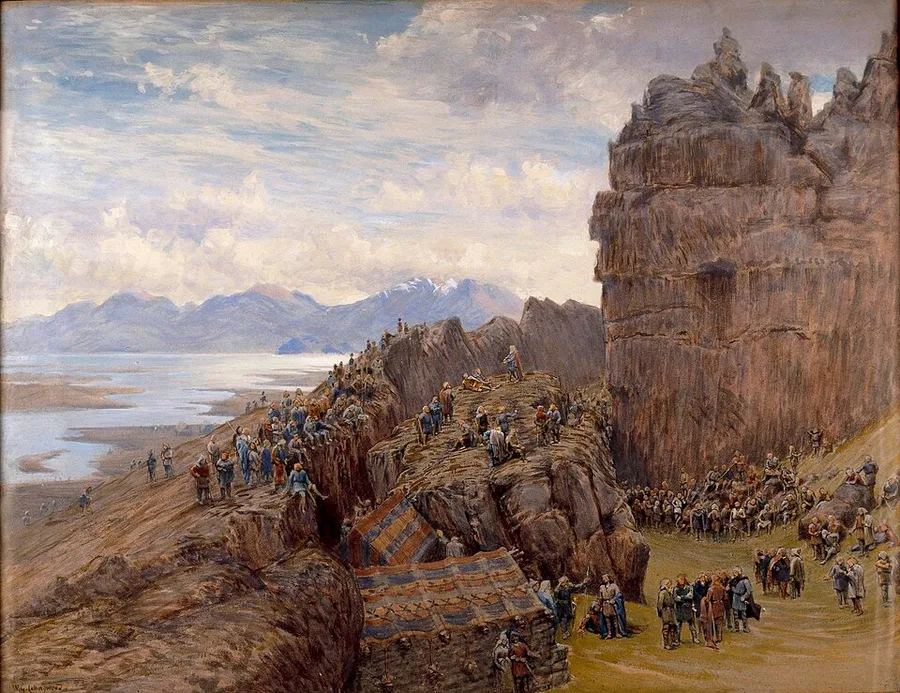 W. G. Collingwood, The Althing in session (c. 1897), The Trustees of the British Museum W.G. Collingwood's 1897 reconstruction of the Icelandic Alþing in session at Þingvellir — chieftains ranged along the rift's rock ledges above the tented booths, picturing the open-air parliament that governed the Commonwealth for three centuries. The annual open-air assembly of the Icelandic Commonwealth,
founded at Þingvellir in 930 CE by the descendants of the Norwegian
chieftains who had emigrated rather than submit to Harald Fairhair's
consolidation. The Alþing met for two weeks each summer, conducted
Iceland's legal business, and operated without a king for over
three centuries — the longest-running stateless polity in medieval
Europe. Reconstituted in 1845 as a consultative body and given
legislative powers in 1874 with Iceland's first constitution. The
modern Icelandic parliament still bears the name Alþingi and is
the oldest continuously named parliament in the world.
Also discussed in Before There Was Norway — petty kingdoms at the edge of the world , which first meets at Þingvellir
W. G. Collingwood, The Althing in session (c. 1897), The Trustees of the British Museum W.G. Collingwood's 1897 reconstruction of the Icelandic Alþing in session at Þingvellir — chieftains ranged along the rift's rock ledges above the tented booths, picturing the open-air parliament that governed the Commonwealth for three centuries. The annual open-air assembly of the Icelandic Commonwealth,
founded at Þingvellir in 930 CE by the descendants of the Norwegian
chieftains who had emigrated rather than submit to Harald Fairhair's
consolidation. The Alþing met for two weeks each summer, conducted
Iceland's legal business, and operated without a king for over
three centuries — the longest-running stateless polity in medieval
Europe. Reconstituted in 1845 as a consultative body and given
legislative powers in 1874 with Iceland's first constitution. The
modern Icelandic parliament still bears the name Alþingi and is
the oldest continuously named parliament in the world.
Also discussed in Before There Was Norway — petty kingdoms at the edge of the world , which first meets at Þingvellir 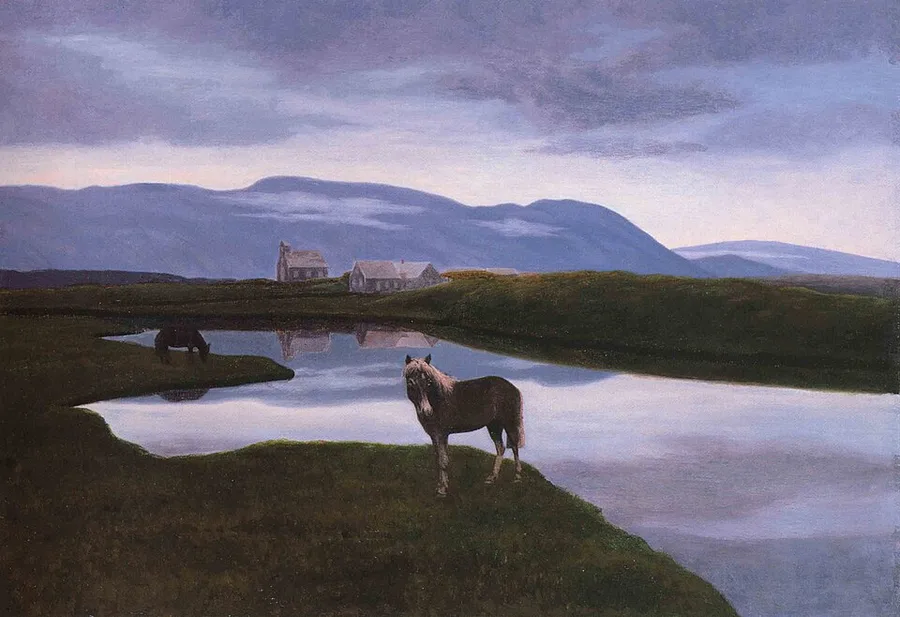 Thorarinn B. Thorlaksson, Thingvellir (1900) Þórarinn B. Þorláksson's 1900 view of the quiet Þingvellir plain. This is where Iceland's Alþing assembly was founded in 930 — free farmers and chieftains gathering yearly for law and judgment — on the rift where the North American and Eurasian plates pull apart. The plain of the thing — the open-air assembly site about forty
kilometres northeast of Reykjavík where the Icelandic Alþing was
founded in 930 CE. Iceland's law-speakers, free farmers, and chieftains
met here annually for two weeks of legal proceedings, dispute
resolution, and announcements of new law. The site sits on the
geological rift where the North American and Eurasian tectonic
plates pull apart. Now Þingvellir National Park, a UNESCO World
Heritage site.
Also discussed in Before There Was Norway — petty kingdoms at the edge of the world in the summer of 930.
Thorarinn B. Thorlaksson, Thingvellir (1900) Þórarinn B. Þorláksson's 1900 view of the quiet Þingvellir plain. This is where Iceland's Alþing assembly was founded in 930 — free farmers and chieftains gathering yearly for law and judgment — on the rift where the North American and Eurasian plates pull apart. The plain of the thing — the open-air assembly site about forty
kilometres northeast of Reykjavík where the Icelandic Alþing was
founded in 930 CE. Iceland's law-speakers, free farmers, and chieftains
met here annually for two weeks of legal proceedings, dispute
resolution, and announcements of new law. The site sits on the
geological rift where the North American and Eurasian tectonic
plates pull apart. Now Þingvellir National Park, a UNESCO World
Heritage site.
Also discussed in Before There Was Norway — petty kingdoms at the edge of the world in the summer of 930.
Greenland is harder. A man named Erik the Red 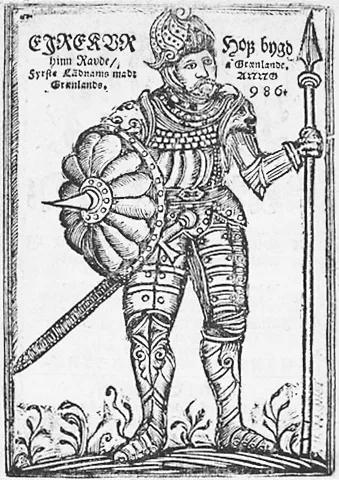 Eiríkur rauði, woodcut frontispiece from Arngrímur Jónsson’s Gronlandia (1688), Fiske Icelandic Collection, Cornell University This 1688 woodcut is an imagined likeness made roughly seven centuries after Erik the Red actually lived — the earliest known printed portrait of Greenland's founding colonist, captioned in its own Latin/Icelandic text as 'first settler of Greenland, in the year 986.' Norse explorer and settler (c. 950–c. 1003), born in Rogaland in
Norway and exiled from Iceland for killings in a feud. During his
three-year banishment in the early 980s he explored the western
coast of Greenland; he returned to Iceland and led a colonising
expedition of perhaps twenty-five ships in 985, of which fourteen
reached Greenland. Founded the Eastern Settlement at Brattahlíð on
the southwestern Greenlandic coast. Father of Leif Erikson.
, outlawed from Iceland for a feud killing, spends his outlaw years exploring the western coast of a great island he names brightly to attract settlers — brightly is required, because the land is marginal at the edge of glacial ice and only the southwestern fjords can sustain agriculture at all. The colony he founds in 985 survives, in steadily diminishing numbers, for more than four centuries before the cold finishes it.
Eiríkur rauði, woodcut frontispiece from Arngrímur Jónsson’s Gronlandia (1688), Fiske Icelandic Collection, Cornell University This 1688 woodcut is an imagined likeness made roughly seven centuries after Erik the Red actually lived — the earliest known printed portrait of Greenland's founding colonist, captioned in its own Latin/Icelandic text as 'first settler of Greenland, in the year 986.' Norse explorer and settler (c. 950–c. 1003), born in Rogaland in
Norway and exiled from Iceland for killings in a feud. During his
three-year banishment in the early 980s he explored the western
coast of Greenland; he returned to Iceland and led a colonising
expedition of perhaps twenty-five ships in 985, of which fourteen
reached Greenland. Founded the Eastern Settlement at Brattahlíð on
the southwestern Greenlandic coast. Father of Leif Erikson.
, outlawed from Iceland for a feud killing, spends his outlaw years exploring the western coast of a great island he names brightly to attract settlers — brightly is required, because the land is marginal at the edge of glacial ice and only the southwestern fjords can sustain agriculture at all. The colony he founds in 985 survives, in steadily diminishing numbers, for more than four centuries before the cold finishes it.
Erik’s son Leif Erikson 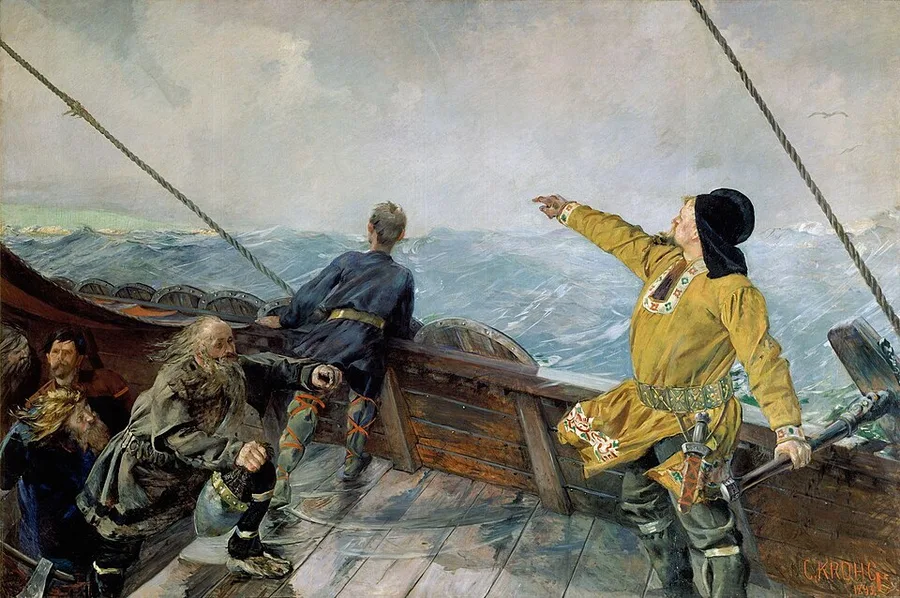 Christian Krohg, Leiv Eirikson discovering America (1893), National Museum of Art, Architecture and Design, Oslo (NG.M.00558) Christian Krohg's Leiv Eirikson discovering America (1893) — the explorer pointing the way west from a heaving deck. Painted nine centuries after the landfall it imagines, for a Norway that wanted its explorers on gallery walls. Norse explorer (c. 970–c. 1020), son of Erik the Red. Around the year
1000 led an expedition west from Greenland that reached the eastern
coast of North America, which he named Vinland for the wild grapes
reportedly found there. The brief Norse settlement at L'Anse aux
Meadows on the northern tip of Newfoundland — the only confirmed
pre-Columbian European presence in the Americas — is associated with
Leif and his expeditions in saga tradition and archaeology. Returned
to Greenland and succeeded his father at Brattahlíð.
sails farther west around the year 1000 and reaches a place he calls Vinland
Christian Krohg, Leiv Eirikson discovering America (1893), National Museum of Art, Architecture and Design, Oslo (NG.M.00558) Christian Krohg's Leiv Eirikson discovering America (1893) — the explorer pointing the way west from a heaving deck. Painted nine centuries after the landfall it imagines, for a Norway that wanted its explorers on gallery walls. Norse explorer (c. 970–c. 1020), son of Erik the Red. Around the year
1000 led an expedition west from Greenland that reached the eastern
coast of North America, which he named Vinland for the wild grapes
reportedly found there. The brief Norse settlement at L'Anse aux
Meadows on the northern tip of Newfoundland — the only confirmed
pre-Columbian European presence in the Americas — is associated with
Leif and his expeditions in saga tradition and archaeology. Returned
to Greenland and succeeded his father at Brattahlíð.
sails farther west around the year 1000 and reaches a place he calls Vinland 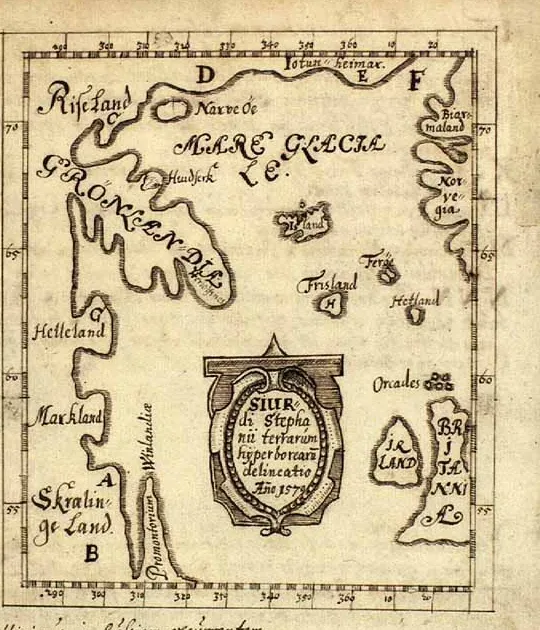 Sigurd Stefánsson (attrib.), Skálholt Map (1570), surviving copy The Skálholt map, drawn in 1570 from Icelandic saga learning — down its left edge, below Greenland's hooked coast, a narrow spit is labeled Promontorium Winlandiae, "the promontory of Vinland." Five centuries before archaeology confirmed it, Icelanders still knew roughly where the wine-land lay. The Norse name for parts of the North American Atlantic coast
reached by Leif Erikson's expedition around 1000 CE and a handful
of follow-up voyages from Greenland. "Vinland" probably means
"wine-land" (from vín, wine), a reference to the wild grapes the
Norse reportedly found there. The exact extent is debated; the
confirmed archaeological evidence at L'Anse aux Meadows in
Newfoundland is the only undisputed Norse settlement, but
scattered Norse artefacts have been found further south along the
Gulf of Saint Lawrence.
, the wine-land, where the climate is mild enough to grow grapes. He overwinters, builds a base camp, and returns to Greenland. The colonizing expeditions that follow — most notably that of Thorfinn Karlsefni a decade later — attempt a lasting settlement and abandon it within a few years. The land is inhabited by people the Norse cannot defeat through superior technology, and the supply line back to Greenland is too long for a contested colony to hold. A site at L'Anse aux Meadows
Sigurd Stefánsson (attrib.), Skálholt Map (1570), surviving copy The Skálholt map, drawn in 1570 from Icelandic saga learning — down its left edge, below Greenland's hooked coast, a narrow spit is labeled Promontorium Winlandiae, "the promontory of Vinland." Five centuries before archaeology confirmed it, Icelanders still knew roughly where the wine-land lay. The Norse name for parts of the North American Atlantic coast
reached by Leif Erikson's expedition around 1000 CE and a handful
of follow-up voyages from Greenland. "Vinland" probably means
"wine-land" (from vín, wine), a reference to the wild grapes the
Norse reportedly found there. The exact extent is debated; the
confirmed archaeological evidence at L'Anse aux Meadows in
Newfoundland is the only undisputed Norse settlement, but
scattered Norse artefacts have been found further south along the
Gulf of Saint Lawrence.
, the wine-land, where the climate is mild enough to grow grapes. He overwinters, builds a base camp, and returns to Greenland. The colonizing expeditions that follow — most notably that of Thorfinn Karlsefni a decade later — attempt a lasting settlement and abandon it within a few years. The land is inhabited by people the Norse cannot defeat through superior technology, and the supply line back to Greenland is too long for a contested colony to hold. A site at L'Anse aux Meadows 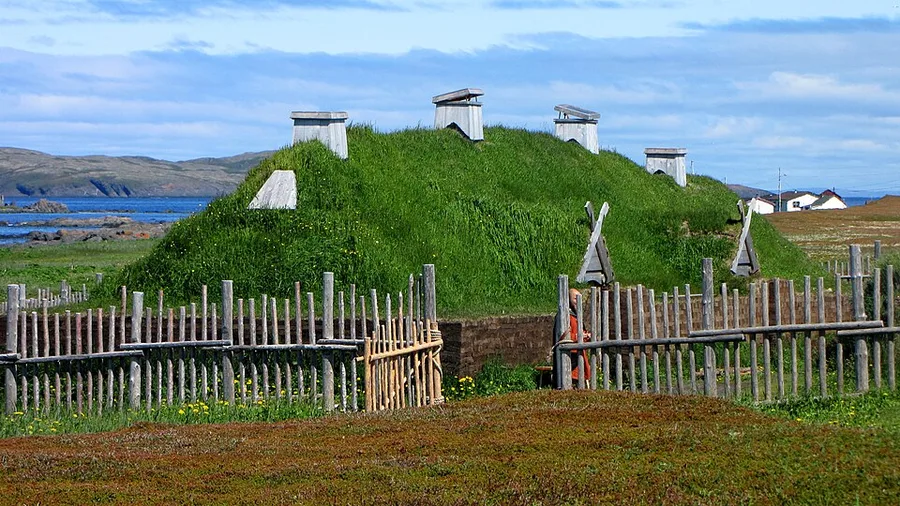 D. Gordon E. Robertson, reconstructed Norse longhouse, L'Anse aux Meadows (2010), Wikimedia Commons, CC BY-SA 3.0 The reconstructed sod longhouses stand on the excavated footprints of the only confirmed Norse settlement in North America — physical proof behind the Vinland voyages of the sagas. Archaeological site at the northern tip of Newfoundland, Canada,
excavated in the 1960s by the Norwegian husband-and-wife team Helge
and Anne Stine Ingstad. Eight Norse-style sod buildings, iron-
smithing remains, and a small collection of Norse artefacts confirm
a short-lived occupation around the year 1000 CE — the only
pre-Columbian European presence in the Americas confirmed by
archaeology, almost certainly associated with the Vinland voyages
led by Leif Erikson from the Greenland colony. Now a UNESCO World
Heritage site.
on the northern tip of Newfoundland
D. Gordon E. Robertson, reconstructed Norse longhouse, L'Anse aux Meadows (2010), Wikimedia Commons, CC BY-SA 3.0 The reconstructed sod longhouses stand on the excavated footprints of the only confirmed Norse settlement in North America — physical proof behind the Vinland voyages of the sagas. Archaeological site at the northern tip of Newfoundland, Canada,
excavated in the 1960s by the Norwegian husband-and-wife team Helge
and Anne Stine Ingstad. Eight Norse-style sod buildings, iron-
smithing remains, and a small collection of Norse artefacts confirm
a short-lived occupation around the year 1000 CE — the only
pre-Columbian European presence in the Americas confirmed by
archaeology, almost certainly associated with the Vinland voyages
led by Leif Erikson from the Greenland colony. Now a UNESCO World
Heritage site.
on the northern tip of Newfoundland 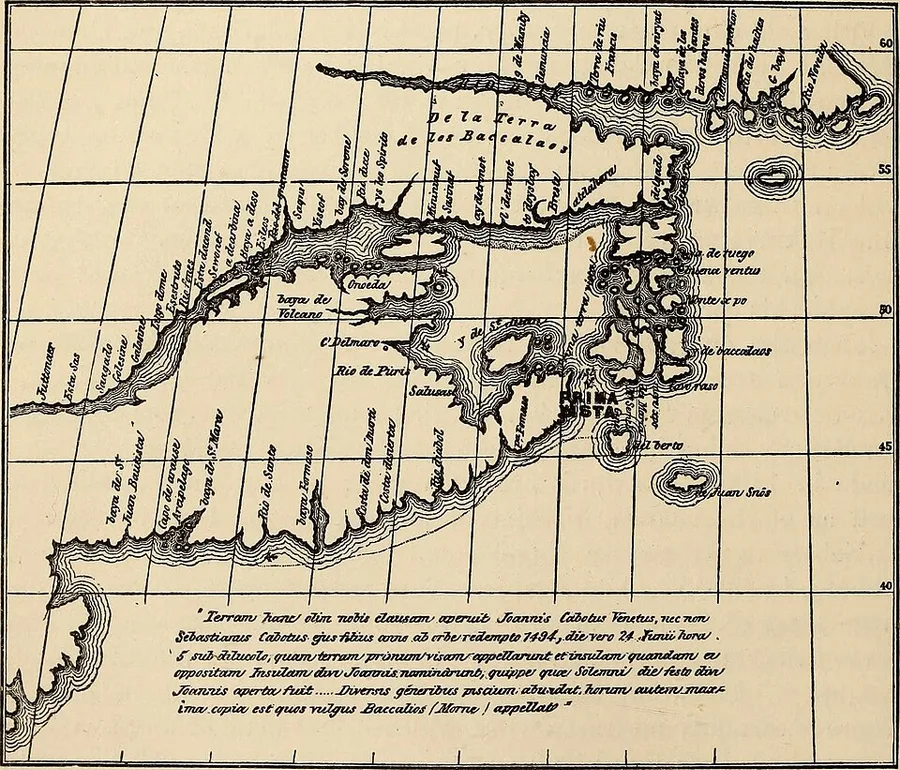 After Sebastiano Caboto, Sebastian Cabot's Map (1544), reproduced in Bryant & Gay, A Popular History of the United States (New York, 1876) This 1544 map carries one of the earliest cartographic namings of Newfoundland — 'the Land First Seen' — more than five centuries after Norse voyagers from Greenland had already wintered at L'Anse aux Meadows on the same island's northern tip. Large island off the eastern coast of Canada at the mouth of the
Gulf of Saint Lawrence; together with Labrador it forms the
Canadian province of Newfoundland and Labrador. The northern tip
of the island, at L'Anse aux Meadows, preserves the only confirmed
pre-Columbian European archaeological site in the Americas — a
brief Norse settlement of around 1000 CE associated with Leif
Erikson's Vinland voyages from Greenland.
(in modern-day Canada) preserves a brief Norse occupation of a few years — the only pre-Columbian European settlement in the Americas yet found.
After Sebastiano Caboto, Sebastian Cabot's Map (1544), reproduced in Bryant & Gay, A Popular History of the United States (New York, 1876) This 1544 map carries one of the earliest cartographic namings of Newfoundland — 'the Land First Seen' — more than five centuries after Norse voyagers from Greenland had already wintered at L'Anse aux Meadows on the same island's northern tip. Large island off the eastern coast of Canada at the mouth of the
Gulf of Saint Lawrence; together with Labrador it forms the
Canadian province of Newfoundland and Labrador. The northern tip
of the island, at L'Anse aux Meadows, preserves the only confirmed
pre-Columbian European archaeological site in the Americas — a
brief Norse settlement of around 1000 CE associated with Leif
Erikson's Vinland voyages from Greenland.
(in modern-day Canada) preserves a brief Norse occupation of a few years — the only pre-Columbian European settlement in the Americas yet found.
What the Norse achieve across this hundred and thirty years has no parallel for a population that size. A community not much larger than a midsize modern town sustains, simultaneously, a raiding economy reaching the Iberian Atlantic, a trading network running from Baghdad to Dublin, a settler colony in Iceland, a marginal farming community at the edge of the Greenland ice, and the only known European presence in the Americas before Columbus. The longships themselves are the supply line. When a raid or a settlement fails, no rescue is coming.
The end of the era
The Viking Age ends, for practical purposes, on a hot September day at a small river crossing in Yorkshire.
The man at the head of the last great Norse invasion of England is Harald Hardrada 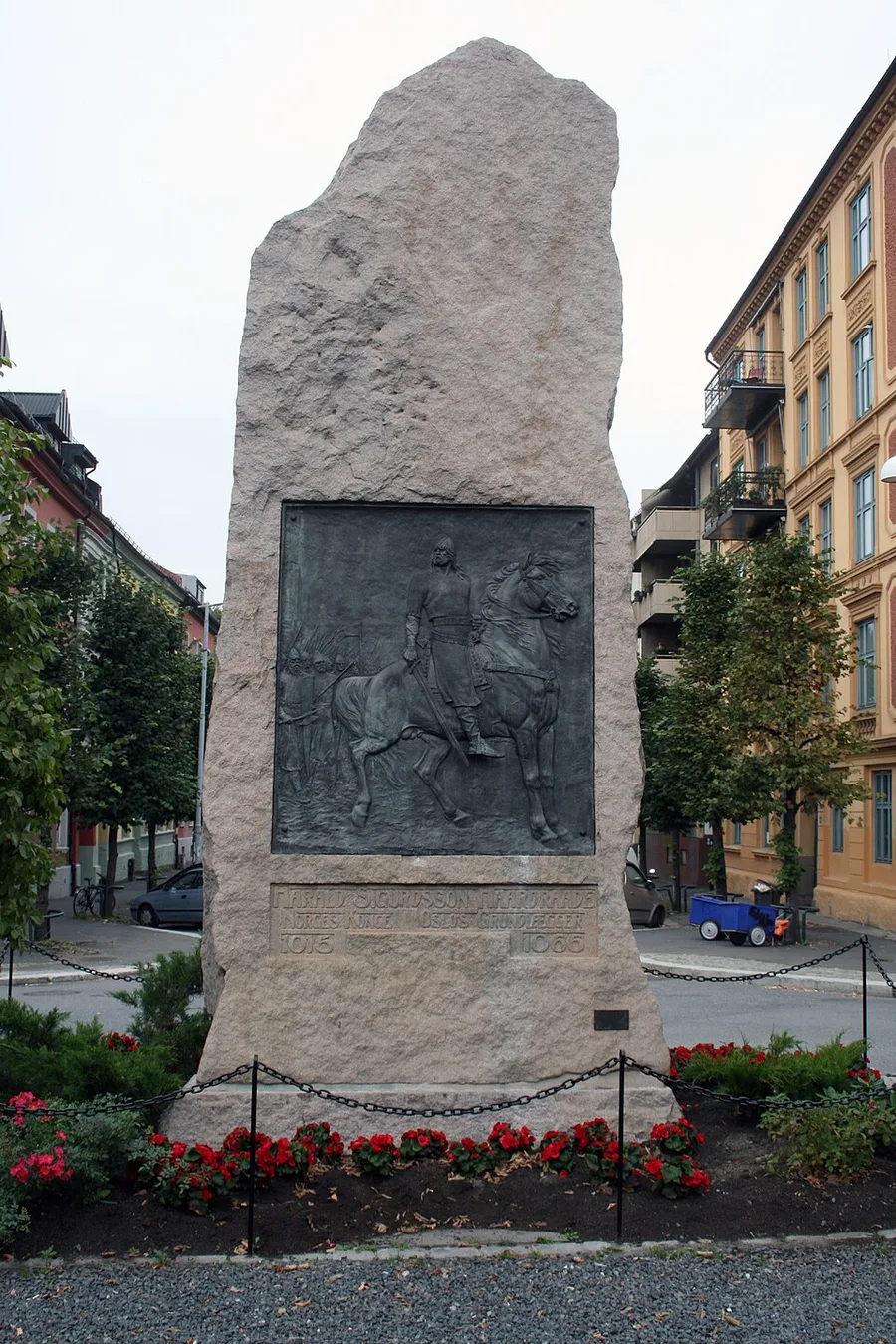 Lars Utne, Harald Hardrada monument, Harald Hårdrådes plass, Oslo (unveiled 1905); photo: GAD (CC BY-SA 3.0) This granite bauta with its bronze relief of Harald leading his horse stands in Oslo's old town, on the square named for him — a 1905 monument to the king who by tradition founded the city, unveiled some eight centuries after his reign. King of Norway 1046–1066, bynamed Hardráði ("the hard counsel" or
"stern ruler"); half-brother of Olav Haraldsson (Saint Olav). Spent
ten years of his thirties as a commander in the Varangian Guard at
Constantinople, fighting in Sicily, North Africa, and the Holy Land
before returning north to claim the Norwegian throne. In 1066 he
invaded England to press a contested claim to the English throne,
defeated an English force at Fulford on 20 September, and was killed
five days later at the Battle of Stamford Bridge in Yorkshire — by
saga tradition, by an arrow through the throat. His death is the
conventional close of the Viking Age.
— “the hard counsel” — fifty-one years old, half-brother of Saint Olav
Lars Utne, Harald Hardrada monument, Harald Hårdrådes plass, Oslo (unveiled 1905); photo: GAD (CC BY-SA 3.0) This granite bauta with its bronze relief of Harald leading his horse stands in Oslo's old town, on the square named for him — a 1905 monument to the king who by tradition founded the city, unveiled some eight centuries after his reign. King of Norway 1046–1066, bynamed Hardráði ("the hard counsel" or
"stern ruler"); half-brother of Olav Haraldsson (Saint Olav). Spent
ten years of his thirties as a commander in the Varangian Guard at
Constantinople, fighting in Sicily, North Africa, and the Holy Land
before returning north to claim the Norwegian throne. In 1066 he
invaded England to press a contested claim to the English throne,
defeated an English force at Fulford on 20 September, and was killed
five days later at the Battle of Stamford Bridge in Yorkshire — by
saga tradition, by an arrow through the throat. His death is the
conventional close of the Viking Age.
— “the hard counsel” — fifty-one years old, half-brother of Saint Olav 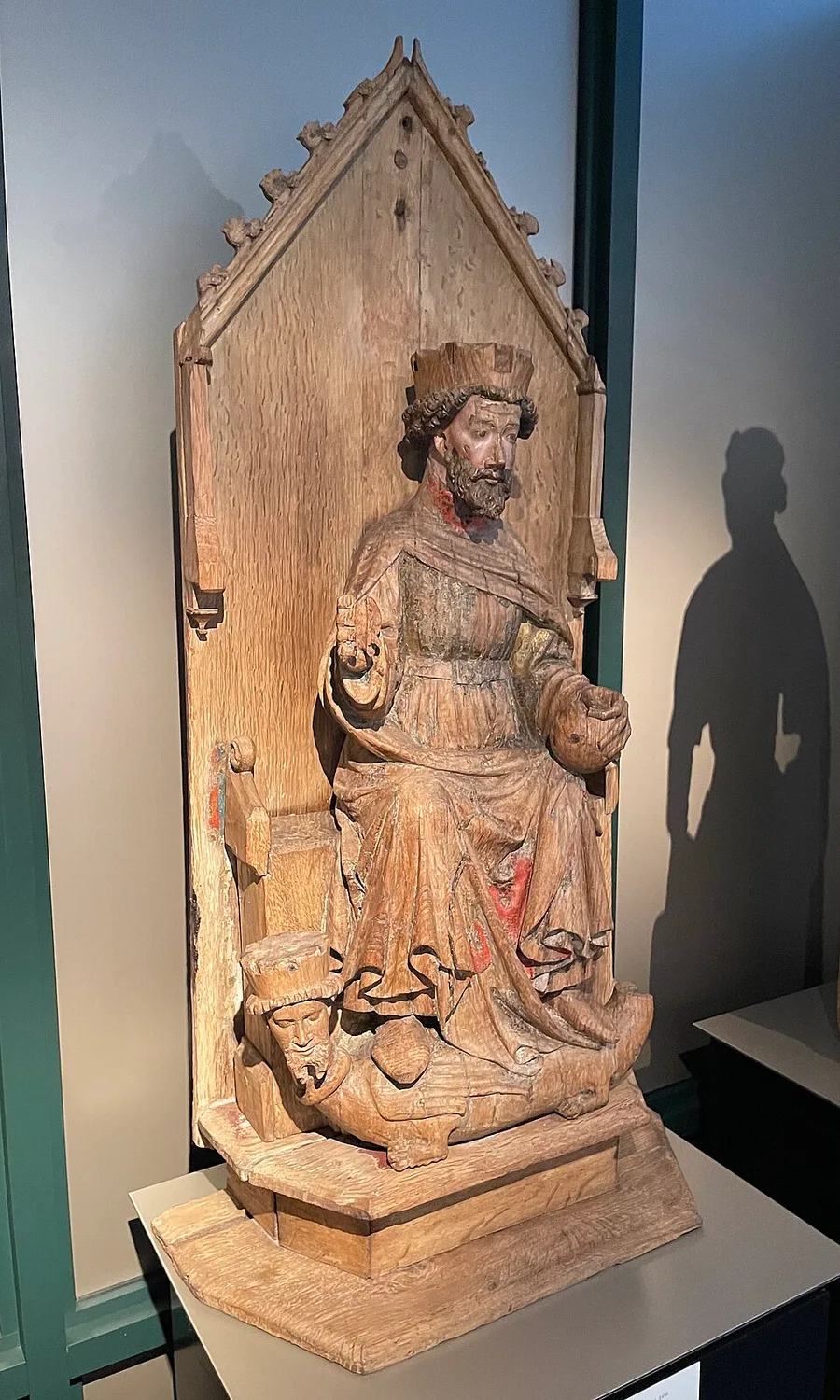 Saint Olav from Austevoll church (c. 1450), University Museum of Bergen; photo Wolfmann, Wikimedia Commons, CC BY-SA 4.0 Olav as medieval Norway saw him: the eternal king crowned and enthroned, trampling a dragon whose crowned human head stands for the heathendom he overcame. Carved around 1450 for Austevoll church south of Bergen — one of the polychrome Olav figures that stood in churches across Norway before the Reformation. Olav Haraldsson, king of Norway 1015–1028, killed at the Battle
of Stiklestad on 29 July 1030 and canonized one year and five days
later by his English bishop Grimkell. Rex Perpetuus Norvegiae —
the Eternal King of Norway. His shrine at Nidaros became the
northernmost pilgrimage destination in medieval Christendom and
the binding narrative of a converted country. The Norwegian Lion
on the modern coat of arms — a golden lion bearing a golden axe
on a red shield — is Saint Olav's iconography.
On the trip The Gråhårsklubben (the Oldsters) visit Nidaros Cathedral on
Tuesday 28 July 2026 — the day before the 996th anniversary of
the Battle of Stiklestad. The Olafskrinet was broken up at the
1537 Reformation and the body buried somewhere inside the
cathedral in a spot no medieval source preserved. The building
is what the nine-and-a-half centuries of devotion built. The
pilgrim road, the Pilegrimsleden, runs past the cathedral's
south door — the same door the medieval pilgrims walked through.
Nidaros Cathedral, Trondheim Also discussed in The King Who Became a Saint — how the Nordmen came to ChristWorshiping Odin and Thor — the lived religion of pre-Christian NorwayA Catholic Norway — the faith that gave the kingdom its first institutions and the stave churchesThe Reformation, 1537 — one church eradicated and another imposedLutheran Norway and Pietism — a farmer named Hans Nielsen Hauge and a lay revival that could not be silencedThe Crusades?!!!! — sixty ships from Bergen, bound for the Holy LandThe 400-Year Night — when the Northern Lion lay dormantThe Quiet Revolution — how Norway won its independence without a warWorld War II — the King’s “No” and the Nazis in Norway , a soldier for nearly forty years. He had spent a decade in his twenties as a Varangian commander in the service of the Byzantine emperors, fighting in Sicily
Saint Olav from Austevoll church (c. 1450), University Museum of Bergen; photo Wolfmann, Wikimedia Commons, CC BY-SA 4.0 Olav as medieval Norway saw him: the eternal king crowned and enthroned, trampling a dragon whose crowned human head stands for the heathendom he overcame. Carved around 1450 for Austevoll church south of Bergen — one of the polychrome Olav figures that stood in churches across Norway before the Reformation. Olav Haraldsson, king of Norway 1015–1028, killed at the Battle
of Stiklestad on 29 July 1030 and canonized one year and five days
later by his English bishop Grimkell. Rex Perpetuus Norvegiae —
the Eternal King of Norway. His shrine at Nidaros became the
northernmost pilgrimage destination in medieval Christendom and
the binding narrative of a converted country. The Norwegian Lion
on the modern coat of arms — a golden lion bearing a golden axe
on a red shield — is Saint Olav's iconography.
On the trip The Gråhårsklubben (the Oldsters) visit Nidaros Cathedral on
Tuesday 28 July 2026 — the day before the 996th anniversary of
the Battle of Stiklestad. The Olafskrinet was broken up at the
1537 Reformation and the body buried somewhere inside the
cathedral in a spot no medieval source preserved. The building
is what the nine-and-a-half centuries of devotion built. The
pilgrim road, the Pilegrimsleden, runs past the cathedral's
south door — the same door the medieval pilgrims walked through.
Nidaros Cathedral, Trondheim Also discussed in The King Who Became a Saint — how the Nordmen came to ChristWorshiping Odin and Thor — the lived religion of pre-Christian NorwayA Catholic Norway — the faith that gave the kingdom its first institutions and the stave churchesThe Reformation, 1537 — one church eradicated and another imposedLutheran Norway and Pietism — a farmer named Hans Nielsen Hauge and a lay revival that could not be silencedThe Crusades?!!!! — sixty ships from Bergen, bound for the Holy LandThe 400-Year Night — when the Northern Lion lay dormantThe Quiet Revolution — how Norway won its independence without a warWorld War II — the King’s “No” and the Nazis in Norway , a soldier for nearly forty years. He had spent a decade in his twenties as a Varangian commander in the service of the Byzantine emperors, fighting in Sicily 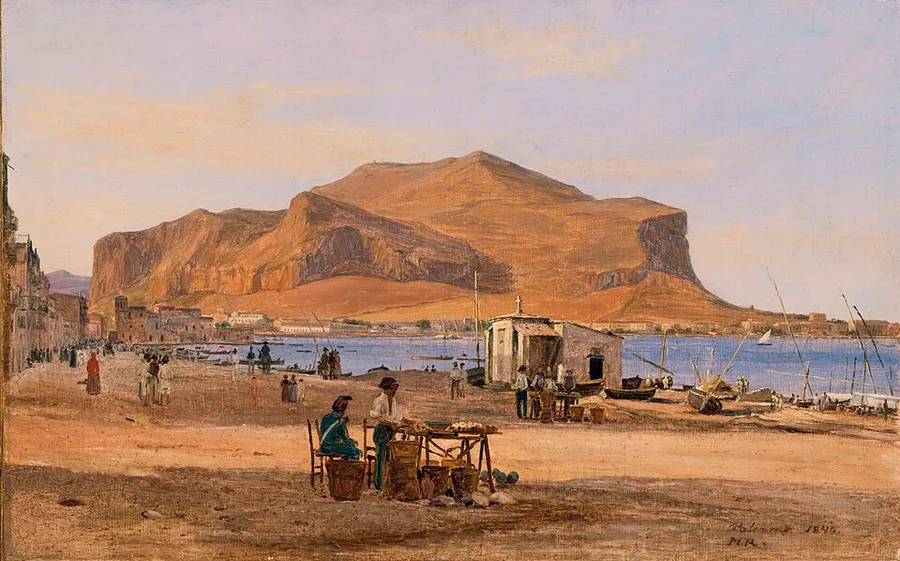 Martinus Rørbye, Palermo Harbor with a View of Monte Pellegrino (1840), Los Angeles County Museum of Art Palermo's harbor beneath Monte Pellegrino, painted by Martinus Rørbye in 1840. In this harbor city Sigurd Jorsalfar's crusade fleet wintered as guests of the young Roger II, and off these coasts Harald Hardrada had campaigned as a Varangian commander a century before. The largest island in the Mediterranean, off the southern tip of
the Italian peninsula. In the early eleventh century divided
politically between Byzantine holdings and the Muslim Kalbid
emirate (under nominal Fatimid suzerainty), fragmenting into
local fiefdoms; from 1061 conquered piecemeal by Norman adventurers,
themselves descended from the Norse settlers of Normandy. Harald
Hardrada fought as a Varangian commander in Byzantine campaigns
against the Sicilian Muslims in the late 1030s, before the Norman
conquest began.
Also discussed in The Crusades?!!!! — sixty ships from Bergen, bound for the Holy Land and North Africa and the Holy Land
Martinus Rørbye, Palermo Harbor with a View of Monte Pellegrino (1840), Los Angeles County Museum of Art Palermo's harbor beneath Monte Pellegrino, painted by Martinus Rørbye in 1840. In this harbor city Sigurd Jorsalfar's crusade fleet wintered as guests of the young Roger II, and off these coasts Harald Hardrada had campaigned as a Varangian commander a century before. The largest island in the Mediterranean, off the southern tip of
the Italian peninsula. In the early eleventh century divided
politically between Byzantine holdings and the Muslim Kalbid
emirate (under nominal Fatimid suzerainty), fragmenting into
local fiefdoms; from 1061 conquered piecemeal by Norman adventurers,
themselves descended from the Norse settlers of Normandy. Harald
Hardrada fought as a Varangian commander in Byzantine campaigns
against the Sicilian Muslims in the late 1030s, before the Norman
conquest began.
Also discussed in The Crusades?!!!! — sixty ships from Bergen, bound for the Holy Land and North Africa and the Holy Land 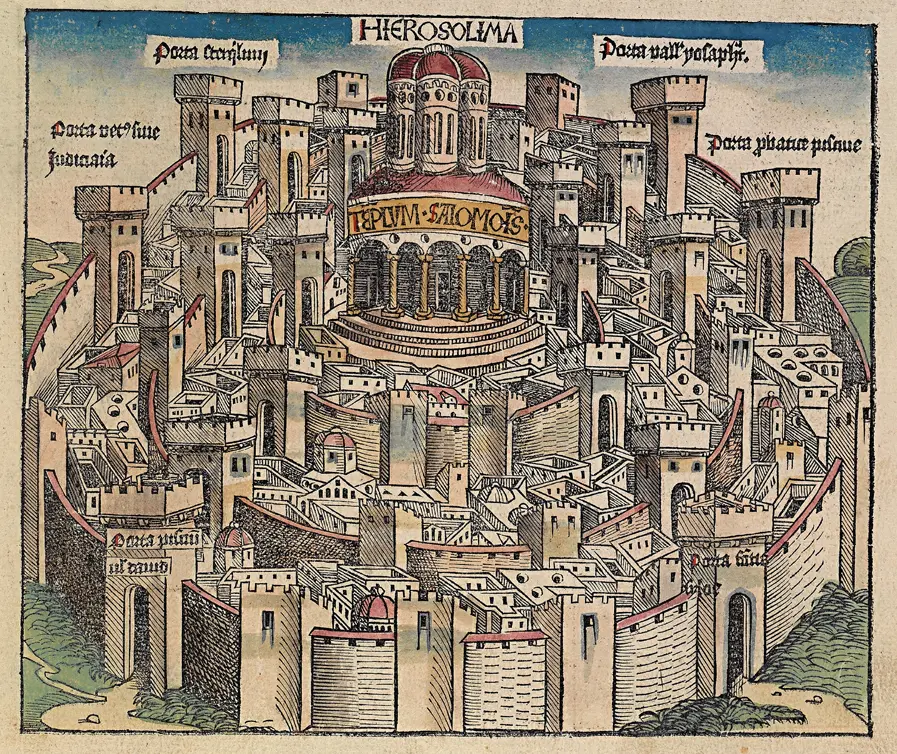 Hartmann Schedel, Hierosolima woodcut, Nuremberg Chronicle (1493) Jerusalem as the Nuremberg Chronicle pictured it in 1493 — a walled holy city drawn for readers who would never see it. This was the Holy Land of the medieval European imagination, the goal that drew Norse pilgrims, Varangian soldiers, and crusading kings alike south. Medieval Christian and Muslim term for the region of Palestine —
the area in which the events of the Old and New Testaments are set,
centred on Jerusalem. In the early eleventh century under Fatimid
Caliphate rule, with a Christian population that retained pilgrim
access to Jerusalem and the other holy sites. Harald Hardrada
served there as a Varangian commander in Byzantine campaigns of
the late 1030s, possibly reaching Jerusalem as a pilgrim. The
Crusader conquest of Jerusalem followed in 1099.
Also discussed in The Crusades?!!!! — sixty ships from Bergen, bound for the Holy Land before returning to claim the Norwegian throne in 1046. In 1066 he claims the English throne as well, on the basis of a contested succession pact made nearly thirty years before, which he inherited from his predecessor Magnus. He lands his army in Yorkshire (modern-day northern England) in mid-September. He wins a battle on the twentieth. Five days later, at a small river crossing called Stamford Bridge
Hartmann Schedel, Hierosolima woodcut, Nuremberg Chronicle (1493) Jerusalem as the Nuremberg Chronicle pictured it in 1493 — a walled holy city drawn for readers who would never see it. This was the Holy Land of the medieval European imagination, the goal that drew Norse pilgrims, Varangian soldiers, and crusading kings alike south. Medieval Christian and Muslim term for the region of Palestine —
the area in which the events of the Old and New Testaments are set,
centred on Jerusalem. In the early eleventh century under Fatimid
Caliphate rule, with a Christian population that retained pilgrim
access to Jerusalem and the other holy sites. Harald Hardrada
served there as a Varangian commander in Byzantine campaigns of
the late 1030s, possibly reaching Jerusalem as a pilgrim. The
Crusader conquest of Jerusalem followed in 1099.
Also discussed in The Crusades?!!!! — sixty ships from Bergen, bound for the Holy Land before returning to claim the Norwegian throne in 1046. In 1066 he claims the English throne as well, on the basis of a contested succession pact made nearly thirty years before, which he inherited from his predecessor Magnus. He lands his army in Yorkshire (modern-day northern England) in mid-September. He wins a battle on the twentieth. Five days later, at a small river crossing called Stamford Bridge 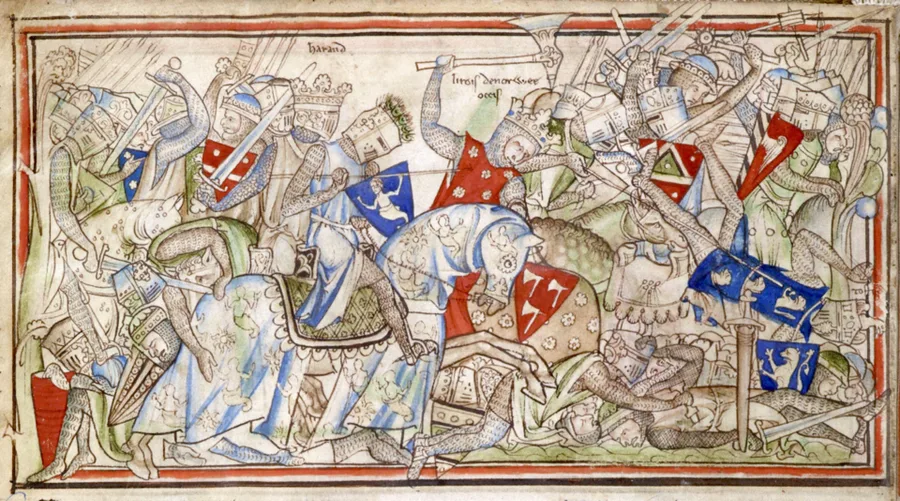 Matthew Paris, The Battle of Stamford Bridge, from The Life of King Edward the Confessor (13th c.), Cambridge University Library MS Ee.3.59 Matthew Paris's thirteenth-century miniature renders Stamford Bridge as a chivalric melee two centuries after the fact. The place itself is quieter — a village crossing of the River Derwent east of York, where on 25 September 1066 the last Norse invasion of England ended. Village in East Yorkshire about twelve kilometres east of York, on
the River Derwent. Site of the battle on 25 September 1066 in
which the English king Harold Godwinson defeated and killed the
Norwegian king Harald Hardrada and the rebel English earl Tostig
Godwinson, ending the last serious Norse invasion of England.
Harold's exhausted army then marched back south and was destroyed
by William the Conqueror at Hastings three weeks later.
, an Battle of Stamford Bridge
Matthew Paris, The Battle of Stamford Bridge, from The Life of King Edward the Confessor (13th c.), Cambridge University Library MS Ee.3.59 Matthew Paris's thirteenth-century miniature renders Stamford Bridge as a chivalric melee two centuries after the fact. The place itself is quieter — a village crossing of the River Derwent east of York, where on 25 September 1066 the last Norse invasion of England ended. Village in East Yorkshire about twelve kilometres east of York, on
the River Derwent. Site of the battle on 25 September 1066 in
which the English king Harold Godwinson defeated and killed the
Norwegian king Harald Hardrada and the rebel English earl Tostig
Godwinson, ending the last serious Norse invasion of England.
Harold's exhausted army then marched back south and was destroyed
by William the Conqueror at Hastings three weeks later.
, an Battle of Stamford Bridge 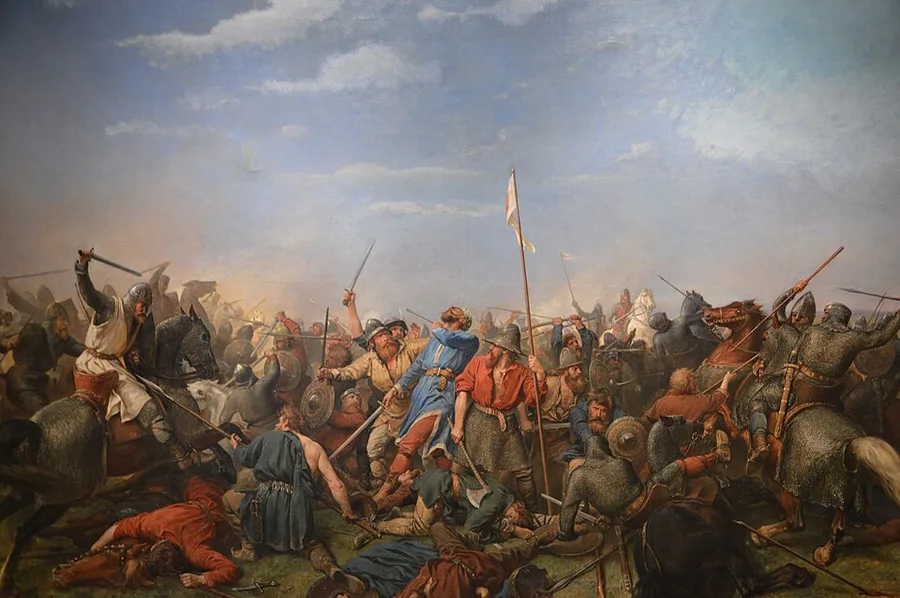 Peter Nicolai Arbo, Battle of Stamford Bridge (1870), Nordnorsk Kunstmuseum, Tromsø Norwegian painter Peter Nicolai Arbo depicts the moment Harald Hardrada falls at Stamford Bridge, struck in the throat by an arrow by tradition — ending the last serious Norse bid for the English crown. Battle fought on 25 September 1066 at Stamford Bridge in East
Yorkshire between an English army under King Harold Godwinson and
a Norse invading force under King Harald Hardrada of Norway. The
English won decisively; Hardrada was killed, along with most of his
army. Conventionally treated as the end of the Viking Age in
English historiography. Harold Godwinson then marched his
exhausted army south to meet William the Conqueror, who landed at
Pevensey three days later — Harold was killed at the Battle of
Hastings on 14 October 1066.
under King Harold Godwinson
Peter Nicolai Arbo, Battle of Stamford Bridge (1870), Nordnorsk Kunstmuseum, Tromsø Norwegian painter Peter Nicolai Arbo depicts the moment Harald Hardrada falls at Stamford Bridge, struck in the throat by an arrow by tradition — ending the last serious Norse bid for the English crown. Battle fought on 25 September 1066 at Stamford Bridge in East
Yorkshire between an English army under King Harold Godwinson and
a Norse invading force under King Harald Hardrada of Norway. The
English won decisively; Hardrada was killed, along with most of his
army. Conventionally treated as the end of the Viking Age in
English historiography. Harold Godwinson then marched his
exhausted army south to meet William the Conqueror, who landed at
Pevensey three days later — Harold was killed at the Battle of
Hastings on 14 October 1066.
under King Harold Godwinson 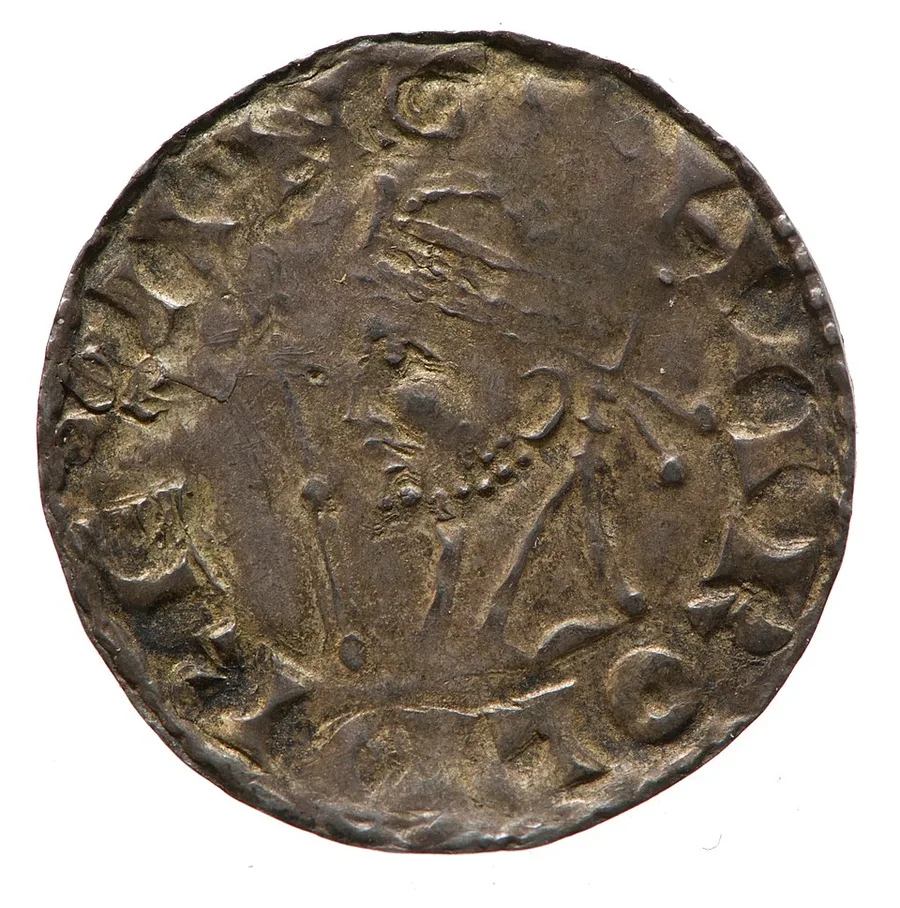 Silver penny of Harold II, obverse (1066), York Museums Trust, YORYM 2000.1348 A silver penny of Harold II — the crowned, bearded king in profile, struck during his nine-month reign in 1066. Contemporary coinage is the nearest thing to a life portrait of the king who broke Hardrada's army at Stamford Bridge, then fell at Hastings nineteen days later. The last crowned Anglo-Saxon king of England, reigning January–October
1066. Crowned the day after the death of Edward the Confessor;
defeated Harald Hardrada's Norse invasion at Stamford Bridge in
Yorkshire on 25 September 1066; marched his army south to the Channel
coast; and was killed on 14 October at the Battle of Hastings against
William the Conqueror — reputedly by an arrow through the eye, though
the Bayeux Tapestry's depiction is debated. His death ends the
Anglo-Saxon kingdom of England.
appears on the road from the south, having marched on foot from London in a campaign no one had thought logistically possible.
Silver penny of Harold II, obverse (1066), York Museums Trust, YORYM 2000.1348 A silver penny of Harold II — the crowned, bearded king in profile, struck during his nine-month reign in 1066. Contemporary coinage is the nearest thing to a life portrait of the king who broke Hardrada's army at Stamford Bridge, then fell at Hastings nineteen days later. The last crowned Anglo-Saxon king of England, reigning January–October
1066. Crowned the day after the death of Edward the Confessor;
defeated Harald Hardrada's Norse invasion at Stamford Bridge in
Yorkshire on 25 September 1066; marched his army south to the Channel
coast; and was killed on 14 October at the Battle of Hastings against
William the Conqueror — reputedly by an arrow through the eye, though
the Bayeux Tapestry's depiction is debated. His death ends the
Anglo-Saxon kingdom of England.
appears on the road from the south, having marched on foot from London in a campaign no one had thought logistically possible.
The Norse are caught in the September heat with most of their chainmail back in the ships. A single warrior is remembered for holding the bridge with an axe long enough for his comrades to form a shield-wall on the far bank, killing every Englishman who came onto the planks, until an English soldier rowed underneath and stabbed upward through the timber. The shield-wall holds for a while. It does not hold long enough.
The sagas say Hardrada is killed by an arrow through the throat.
In the sagas’ telling, as the armies form up a rider comes out from the English line under flag of truce, and when the question is put — how much of England will Harold Godwinson grant the Norwegian king? — the answer comes back: seven feet of ground, or as much more as he is taller than other men. Hardrada chooses the fight.
Less than three weeks later, on the fourteenth of October, the same Harold Godwinson is killed at Battle of Hastings 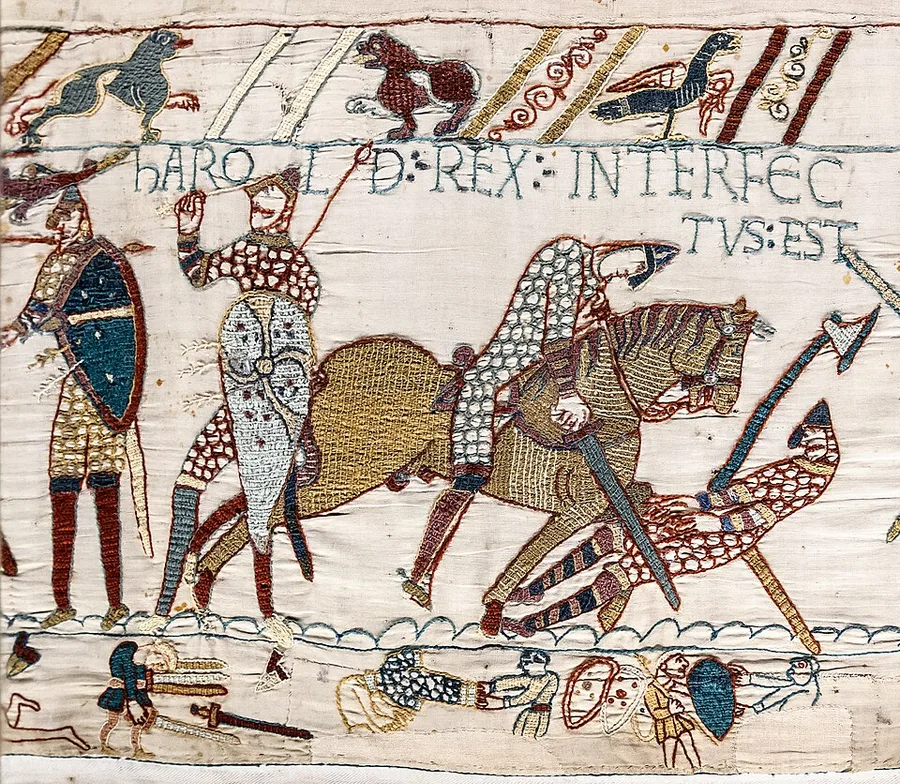 Bayeux Tapestry, Scene 57 (c. 1070s), Musée de la Tapisserie de Bayeux; photograph by Wikimedia contributor Myrabella Scene 57 of the Bayeux Tapestry, embroidered within living memory of 1066: HAROLD REX INTERFECTUS EST — King Harold is killed. The army that had beaten the Norwegians at Stamford Bridge three weeks earlier breaks on Senlac Hill, and a Norse-descended dynasty takes the English crown. Battle fought on 14 October 1066 between an English army under
King Harold Godwinson and an invading Norman force under William
the Conqueror, on Senlac Hill about ten kilometres north of the
town of Hastings in East Sussex. The Normans — themselves descended
from the Norse settlers Charles the Simple had granted Normandy in
911 — won decisively; Harold was killed (the Bayeux Tapestry shows
him reputedly struck through the eye by an arrow). The Norman
Conquest that followed put a Norse-descended dynasty on the English
throne, closing the long arc of the Viking Age.
by William the Conqueror
Bayeux Tapestry, Scene 57 (c. 1070s), Musée de la Tapisserie de Bayeux; photograph by Wikimedia contributor Myrabella Scene 57 of the Bayeux Tapestry, embroidered within living memory of 1066: HAROLD REX INTERFECTUS EST — King Harold is killed. The army that had beaten the Norwegians at Stamford Bridge three weeks earlier breaks on Senlac Hill, and a Norse-descended dynasty takes the English crown. Battle fought on 14 October 1066 between an English army under
King Harold Godwinson and an invading Norman force under William
the Conqueror, on Senlac Hill about ten kilometres north of the
town of Hastings in East Sussex. The Normans — themselves descended
from the Norse settlers Charles the Simple had granted Normandy in
911 — won decisively; Harold was killed (the Bayeux Tapestry shows
him reputedly struck through the eye by an arrow). The Norman
Conquest that followed put a Norse-descended dynasty on the English
throne, closing the long arc of the Viking Age.
by William the Conqueror 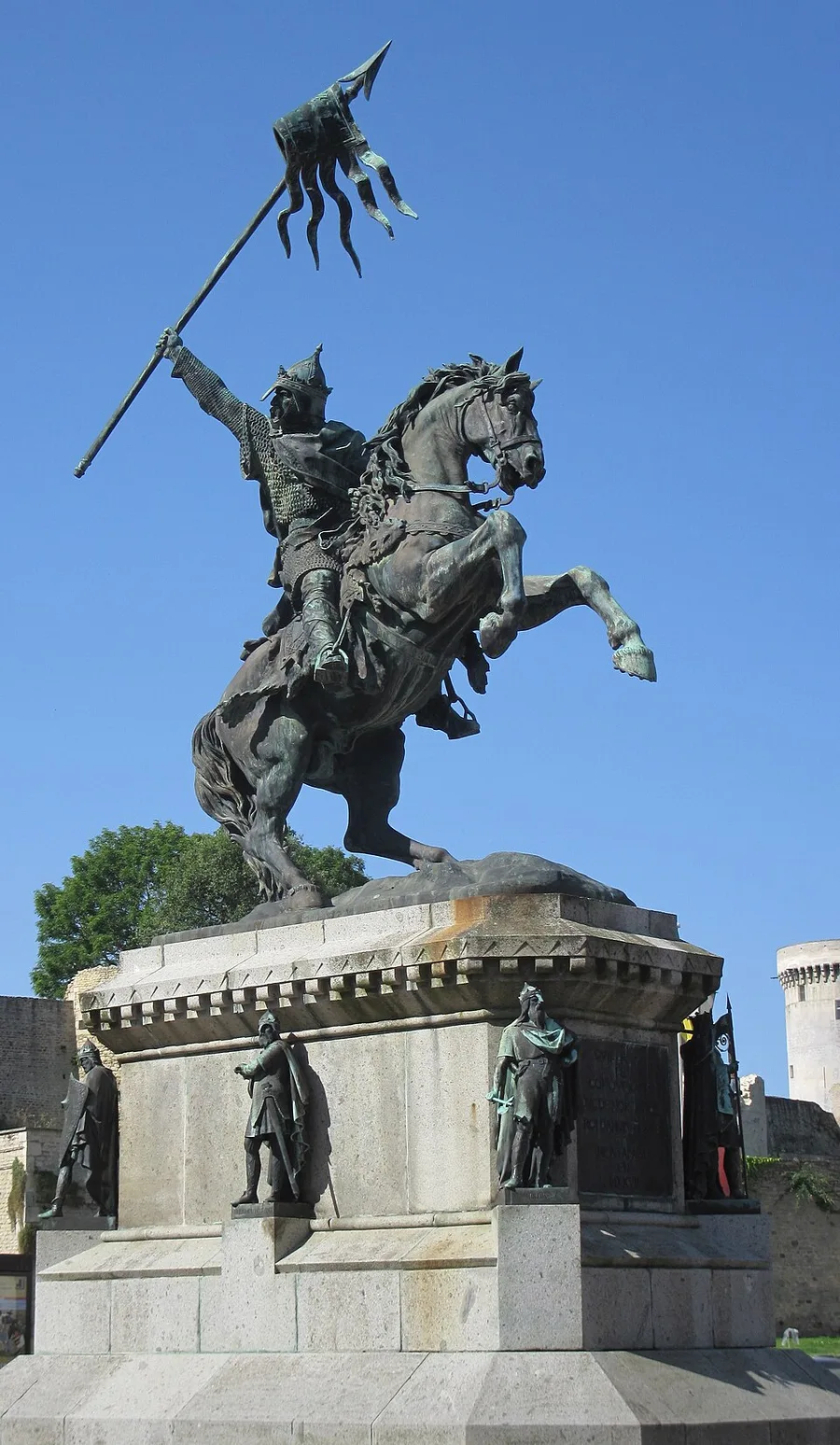 Louis Rochet, equestrian monument to William the Conqueror (1851), Falaise, Calvados. Photograph by Man vyi This 1851 monument stands in Falaise, William's birthplace: the mounted duke raises his gonfanon above a pedestal ringed by statues of his ducal predecessors in the line from Rollo — the Norse lineage that reached the English throne in 1066. Duke of Normandy from 1035 and King of England from 1066, born
c. 1028, died 1087. Direct descendant (great-great-great-grandson)
of the Norse warrior Rollo who had taken Normandy in 911. Defeated
Harold Godwinson at the Battle of Hastings on 14 October 1066 and
was crowned at Westminster Abbey on Christmas Day. The Norman
Conquest reorganised English landholding, replaced the Anglo-Saxon
aristocracy with a Norman one, and transformed the English language
through three centuries of French-speaking ruling-class influence.
— whose Norman ancestors are themselves descended from the Norse settlers who took the lower Seine valley a century and a half before. The English kingdom changes hands. The kind of campaign Hardrada had just attempted is never tried again at scale. The Norse age ends not with a formal close but with a fifty-one-year-old half-brother of a saint, offered seven feet of English ground and choosing the fight.
Louis Rochet, equestrian monument to William the Conqueror (1851), Falaise, Calvados. Photograph by Man vyi This 1851 monument stands in Falaise, William's birthplace: the mounted duke raises his gonfanon above a pedestal ringed by statues of his ducal predecessors in the line from Rollo — the Norse lineage that reached the English throne in 1066. Duke of Normandy from 1035 and King of England from 1066, born
c. 1028, died 1087. Direct descendant (great-great-great-grandson)
of the Norse warrior Rollo who had taken Normandy in 911. Defeated
Harold Godwinson at the Battle of Hastings on 14 October 1066 and
was crowned at Westminster Abbey on Christmas Day. The Norman
Conquest reorganised English landholding, replaced the Anglo-Saxon
aristocracy with a Norman one, and transformed the English language
through three centuries of French-speaking ruling-class influence.
— whose Norman ancestors are themselves descended from the Norse settlers who took the lower Seine valley a century and a half before. The English kingdom changes hands. The kind of campaign Hardrada had just attempted is never tried again at scale. The Norse age ends not with a formal close but with a fifty-one-year-old half-brother of a saint, offered seven feet of English ground and choosing the fight.
What survives in Norway
The most tangible traces of the Viking Age in modern Norway are concentrated in three places.
The Museum of the Viking Age 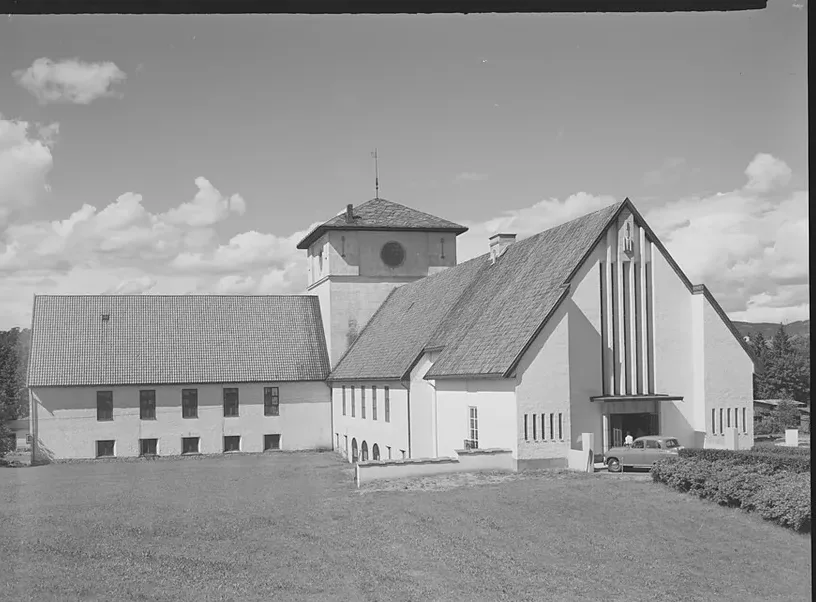 Mittet & Co. (photographer), Vikingskiphuset, Bygdøy (before 1957), National Library of Norway The Viking Ship House on Bygdøy in a mid-century photograph — Arnstein Arneberg's whitewashed halls, opened from 1926 to house the Oseberg, Gokstad, and Tune ships. Now closed for its rebuild into the Museum of the Viking Age, with reopening planned for 2027. The University of Oslo's museum on the Bygdøy peninsula in Oslo
that holds the Oseberg, Gokstad, and Tune Viking-Age ships — the
three most complete Viking longships ever recovered — along with
the grave goods buried with them and other Viking-Age material.
Originally opened in 1926 as the Viking Ship House; closed for
major rebuild from 2021 with reopening planned for 2027. While
closed, the VÍKINGR exhibition at the Historical Museum in central
Oslo holds Viking-Age material from the collections.
On the trip The Museum of the Viking Age on Bygdøy is closed for rebuild
through the family's July 2026 trip; the VÍKINGR exhibition at
the Historical Museum in central Oslo holds Viking-Age material
in its place.
Museum of the Viking Age, Bygdøy on the Bygdøy
Mittet & Co. (photographer), Vikingskiphuset, Bygdøy (before 1957), National Library of Norway The Viking Ship House on Bygdøy in a mid-century photograph — Arnstein Arneberg's whitewashed halls, opened from 1926 to house the Oseberg, Gokstad, and Tune ships. Now closed for its rebuild into the Museum of the Viking Age, with reopening planned for 2027. The University of Oslo's museum on the Bygdøy peninsula in Oslo
that holds the Oseberg, Gokstad, and Tune Viking-Age ships — the
three most complete Viking longships ever recovered — along with
the grave goods buried with them and other Viking-Age material.
Originally opened in 1926 as the Viking Ship House; closed for
major rebuild from 2021 with reopening planned for 2027. While
closed, the VÍKINGR exhibition at the Historical Museum in central
Oslo holds Viking-Age material from the collections.
On the trip The Museum of the Viking Age on Bygdøy is closed for rebuild
through the family's July 2026 trip; the VÍKINGR exhibition at
the Historical Museum in central Oslo holds Viking-Age material
in its place.
Museum of the Viking Age, Bygdøy on the Bygdøy 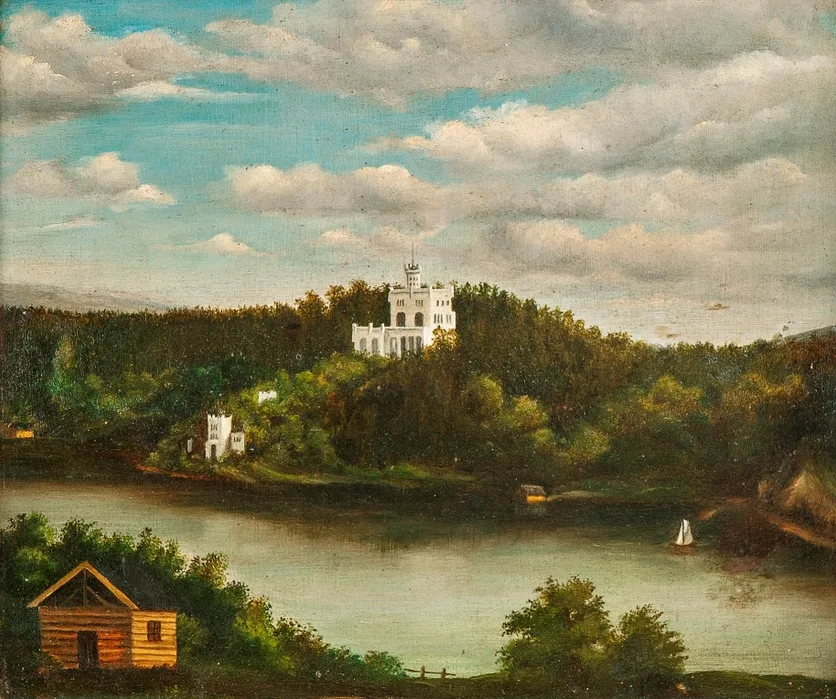 Aasta Hansteen, Oscarshall on Bygdøy (1854) Aasta Hansteen's 1854 painting shows Oscarshall, the royal pleasure palace built for King Oscar I on the Bygdøy peninsula — one of the estates and museum grounds that make up the Bygdøy the card describes. Peninsula at the western edge of the Oslo Fjord, immediately west
of central Oslo. Mostly green parkland, royal residences, and
museums — including the Museum of the Viking Age (closed for
rebuild, reopening planned 2027), the Norwegian Museum of Cultural
History, the Fram Museum (Polar exploration), the Kon-Tiki Museum,
and the Norwegian Maritime Museum. Bygdøy is reached from the city
by ferry across the Oslo harbour in summer or by bus.
Bygdøy, Oslo peninsula in Oslo holds the three most complete Viking-Age longships ever recovered — the Oseberg, the The Gokstad ship
Aasta Hansteen, Oscarshall on Bygdøy (1854) Aasta Hansteen's 1854 painting shows Oscarshall, the royal pleasure palace built for King Oscar I on the Bygdøy peninsula — one of the estates and museum grounds that make up the Bygdøy the card describes. Peninsula at the western edge of the Oslo Fjord, immediately west
of central Oslo. Mostly green parkland, royal residences, and
museums — including the Museum of the Viking Age (closed for
rebuild, reopening planned 2027), the Norwegian Museum of Cultural
History, the Fram Museum (Polar exploration), the Kon-Tiki Museum,
and the Norwegian Maritime Museum. Bygdøy is reached from the city
by ferry across the Oslo harbour in summer or by bus.
Bygdøy, Oslo peninsula in Oslo holds the three most complete Viking-Age longships ever recovered — the Oseberg, the The Gokstad ship 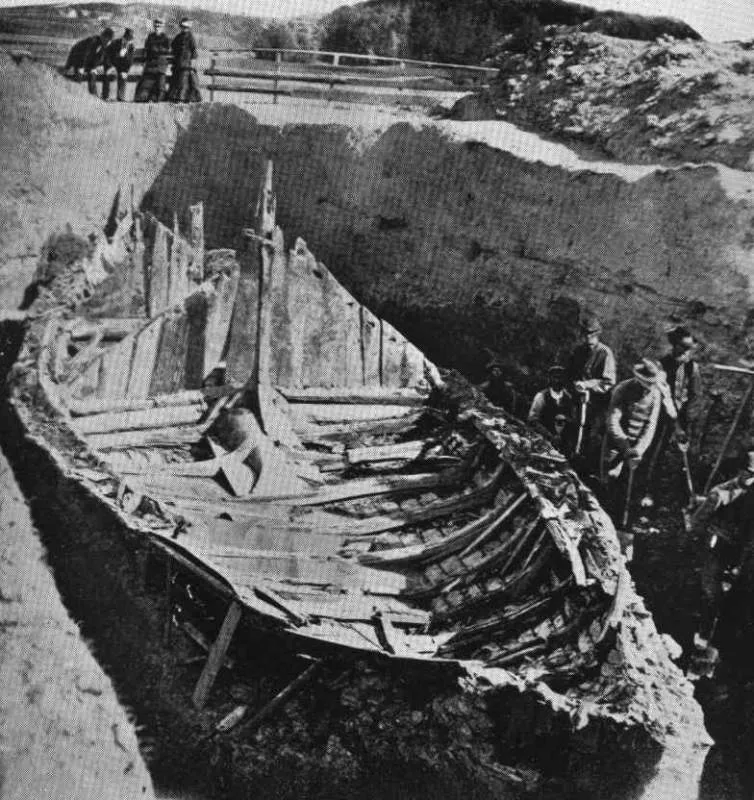 Unknown photographer, excavation of the Gokstad ship at the Gokstad farm, Sandefjord (c. 1880) This 1880 photograph, taken as the ship was lifted from the burial mound at the Gokstad farm, documents the actual moment of discovery of the ninth-century longship the card describes, now displayed at the Museum of the Viking Age on Bygdøy. Ninth-century Viking longship, built around 890 and excavated in
1880 from a burial mound at the Gokstad farm in Vestfold, Norway.
At twenty-four metres long it is larger than the Oseberg ship and
was clearly built for ocean voyaging — the keel and hull are
optimised for open-water sailing rather than ceremonial display.
The ship was the funerary vessel of a high-ranking man who died
around 900. Held at the Museum of the Viking Age on Bygdøy, Oslo
(closed for rebuild until 2027).
, and the The Tune ship
Unknown photographer, excavation of the Gokstad ship at the Gokstad farm, Sandefjord (c. 1880) This 1880 photograph, taken as the ship was lifted from the burial mound at the Gokstad farm, documents the actual moment of discovery of the ninth-century longship the card describes, now displayed at the Museum of the Viking Age on Bygdøy. Ninth-century Viking longship, built around 890 and excavated in
1880 from a burial mound at the Gokstad farm in Vestfold, Norway.
At twenty-four metres long it is larger than the Oseberg ship and
was clearly built for ocean voyaging — the keel and hull are
optimised for open-water sailing rather than ceremonial display.
The ship was the funerary vessel of a high-ranking man who died
around 900. Held at the Museum of the Viking Age on Bygdøy, Oslo
(closed for rebuild until 2027).
, and the The Tune ship 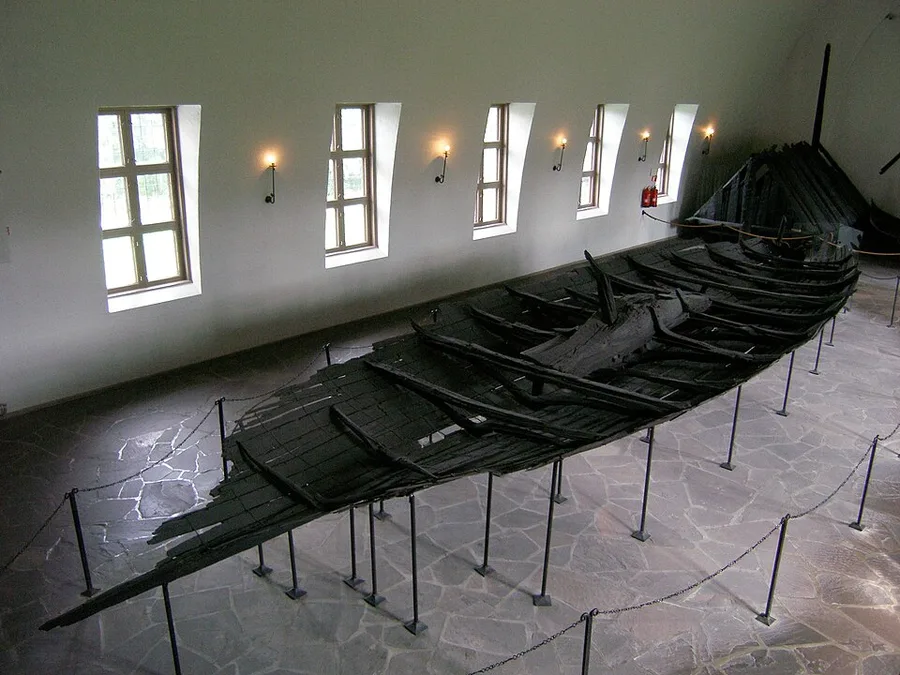 The Tune ship, Viking Ship Museum, Bygdøy, Oslo. Photograph by China Crisis (2006), CC BY-SA 2.5 The Tune ship as it stands in the museum hall — a fragmentary, blackened hull raised on steel supports. Dug from a burial mound at Tune in Østfold in 1867, it was the first major Viking ship ever excavated and remains the least complete of Bygdøy's three. Late-ninth-century Viking longship excavated in 1867 from a burial
mound at Haugen Farm in Tune (now Sarpsborg), Østfold, Norway —
the first major Viking ship ever excavated. Substantially less
complete than the later Oseberg and Gokstad finds; the surviving
hull is partially restored. The vessel was a seagoing ship of about
twenty metres in length. Held at the Museum of the Viking Age on
Bygdøy, Oslo (closed for rebuild until 2027).
ships, preserved in the heavy blue clay of burial mounds around the Oslofjord — the Oseberg and Gokstad in Vestfold, the Tune across the fjord in Østfold. The Oseberg is the richest. It was buried in the autumn of 834 with two very high-ranking women, one in her seventies and one perhaps in her fifties, along with horses and dogs and an ox, a four-wheeled wooden cart carved with animal-head terminals, ornamented sledges, the most elaborate textiles of any Viking-age burial, and a small wooden bucket of red apples preserved by the clay. The ship that carried them was built to sail, and it was buried with everything they would need for the world they were going to. (The museum is closed for rebuild until 2027; the VÍKINGR exhibition at the Historical Museum (Oslo)
The Tune ship, Viking Ship Museum, Bygdøy, Oslo. Photograph by China Crisis (2006), CC BY-SA 2.5 The Tune ship as it stands in the museum hall — a fragmentary, blackened hull raised on steel supports. Dug from a burial mound at Tune in Østfold in 1867, it was the first major Viking ship ever excavated and remains the least complete of Bygdøy's three. Late-ninth-century Viking longship excavated in 1867 from a burial
mound at Haugen Farm in Tune (now Sarpsborg), Østfold, Norway —
the first major Viking ship ever excavated. Substantially less
complete than the later Oseberg and Gokstad finds; the surviving
hull is partially restored. The vessel was a seagoing ship of about
twenty metres in length. Held at the Museum of the Viking Age on
Bygdøy, Oslo (closed for rebuild until 2027).
ships, preserved in the heavy blue clay of burial mounds around the Oslofjord — the Oseberg and Gokstad in Vestfold, the Tune across the fjord in Østfold. The Oseberg is the richest. It was buried in the autumn of 834 with two very high-ranking women, one in her seventies and one perhaps in her fifties, along with horses and dogs and an ox, a four-wheeled wooden cart carved with animal-head terminals, ornamented sledges, the most elaborate textiles of any Viking-age burial, and a small wooden bucket of red apples preserved by the clay. The ship that carried them was built to sail, and it was buried with everything they would need for the world they were going to. (The museum is closed for rebuild until 2027; the VÍKINGR exhibition at the Historical Museum (Oslo) 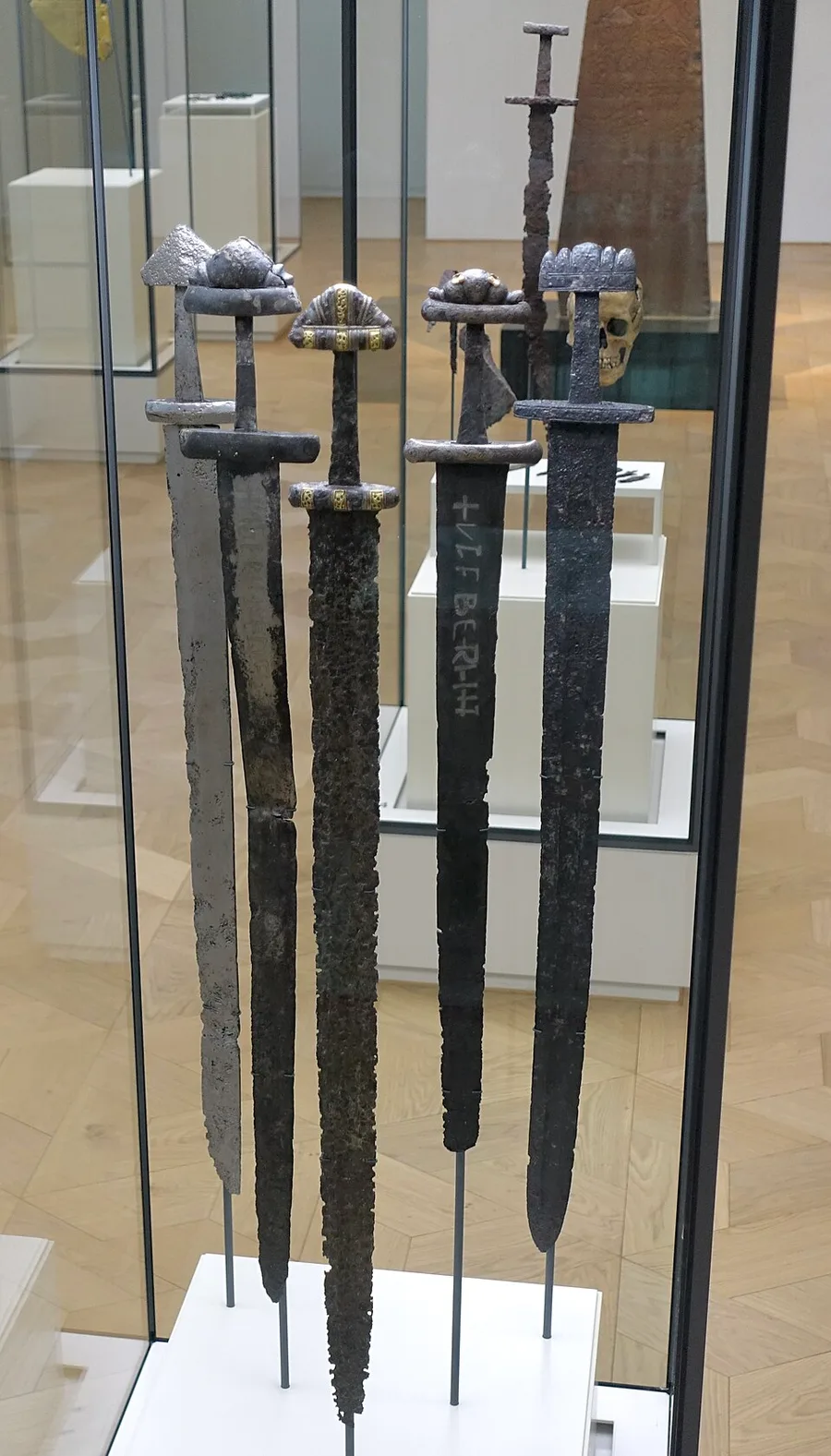 Wolfmann, Viking-Age swords in the VÍKINGR exhibition, Historical Museum, Oslo (2020), Wikimedia Commons, CC BY-SA 4.0 Viking-Age swords from Telemark, Nordland, and Hedmark are among eleven on display together in the museum's VÍKINGR exhibition; this frame captures five of them, including one blade inlaid ULFBERHT — the rotating showcase now more prominent while the Bygdøy ship museum rebuilds. The University of Oslo's archaeological and ethnographic museum in
central Oslo, near the Royal Palace. Houses Norway's principal
collection of pre-Reformation artefacts, including medieval
altarpieces from the country's wooden churches and the rotating
VÍKINGR exhibition of Viking-Age material — particularly important
while the Museum of the Viking Age on Bygdøy is closed for rebuild.
Historical Museum, central Oslo Also discussed in Worshiping Odin and Thor — the lived religion of pre-Christian Norway in central Oslo holds Viking material in the meantime.)
Wolfmann, Viking-Age swords in the VÍKINGR exhibition, Historical Museum, Oslo (2020), Wikimedia Commons, CC BY-SA 4.0 Viking-Age swords from Telemark, Nordland, and Hedmark are among eleven on display together in the museum's VÍKINGR exhibition; this frame captures five of them, including one blade inlaid ULFBERHT — the rotating showcase now more prominent while the Bygdøy ship museum rebuilds. The University of Oslo's archaeological and ethnographic museum in
central Oslo, near the Royal Palace. Houses Norway's principal
collection of pre-Reformation artefacts, including medieval
altarpieces from the country's wooden churches and the rotating
VÍKINGR exhibition of Viking-Age material — particularly important
while the Museum of the Viking Age on Bygdøy is closed for rebuild.
Historical Museum, central Oslo Also discussed in Worshiping Odin and Thor — the lived religion of pre-Christian Norway in central Oslo holds Viking material in the meantime.)
The Sverd i fjell 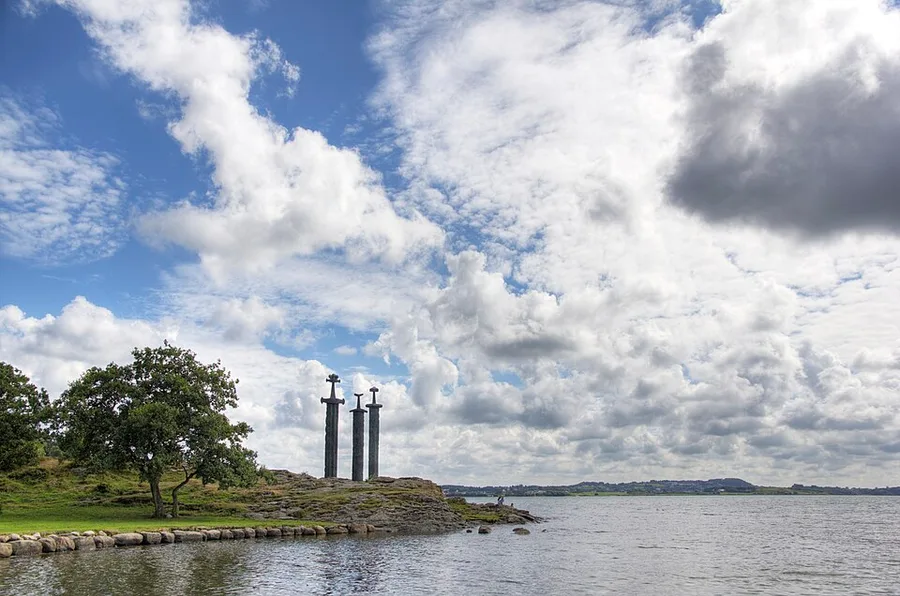 Photo: TomasEE (2013), Sverd i fjell, Hafrsfjord — CC BY 3.0 via Wikimedia Commons Fritz Røed's 1983 monument on Hafrsfjord: three bronze swords, each about ten metres, driven point-down into the bedrock. They mark the traditional site of Harald Fairhair's unifying sea-battle — the tallest sword for Harald, the other two for the petty kings he defeated. Norwegian for "swords in mountain" — a 1983 sculpture by Fritz Røed
on the eastern shore of Hafrsfjord near Stavanger, marking the
traditional site of Harald Fairhair's consolidating sea-battle.
Three giant bronze swords, each about ten metres tall, are driven
point-down into the bedrock; one represents Harald, the other two
represent the defeated petty kings. The monument commemorates both
the battle itself and the country's unification under a single
crown. One of Stavanger's principal landmarks.
Sverd i fjell, Hafrsfjord Also discussed in Before There Was Norway — petty kingdoms at the edge of the world monument — “Swords in Stone” — on the southern shore of Hafrsfjord
Photo: TomasEE (2013), Sverd i fjell, Hafrsfjord — CC BY 3.0 via Wikimedia Commons Fritz Røed's 1983 monument on Hafrsfjord: three bronze swords, each about ten metres, driven point-down into the bedrock. They mark the traditional site of Harald Fairhair's unifying sea-battle — the tallest sword for Harald, the other two for the petty kings he defeated. Norwegian for "swords in mountain" — a 1983 sculpture by Fritz Røed
on the eastern shore of Hafrsfjord near Stavanger, marking the
traditional site of Harald Fairhair's consolidating sea-battle.
Three giant bronze swords, each about ten metres tall, are driven
point-down into the bedrock; one represents Harald, the other two
represent the defeated petty kings. The monument commemorates both
the battle itself and the country's unification under a single
crown. One of Stavanger's principal landmarks.
Sverd i fjell, Hafrsfjord Also discussed in Before There Was Norway — petty kingdoms at the edge of the world monument — “Swords in Stone” — on the southern shore of Hafrsfjord 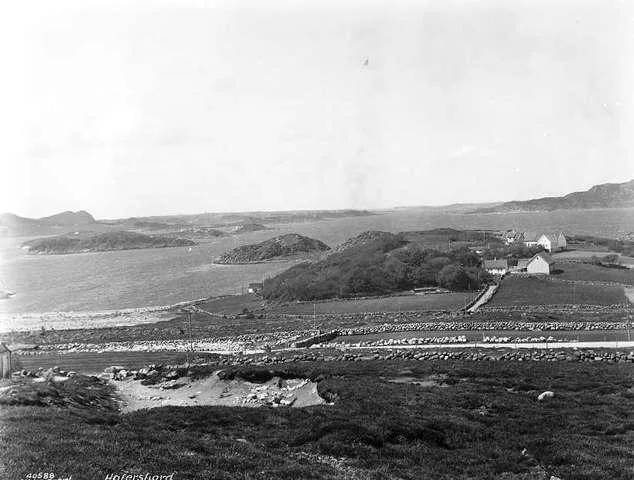 Anders Beer Wilse, Hafrsfjord (1934), Galleri Nor / Norsk Folkemuseum Wilse's 1934 photograph of the calm, shallow fjord southwest of Stavanger. Saga tradition places the sea-battle that completed Harald Fairhair's unification of western Norway in these waters, the shore now marked by the three great swords of Sverd i fjell. Shallow fjord at the southwestern edge of present-day Stavanger,
in Rogaland. Saga tradition places the sea-battle that completed
Harald Fairhair's consolidation of the western Norwegian coast in
this fjord — traditionally dated 872 (a nineteenth-century
back-calculation from Snorri's chronology) but placed by modern
scholarship in the 880s. The traditional battle site is marked by
the Sverd i fjell monument, three giant bronze swords driven into
bedrock on the eastern shore.
Hafrsfjord, Stavanger Also discussed in Before There Was Norway — petty kingdoms at the edge of the world near Stavanger
Anders Beer Wilse, Hafrsfjord (1934), Galleri Nor / Norsk Folkemuseum Wilse's 1934 photograph of the calm, shallow fjord southwest of Stavanger. Saga tradition places the sea-battle that completed Harald Fairhair's unification of western Norway in these waters, the shore now marked by the three great swords of Sverd i fjell. Shallow fjord at the southwestern edge of present-day Stavanger,
in Rogaland. Saga tradition places the sea-battle that completed
Harald Fairhair's consolidation of the western Norwegian coast in
this fjord — traditionally dated 872 (a nineteenth-century
back-calculation from Snorri's chronology) but placed by modern
scholarship in the 880s. The traditional battle site is marked by
the Sverd i fjell monument, three giant bronze swords driven into
bedrock on the eastern shore.
Hafrsfjord, Stavanger Also discussed in Before There Was Norway — petty kingdoms at the edge of the world near Stavanger 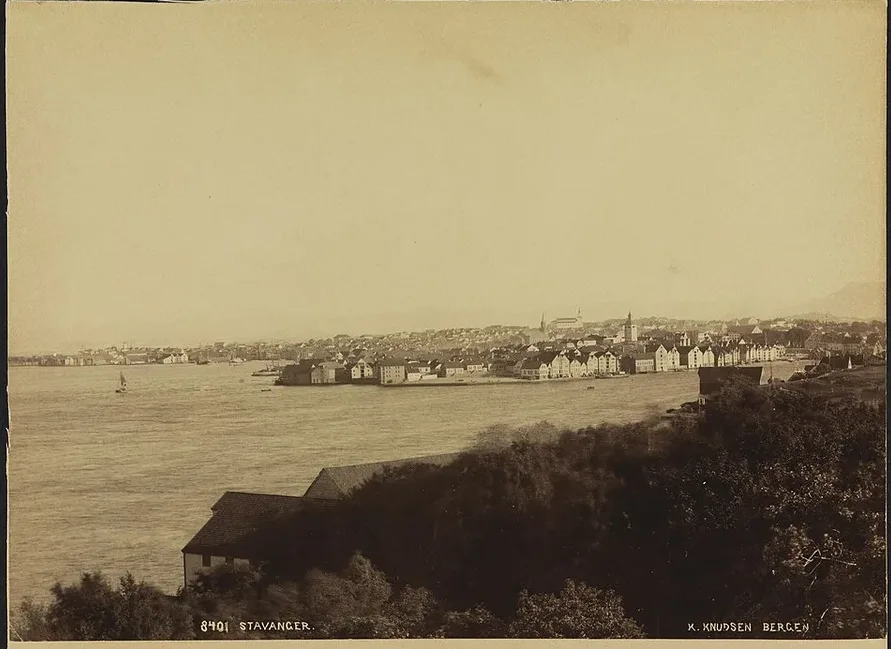 Knud Knudsen, Stavanger (1888-1894), National Library of Norway Stavanger in the late 1880s — the low wooden harbour town, church towers on the skyline, that the emigrant ships had been sailing from for two generations by the time Knudsen photographed it. City on the southwestern Norwegian coast in Rogaland; modern
Norway's fourth-largest city and the operational capital of the
Norwegian petroleum economy since the 1970s. The traditional site
of the sea-battle of Hafrsfjord that completed Harald Fairhair's
consolidation lies at the city's southwestern edge, marked by the
Sverd i fjell monument. The Norwegian Petroleum Directorate, the
safety regulator (Havtil), and Equinor (formerly Statoil) are all
headquartered in or around the city. Population around one hundred
and forty thousand in the municipality; metropolitan area roughly
twice that.
Stavanger Also discussed in Before There Was Norway — petty kingdoms at the edge of the worldA Catholic Norway — the faith that gave the kingdom its first institutions and the stave churchesThe 400-Year Night — when the Northern Lion lay dormantThe 'Lucky Country' — the discovery that changed everything800,000 Norwegians Leave — the century that built a Second NorwayWorld War II — the King’s “No” and the Nazis in Norway marks the traditional site of Harald Fairhair
Knud Knudsen, Stavanger (1888-1894), National Library of Norway Stavanger in the late 1880s — the low wooden harbour town, church towers on the skyline, that the emigrant ships had been sailing from for two generations by the time Knudsen photographed it. City on the southwestern Norwegian coast in Rogaland; modern
Norway's fourth-largest city and the operational capital of the
Norwegian petroleum economy since the 1970s. The traditional site
of the sea-battle of Hafrsfjord that completed Harald Fairhair's
consolidation lies at the city's southwestern edge, marked by the
Sverd i fjell monument. The Norwegian Petroleum Directorate, the
safety regulator (Havtil), and Equinor (formerly Statoil) are all
headquartered in or around the city. Population around one hundred
and forty thousand in the municipality; metropolitan area roughly
twice that.
Stavanger Also discussed in Before There Was Norway — petty kingdoms at the edge of the worldA Catholic Norway — the faith that gave the kingdom its first institutions and the stave churchesThe 400-Year Night — when the Northern Lion lay dormantThe 'Lucky Country' — the discovery that changed everything800,000 Norwegians Leave — the century that built a Second NorwayWorld War II — the King’s “No” and the Nazis in Norway marks the traditional site of Harald Fairhair 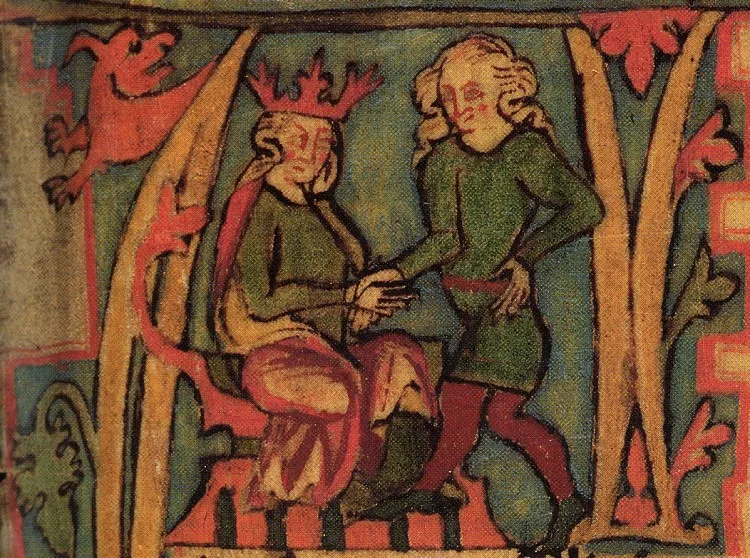 Flateyjarbók illumination, Harald Fairhair receives the kingdom (c. 1387–1394), Árni Magnússon Institute A page from the medieval saga manuscript Flateyjarbók, painted around 1390 — Harald crowned and enthroned, receiving the kingdom out of his father's line, some five centuries after he actually lived. Traditionally remembered as the first king of a unified Norway,
reigning ca. 872 to ca. 933. Inherited the small kingdom of Vestfold
at ten on the death of his father Halfdan the Black; over two decades
subdued the petty kingdoms of the western coast, climaxing at the
sea-battle of Hafrsfjord. His court poet's Haraldskvæði calls him
lúfa ("shock-head"); Hárfagri ("Fairhair") appears in verse of
debated authenticity attributed to his skalds, and is first securely
attested in twelfth-century prose (Íslendingabók). The famous
oath not to cut his hair until he had subjected every petty king is
later saga construction. His actual authority stopped short of the Arctic
north and the inland mountains, but he established the durable idea
of a single Norwegian crown.
Also discussed in Before There Was Norway — petty kingdoms at the edge of the worldThe Long Fall — the sudden loss of Norwegian nobility, the end of the kings, and half of Norway gone foreverThe Golden Age — a North Atlantic empire … reaching farther than you think ’s decisive Battle of Hafrsfjord
Flateyjarbók illumination, Harald Fairhair receives the kingdom (c. 1387–1394), Árni Magnússon Institute A page from the medieval saga manuscript Flateyjarbók, painted around 1390 — Harald crowned and enthroned, receiving the kingdom out of his father's line, some five centuries after he actually lived. Traditionally remembered as the first king of a unified Norway,
reigning ca. 872 to ca. 933. Inherited the small kingdom of Vestfold
at ten on the death of his father Halfdan the Black; over two decades
subdued the petty kingdoms of the western coast, climaxing at the
sea-battle of Hafrsfjord. His court poet's Haraldskvæði calls him
lúfa ("shock-head"); Hárfagri ("Fairhair") appears in verse of
debated authenticity attributed to his skalds, and is first securely
attested in twelfth-century prose (Íslendingabók). The famous
oath not to cut his hair until he had subjected every petty king is
later saga construction. His actual authority stopped short of the Arctic
north and the inland mountains, but he established the durable idea
of a single Norwegian crown.
Also discussed in Before There Was Norway — petty kingdoms at the edge of the worldThe Long Fall — the sudden loss of Norwegian nobility, the end of the kings, and half of Norway gone foreverThe Golden Age — a North Atlantic empire … reaching farther than you think ’s decisive Battle of Hafrsfjord 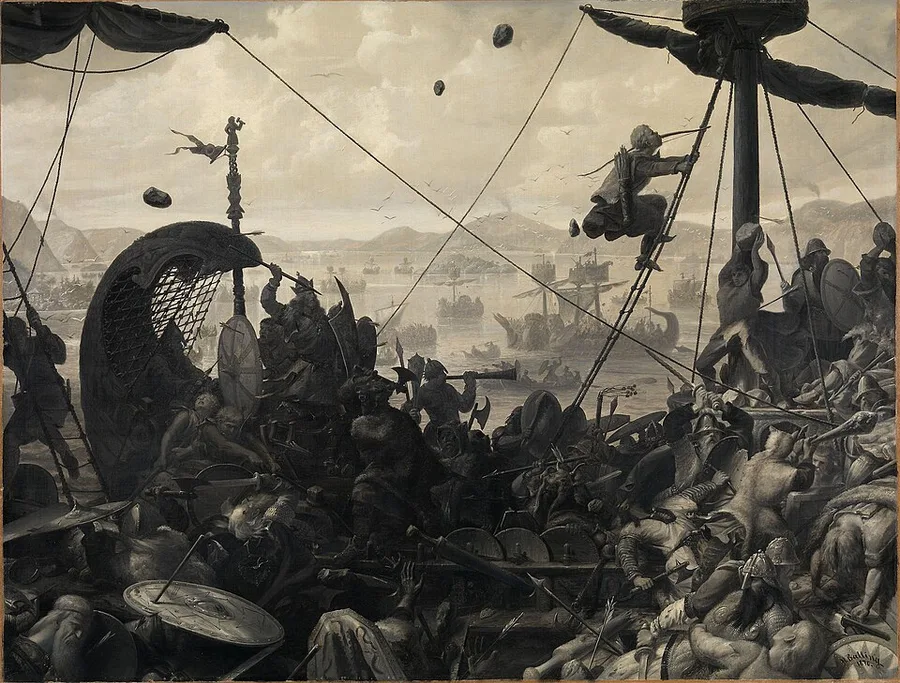 Ole Peter Hansen Balling, Harald Fairhair in the Battle of Hafrsfjord (1870), Nasjonalmuseet, NG.M.03750 Balling painted the sea-fight itself — men clashing across grappled longship decks as stones fly over a crowded fjord — the battle saga tradition treats as the climax of Harald Fairhair's conquest of the western coast. The sea-battle in the Hafrsfjord near present-day Stavanger that
saga tradition treats as the climactic engagement of Harald Fairhair's
consolidation of the western Norwegian coast. The traditional date
of 872 is a nineteenth-century back-calculation from Snorri's
chronology; modern Norwegian scholarship places the battle in the
880s. Harald's coalition defeated an alliance of the petty kings of
the western coast who had combined against him. The traditional
site is marked by the Sverd i fjell monument — three giant bronze
swords driven into the bedrock — on the eastern shore of the fjord.
Also discussed in Before There Was Norway — petty kingdoms at the edge of the world . Three enormous bronze swords stand driven hilts-up into the bedrock at the water’s edge. The image is the argument: weapons struck into stone that can never be drawn against each other again.
Ole Peter Hansen Balling, Harald Fairhair in the Battle of Hafrsfjord (1870), Nasjonalmuseet, NG.M.03750 Balling painted the sea-fight itself — men clashing across grappled longship decks as stones fly over a crowded fjord — the battle saga tradition treats as the climax of Harald Fairhair's conquest of the western coast. The sea-battle in the Hafrsfjord near present-day Stavanger that
saga tradition treats as the climactic engagement of Harald Fairhair's
consolidation of the western Norwegian coast. The traditional date
of 872 is a nineteenth-century back-calculation from Snorri's
chronology; modern Norwegian scholarship places the battle in the
880s. Harald's coalition defeated an alliance of the petty kings of
the western coast who had combined against him. The traditional
site is marked by the Sverd i fjell monument — three giant bronze
swords driven into the bedrock — on the eastern shore of the fjord.
Also discussed in Before There Was Norway — petty kingdoms at the edge of the world . Three enormous bronze swords stand driven hilts-up into the bedrock at the water’s edge. The image is the argument: weapons struck into stone that can never be drawn against each other again.
The reconstructed chieftain’s hall at Borg (Lofoten) 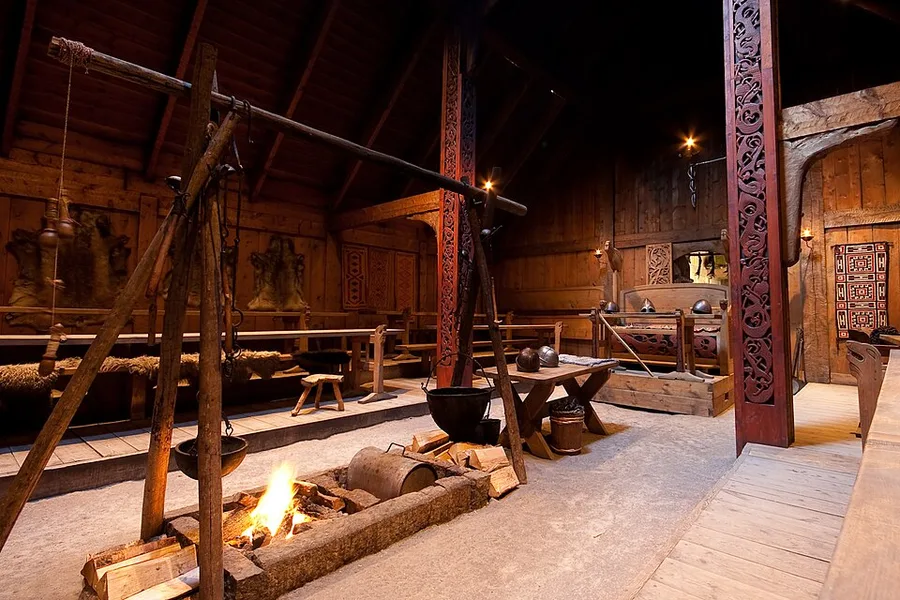 Photo: Jon Olav Eikenes (2009), CC BY 2.0 The hall as a chieftain's household would have known it: the interior of the Borg longhouse reconstruction, raised on the original footprint of the largest Viking-Age building ever found. Archaeological site on the island of Vestvågøy in the Lofoten
archipelago, above the Arctic Circle. Excavations in the 1980s
uncovered the foundations of a Viking-Age chieftain's longhouse
eighty-three metres in length — the largest known Viking-Age
building anywhere in Scandinavia. The hall has been reconstructed
on its original footprint as part of the Lofotr Viking Museum,
which presents the daily life of a chieftain's household at the
northern edge of the Viking world.
Borg, Lofoten on the Lofoten
Photo: Jon Olav Eikenes (2009), CC BY 2.0 The hall as a chieftain's household would have known it: the interior of the Borg longhouse reconstruction, raised on the original footprint of the largest Viking-Age building ever found. Archaeological site on the island of Vestvågøy in the Lofoten
archipelago, above the Arctic Circle. Excavations in the 1980s
uncovered the foundations of a Viking-Age chieftain's longhouse
eighty-three metres in length — the largest known Viking-Age
building anywhere in Scandinavia. The hall has been reconstructed
on its original footprint as part of the Lofotr Viking Museum,
which presents the daily life of a chieftain's household at the
northern edge of the Viking world.
Borg, Lofoten on the Lofoten  Gunnar Berg, Vinter i Lofoten (before 1893), via Wikimedia Commons Gunnar Berg's winter scene of a Lofoten fishing hamlet, barrels stacked by the boathouses. The archipelago's centuries-old winter cod fishery produced the dried stockfish that Bergen's Hanseatic merchants traded across Europe. Archipelago in Nordland County in northern Norway, lying north of
the Arctic Circle and stretching about a hundred and seventy
kilometres off the mainland coast. Famous for dramatic peaks
rising directly out of the sea, traditional fishing villages built
on stilts (rorbuer), and the centuries-old winter cod-fishing
industry that supplied the dried-stockfish trade Bergen ran during
the Hanseatic era. Site of the reconstructed Viking-Age chieftain's
hall at Borg — the largest known Viking-Age building in Scandinavia.
Lofoten Islands Also discussed in The Golden Age — a North Atlantic empire … reaching farther than you thinkThe Germans Who "Ruled" Bergen — the Hanseatic merchants on Bryggen WharfDraugen — the drowned man who never came home islands, above the Arctic Circle, is the largest known Viking-Age building in Scandinavia. The original longhouse — eighty-three meters from end to end, unmatched at any other excavated Norse site — was found beneath the modern farmland and rebuilt on its original footprint. A visitor steps inside and stands in a single room the length of a small street: smoke-blackened oak pillars rising into the dim, the long fire down the middle of the floor, benches running the length of both walls, the chieftain’s high seat at one end. This is where the men slept through the winter, ate at the chieftain’s table, listened to the skald’s verses, drank from the same cups, and swore the oaths they would later die under. The hall was not a barracks. It was a household, in the broadest Norse sense — the place a chieftain’s hird were, in their own understanding, members of his family.
Gunnar Berg, Vinter i Lofoten (before 1893), via Wikimedia Commons Gunnar Berg's winter scene of a Lofoten fishing hamlet, barrels stacked by the boathouses. The archipelago's centuries-old winter cod fishery produced the dried stockfish that Bergen's Hanseatic merchants traded across Europe. Archipelago in Nordland County in northern Norway, lying north of
the Arctic Circle and stretching about a hundred and seventy
kilometres off the mainland coast. Famous for dramatic peaks
rising directly out of the sea, traditional fishing villages built
on stilts (rorbuer), and the centuries-old winter cod-fishing
industry that supplied the dried-stockfish trade Bergen ran during
the Hanseatic era. Site of the reconstructed Viking-Age chieftain's
hall at Borg — the largest known Viking-Age building in Scandinavia.
Lofoten Islands Also discussed in The Golden Age — a North Atlantic empire … reaching farther than you thinkThe Germans Who "Ruled" Bergen — the Hanseatic merchants on Bryggen WharfDraugen — the drowned man who never came home islands, above the Arctic Circle, is the largest known Viking-Age building in Scandinavia. The original longhouse — eighty-three meters from end to end, unmatched at any other excavated Norse site — was found beneath the modern farmland and rebuilt on its original footprint. A visitor steps inside and stands in a single room the length of a small street: smoke-blackened oak pillars rising into the dim, the long fire down the middle of the floor, benches running the length of both walls, the chieftain’s high seat at one end. This is where the men slept through the winter, ate at the chieftain’s table, listened to the skald’s verses, drank from the same cups, and swore the oaths they would later die under. The hall was not a barracks. It was a household, in the broadest Norse sense — the place a chieftain’s hird were, in their own understanding, members of his family.
The country that built the longships is gone. The ships, the swords, and the hall are still here.
Sources & further reading
Primary sources
- Anglo-Saxon Chronicle
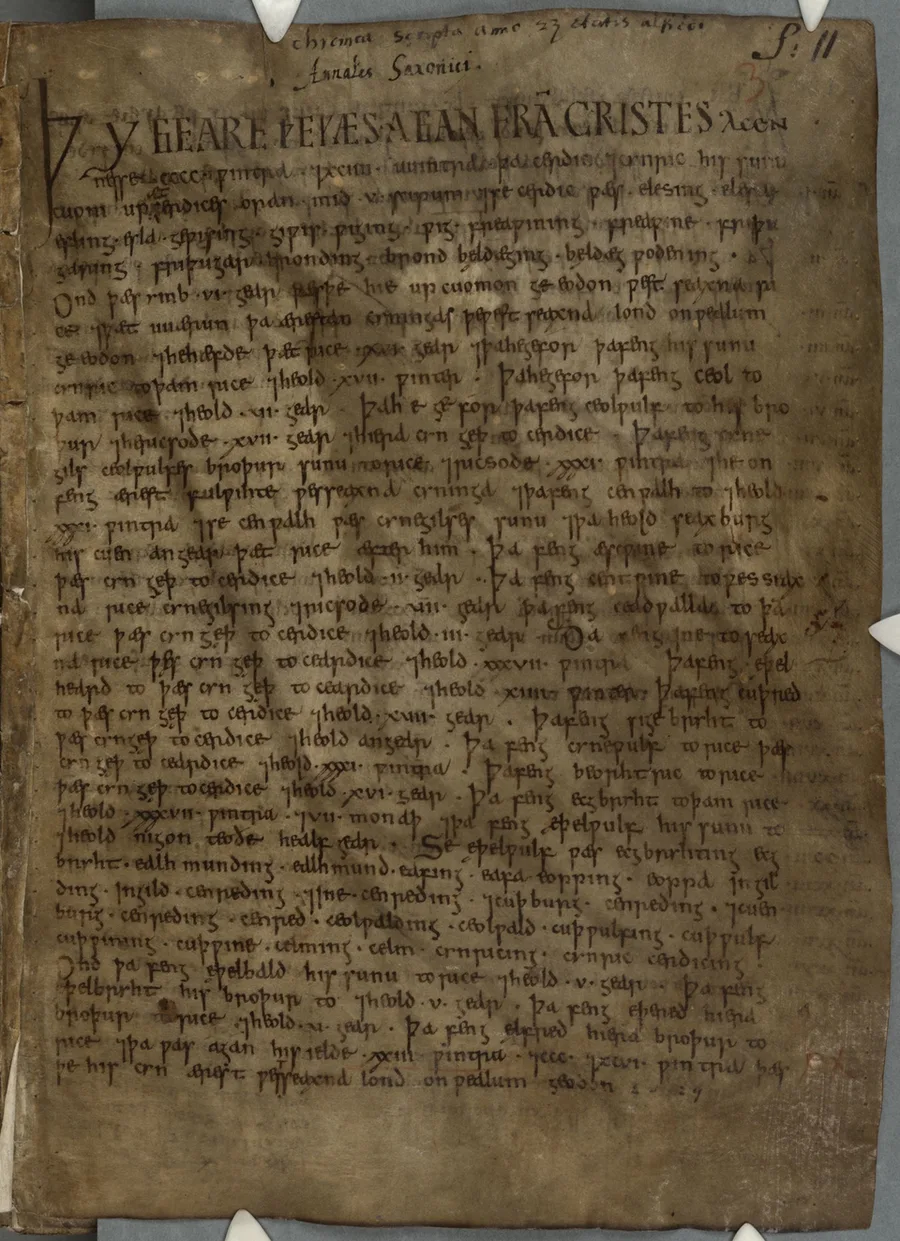 Unknown scribe, the Parker Chronicle (Corpus Christi College, Cambridge, MS 173), c. 890s A page of the Parker Chronicle, the oldest surviving manuscript of the Anglo-Saxon Chronicle, copied in the 890s — the annals whose terse Old English entries for 789 and 793 are the closest thing to a news record of the Viking Age's opening. The principal historical chronicle of Anglo-Saxon and early-Norman
England, compiled originally in the late ninth century under King
Alfred the Great's patronage and continued by various monastic
scribes into the mid-twelfth century. The Chronicle survives in nine
manuscripts and fragments (seven wholly in Old English) with
overlapping but not identical content. Its annal entries for 789 (the Portland raid) and 793 (the
Lindisfarne raid) are the principal written witnesses to the
opening of the Viking Age in the British Isles.
, annal entries for 789 (Portland) and 793 (Lindisfarne).
Unknown scribe, the Parker Chronicle (Corpus Christi College, Cambridge, MS 173), c. 890s A page of the Parker Chronicle, the oldest surviving manuscript of the Anglo-Saxon Chronicle, copied in the 890s — the annals whose terse Old English entries for 789 and 793 are the closest thing to a news record of the Viking Age's opening. The principal historical chronicle of Anglo-Saxon and early-Norman
England, compiled originally in the late ninth century under King
Alfred the Great's patronage and continued by various monastic
scribes into the mid-twelfth century. The Chronicle survives in nine
manuscripts and fragments (seven wholly in Old English) with
overlapping but not identical content. Its annal entries for 789 (the Portland raid) and 793 (the
Lindisfarne raid) are the principal written witnesses to the
opening of the Viking Age in the British Isles.
, annal entries for 789 (Portland) and 793 (Lindisfarne). - Alcuin of York, letters to King Æthelred of Northumbria and Bishop Higbald of Lindisfarne, 793.
- Snorri Sturluson
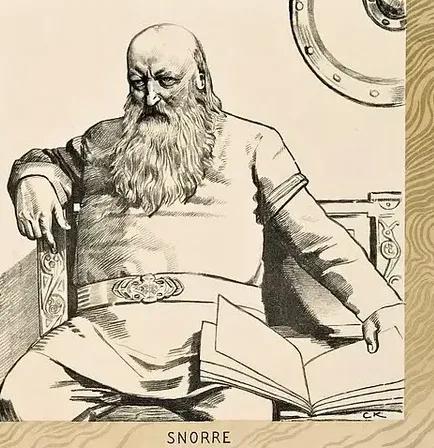 Christian Krohg, Snorre Sturlason (1899), from Norges Kongesagaer; scan: National Library of Norway Christian Krohg's portrait of Snorri from the 1899 folk edition of Heimskringla — the historian seated with a great open book across his knees. No contemporary likeness of Snorri exists; Krohg's drawing is the face Norway gave its most important medieval source. Thirteenth-century Icelandic chieftain, poet, and historian.
Composed the Heimskringla and the Prose Edda in the 1220s
from oral tradition and skaldic verse — three hundred years after
the Viking-age events he describes. The single richest source for
Norway's pre-conversion centuries and also the most aware
Christian-Icelandic editor of them. Modern scholarship accepts
what other sources independently confirm and treats his richest
expansions as the work of a poet writing about a kingdom he had
never seen. Assassinated at Reykholt on 23 September 1241 by
agents of King Hákon IV after a falling-out at court.
Also discussed in Before There Was Norway — petty kingdoms at the edge of the worldWorshiping Odin and Thor — the lived religion of pre-Christian NorwayThe King Who Became a Saint — how the Nordmen came to ChristA Catholic Norway — the faith that gave the kingdom its first institutions and the stave churchesThe Golden Age — a North Atlantic empire … reaching farther than you thinkThe Crusades?!!!! — sixty ships from Bergen, bound for the Holy LandNordisk Mytologi — Odin, the giants, and Ragnarok , Heimskringla
Christian Krohg, Snorre Sturlason (1899), from Norges Kongesagaer; scan: National Library of Norway Christian Krohg's portrait of Snorri from the 1899 folk edition of Heimskringla — the historian seated with a great open book across his knees. No contemporary likeness of Snorri exists; Krohg's drawing is the face Norway gave its most important medieval source. Thirteenth-century Icelandic chieftain, poet, and historian.
Composed the Heimskringla and the Prose Edda in the 1220s
from oral tradition and skaldic verse — three hundred years after
the Viking-age events he describes. The single richest source for
Norway's pre-conversion centuries and also the most aware
Christian-Icelandic editor of them. Modern scholarship accepts
what other sources independently confirm and treats his richest
expansions as the work of a poet writing about a kingdom he had
never seen. Assassinated at Reykholt on 23 September 1241 by
agents of King Hákon IV after a falling-out at court.
Also discussed in Before There Was Norway — petty kingdoms at the edge of the worldWorshiping Odin and Thor — the lived religion of pre-Christian NorwayThe King Who Became a Saint — how the Nordmen came to ChristA Catholic Norway — the faith that gave the kingdom its first institutions and the stave churchesThe Golden Age — a North Atlantic empire … reaching farther than you thinkThe Crusades?!!!! — sixty ships from Bergen, bound for the Holy LandNordisk Mytologi — Odin, the giants, and Ragnarok , Heimskringla 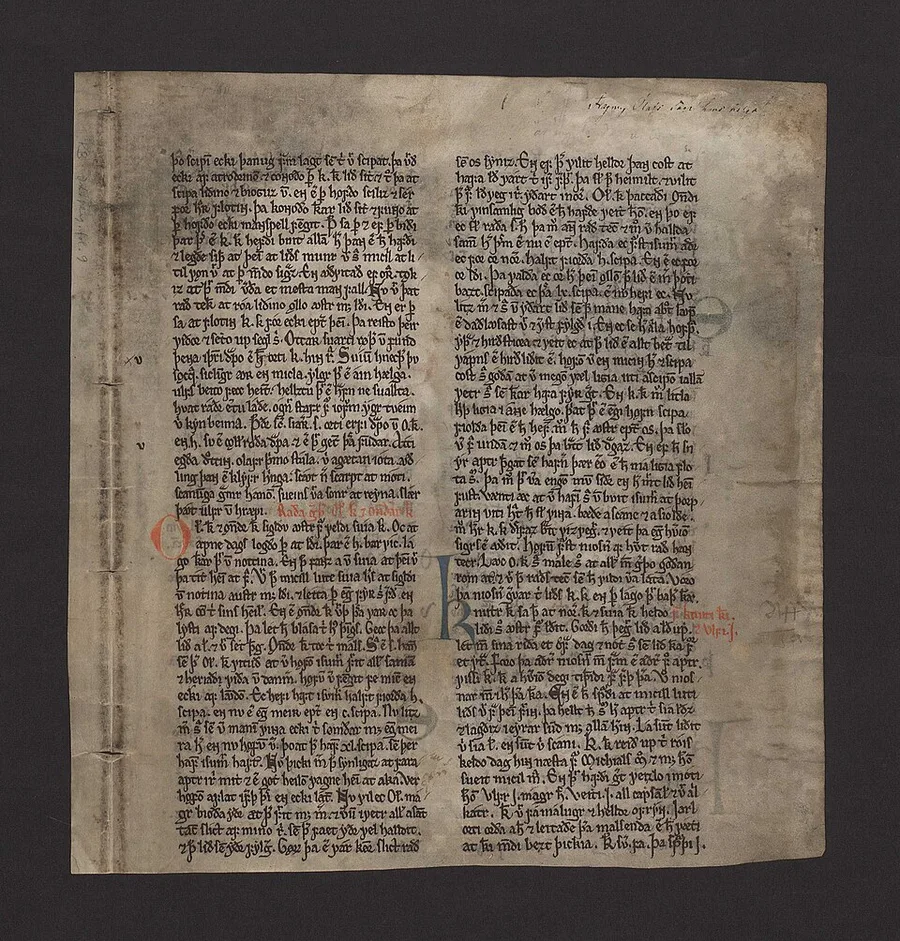 Kringlublaðið (the Kringla leaf), Lbs fragm 82, c. 1260 — National and University Library of Iceland This single surviving vellum leaf is all that remains of the original Kringla manuscript — the best medieval copy of Heimskringla — after the rest burned in Copenhagen's 1728 fire. Snorri Sturluson's prose history of the kings of Norway, composed
in the 1220s. Sixteen sagas running from the semi-mythical Yngling
line through to the late twelfth century. The single most extensive
medieval source for Norway's Viking and Christianization centuries
— trusted on the broad shape of political history, questioned in
the literary expansions, and written by a Christian Icelander
three hundred years after the events.
Also discussed in Worshiping Odin and Thor — the lived religion of pre-Christian NorwayThe King Who Became a Saint — how the Nordmen came to ChristA Catholic Norway — the faith that gave the kingdom its first institutions and the stave churchesThe Golden Age — a North Atlantic empire … reaching farther than you thinkThe Crusades?!!!! — sixty ships from Bergen, bound for the Holy Land (c. 1230), especially the sagas of Harald Fairhair, Olav Haraldsson, and Harald Hardrada.
Kringlublaðið (the Kringla leaf), Lbs fragm 82, c. 1260 — National and University Library of Iceland This single surviving vellum leaf is all that remains of the original Kringla manuscript — the best medieval copy of Heimskringla — after the rest burned in Copenhagen's 1728 fire. Snorri Sturluson's prose history of the kings of Norway, composed
in the 1220s. Sixteen sagas running from the semi-mythical Yngling
line through to the late twelfth century. The single most extensive
medieval source for Norway's Viking and Christianization centuries
— trusted on the broad shape of political history, questioned in
the literary expansions, and written by a Christian Icelander
three hundred years after the events.
Also discussed in Worshiping Odin and Thor — the lived religion of pre-Christian NorwayThe King Who Became a Saint — how the Nordmen came to ChristA Catholic Norway — the faith that gave the kingdom its first institutions and the stave churchesThe Golden Age — a North Atlantic empire … reaching farther than you thinkThe Crusades?!!!! — sixty ships from Bergen, bound for the Holy Land (c. 1230), especially the sagas of Harald Fairhair, Olav Haraldsson, and Harald Hardrada.
Modern scholarship
- Neil Price, Children of Ash and Elm: A History of the Vikings (Basic Books, 2020). The leading recent synthesis, particularly strong on worldview, gender, and the slave economy.
- Anders Winroth, The Age of the Vikings (Princeton University Press, 2014). The standard modern English-language synthesis.
- Knut Helle, ed., The Cambridge History of Scandinavia, Volume 1: Prehistory to 1520 (Cambridge University Press, 2003).
- Jenny Jochens, Women in Old Norse Society (Cornell University Press, 1995).
- Ruth Mazo Karras, Slavery and Society in Medieval Scandinavia (Yale University Press, 1988).
Reference
- Store norske leksikon (snl.no), entries “Vikingtid,” “Slaget i Hafrsfjord,” “Osebergskipet,” “Slaget ved Stamford Bridge.”
Visit
- Museum of the Viking Age, Bygdøy, Oslo — closed for rebuild until 2027. https://www.khm.uio.no/english/visit-us/museum-of-the-viking-age/
- VÍKINGR exhibition, Historical Museum, central Oslo — substitute Viking-Age display while Bygdøy is closed. https://www.khm.uio.no/english/visit-us/historical-museum/
- Sverd i fjell, Hafrsfjord, Stavanger
- Lofotr Viking Museum
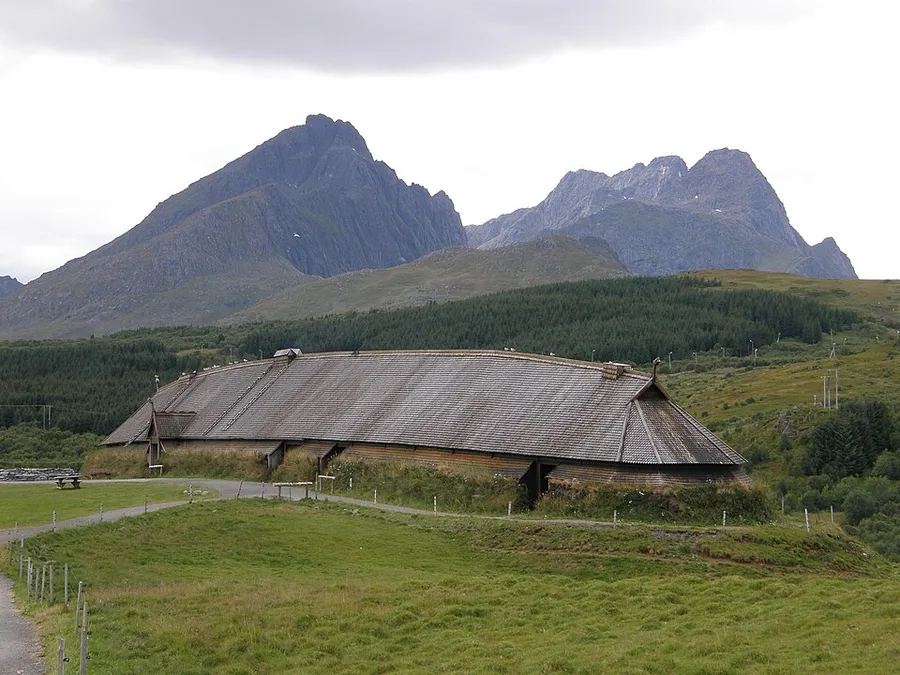 Paul Berzinn, reconstructed Viking longhouse, Lofotr Viking Museum, Borg (2008), Wikimedia Commons, CC BY-SA 3.0 The reconstructed chieftain's longhouse at Borg in Lofoten, raised full-scale on the excavated footprint of the largest known Viking-Age building anywhere — eighty-three metres of hall under one roof beneath the island peaks. The closest a visitor gets to standing inside a chieftain's hall. Open-air museum at Borg on the island of Vestvågøy in the Lofoten
archipelago, opened in 1995. Built around the excavated foundations
of the largest known Viking-Age building anywhere — an eighty-three-
metre chieftain's longhouse — the museum reconstructs the longhouse
on its original footprint and presents the daily life of a
high-ranking Viking-Age household at the northern edge of the Norse
world. Includes a working forge, costumed interpreters, and a
reproduction longship.
Lofotr Viking Museum, Borg Also discussed in Worshiping Odin and Thor — the lived religion of pre-Christian Norway , Borg, Lofoten — https://www.lofotr.no
Paul Berzinn, reconstructed Viking longhouse, Lofotr Viking Museum, Borg (2008), Wikimedia Commons, CC BY-SA 3.0 The reconstructed chieftain's longhouse at Borg in Lofoten, raised full-scale on the excavated footprint of the largest known Viking-Age building anywhere — eighty-three metres of hall under one roof beneath the island peaks. The closest a visitor gets to standing inside a chieftain's hall. Open-air museum at Borg on the island of Vestvågøy in the Lofoten
archipelago, opened in 1995. Built around the excavated foundations
of the largest known Viking-Age building anywhere — an eighty-three-
metre chieftain's longhouse — the museum reconstructs the longhouse
on its original footprint and presents the daily life of a
high-ranking Viking-Age household at the northern edge of the Norse
world. Includes a working forge, costumed interpreters, and a
reproduction longship.
Lofotr Viking Museum, Borg Also discussed in Worshiping Odin and Thor — the lived religion of pre-Christian Norway , Borg, Lofoten — https://www.lofotr.no