Driving in Norway — Tolls, ferries, and a near-zero alcohol limit
AutoPASS tolls collect themselves, some ferries are part of the road, speed cameras are enforced strictly, mountain roads are slow, and Norway's drink-driving limit is effectively zero. The Gråhårsklubben (the Oldsters) drives most of this leg.
Driving in Norway is not difficult — the roads are well kept, the signage is clear, and Norwegians drive calmly. Several things work differently than they do in the United States; the differences are easier to absorb before the trip than to discover from the driver’s seat. This matters most for the Gråhårsklubben (the Oldsters), who drive their own Slektsreisen (the family-lineage journey) leg north to Trondheim 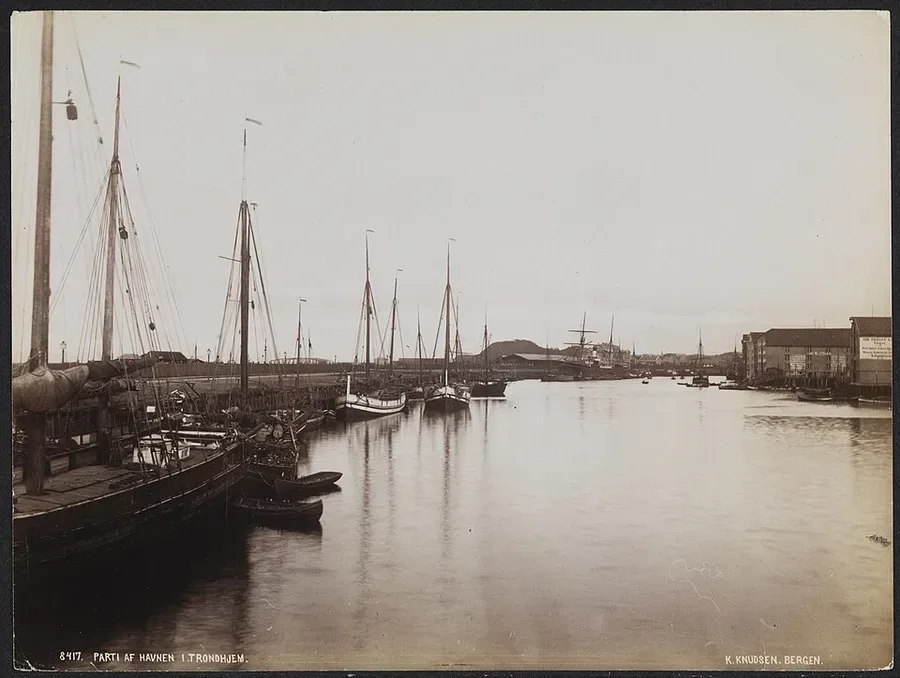 Knud Knudsen, Parti af Havnen i Trondhjem (1888-1894), National Library of Norway Knud Knudsen's photograph of Trondheim harbour in the early 1890s. Founded by Olav Tryggvason in 997 as Nidaros, the city was Norway's medieval capital and the seat of the archbishopric and the Olav cult that anchored the country's Christianity. Norway's third-largest city, founded by Olav Tryggvason in 997 as
Nidaros at the mouth of the Nid River on the inner Trondheim
Fjord. Capital of the Norwegian kingdom for much of the medieval
period; seat of the Norwegian archbishopric from 1153 and of the
Olav cult that anchored medieval Norwegian Christianity. Renamed
Trondheim in 1931 — after a controversial one-year spell
officially named Nidaros from 1930 — replacing the Danish-era
spelling Trondhjem and reviving the medieval Old Norse district
name (Þrándheimr). About two hundred thousand people in the municipality
today. Home to Nidaros Cathedral, NTNU (the Norwegian University
of Science and Technology), and the Trondheim Fjord harbour.
In this article Day 3 of the Slektsreisen brings the Gråhårsklubben (the
Oldsters) up the E6 into Trondheim by car — the northern turn
of the heritage drive, and the base for the Day-4 run out to
the Stjørdal valley.
On the trip Day 3 of the trip routes the Gråhårsklubben (the Oldsters) through
Trondheim. The visit centres on Nidaros Cathedral — the building
the Olav devotion raised, and the architectural inheritance of
Bishop Grimkell's pronouncement on a summer day in 1031.
Trondheim Also discussed in The King Who Became a Saint — how the Nordmen came to ChristA Catholic Norway — the faith that gave the kingdom its first institutions and the stave churchesThe Crusades?!!!! — sixty ships from Bergen, bound for the Holy LandThe Golden Age — a North Atlantic empire … reaching farther than you thinkThe Long Fall — the sudden loss of Norwegian nobility, the end of the kings, and half of Norway gone foreverThe 400-Year Night — when the Northern Lion lay dormantThe Reformation, 1537 — one church eradicated and another imposedLutheran Norway and Pietism — a farmer named Hans Nielsen Hauge and a lay revival that could not be silencedWorld War II — the King’s “No” and the Nazis in NorwayBefore There Was Norway — petty kingdoms at the edge of the worldEveryday etiquette — quiet voices, wide space, no smiling🚨 Emergencies - important numbers, hospitals, and what you can doLanguage basics — just enough Norwegian to be polite , Hegra, and Kylloplass.
Knud Knudsen, Parti af Havnen i Trondhjem (1888-1894), National Library of Norway Knud Knudsen's photograph of Trondheim harbour in the early 1890s. Founded by Olav Tryggvason in 997 as Nidaros, the city was Norway's medieval capital and the seat of the archbishopric and the Olav cult that anchored the country's Christianity. Norway's third-largest city, founded by Olav Tryggvason in 997 as
Nidaros at the mouth of the Nid River on the inner Trondheim
Fjord. Capital of the Norwegian kingdom for much of the medieval
period; seat of the Norwegian archbishopric from 1153 and of the
Olav cult that anchored medieval Norwegian Christianity. Renamed
Trondheim in 1931 — after a controversial one-year spell
officially named Nidaros from 1930 — replacing the Danish-era
spelling Trondhjem and reviving the medieval Old Norse district
name (Þrándheimr). About two hundred thousand people in the municipality
today. Home to Nidaros Cathedral, NTNU (the Norwegian University
of Science and Technology), and the Trondheim Fjord harbour.
In this article Day 3 of the Slektsreisen brings the Gråhårsklubben (the
Oldsters) up the E6 into Trondheim by car — the northern turn
of the heritage drive, and the base for the Day-4 run out to
the Stjørdal valley.
On the trip Day 3 of the trip routes the Gråhårsklubben (the Oldsters) through
Trondheim. The visit centres on Nidaros Cathedral — the building
the Olav devotion raised, and the architectural inheritance of
Bishop Grimkell's pronouncement on a summer day in 1031.
Trondheim Also discussed in The King Who Became a Saint — how the Nordmen came to ChristA Catholic Norway — the faith that gave the kingdom its first institutions and the stave churchesThe Crusades?!!!! — sixty ships from Bergen, bound for the Holy LandThe Golden Age — a North Atlantic empire … reaching farther than you thinkThe Long Fall — the sudden loss of Norwegian nobility, the end of the kings, and half of Norway gone foreverThe 400-Year Night — when the Northern Lion lay dormantThe Reformation, 1537 — one church eradicated and another imposedLutheran Norway and Pietism — a farmer named Hans Nielsen Hauge and a lay revival that could not be silencedWorld War II — the King’s “No” and the Nazis in NorwayBefore There Was Norway — petty kingdoms at the edge of the worldEveryday etiquette — quiet voices, wide space, no smiling🚨 Emergencies - important numbers, hospitals, and what you can doLanguage basics — just enough Norwegian to be polite , Hegra, and Kylloplass.
Tolls collect themselves
Norway has many toll roads, and you will almost never stop for one. The system, AutoPASS, reads your license plate automatically as you pass under a gantry. A rental car is registered to the system; the tolls are tallied and either billed to the rental company (which passes the charge through, sometimes with a small handling fee) or invoiced later. Ask the rental company how they handle AutoPASS billing at pickup so the later invoice isn’t a surprise. A typical week of driving the heritage leg accumulates somewhere in the Norwegian krone (NOK) 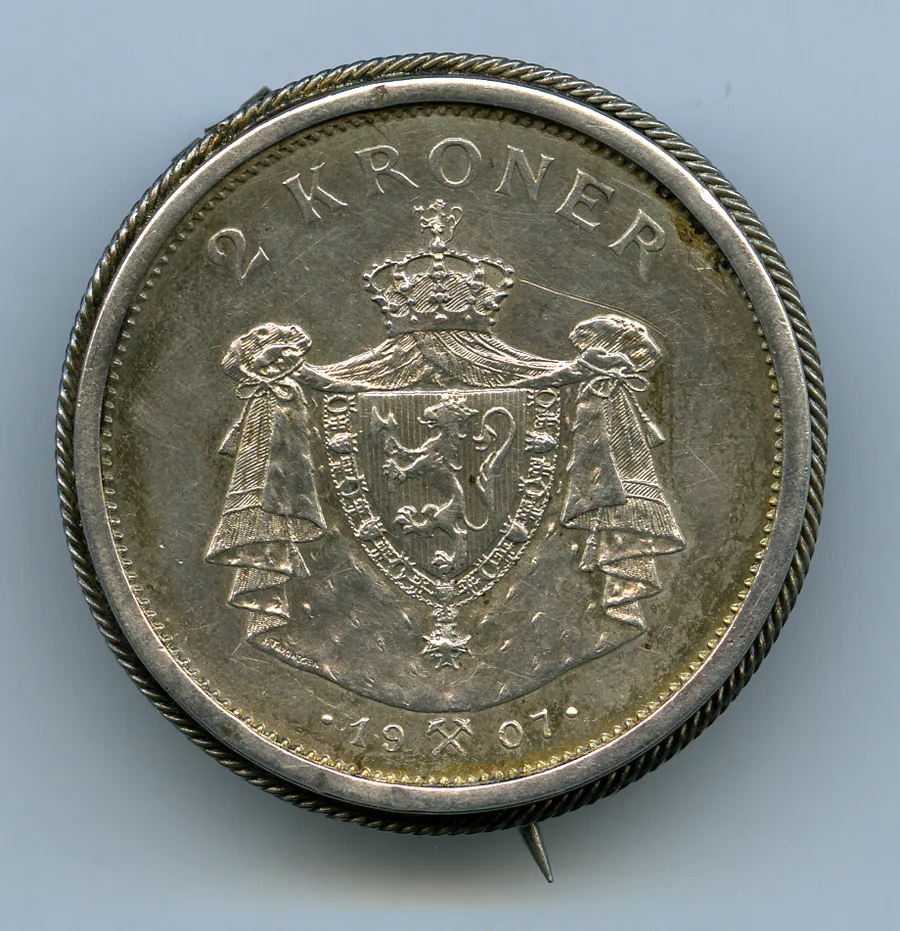 Trondheim Municipal Archives (Trondheim byarkiv), CC BY 2.0, via Wikimedia Commons Struck for the 1906 coronation of Haakon VII (this specimen dated 1907, the commemorative type's second mintage year), a generation into the krone's own history, this coin is a genuine early example of the currency the card describes — not a modern note or coin still in Norges Bank circulation. Norway's currency since 1875, when it replaced the earlier speciedaler (at 4 kroner to 1 speciedaler) and joined the short-lived Scandinavian Monetary Union that pegged the Norwegian, Swedish, and Danish kroner at par. Abbreviated NOK and written kr, nominally subdivided into 100 øre, though no øre coins have circulated since 2012 — cash and card transactions both settle in whole kroner even where a listed price still shows two decimal places. Present-day notes run 50 to 1000 kroner; coins run 1 to 20 kroner. The krone has floated freely since Norway abandoned its currency peg in December 1992, and the country's oil-linked wealth keeps it among Europe's stronger, and more expensive-to-spend, currencies. In this article Tolls, fuel, and parking all price out in kroner on the Slektsreisen driving leg — a typical week of tolls lands in the NOK 400–800 range, fuel runs roughly NOK 20–23 per liter, and parking garages charge NOK 30–50 an hour. On the trip The kroner meet the family at Oslo Gardermoen, where an arrival ATM covers a cash backup that mostly goes unused across nine days of tap-to-pay cafés, transit gates, and hotel front desks. The Gråhårsklubben (the Oldsters) watch the krone add up in smaller doses on the Slektsreisen drive north — a fuel stop, a parking meter, a toll gantry reading a plate rather than a card — while the Ungdommene (the Youngsters) spend theirs mostly on trains, ferries, and a Bergen coffee or two. Also discussed in Money — currency, cards, prices, and tippingHotels in Norway — frokost, check-in, and the luggage-room habitPublic transit basics — trains, trams, boats, and buying tickets range of tolls; more if you cross the Oslofjord tunnel or the Bergen-area rings.
Some ferries are part of the road
On the western coast, certain ferry crossings are the road — the only way to continue without a long detour. You drive on, the ferry crosses, you drive off. Many ferries also read AutoPASS and bill the same way. For independent driving on the west coast, check schedules ahead at fjord1.no or norled.no — a missed ferry can mean an hour’s wait. The Ungdommene (the Youngsters) don’t deal with this: the Norway in a Nutshell package has all ferry legs pre-booked.
Speed cameras are real, and strict
Norway enforces its speed limits with fixed cameras (often marked) and section control — paired cameras that measure your average speed across a stretch and ticket the average. Limits are low by American standards:
| Road type | Limit |
|---|---|
| Urban / built-up areas | 30–50 km/h (19–31 mph) |
| Rural roads | 80 km/h (50 mph) |
| Motorways (motorvei) | 90–110 km/h (56–68 mph) |
Treat the posted limit as the actual limit. Speeding fines start around NOK 1,150–1,300 for minor overruns and climb steeply.
The 0.02 alcohol limit
Norway’s legal blood-alcohol limit for driving is The 0.02% blood-alcohol limit Norway's legal blood-alcohol limit for driving: 0.2 per mille, equivalent to 0.02% BAC — a quarter of the 0.08% limit common in the United States. The limit applies uniformly to every driver, with no separate, higher allowance for experienced license-holders. It was lowered from an earlier 0.5 per mille (0.05%) limit effective 1 January 2001, following Sweden's identical cut a decade earlier, part of a broader Nordic move toward near-zero-tolerance drink-driving law. In practice the limit means a single standard beer or glass of wine with a meal can put a driver over it, and Norwegian penalties for exceeding it — fines scaled to income, license suspension, and possible jail time at higher readings — are enforced strictly and escalate fast. On the trip The Gråhårsklubben (the Oldsters) drive themselves for the Slektsreisen leg north to Trondheim, Hegra, and Kylloplass, which puts Norway's near-zero limit directly in play: whoever is behind the wheel that day skips the wine at dinner and the akevitt with the meal, full stop. The same rule holds for anyone renting a car on any other leg of the trip — one beer is already too many before driving. Also discussed in Alcohol and Vinmonopolet — when and where to buy a drink — a quarter of the US 0.08 limit. Effectively this is zero. A single beer at dinner can put you over. Penalties start at a heavy fine and license suspension and escalate quickly. If anyone in the group drinks at dinner, the driver doesn’t.
Headlights stay on
Norwegian law requires headlights — at least daytime running lights — on at all times, day or night, summer included. Rental cars are generally set to handle this automatically; worth a glance at the dashboard.
Mountain roads are slow
Inland and on the fjords, roads narrow, twist, and climb. Some stretches are barely wide enough for two cars and rely on marked passing places (møteplass) — wide spots where one car pulls in to let the other by. The etiquette: the car closest to a passing place uses it; a small wave of thanks is customary. A drive that looks like ninety minutes on a map can take well over two hours. Plan the day’s driving with generous margins.
Cloudburst weather
If a Norwegian forecast mentions skybrudd, that is a cloudburst — a sudden heavy downpour. Heavy rain on a narrow mountain road is a good reason to slow down further and, if it is bad, pull into the next passing place and wait it out.
Fuel and EVs
Most Norwegian gas stations are unmanned and self-serve, paying at the pump by card. Two grades of gasoline (95 and 98 oktan) and diesel — match what the rental contract specifies. Expect roughly NOK 20–23 per liter for gasoline, which works out to about $7.50–8.50 per US gallon. Many Norwegian rentals are now EVs — if yours is, Recharge and Tesla Supercharger networks cover the trip route well; charge at the hotel overnight where possible.
Parking
City-center parking is paid and metered, almost entirely via app. EasyPark is the dominant one — install it before you need it. Parking garages (parkeringshus) are common in Oslo, Bergen, and Trondheim and run roughly NOK 40–80 per hour in city centres, often capped at NOK 250–350 per day. On the heritage drive, parking at trailheads and viewpoints is usually free or a modest day fee.
The long evening is a trap and a gift
In late July the sun is up until around 22:30 and the sky never fully darkens. This is a gift for a driving day — there is no rush to beat the dark, and an evening arrival still happens in full light. It is also a quiet trap: 9 PM feels like 5 PM, and it is easy to keep driving long past the point where the driver is actually tired. The light is not a measure of how alert you are. Build in real stops, and call the day done on a clock, not on the sky.