Everyday etiquette — Quiet voices, wide space, no smiling
How Norwegians actually behave in public, in a short list of observed habits. The bus is silent, no one smiles at strangers, and the compliment register runs colder than the American one. None of it is rude. Match the room.
A Norwegian can usually spot an American visitor within a minute or two. The voice goes first, then the clothes, then the smile aimed at no one in particular, then the way you take up space at the table. None of this is a problem. There is a short list of observable Norwegian habits — not values, not history, just behaviors — and an American who matches them is quietly welcomed for it.
Lower the volume. The conversational baseline in the United States is genuinely higher than the baseline in Northern Europe, even for Americans who consider themselves quiet. On a Norwegian train, in a café, in a museum, in a shop, conversations are held at a volume where the table next to you cannot quite make out the words. A normal-volume American conversation in a Norwegian café tends to read as a public announcement. The fix is mechanical — hear the silence around you, and meet it. A notch or two below what feels natural is usually right.
Don’t smile at strangers. The American habit of fleeting eye contact and a small smile when passing someone on the sidewalk is read in Norway as unusual — a little forward, or a little baffling. Walk past with neutral focus. The smile that an American would call cold is the Norwegian default and reads, locally, as polite. Save the smile for when you actually have something to be smiled about — and then the smile lands warmly, because it means something.
Take up less space. On a half-empty bus or train, Norwegians sit one seat apart, never adjacent if there is a choice — and as the carriage fills they tend to take the window seat so the aisle seat opens for someone else. On the sidewalk, walking traffic moves on the right; standing still, the right side of an escalator or a moving walkway is the standing side and the left side is the passing lane. You won’t notice the rule until you violate it; then you’ll feel it.
Don’t photograph strangers, and don’t pet their dogs. A camera pointed at a Norwegian on the street is read as an intrusion. A photograph of a place is fine; a photograph of a person without permission is not. The same instinct extends to dogs — the American habit of approaching a stranger’s dog with both hands out is, in Norway, the same as approaching the stranger. Ask, briefly, and accept either answer. Most Norwegians will say yes; the question is the point.
Use understatement. The Norwegian compliment register runs colder than the American one. Amazing! Awesome! Incredible! Fantastic! — these are American tells. The Norwegian equivalents are ikke verst (not bad), helt greit (totally fine), det går an (it’ll do), ganske bra (pretty good). The bigger the experience, the more restrained the description. A Norwegian who says ganske bra about a meal has loved it. The American who says amazing about the same meal has, by the local scale, performed for the room.
Get comfortable with silence. A Norwegian dinner table holds quiet stretches that an American would rush to fill. A taxi ride does not require small talk. A hike with friends can run for kilometres without anyone saying anything. The silence is not awkward to a Norwegian — it is simply the absence of something nobody needed to say. The fix is to stop trying to fill it. Ride the cable car looking out the window; watch the rain. The silence is the offer of company without the obligation to perform.
Phone manners. Calls in public are short, quiet, and apologetic in tone if anyone nearby could overhear. Speakerphone on the bus is rare. FaceTime on a café table, in a museum, on a hotel staircase reads as a small public act of self-importance — even when the call is brief. Step outside. Lower the volume of the call itself; raise the volume of the surround.
Norwegians under thirty are different. The generational shift in Norwegian public behavior is real. Younger Norwegians smile at strangers more, talk more on transit, take their phones out earlier, dress in brighter colors, photograph their food without embarrassment. They have grown up with American media and English-language internet, and the rules described above are softening as the people who learned them get older. A traveler under forty will encounter younger Norwegians who break every one of these habits and seem perfectly Norwegian doing it. The older the audience, the more closely the rules apply.
Norway is not the same in every city. Oslo 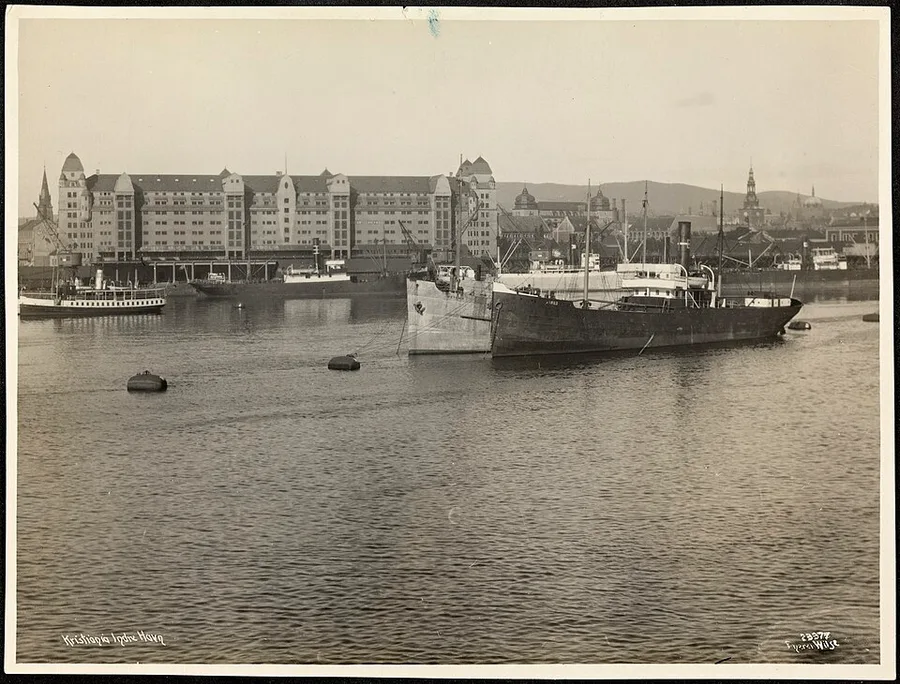 Anders Beer Wilse, Kristiania Indre Havn (1923), National Library of Norway Wilse's 1923 photograph of the inner harbor at Bjørvika, two years before Kristiania took back its old name Oslo — steamers at the quays beneath the spires of the city that grew from a medieval royal seat into Norway's capital. Capital of modern Norway, at the head of the Oslofjord on
the country's southeastern coast. Founded according to the
sagas by Harald Hardrada about 1049 and known through the
medieval period as a secondary royal seat behind Bergen and
Nidaros. Hákon V moved the royal residence permanently to
Oslo about 1300 and built Akershus Fortress to guard the
harbour. After a fire in 1624 the medieval town was
abandoned and Christian IV rebuilt the city to the west
under the new name Christiania (later Kristiania); the
name Oslo was restored in 1925. The original medieval
street pattern survives as the Gamlebyen district east of
the modern centre.
In this article Oslo runs faster and more international than the rest of the
country — the one stop where an American conversation can hide
in the noise of Karl Johans gate at rush hour.
On the trip Days 1–2 belong to Oslo, with both groups together —
Roseslottet and the harbourside museums on Day 1, then the
Day-2 e-bike tour through Akershus Fortress, up Karl Johans
gate, and out to Vigeland Park.
Oslo Also discussed in The Long Fall — the sudden loss of Norwegian nobility, the end of the kings, and half of Norway gone foreverA Catholic Norway — the faith that gave the kingdom its first institutions and the stave churchesThe 400-Year Night — when the Northern Lion lay dormantThe Reformation, 1537 — one church eradicated and another imposedLutheran Norway and Pietism — a farmer named Hans Nielsen Hauge and a lay revival that could not be silencedThe Constitution That Saved a Nation — five radical weeks at Eidsvoll, 1814800,000 Norwegians Leave — the century that built a Second NorwayThe Quiet Revolution — how Norway won its independence without a warWorld War II — the King’s “No” and the Nazis in NorwayAlcohol and Vinmonopolet — when and where to buy a drink🚨 Emergencies - important numbers, hospitals, and what you can doLanding in Norway — off the plane in Oslo, where to go, step by stepMoney — currency, cards, prices, and tipping runs faster, more international, and slightly more permissive of American tells — Karl Johans gate at 17:00 is loud enough to hide an American conversation. Bergen
Anders Beer Wilse, Kristiania Indre Havn (1923), National Library of Norway Wilse's 1923 photograph of the inner harbor at Bjørvika, two years before Kristiania took back its old name Oslo — steamers at the quays beneath the spires of the city that grew from a medieval royal seat into Norway's capital. Capital of modern Norway, at the head of the Oslofjord on
the country's southeastern coast. Founded according to the
sagas by Harald Hardrada about 1049 and known through the
medieval period as a secondary royal seat behind Bergen and
Nidaros. Hákon V moved the royal residence permanently to
Oslo about 1300 and built Akershus Fortress to guard the
harbour. After a fire in 1624 the medieval town was
abandoned and Christian IV rebuilt the city to the west
under the new name Christiania (later Kristiania); the
name Oslo was restored in 1925. The original medieval
street pattern survives as the Gamlebyen district east of
the modern centre.
In this article Oslo runs faster and more international than the rest of the
country — the one stop where an American conversation can hide
in the noise of Karl Johans gate at rush hour.
On the trip Days 1–2 belong to Oslo, with both groups together —
Roseslottet and the harbourside museums on Day 1, then the
Day-2 e-bike tour through Akershus Fortress, up Karl Johans
gate, and out to Vigeland Park.
Oslo Also discussed in The Long Fall — the sudden loss of Norwegian nobility, the end of the kings, and half of Norway gone foreverA Catholic Norway — the faith that gave the kingdom its first institutions and the stave churchesThe 400-Year Night — when the Northern Lion lay dormantThe Reformation, 1537 — one church eradicated and another imposedLutheran Norway and Pietism — a farmer named Hans Nielsen Hauge and a lay revival that could not be silencedThe Constitution That Saved a Nation — five radical weeks at Eidsvoll, 1814800,000 Norwegians Leave — the century that built a Second NorwayThe Quiet Revolution — how Norway won its independence without a warWorld War II — the King’s “No” and the Nazis in NorwayAlcohol and Vinmonopolet — when and where to buy a drink🚨 Emergencies - important numbers, hospitals, and what you can doLanding in Norway — off the plane in Oslo, where to go, step by stepMoney — currency, cards, prices, and tipping runs faster, more international, and slightly more permissive of American tells — Karl Johans gate at 17:00 is loud enough to hide an American conversation. Bergen 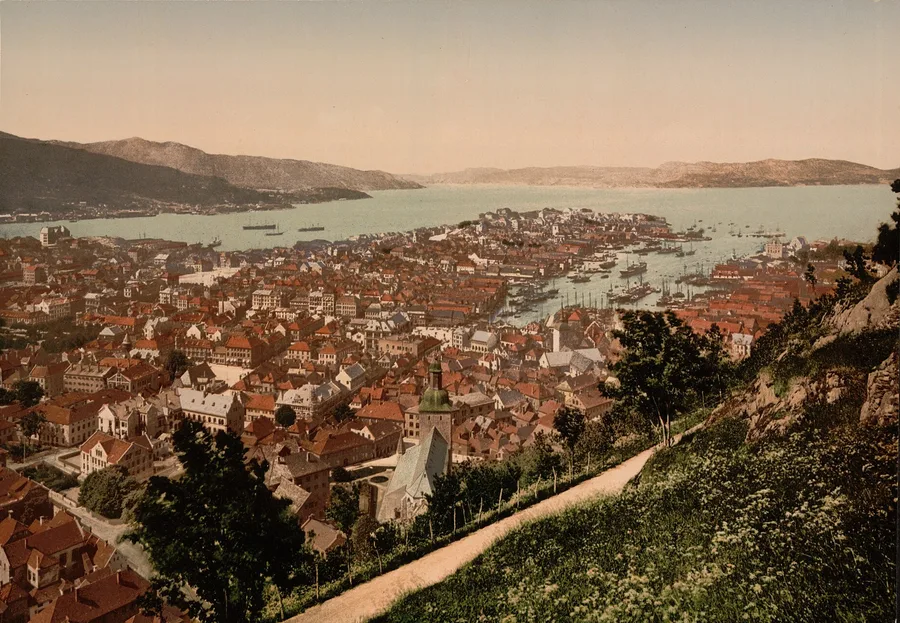 Photochrom print, General view from Fjeldveien, Bergen (c. 1890–1900), Library of Congress Bergen in the 1890s from the Fjellveien path on Fløyfjellet — the whole city between its mountains, Vågen harbour still crowded with sailing ships at its heart. For four centuries Norway's largest city, and the wharf through which the entire western export economy ran. Norway's western trading capital, founded around 1070 on the
inner Byfjorden. For four centuries the largest city in the
country and the wharf through which the entire western export
economy ran — dried cod from the Lofoten fisheries, stockpiled
and traded by the Hanseatic merchants at Bryggen from 1360 to
1754. Norway's commercial and intellectual heart through the
Hanseatic period; overtaken in size by Christiania (Oslo) in the
1830s. The painted wooden Bryggen wharf is on the UNESCO World
Heritage list and substantially what it was in the late
seventeenth century.
In this article Bergen is the west-coast exception to Norwegian reserve —
Bergensers have a reputation as the country's most outgoing
people, quick to talk and openly proud of their city, the loud
counterpoint to the quieter northern and small-town stops the
trip's reserve gradient runs toward.
On the trip The Ungdommene (the Youngsters) reach Bergen late on Day 3
via the Norway-in-a-Nutshell train-and-ferry route from
Oslo. On the Day 4 morning they walk Bryggen and ride the
funicular up Mount Fløyen before flying back to Oslo and driving
on to Lillehammer that evening — a day ahead of the Gråhårsklubben
(the Oldsters), who spend the split days north in Trondheim and
the heritage country of Stjørdal, Hegra, and Kylloplass and come
south on Day 5.
Bergen Also discussed in The Germans Who "Ruled" Bergen — the Hanseatic merchants on Bryggen WharfBefore There Was Norway — petty kingdoms at the edge of the worldThe King Who Became a Saint — how the Nordmen came to ChristA Catholic Norway — the faith that gave the kingdom its first institutions and the stave churchesThe Long Fall — the sudden loss of Norwegian nobility, the end of the kings, and half of Norway gone foreverThe Golden Age — a North Atlantic empire … reaching farther than you thinkThe 400-Year Night — when the Northern Lion lay dormantThe Crusades?!!!! — sixty ships from Bergen, bound for the Holy LandThe Reformation, 1537 — one church eradicated and another imposedWorld War II — the King’s “No” and the Nazis in NorwayKraken — the island-sized beast, logged as factSjøormer — the serpents in the deep lakes and fjordsPesta — an old woman walking from farm to farmFossegrimen — the waterfall fiddler who teaches you to playAlcohol and Vinmonopolet — when and where to buy a drinkFood and dining customs — having patience, free water, brunost on everything🚨 Emergencies - important numbers, hospitals, and what you can doLanguage basics — just enough Norwegian to be politeWhat to wear — the layering system, on the ground is the loud exception on the west coast — Bergensers are known as the most outgoing people in Norway, sometimes called the country’s Italians, quick to strike up a conversation and openly proud of their city. Trondheim
Photochrom print, General view from Fjeldveien, Bergen (c. 1890–1900), Library of Congress Bergen in the 1890s from the Fjellveien path on Fløyfjellet — the whole city between its mountains, Vågen harbour still crowded with sailing ships at its heart. For four centuries Norway's largest city, and the wharf through which the entire western export economy ran. Norway's western trading capital, founded around 1070 on the
inner Byfjorden. For four centuries the largest city in the
country and the wharf through which the entire western export
economy ran — dried cod from the Lofoten fisheries, stockpiled
and traded by the Hanseatic merchants at Bryggen from 1360 to
1754. Norway's commercial and intellectual heart through the
Hanseatic period; overtaken in size by Christiania (Oslo) in the
1830s. The painted wooden Bryggen wharf is on the UNESCO World
Heritage list and substantially what it was in the late
seventeenth century.
In this article Bergen is the west-coast exception to Norwegian reserve —
Bergensers have a reputation as the country's most outgoing
people, quick to talk and openly proud of their city, the loud
counterpoint to the quieter northern and small-town stops the
trip's reserve gradient runs toward.
On the trip The Ungdommene (the Youngsters) reach Bergen late on Day 3
via the Norway-in-a-Nutshell train-and-ferry route from
Oslo. On the Day 4 morning they walk Bryggen and ride the
funicular up Mount Fløyen before flying back to Oslo and driving
on to Lillehammer that evening — a day ahead of the Gråhårsklubben
(the Oldsters), who spend the split days north in Trondheim and
the heritage country of Stjørdal, Hegra, and Kylloplass and come
south on Day 5.
Bergen Also discussed in The Germans Who "Ruled" Bergen — the Hanseatic merchants on Bryggen WharfBefore There Was Norway — petty kingdoms at the edge of the worldThe King Who Became a Saint — how the Nordmen came to ChristA Catholic Norway — the faith that gave the kingdom its first institutions and the stave churchesThe Long Fall — the sudden loss of Norwegian nobility, the end of the kings, and half of Norway gone foreverThe Golden Age — a North Atlantic empire … reaching farther than you thinkThe 400-Year Night — when the Northern Lion lay dormantThe Crusades?!!!! — sixty ships from Bergen, bound for the Holy LandThe Reformation, 1537 — one church eradicated and another imposedWorld War II — the King’s “No” and the Nazis in NorwayKraken — the island-sized beast, logged as factSjøormer — the serpents in the deep lakes and fjordsPesta — an old woman walking from farm to farmFossegrimen — the waterfall fiddler who teaches you to playAlcohol and Vinmonopolet — when and where to buy a drinkFood and dining customs — having patience, free water, brunost on everything🚨 Emergencies - important numbers, hospitals, and what you can doLanguage basics — just enough Norwegian to be politeWhat to wear — the layering system, on the ground is the loud exception on the west coast — Bergensers are known as the most outgoing people in Norway, sometimes called the country’s Italians, quick to strike up a conversation and openly proud of their city. Trondheim 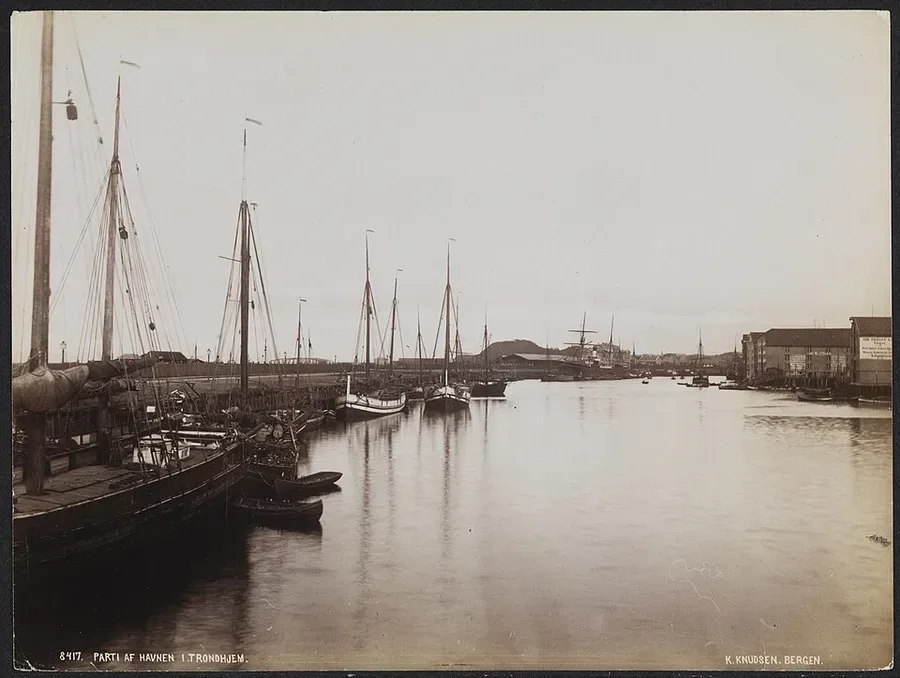 Knud Knudsen, Parti af Havnen i Trondhjem (1888-1894), National Library of Norway Knud Knudsen's photograph of Trondheim harbour in the early 1890s. Founded by Olav Tryggvason in 997 as Nidaros, the city was Norway's medieval capital and the seat of the archbishopric and the Olav cult that anchored the country's Christianity. Norway's third-largest city, founded by Olav Tryggvason in 997 as
Nidaros at the mouth of the Nid River on the inner Trondheim
Fjord. Capital of the Norwegian kingdom for much of the medieval
period; seat of the Norwegian archbishopric from 1153 and of the
Olav cult that anchored medieval Norwegian Christianity. Renamed
Trondheim in 1931 — after a controversial one-year spell
officially named Nidaros from 1930 — replacing the Danish-era
spelling Trondhjem and reviving the medieval Old Norse district
name (Þrándheimr). About two hundred thousand people in the municipality
today. Home to Nidaros Cathedral, NTNU (the Norwegian University
of Science and Technology), and the Trondheim Fjord harbour.
In this article The most reserved of the trip's stops — the quiet the
Gråhårsklubben (the Oldsters) meet across the split days, and
the place where matching the room matters most.
On the trip Day 3 of the trip routes the Gråhårsklubben (the Oldsters) through
Trondheim. The visit centres on Nidaros Cathedral — the building
the Olav devotion raised, and the architectural inheritance of
Bishop Grimkell's pronouncement on a summer day in 1031.
Trondheim Also discussed in The King Who Became a Saint — how the Nordmen came to ChristA Catholic Norway — the faith that gave the kingdom its first institutions and the stave churchesThe Crusades?!!!! — sixty ships from Bergen, bound for the Holy LandThe Golden Age — a North Atlantic empire … reaching farther than you thinkThe Long Fall — the sudden loss of Norwegian nobility, the end of the kings, and half of Norway gone foreverThe 400-Year Night — when the Northern Lion lay dormantThe Reformation, 1537 — one church eradicated and another imposedLutheran Norway and Pietism — a farmer named Hans Nielsen Hauge and a lay revival that could not be silencedWorld War II — the King’s “No” and the Nazis in NorwayBefore There Was Norway — petty kingdoms at the edge of the worldDriving in Norway — tolls, ferries, and a near-zero alcohol limit🚨 Emergencies - important numbers, hospitals, and what you can doLanguage basics — just enough Norwegian to be polite is the most reserved of the trip’s cities and the place where matching the room matters most. Lillehammer and the rural Trøndelag valleys around Hegra and Stjørdal are quieter still — small-town Norway where the conversational baseline is the lowest. Adjust as you cross.
Knud Knudsen, Parti af Havnen i Trondhjem (1888-1894), National Library of Norway Knud Knudsen's photograph of Trondheim harbour in the early 1890s. Founded by Olav Tryggvason in 997 as Nidaros, the city was Norway's medieval capital and the seat of the archbishopric and the Olav cult that anchored the country's Christianity. Norway's third-largest city, founded by Olav Tryggvason in 997 as
Nidaros at the mouth of the Nid River on the inner Trondheim
Fjord. Capital of the Norwegian kingdom for much of the medieval
period; seat of the Norwegian archbishopric from 1153 and of the
Olav cult that anchored medieval Norwegian Christianity. Renamed
Trondheim in 1931 — after a controversial one-year spell
officially named Nidaros from 1930 — replacing the Danish-era
spelling Trondhjem and reviving the medieval Old Norse district
name (Þrándheimr). About two hundred thousand people in the municipality
today. Home to Nidaros Cathedral, NTNU (the Norwegian University
of Science and Technology), and the Trondheim Fjord harbour.
In this article The most reserved of the trip's stops — the quiet the
Gråhårsklubben (the Oldsters) meet across the split days, and
the place where matching the room matters most.
On the trip Day 3 of the trip routes the Gråhårsklubben (the Oldsters) through
Trondheim. The visit centres on Nidaros Cathedral — the building
the Olav devotion raised, and the architectural inheritance of
Bishop Grimkell's pronouncement on a summer day in 1031.
Trondheim Also discussed in The King Who Became a Saint — how the Nordmen came to ChristA Catholic Norway — the faith that gave the kingdom its first institutions and the stave churchesThe Crusades?!!!! — sixty ships from Bergen, bound for the Holy LandThe Golden Age — a North Atlantic empire … reaching farther than you thinkThe Long Fall — the sudden loss of Norwegian nobility, the end of the kings, and half of Norway gone foreverThe 400-Year Night — when the Northern Lion lay dormantThe Reformation, 1537 — one church eradicated and another imposedLutheran Norway and Pietism — a farmer named Hans Nielsen Hauge and a lay revival that could not be silencedWorld War II — the King’s “No” and the Nazis in NorwayBefore There Was Norway — petty kingdoms at the edge of the worldDriving in Norway — tolls, ferries, and a near-zero alcohol limit🚨 Emergencies - important numbers, hospitals, and what you can doLanguage basics — just enough Norwegian to be polite is the most reserved of the trip’s cities and the place where matching the room matters most. Lillehammer and the rural Trøndelag valleys around Hegra and Stjørdal are quieter still — small-town Norway where the conversational baseline is the lowest. Adjust as you cross.
Saturday night is the exception. A Norwegian Saturday night downtown is louder, friendlier, more openly expressive than any other window in the Norwegian week. In Oslo, Bergen, Trondheim, the bars after 22:00 sound like American bars. Strangers strike up conversations; the smiles are real and unbidden. Match that energy when you find it. Sunday morning the country resets to its usual quiet.
A short note on what is completely fine. Asking a Norwegian for directions in English — fine, and welcome. Apologizing in Norwegian for not speaking the language better — charming. Eating breakfast slowly. Saying takk at the cashier even when the cashier doesn’t return it. Walking into a museum and being the only person there. Being visibly American in a way that is not loud, not pushy, and not in a hurry. Nobody expects a visitor to disappear into Norwegian-ness — the goal is only to lower the contrast a little, so the room is comfortable around you.
Forget every habit above and stay quiet about it, and you will be received warmly. Remember the volume one, and you will be received as a sympathetic guest.