🚨 Emergencies — Important numbers, hospitals, and what you can do
When something goes wrong: finding help 📞. Emergency numbers, the nearest hospital and 24-hour pharmacy for every place on the trip, plus answers for a lost passport, stolen card, or lost luggage. Save it on your phone before you fly.
The numbers that work from any phone
All three Norwegian emergency numbers work from any cell phone in the country, even with no SIM card and no service plan. Operators speak English fluently. The calls are free.
- Police / all-emergency: 112 (EU-wide. If you don’t know which service you need, dial this.)
- Ambulance: 113 (chest pain, stroke symptoms, severe injury, unconsciousness, severe allergic reaction.)
- Fire / gas / hazardous materials: 110
- Text-based emergency access — Nød-SMS: for deaf, hard-of-hearing, or speech-impaired travelers, Norway’s emergency-SMS service must be set up ahead of time at nodsms.no; once registered, you can reach 112, 113, and 110 by text.
One more number most Americans have never heard of — and the one you’ll most likely actually use:
- Urgent care (legevakt): 116 117 (after-hours / non-life-threatening urgent care. A high fever, a pain like a kidney stone, a deep cut that needs stitches, vomiting that won’t stop, a prescription crisis at 9 PM on a Saturday. Routes automatically to the nearest legevakt district anywhere in the country. From a US phone, +47 116 117 works if the short code balks. Save it next to 911 in your contacts.)
For mental-health distress:
- National crisis line: 116 123 (free, anonymous, 24/7.)
Per-location hospital reference
Oslo (Days 1–2, and arrival/departure at Gardermoen)
Hospital — Oslo universitetssykehus, Ullevål (The city’s main adult emergency hospital and the region’s major trauma centre.)
- Address: Kirkeveien 166, 0450 Oslo
- Distance from the Tjuvholmen hotel: ~5 km · 10–15 min by taxi
- Distance from the Holmenkollen-ridge arrival-night hotel: ~7 km · 15–20 min by taxi
- Emergency: 113 (the dispatcher decides which ER to send the ambulance to.)
After-hours clinic — Oslo Legevakt (Storbylegevakten ved Aker) (Note: the legevakt moved from Storgata to Aker in November 2023. Older guidebooks are out of date.)
- Address: Trondheimsveien 233, 0586 Oslo
- Open: 24 hours, every day
- Phone: 116 117 (or walk in.)
- Notes: A 24-hour pharmacy operates inside the same building.
Norway in a Nutshell route — Flåm, Stegastein, Voss
Flåm has no hospital. For the fjord stretch of the day — Flåm, Aurland, Stegastein, the Nærøyfjord — the nearest is the small local hospital at Lærdal, about a half-hour east of Aurland; from Gudvangen onward toward Bergen 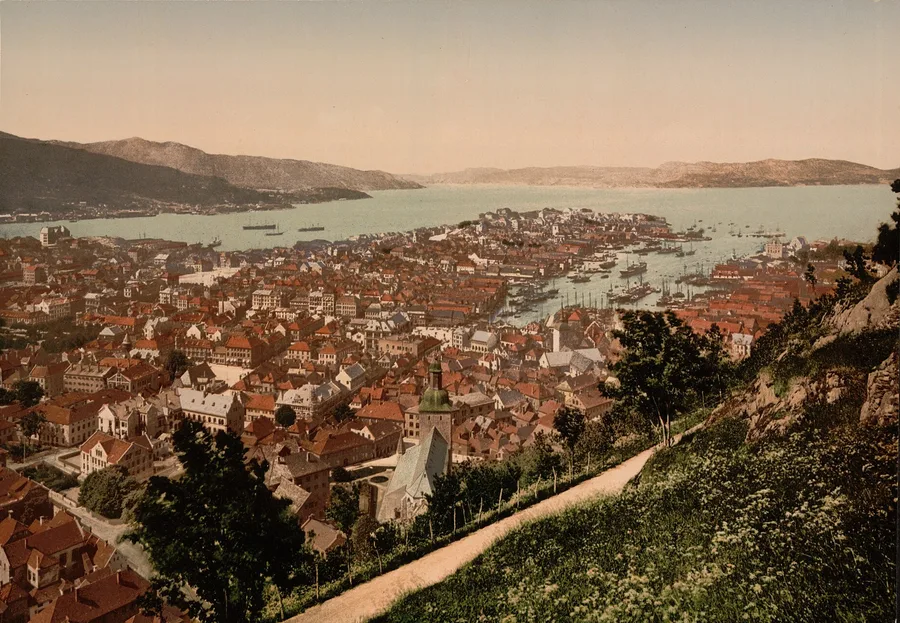 Photochrom print, General view from Fjeldveien, Bergen (c. 1890–1900), Library of Congress Bergen in the 1890s from the Fjellveien path on Fløyfjellet — the whole city between its mountains, Vågen harbour still crowded with sailing ships at its heart. For four centuries Norway's largest city, and the wharf through which the entire western export economy ran. Norway's western trading capital, founded around 1070 on the
inner Byfjorden. For four centuries the largest city in the
country and the wharf through which the entire western export
economy ran — dried cod from the Lofoten fisheries, stockpiled
and traded by the Hanseatic merchants at Bryggen from 1360 to
1754. Norway's commercial and intellectual heart through the
Hanseatic period; overtaken in size by Christiania (Oslo) in the
1830s. The painted wooden Bryggen wharf is on the UNESCO World
Heritage list and substantially what it was in the late
seventeenth century.
In this article Haukeland, western Norway's main hospital, stands about three
kilometres from Bryggen — ten minutes by taxi, or the Bybanen
light rail to its own Haukeland sjukehus stop.
On the trip The Ungdommene (the Youngsters) reach Bergen late on Day 3
via the Norway-in-a-Nutshell train-and-ferry route from
Oslo. On the Day 4 morning they walk Bryggen and ride the
funicular up Mount Fløyen before flying back to Oslo and driving
on to Lillehammer that evening — a day ahead of the Gråhårsklubben
(the Oldsters), who spend the split days north in Trondheim and
the heritage country of Stjørdal, Hegra, and Kylloplass and come
south on Day 5.
Bergen Also discussed in The Germans Who "Ruled" Bergen — the Hanseatic merchants on Bryggen WharfBefore There Was Norway — petty kingdoms at the edge of the worldThe King Who Became a Saint — how the Nordmen came to ChristA Catholic Norway — the faith that gave the kingdom its first institutions and the stave churchesThe Long Fall — the sudden loss of Norwegian nobility, the end of the kings, and half of Norway gone foreverThe Golden Age — a North Atlantic empire … reaching farther than you thinkThe 400-Year Night — when the Northern Lion lay dormantThe Crusades?!!!! — sixty ships from Bergen, bound for the Holy LandThe Reformation, 1537 — one church eradicated and another imposedWorld War II — the King’s “No” and the Nazis in NorwayKraken — the island-sized beast, logged as factSjøormer — the serpents in the deep lakes and fjordsPesta — an old woman walking from farm to farmFossegrimen — the waterfall fiddler who teaches you to playAlcohol and Vinmonopolet — when and where to buy a drinkEveryday etiquette — quiet voices, wide space, no smilingFood and dining customs — having patience, free water, brunost on everythingLanguage basics — just enough Norwegian to be politeWhat to wear — the layering system, on the ground , the route’s hospital is in Voss.
Photochrom print, General view from Fjeldveien, Bergen (c. 1890–1900), Library of Congress Bergen in the 1890s from the Fjellveien path on Fløyfjellet — the whole city between its mountains, Vågen harbour still crowded with sailing ships at its heart. For four centuries Norway's largest city, and the wharf through which the entire western export economy ran. Norway's western trading capital, founded around 1070 on the
inner Byfjorden. For four centuries the largest city in the
country and the wharf through which the entire western export
economy ran — dried cod from the Lofoten fisheries, stockpiled
and traded by the Hanseatic merchants at Bryggen from 1360 to
1754. Norway's commercial and intellectual heart through the
Hanseatic period; overtaken in size by Christiania (Oslo) in the
1830s. The painted wooden Bryggen wharf is on the UNESCO World
Heritage list and substantially what it was in the late
seventeenth century.
In this article Haukeland, western Norway's main hospital, stands about three
kilometres from Bryggen — ten minutes by taxi, or the Bybanen
light rail to its own Haukeland sjukehus stop.
On the trip The Ungdommene (the Youngsters) reach Bergen late on Day 3
via the Norway-in-a-Nutshell train-and-ferry route from
Oslo. On the Day 4 morning they walk Bryggen and ride the
funicular up Mount Fløyen before flying back to Oslo and driving
on to Lillehammer that evening — a day ahead of the Gråhårsklubben
(the Oldsters), who spend the split days north in Trondheim and
the heritage country of Stjørdal, Hegra, and Kylloplass and come
south on Day 5.
Bergen Also discussed in The Germans Who "Ruled" Bergen — the Hanseatic merchants on Bryggen WharfBefore There Was Norway — petty kingdoms at the edge of the worldThe King Who Became a Saint — how the Nordmen came to ChristA Catholic Norway — the faith that gave the kingdom its first institutions and the stave churchesThe Long Fall — the sudden loss of Norwegian nobility, the end of the kings, and half of Norway gone foreverThe Golden Age — a North Atlantic empire … reaching farther than you thinkThe 400-Year Night — when the Northern Lion lay dormantThe Crusades?!!!! — sixty ships from Bergen, bound for the Holy LandThe Reformation, 1537 — one church eradicated and another imposedWorld War II — the King’s “No” and the Nazis in NorwayKraken — the island-sized beast, logged as factSjøormer — the serpents in the deep lakes and fjordsPesta — an old woman walking from farm to farmFossegrimen — the waterfall fiddler who teaches you to playAlcohol and Vinmonopolet — when and where to buy a drinkEveryday etiquette — quiet voices, wide space, no smilingFood and dining customs — having patience, free water, brunost on everythingLanguage basics — just enough Norwegian to be politeWhat to wear — the layering system, on the ground , the route’s hospital is in Voss.
Hospital — Voss sjukehus (part of Helse Bergen.)
- Address: Sjukehusvegen 16, 5704 Voss
- Distance from Flåm: ~65 km · ~1 hour by road · or Flåmsbana to Myrdal then Bergensbanen to Voss
- Switchboard: +47 56 53 35 00
- Emergency: 113 (on the boat or in the fjord, the dispatcher routes by helicopter ambulance if the ground roads are too slow.)
- Urgent care: 116 117 (reaches the local legevakt from anywhere on the route.)
Bergen (Day 3 night, Day 4)
Hospital — Haukeland universitetssjukehus (Western Norway’s main hospital.)
- Address: Jonas Lies vei 65, 5021 Bergen
- Distance from Bryggen / central Bergen: ~3 km · 10 min by taxi · 15 min on the Bybanen light rail to the Haukeland sjukehus stop
- Switchboard: +47 55 97 50 00
Trondheim (Days 3–5 for the Gråhårsklubben (the Oldsters))
Hospital — St. Olavs hospital (The acute-care building, Akutten og Hjerte-lunge-senteret, is the dedicated emergency entrance.)
- Address: Prinsesse Kristinas gate 3, 7030 Trondheim
- Distance from central Trondheim
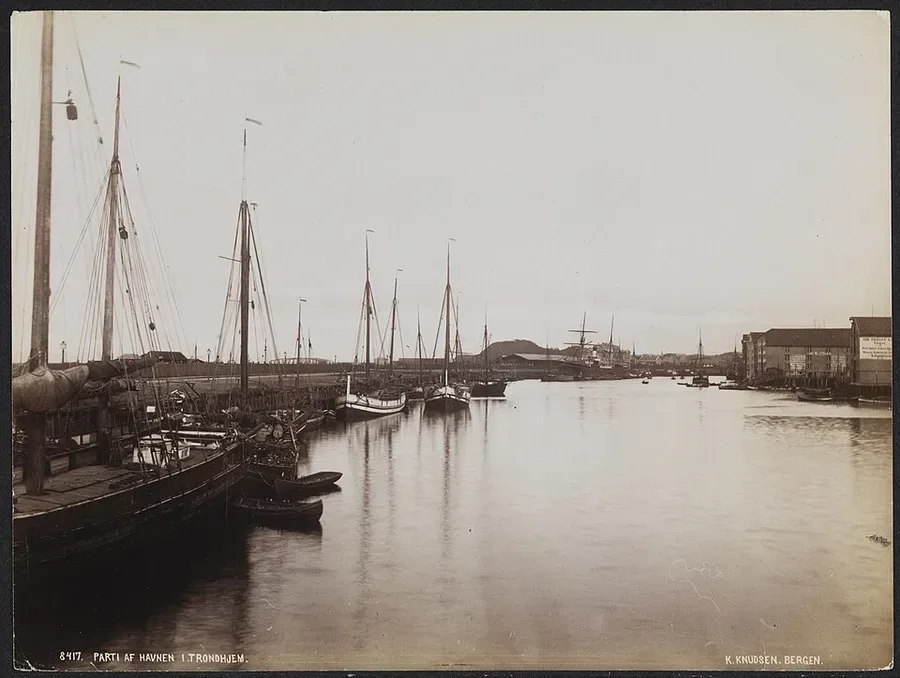 Knud Knudsen, Parti af Havnen i Trondhjem (1888-1894), National Library of Norway Knud Knudsen's photograph of Trondheim harbour in the early 1890s. Founded by Olav Tryggvason in 997 as Nidaros, the city was Norway's medieval capital and the seat of the archbishopric and the Olav cult that anchored the country's Christianity. Norway's third-largest city, founded by Olav Tryggvason in 997 as
Nidaros at the mouth of the Nid River on the inner Trondheim
Fjord. Capital of the Norwegian kingdom for much of the medieval
period; seat of the Norwegian archbishopric from 1153 and of the
Olav cult that anchored medieval Norwegian Christianity. Renamed
Trondheim in 1931 — after a controversial one-year spell
officially named Nidaros from 1930 — replacing the Danish-era
spelling Trondhjem and reviving the medieval Old Norse district
name (Þrándheimr). About two hundred thousand people in the municipality
today. Home to Nidaros Cathedral, NTNU (the Norwegian University
of Science and Technology), and the Trondheim Fjord harbour.
In this article St. Olavs hospital sits walkable from the cathedral quarter,
and the city legevakt shares the same Øya campus — the safety
net behind the Gråhårsklubben (the Oldsters) nights in the city.
On the trip Day 3 of the trip routes the Gråhårsklubben (the Oldsters) through
Trondheim. The visit centres on Nidaros Cathedral — the building
the Olav devotion raised, and the architectural inheritance of
Bishop Grimkell's pronouncement on a summer day in 1031.
Trondheim Also discussed in The King Who Became a Saint — how the Nordmen came to ChristA Catholic Norway — the faith that gave the kingdom its first institutions and the stave churchesThe Crusades?!!!! — sixty ships from Bergen, bound for the Holy LandThe Golden Age — a North Atlantic empire … reaching farther than you thinkThe Long Fall — the sudden loss of Norwegian nobility, the end of the kings, and half of Norway gone foreverThe 400-Year Night — when the Northern Lion lay dormantThe Reformation, 1537 — one church eradicated and another imposedLutheran Norway and Pietism — a farmer named Hans Nielsen Hauge and a lay revival that could not be silencedWorld War II — the King’s “No” and the Nazis in NorwayBefore There Was Norway — petty kingdoms at the edge of the worldDriving in Norway — tolls, ferries, and a near-zero alcohol limitEveryday etiquette — quiet voices, wide space, no smilingLanguage basics — just enough Norwegian to be polite / Nidaros Cathedral: ~1.5 km · walkable · trivial by taxi
Knud Knudsen, Parti af Havnen i Trondhjem (1888-1894), National Library of Norway Knud Knudsen's photograph of Trondheim harbour in the early 1890s. Founded by Olav Tryggvason in 997 as Nidaros, the city was Norway's medieval capital and the seat of the archbishopric and the Olav cult that anchored the country's Christianity. Norway's third-largest city, founded by Olav Tryggvason in 997 as
Nidaros at the mouth of the Nid River on the inner Trondheim
Fjord. Capital of the Norwegian kingdom for much of the medieval
period; seat of the Norwegian archbishopric from 1153 and of the
Olav cult that anchored medieval Norwegian Christianity. Renamed
Trondheim in 1931 — after a controversial one-year spell
officially named Nidaros from 1930 — replacing the Danish-era
spelling Trondhjem and reviving the medieval Old Norse district
name (Þrándheimr). About two hundred thousand people in the municipality
today. Home to Nidaros Cathedral, NTNU (the Norwegian University
of Science and Technology), and the Trondheim Fjord harbour.
In this article St. Olavs hospital sits walkable from the cathedral quarter,
and the city legevakt shares the same Øya campus — the safety
net behind the Gråhårsklubben (the Oldsters) nights in the city.
On the trip Day 3 of the trip routes the Gråhårsklubben (the Oldsters) through
Trondheim. The visit centres on Nidaros Cathedral — the building
the Olav devotion raised, and the architectural inheritance of
Bishop Grimkell's pronouncement on a summer day in 1031.
Trondheim Also discussed in The King Who Became a Saint — how the Nordmen came to ChristA Catholic Norway — the faith that gave the kingdom its first institutions and the stave churchesThe Crusades?!!!! — sixty ships from Bergen, bound for the Holy LandThe Golden Age — a North Atlantic empire … reaching farther than you thinkThe Long Fall — the sudden loss of Norwegian nobility, the end of the kings, and half of Norway gone foreverThe 400-Year Night — when the Northern Lion lay dormantThe Reformation, 1537 — one church eradicated and another imposedLutheran Norway and Pietism — a farmer named Hans Nielsen Hauge and a lay revival that could not be silencedWorld War II — the King’s “No” and the Nazis in NorwayBefore There Was Norway — petty kingdoms at the edge of the worldDriving in Norway — tolls, ferries, and a near-zero alcohol limitEveryday etiquette — quiet voices, wide space, no smilingLanguage basics — just enough Norwegian to be polite / Nidaros Cathedral: ~1.5 km · walkable · trivial by taxi - Switchboard: +47 72 57 30 00
After-hours clinic — Trondheim legevakt (same campus as St. Olavs.)
- Phone: 116 117 (call first.)
Stjørdal, Hegra, Kylloplass (Day 4 heritage drive)
This rural area sits between two hospitals; the dispatcher will choose.
Hospital — St. Olavs hospital, Trondheim (for anything serious.)
- Address: Prinsesse Kristinas gate 3, 7030 Trondheim
- Distance: ~35–40 km west · 40–50 min by road
- Switchboard: +47 72 57 30 00
- Emergency: 113
Hospital — Sykehuset Levanger (Stjørdal’s formal catchment hospital.)
- Address: Kirkegata 2, 7600 Levanger
- Distance: ~45 km north · ~40 min by road
- Switchboard (Helse Nord-Trøndelag): +47 74 09 80 00
Urgent care: 116 117 (reaches the Stjørdal-area legevakt from anywhere in the valley.)
Lillehammer (Days 5–7)
Hospital — Sykehuset Innlandet, Lillehammer (The ER has its own dedicated entrance near the helicopter landing pad.)
- Address: Anders Sandvigs gate 17, 2609 Lillehammer
- Distance from the Storgata hotel in central Lillehammer: ~1 km · walkable · trivial by taxi
- Switchboard: +47 62 33 30 00
- Urgent care: 116 117 (reaches the Lillehammer interkommunale legevakt for non-emergencies.)
Oslo Gardermoen (Day 7 night, Day 8 departure)
The Oslo Airport (Gardermoen) 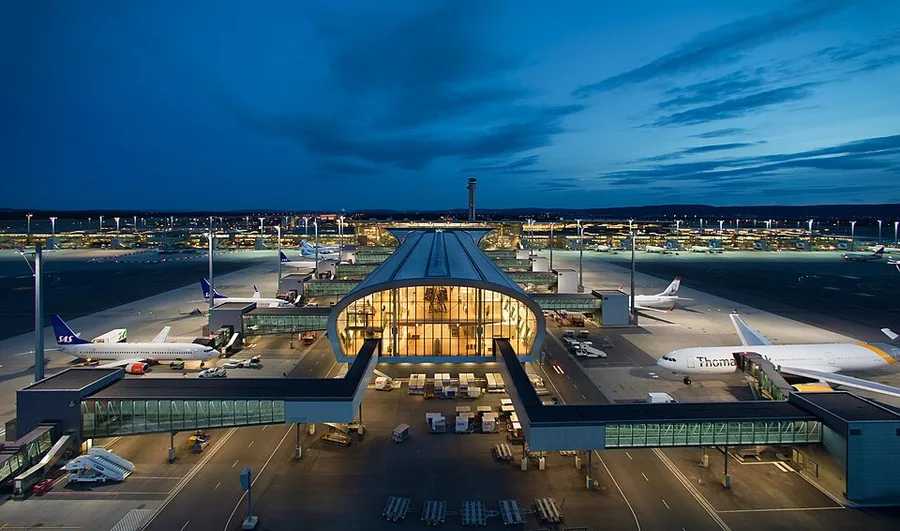 Espen Solli / Avinor Oslo lufthavn, Oslo Airport terminal night view (2017), CC BY 3.0 The terminal every traveler passes through on arrival, and again before the final morning's flights home — the Gardermobanen rail line into Oslo S starts just beneath this building. Norway's principal airport (IATA: OSL), opened on 8 October 1998 roughly 50 km north-northeast of central Oslo near the town of Gardermoen, in Ullensaker municipality, replacing the smaller in-town airport at Fornebu. Built at a cost of some NOK 11.4 billion, Gardermoen handles the overwhelming majority of Norway's international air traffic and anchors the dedicated Gardermobanen high-speed rail line into Oslo Central Station — one of the fastest airport-to-city rail connections in Europe, run by both Flytoget and the ordinary Vy trains. In this article The airline baggage desks for a missing-bag claim sit off the arrivals hall, worked before walking out into the rest of the arrival sequence. On the trip The whole family's Norway begins and ends at Gardermoen — everyone lands here before Day 1 and rides the train into Oslo S, and on Day 7 the group returns to spend one last Norwegian night near the airport before the flights home the next morning. Gardermoen Also discussed in Landing in Norway — off the plane in Oslo, where to go, step by stepHotels in Norway — frokost, check-in, and the luggage-room habitAlcohol and Vinmonopolet — when and where to buy a drinkMoney — currency, cards, prices, and tippingWhat to wear — the layering system, on the groundPublic transit basics — trains, trams, boats, and buying tickets sits between two viable hospitals; the dispatcher will choose by severity and traffic.
Hospital — Akershus universitetssykehus (Ahus), Nordbyhagen
- Address: Sykehusveien 25, 1474 Nordbyhagen (Lørenskog)
- Distance from the airport: ~40 km · 25–30 min by road
Hospital — Ullevål, Oslo
- Address: Kirkeveien 166, 0450 Oslo
- Distance from the airport: ~50 km · ~40 min by road (farther than Ahus, on the far side of the city)
Urgent care: 116 117 (reaches the Ullensaker / Nannestad legevakt.)
The 24-hour pharmacy safety net
Norway’s round-the-clock pharmacies are both in Oslo — only one sits on the route’s daily path:
Pharmacy — Vitusapotek Jernbanetorget (next to Oslo S (Oslo Central Station) 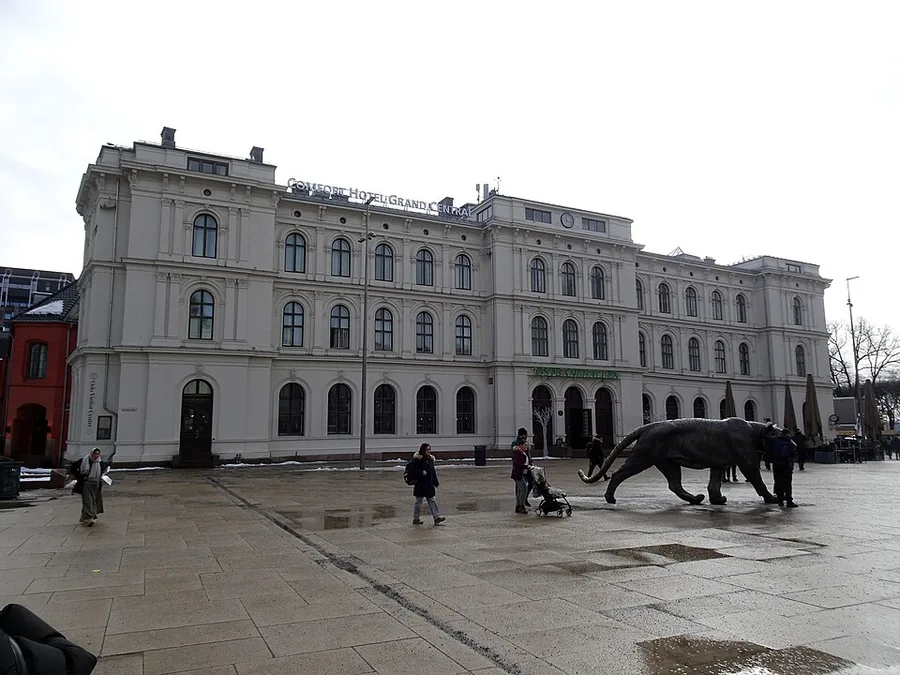 Østbanehallen (the historic 1882 East Station hall), Jernbanetorget, Oslo — Wikimedia Commons Østbanehallen, the 1882 East Station building on Jernbanetorget, is the historic face of Oslo S — Norway’s busiest station, where airport, intercity and local trains and the metro all converge; the bronze tiger gives Oslo its nickname ‘Tigerstaden.’ Norway's largest and busiest railway station, sitting at Jernbanetorget in central Oslo. The current station building opened in 1980, merging two older, separately run stations — the Østbanen (East Line Station) and the Vestbanen (West Line Station) — that had served the country's rail network since its first line opened between Christiania and Eidsvoll in 1854; the merged station took its current name, Oslo S, in 1981. Operated by Bane NOR, it is the hub for the Flytoget airport express, the Vy long-distance and regional trains (to Bergen, Trondheim, Stavanger, and international routes into Sweden and Denmark), and the T-bane metro, trikk (tram) lines, and city buses converging at the adjoining Jernbanetorget square. In this article The 24-hour Vitusapotek pharmacy sits right next to the station, anchoring the route's pharmacy safety net for the first two days in Oslo. On the trip Every traveler passes through Oslo S more than once — off the Flytoget or Vy train from Gardermoen on arrival, and again when the Ungdommene (the Youngsters) find their platform for the early Bergensbanen departure toward Myrdal and the Norway in a Nutshell route on Day 3. The station's food court past the train gates is the family's fallback meeting point if flights or bags don't land together. Oslo Also discussed in Public transit basics — trains, trams, boats, and buying ticketsLanding in Norway — off the plane in Oslo, where to go, step by stepHotels in Norway — frokost, check-in, and the luggage-room habit .)
- Address: Jernbanetorget 4B, 0154 Oslo
- Open: 24 hours, every day including holidays
- Phone: +47 23 35 81 00
A second 24-hour pharmacy lives inside the new Aker legevakt building (Trondheimsveien 233) — useful only if you’re already there.
Most pharmacies close by about 18:00 on weekdays, mid-afternoon on Saturdays, and nearly all shut on Sunday. If anyone in the group is running marginal on a prescription, refill on the first day in Oslo 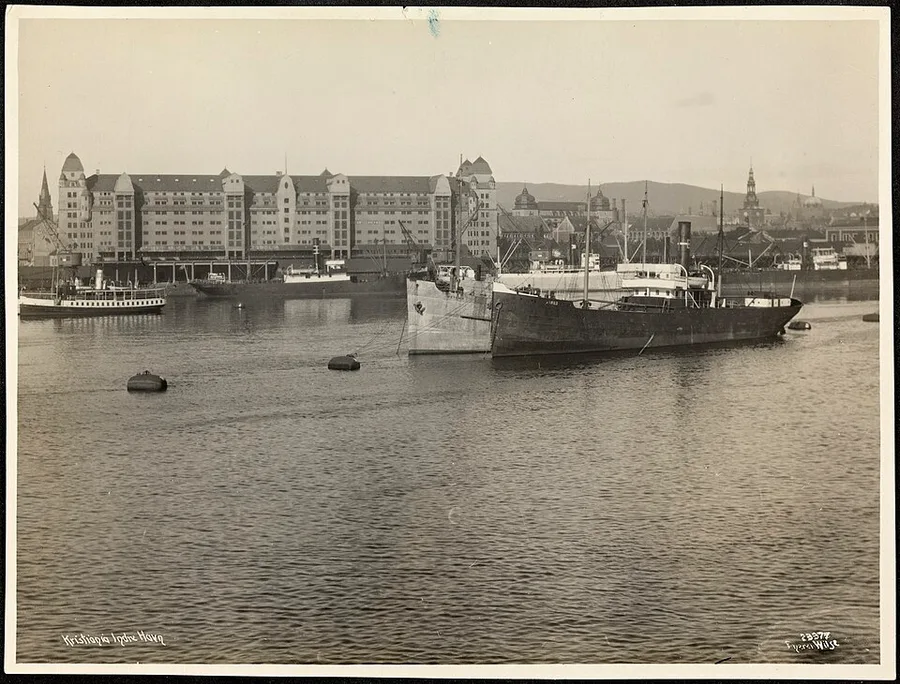 Anders Beer Wilse, Kristiania Indre Havn (1923), National Library of Norway Wilse's 1923 photograph of the inner harbor at Bjørvika, two years before Kristiania took back its old name Oslo — steamers at the quays beneath the spires of the city that grew from a medieval royal seat into Norway's capital. Capital of modern Norway, at the head of the Oslofjord on
the country's southeastern coast. Founded according to the
sagas by Harald Hardrada about 1049 and known through the
medieval period as a secondary royal seat behind Bergen and
Nidaros. Hákon V moved the royal residence permanently to
Oslo about 1300 and built Akershus Fortress to guard the
harbour. After a fire in 1624 the medieval town was
abandoned and Christian IV rebuilt the city to the west
under the new name Christiania (later Kristiania); the
name Oslo was restored in 1925. The original medieval
street pattern survives as the Gamlebyen district east of
the modern centre.
In this article The first two days in Oslo are the trip's refill window — the
route's only 24-hour pharmacies and the US Embassy are all in
this one city.
On the trip Days 1–2 belong to Oslo, with both groups together —
Roseslottet and the harbourside museums on Day 1, then the
Day-2 e-bike tour through Akershus Fortress, up Karl Johans
gate, and out to Vigeland Park.
Oslo Also discussed in The Long Fall — the sudden loss of Norwegian nobility, the end of the kings, and half of Norway gone foreverA Catholic Norway — the faith that gave the kingdom its first institutions and the stave churchesThe 400-Year Night — when the Northern Lion lay dormantThe Reformation, 1537 — one church eradicated and another imposedLutheran Norway and Pietism — a farmer named Hans Nielsen Hauge and a lay revival that could not be silencedThe Constitution That Saved a Nation — five radical weeks at Eidsvoll, 1814800,000 Norwegians Leave — the century that built a Second NorwayThe Quiet Revolution — how Norway won its independence without a warWorld War II — the King’s “No” and the Nazis in NorwayAlcohol and Vinmonopolet — when and where to buy a drinkEveryday etiquette — quiet voices, wide space, no smilingLanding in Norway — off the plane in Oslo, where to go, step by stepMoney — currency, cards, prices, and tipping .
Anders Beer Wilse, Kristiania Indre Havn (1923), National Library of Norway Wilse's 1923 photograph of the inner harbor at Bjørvika, two years before Kristiania took back its old name Oslo — steamers at the quays beneath the spires of the city that grew from a medieval royal seat into Norway's capital. Capital of modern Norway, at the head of the Oslofjord on
the country's southeastern coast. Founded according to the
sagas by Harald Hardrada about 1049 and known through the
medieval period as a secondary royal seat behind Bergen and
Nidaros. Hákon V moved the royal residence permanently to
Oslo about 1300 and built Akershus Fortress to guard the
harbour. After a fire in 1624 the medieval town was
abandoned and Christian IV rebuilt the city to the west
under the new name Christiania (later Kristiania); the
name Oslo was restored in 1925. The original medieval
street pattern survives as the Gamlebyen district east of
the modern centre.
In this article The first two days in Oslo are the trip's refill window — the
route's only 24-hour pharmacies and the US Embassy are all in
this one city.
On the trip Days 1–2 belong to Oslo, with both groups together —
Roseslottet and the harbourside museums on Day 1, then the
Day-2 e-bike tour through Akershus Fortress, up Karl Johans
gate, and out to Vigeland Park.
Oslo Also discussed in The Long Fall — the sudden loss of Norwegian nobility, the end of the kings, and half of Norway gone foreverA Catholic Norway — the faith that gave the kingdom its first institutions and the stave churchesThe 400-Year Night — when the Northern Lion lay dormantThe Reformation, 1537 — one church eradicated and another imposedLutheran Norway and Pietism — a farmer named Hans Nielsen Hauge and a lay revival that could not be silencedThe Constitution That Saved a Nation — five radical weeks at Eidsvoll, 1814800,000 Norwegians Leave — the century that built a Second NorwayThe Quiet Revolution — how Norway won its independence without a warWorld War II — the King’s “No” and the Nazis in NorwayAlcohol and Vinmonopolet — when and where to buy a drinkEveryday etiquette — quiet voices, wide space, no smilingLanding in Norway — off the plane in Oslo, where to go, step by stepMoney — currency, cards, prices, and tipping .
US Embassy
The US Embassy is the only US consular post in Norway.
Embassy — US Embassy Oslo
- Address: Morgedalsvegen 36, 0378 Oslo
- Main number: +47 21 30 85 40 (business hours · reaches a duty officer 24/7 for genuine emergencies: arrest, death, serious hospitalization, lost or stolen passport with imminent travel.)
- Notes: Add this number to your phone before you fly.
Routine services (passport renewal, notarials, reports of birth or death) require an appointment. The embassy doesn’t fix bad days — it helps with the few things only it can do: replacing a lost passport when you’re about to depart, lists of English-speaking lawyers and doctors, and emergency loans of last resort for repatriation.
Insurance — what to expect at the desk
US health insurance generally does not cover treatment in Norway. Medicare specifically does not. Norwegian public hospitals will treat you regardless of nationality or coverage, and then they will bill you. Rough figures for an uninsured visitor:
- GP or legevakt consultation: NOK 1,000–2,000 (~$100–200)
- Emergency-room visit: NOK 3,000–6,000+ (~$300–600+)
- Hospital admission: NOK 10,000–20,000+ per day (~$1,000–2,000+)
- Ambulance: NOK 3,000–5,000 (~$300–500)
- Medical evacuation back to the US: typically $50,000–$200,000
Travel insurance with at least $100,000 in emergency medical and $100,000 in medical evacuation is the standard floor. For a nine-day Norway trip, that’s roughly $40–120 per traveler.
Keep itemized hospital receipts. US travel insurers accept Norwegian invoices for reimbursement, but you have to file the claim.
A few things that aren’t health
Lost passport. Get a police report from the nearest station, then call the embassy. If a flight is leaving in days, the embassy can usually issue an emergency replacement on short notice — but the appointment is the bottleneck, so call as soon as you know.
Stolen credit card. Call the issuer’s collect-call international line (it’s on the back of the card or in the app). Most major US issuers have a 24-hour line that works from a Norwegian phone. Pack a backup card in a different bag.
Lost luggage on arrival. File the claim at the airline desk before leaving Gardermoen — typically the SAS or KLM counter near baggage claim. Get the reference number on paper. Most delayed bags are delivered to your hotel within 24–48 hours.
Pickpockets. Norway is among the safest countries in the world for tourists, but the genuine risk spots on the route are the Oslo Central Station, the Bryggen tourist crush in Bergen, and crowded summer trams in Oslo. Standard precautions, nothing more.
In a crisis, help speaks English
Norwegian institutions are competent and helpful in a crisis. English is universal in every emergency setting in this country — operators, ambulance crews, ER doctors, embassy duty officers. None of this is likely to happen on a nine-day trip. If any of it does, what saves the day is having the numbers, the address, and the appointment ready before you need them.