Phones, data, and apps — eSIMs, coverage, and what to load
Coverage is excellent, eSIMs are cheap, and most American carriers offer reasonable Norway plans. Set things up before you land — and load the six apps that make the trip easier the moment you do.
Staying connected in Norway is genuinely easy. Coverage is excellent, the options are cheap, and the only real failure mode is forgetting to set anything up until you have already landed.
Three ways to do data
1. Your US carrier’s international plan. The simplest option — no new hardware or numbers.
- T-Mobile — most of its plans include basic international data and texting in Norway at no extra charge; speeds are modest but workable for maps and messaging. Usually the easiest answer for existing customers.
- AT&T and Verizon — both sell an international day pass at roughly $12 per day that gives you your normal plan abroad. Fine for a short trip; it adds up to ~$100 over nine days, so check the math.
- Mint and other budget carriers — international options vary; check before assuming.
Whatever the carrier, confirm in the app before departure and switch the plan on.
2. An eSIM. If your phone supports eSIM — most iPhones from XS forward and most recent Androids — a travel eSIM is cheap and installs in minutes from an app. Airalo sells tiered Norway/Europe data packages (often $8–18 for a trip this length); Holafly sells unlimited-data plans that run more (roughly $27–30 for a week). Your US number stays active for calls and texts; the eSIM carries data. This is usually the best value for a trip this length.
3. A physical local SIM bought in Norway. Workable, but the most friction for the least gain now that eSIMs exist. Not worth the errand.
For a group, one or two phones with solid data sharing a hotspot is plenty.
The six apps to load before you fly
| App | What it does | Needs Norwegian number? | Works offline? |
|---|---|---|---|
Vy 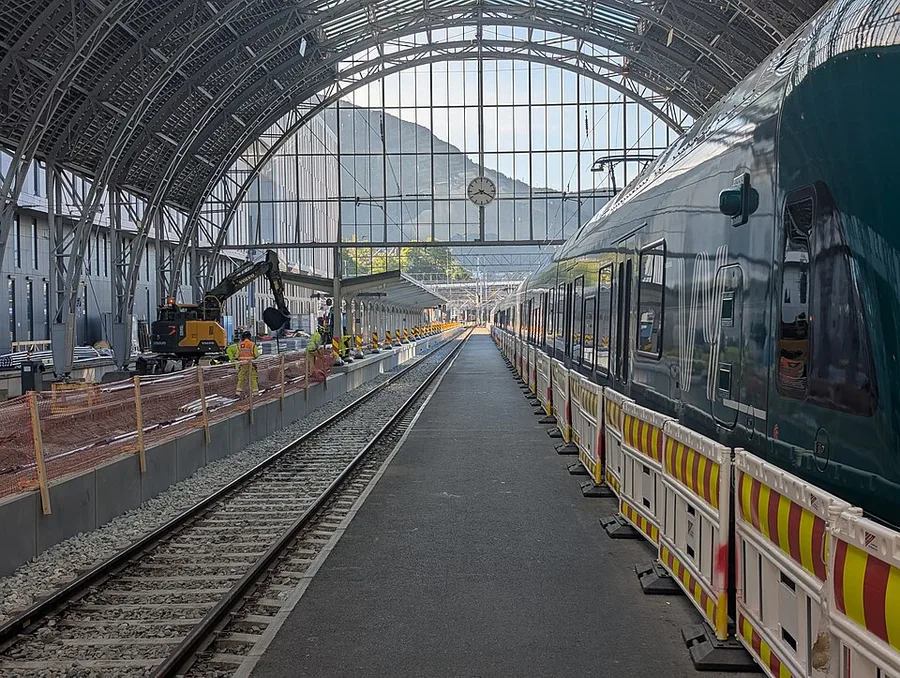 AleWi, CC BY-SA 4.0, via Wikimedia Commons A Vy-liveried train at Bergen station, the western terminus of the Bergensbanen line this card describes — the same dark-green corporate look, adopted in the 2019 rebrand, replaces the red paint scheme older Norwegians still associate with the former NSB name. Norway's state-owned passenger railway, renamed from Norges Statsbaner (NSB) to Vy on 24 April 2019 as part of a wider corporate rebrand ahead of the liberalization of the domestic rail market. Vy operates the great majority of Norway's long-distance and regional trains, including the Bergensbanen (Bergen Line) across the Hardangervidda plateau and the mainline service connecting to the Flåmsbana, alongside a network of buses under the same parent group. Tickets are sold through the Vy app and at station machines; some signage and older Norwegians still use the former name. In this article The Vy app needs no Norwegian phone number and keeps a downloaded ticket readable without a signal. On the trip Vy sells the Bergensbanen tickets that carry the Ungdommene (the Youngsters) out of Oslo across the Hardangervidda plateau to Myrdal on Day 3, the first leg of the Norway-in-a-Nutshell run to Bergen, and its regular trains are also the cheaper option off the plane at Gardermoen on arrival. Also discussed in Public transit basics — trains, trams, boats, and buying ticketsLanding in Norway — off the plane in Oslo, where to go, step by stepHotels in Norway — frokost, check-in, and the luggage-room habitThe stuff no one warns you about - Bathrooms, shoes off and plastic bags AleWi, CC BY-SA 4.0, via Wikimedia Commons A Vy-liveried train at Bergen station, the western terminus of the Bergensbanen line this card describes — the same dark-green corporate look, adopted in the 2019 rebrand, replaces the red paint scheme older Norwegians still associate with the former NSB name. Norway's state-owned passenger railway, renamed from Norges Statsbaner (NSB) to Vy on 24 April 2019 as part of a wider corporate rebrand ahead of the liberalization of the domestic rail market. Vy operates the great majority of Norway's long-distance and regional trains, including the Bergensbanen (Bergen Line) across the Hardangervidda plateau and the mainline service connecting to the Flåmsbana, alongside a network of buses under the same parent group. Tickets are sold through the Vy app and at station machines; some signage and older Norwegians still use the former name. In this article The Vy app needs no Norwegian phone number and keeps a downloaded ticket readable without a signal. On the trip Vy sells the Bergensbanen tickets that carry the Ungdommene (the Youngsters) out of Oslo across the Hardangervidda plateau to Myrdal on Day 3, the first leg of the Norway-in-a-Nutshell run to Bergen, and its regular trains are also the cheaper option off the plane at Gardermoen on arrival. Also discussed in Public transit basics — trains, trams, boats, and buying ticketsLanding in Norway — off the plane in Oslo, where to go, step by stepHotels in Norway — frokost, check-in, and the luggage-room habitThe stuff no one warns you about - Bathrooms, shoes off and plastic bags | National rail tickets — including the Bergensbanen | No | Tickets, once downloaded |
Ruter  Tim Adams, CC BY 3.0, via Wikimedia Commons A T-bane train on the Sognsvannsbanen line near Blindern — the same single-ticket, single-authority network Ruter runs across Oslo's metro, trams, buses, and ferries. The public transport authority for Oslo and the surrounding Akershus region, formed on 1 January 2008 by the merger of Oslo Sporveier and Stor-Oslo Lokaltrafikk. Ruter does not operate vehicles itself — it plans routes, sets fares, and contracts operators such as Sporveien for the T-banen (metro) and Trikken (tram) networks — but a single Ruter ticket, sold through the Ruter app or station machines, covers the metro, tram, city buses, local trains, and harbor ferries within its zone on one fare, valid for an hour of transfers across every mode. In this article The Ruter app needs no Norwegian phone number, and a ticket bought before you tap in stays scannable without a signal. On the trip Every Oslo transit ride the family takes on Days 1–2 — T-bane out to Holmenkollen, tram along the harbor, ferry out to Hovedøya — runs on the same Ruter ticket, tapped once and good for an hour of transfers across every mode along the way. Also discussed in Public transit basics — trains, trams, boats, and buying ticketsHotels in Norway — frokost, check-in, and the luggage-room habit Tim Adams, CC BY 3.0, via Wikimedia Commons A T-bane train on the Sognsvannsbanen line near Blindern — the same single-ticket, single-authority network Ruter runs across Oslo's metro, trams, buses, and ferries. The public transport authority for Oslo and the surrounding Akershus region, formed on 1 January 2008 by the merger of Oslo Sporveier and Stor-Oslo Lokaltrafikk. Ruter does not operate vehicles itself — it plans routes, sets fares, and contracts operators such as Sporveien for the T-banen (metro) and Trikken (tram) networks — but a single Ruter ticket, sold through the Ruter app or station machines, covers the metro, tram, city buses, local trains, and harbor ferries within its zone on one fare, valid for an hour of transfers across every mode. In this article The Ruter app needs no Norwegian phone number, and a ticket bought before you tap in stays scannable without a signal. On the trip Every Oslo transit ride the family takes on Days 1–2 — T-bane out to Holmenkollen, tram along the harbor, ferry out to Hovedøya — runs on the same Ruter ticket, tapped once and good for an hour of transfers across every mode along the way. Also discussed in Public transit basics — trains, trams, boats, and buying ticketsHotels in Norway — frokost, check-in, and the luggage-room habit | Oslo transit (T-bane, tram, bus, harbor ferries) | No | Tickets, once downloaded |
| Entur | National journey planner across train + bus + ferry + tram | No | Limited |
| Yr (yr.no) | The Norwegian Meteorological Institute’s own service — the local standard for fjord and mountain forecasts | No | Cached forecast |
| Google Maps | With offline regions downloaded for Oslo, the Nutshell route, Bergen, Trondheim, Stjørdal, and Lillehammer | No | Yes, with regions saved |
| Default for staying in touch with Norwegian relatives — iMessage won’t reach relatives on Android | No | Sends when signal returns |
Vipps — the one you can’t use
Vipps is the Norwegian peer-to-peer payment app — essentially ubiquitous in daily Norwegian life. Some food trucks, small farm stands, and a few small shops accept Vipps but do not accept foreign cards. The catch is that Vipps requires a Norwegian phone number to set up, so most American travelers cannot use it. Knowing what it is prevents confusion at a cash register that says Vipps only. In practice, most places that accept Vipps also accept a card or cash; the exceptions are small and rare.
WiFi fills in the gaps
WiFi is widely available — hotels, most accommodations, cafés, museums, trains (Vy and SJ Nord both offer it free). In the cities you can lean on WiFi heavily and treat mobile data as backup. Don’t rely on it for navigation or anything time-sensitive on the move.
Where coverage drops
- The Bergensbanen — the Oslo-to-Bergen train passes through many mountain tunnels; coverage flickers across the high country.
- The Slektsreisen (the family-lineage journey) drive — inland valleys toward Hegra and Kylloplass have thinner coverage than the cities.
- The Nærøyfjord — the cliff walls block signal on the cruise.
Before leaving a covered area: download offline maps of the day’s route in Google Maps, and download any train tickets and reservations so they live on the phone rather than in the cloud. The site itself caches pages you have already visited, so previously-read articles stay readable offline.