What to wear — The layering system, on the ground
Morning in Bergen 12°C and rain, afternoon in Oslo 24°C and sun — the Norwegian layering system handles both. Base, mid, shell, and shoes, with the choice rules for each.
Morning in Bergen, 12 °C and rain. Afternoon in Oslo, 24 °C and sun. You will wear both.
The Norwegian answer is layers — base, mid, shell — chosen so that on any morning you can put the whole stack on and by mid-afternoon strip down to one. None of it has to be expensive or technical. What matters is that the layers stack and unstack quickly, and that you have all three with you when the day starts.
One thing to weigh before you pack: Norwegians dress in muted tones — heathered greys, deep blues, mossy greens, black, beige, the occasional cream. Bright primaries and logo-heavy gear read as visitor-wear. Nobody minds, and nobody will say anything. But if you’d rather not signal it, the easy fix is to bring darker, simpler clothes than you usually pack. They photograph well in Norwegian landscapes anyway.
The three layers:
Base layer
What: a thin merino-wool t-shirt or long-sleeve, worn against the skin.
Why: wool keeps you warm when it’s cold, breathes when you warm up, doesn’t smell after two days of wear, and dries faster than cotton. Cotton holds sweat and goes cold; on a fjord-cruise day, cotton is genuinely uncomfortable.
When it comes off: rarely. The base stays on most of the day. You’ll add and remove the layers above it.
Mid layer
What: a light fleece or thin wool sweater that fits over the base.
Why: the mid layer is the one you’ll add and remove three times a day. Train carriage is warm; mountain platform is cold; Flåm wharf is warm; Stegastein at altitude is cold; cabin on the Nærøyfjord boat is warm; deck is sharply cold even in late July. The mid is the negotiation.
When it comes off: indoors, in direct afternoon sun, on the bus between attractions.
Shell
What: a packable, hooded, waterproof rain jacket — not water-resistant. A two-ounce nylon shell that folds into its own pocket.
Why: Bergen 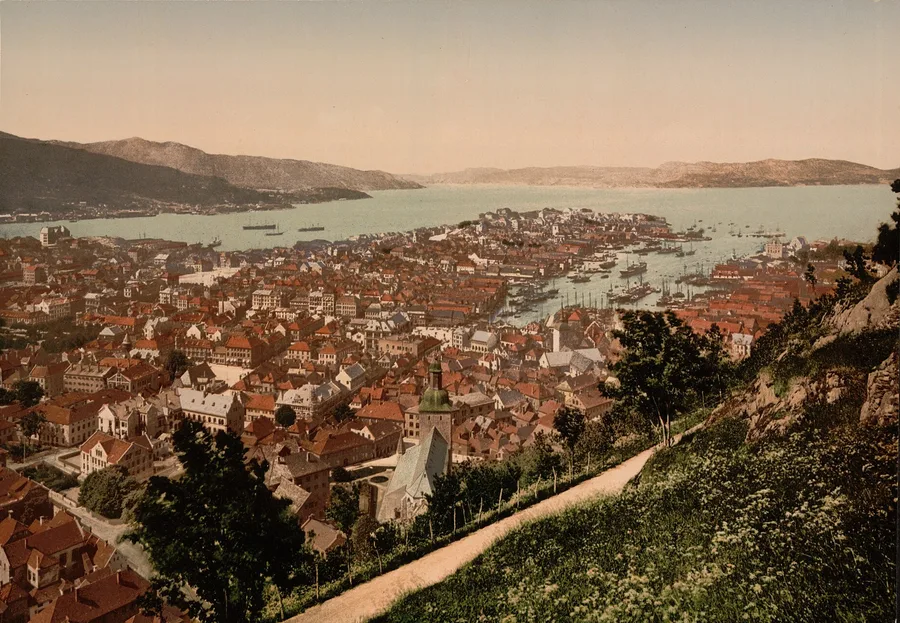 Photochrom print, General view from Fjeldveien, Bergen (c. 1890–1900), Library of Congress Bergen in the 1890s from the Fjellveien path on Fløyfjellet — the whole city between its mountains, Vågen harbour still crowded with sailing ships at its heart. For four centuries Norway's largest city, and the wharf through which the entire western export economy ran. Norway's western trading capital, founded around 1070 on the
inner Byfjorden. For four centuries the largest city in the
country and the wharf through which the entire western export
economy ran — dried cod from the Lofoten fisheries, stockpiled
and traded by the Hanseatic merchants at Bryggen from 1360 to
1754. Norway's commercial and intellectual heart through the
Hanseatic period; overtaken in size by Christiania (Oslo) in the
1830s. The painted wooden Bryggen wharf is on the UNESCO World
Heritage list and substantially what it was in the late
seventeenth century.
In this article One of the rainiest cities in Europe — the case for the packable
hooded shell at the top of the layer stack, and the sideways
Day-4 rain on Bryggen's cobbles is exactly what it defends
against.
On the trip The Ungdommene (the Youngsters) reach Bergen late on Day 3
via the Norway-in-a-Nutshell train-and-ferry route from
Oslo. On the Day 4 morning they walk Bryggen and ride the
funicular up Mount Fløyen before flying back to Oslo and driving
on to Lillehammer that evening — a day ahead of the Gråhårsklubben
(the Oldsters), who spend the split days north in Trondheim and
the heritage country of Stjørdal, Hegra, and Kylloplass and come
south on Day 5.
Bergen Also discussed in The Germans Who "Ruled" Bergen — the Hanseatic merchants on Bryggen WharfBefore There Was Norway — petty kingdoms at the edge of the worldThe King Who Became a Saint — how the Nordmen came to ChristA Catholic Norway — the faith that gave the kingdom its first institutions and the stave churchesThe Long Fall — the sudden loss of Norwegian nobility, the end of the kings, and half of Norway gone foreverThe Golden Age — a North Atlantic empire … reaching farther than you thinkThe 400-Year Night — when the Northern Lion lay dormantThe Crusades?!!!! — sixty ships from Bergen, bound for the Holy LandThe Reformation, 1537 — one church eradicated and another imposedWorld War II — the King’s “No” and the Nazis in NorwayKraken — the island-sized beast, logged as factSjøormer — the serpents in the deep lakes and fjordsPesta — an old woman walking from farm to farmFossegrimen — the waterfall fiddler who teaches you to playAlcohol and Vinmonopolet — when and where to buy a drinkEveryday etiquette — quiet voices, wide space, no smilingFood and dining customs — having patience, free water, brunost on everything🚨 Emergencies - important numbers, hospitals, and what you can doLanguage basics — just enough Norwegian to be polite is one of the rainiest cities in Europe and the western fjords run a similar rate. Late-July rain comes sideways and the wind eats umbrellas; a hooded shell is the only reliable defense. The hood matters more than you think.
Photochrom print, General view from Fjeldveien, Bergen (c. 1890–1900), Library of Congress Bergen in the 1890s from the Fjellveien path on Fløyfjellet — the whole city between its mountains, Vågen harbour still crowded with sailing ships at its heart. For four centuries Norway's largest city, and the wharf through which the entire western export economy ran. Norway's western trading capital, founded around 1070 on the
inner Byfjorden. For four centuries the largest city in the
country and the wharf through which the entire western export
economy ran — dried cod from the Lofoten fisheries, stockpiled
and traded by the Hanseatic merchants at Bryggen from 1360 to
1754. Norway's commercial and intellectual heart through the
Hanseatic period; overtaken in size by Christiania (Oslo) in the
1830s. The painted wooden Bryggen wharf is on the UNESCO World
Heritage list and substantially what it was in the late
seventeenth century.
In this article One of the rainiest cities in Europe — the case for the packable
hooded shell at the top of the layer stack, and the sideways
Day-4 rain on Bryggen's cobbles is exactly what it defends
against.
On the trip The Ungdommene (the Youngsters) reach Bergen late on Day 3
via the Norway-in-a-Nutshell train-and-ferry route from
Oslo. On the Day 4 morning they walk Bryggen and ride the
funicular up Mount Fløyen before flying back to Oslo and driving
on to Lillehammer that evening — a day ahead of the Gråhårsklubben
(the Oldsters), who spend the split days north in Trondheim and
the heritage country of Stjørdal, Hegra, and Kylloplass and come
south on Day 5.
Bergen Also discussed in The Germans Who "Ruled" Bergen — the Hanseatic merchants on Bryggen WharfBefore There Was Norway — petty kingdoms at the edge of the worldThe King Who Became a Saint — how the Nordmen came to ChristA Catholic Norway — the faith that gave the kingdom its first institutions and the stave churchesThe Long Fall — the sudden loss of Norwegian nobility, the end of the kings, and half of Norway gone foreverThe Golden Age — a North Atlantic empire … reaching farther than you thinkThe 400-Year Night — when the Northern Lion lay dormantThe Crusades?!!!! — sixty ships from Bergen, bound for the Holy LandThe Reformation, 1537 — one church eradicated and another imposedWorld War II — the King’s “No” and the Nazis in NorwayKraken — the island-sized beast, logged as factSjøormer — the serpents in the deep lakes and fjordsPesta — an old woman walking from farm to farmFossegrimen — the waterfall fiddler who teaches you to playAlcohol and Vinmonopolet — when and where to buy a drinkEveryday etiquette — quiet voices, wide space, no smilingFood and dining customs — having patience, free water, brunost on everything🚨 Emergencies - important numbers, hospitals, and what you can doLanguage basics — just enough Norwegian to be polite is one of the rainiest cities in Europe and the western fjords run a similar rate. Late-July rain comes sideways and the wind eats umbrellas; a hooded shell is the only reliable defense. The hood matters more than you think.
When it comes off: when the rain stops. Folds away small enough to live in a day-bag.
Feet
Walking shoes that are already broken in. Cobblestones in Bergen’s Bryggen 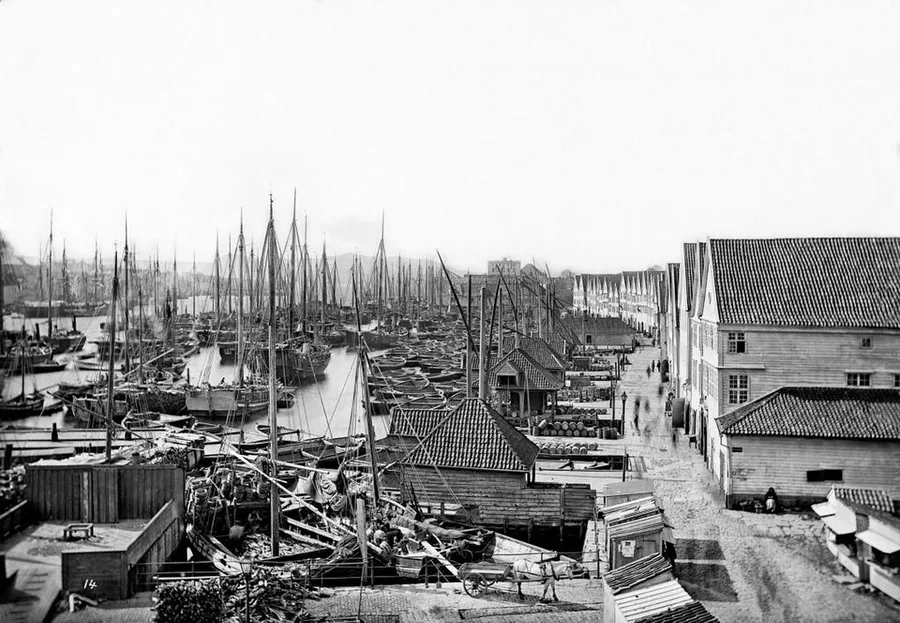 Knud Knudsen, Bryggen in Bergen (1865), University of Bergen Library Knudsen's 1865 photograph shows Bryggen still standing to its post-1702-fire medieval footprint -- the same wharf the Hanseatic kontor traded stockfish out of for four centuries, captured by one of Norway's first professional photographers. The Hanseatic wharf at Bergen — a long row of narrow
gable-fronted wooden warehouses and trading houses lining
the eastern shore of the Vågen harbour. From around 1360
the German Hansa established its Bergen kontor here, and
for nearly four hundred years (until 1754) the buildings
housed German merchants who controlled the export of
Norwegian stockfish to Catholic Europe. The structures
burned and were rebuilt repeatedly to the same medieval
footprint; the surviving wooden buildings (most after the
1702 fire) preserve the medieval urban plan. UNESCO World
Heritage site since 1979 and Bergen's most-visited landmark.
In this article Day 4 walks the Ungdommene (the Youngsters) across Bryggen's
uneven, rain-slicked cobbles — the wharf that makes the case for
already-broken-in shoes.
On the trip Day 4 in Bergen lands the Ungdommene (the Youngsters) directly
on the Bryggen waterfront — the wharf the Hanseatic trade in
Norwegian stockfish built and rebuilt for four centuries.
Also discussed in The Golden Age — a North Atlantic empire … reaching farther than you thinkThe Long Fall — the sudden loss of Norwegian nobility, the end of the kings, and half of Norway gone foreverThe Germans Who "Ruled" Bergen — the Hanseatic merchants on Bryggen WharfThe 400-Year Night — when the Northern Lion lay dormantAlcohol and Vinmonopolet — when and where to buy a drinkRespecting nature — why you can roam and camp on private land and Trondheim’s Bakklandet are uneven enough to twist an ankle in unfamiliar shoes; the long airport walks at Oslo Airport (Gardermoen)
Knud Knudsen, Bryggen in Bergen (1865), University of Bergen Library Knudsen's 1865 photograph shows Bryggen still standing to its post-1702-fire medieval footprint -- the same wharf the Hanseatic kontor traded stockfish out of for four centuries, captured by one of Norway's first professional photographers. The Hanseatic wharf at Bergen — a long row of narrow
gable-fronted wooden warehouses and trading houses lining
the eastern shore of the Vågen harbour. From around 1360
the German Hansa established its Bergen kontor here, and
for nearly four hundred years (until 1754) the buildings
housed German merchants who controlled the export of
Norwegian stockfish to Catholic Europe. The structures
burned and were rebuilt repeatedly to the same medieval
footprint; the surviving wooden buildings (most after the
1702 fire) preserve the medieval urban plan. UNESCO World
Heritage site since 1979 and Bergen's most-visited landmark.
In this article Day 4 walks the Ungdommene (the Youngsters) across Bryggen's
uneven, rain-slicked cobbles — the wharf that makes the case for
already-broken-in shoes.
On the trip Day 4 in Bergen lands the Ungdommene (the Youngsters) directly
on the Bryggen waterfront — the wharf the Hanseatic trade in
Norwegian stockfish built and rebuilt for four centuries.
Also discussed in The Golden Age — a North Atlantic empire … reaching farther than you thinkThe Long Fall — the sudden loss of Norwegian nobility, the end of the kings, and half of Norway gone foreverThe Germans Who "Ruled" Bergen — the Hanseatic merchants on Bryggen WharfThe 400-Year Night — when the Northern Lion lay dormantAlcohol and Vinmonopolet — when and where to buy a drinkRespecting nature — why you can roam and camp on private land and Trondheim’s Bakklandet are uneven enough to twist an ankle in unfamiliar shoes; the long airport walks at Oslo Airport (Gardermoen) 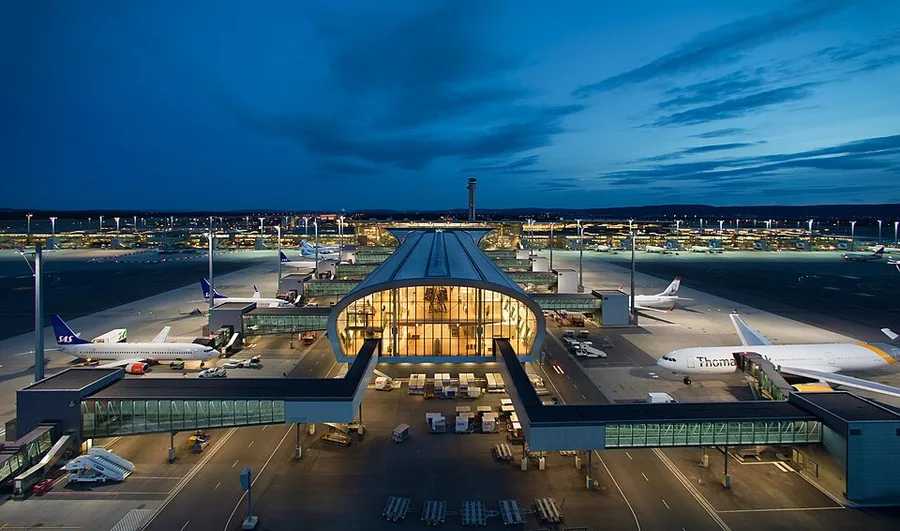 Espen Solli / Avinor Oslo lufthavn, Oslo Airport terminal night view (2017), CC BY 3.0 The terminal every traveler passes through on arrival, and again before the final morning's flights home — the Gardermobanen rail line into Oslo S starts just beneath this building. Norway's principal airport (IATA: OSL), opened on 8 October 1998 roughly 50 km north-northeast of central Oslo near the town of Gardermoen, in Ullensaker municipality, replacing the smaller in-town airport at Fornebu. Built at a cost of some NOK 11.4 billion, Gardermoen handles the overwhelming majority of Norway's international air traffic and anchors the dedicated Gardermobanen high-speed rail line into Oslo Central Station — one of the fastest airport-to-city rail connections in Europe, run by both Flytoget and the ordinary Vy trains. In this article The long pier walks between gate and baggage hall are where the broken-in shoes earn their place — the airport is a walking day at both ends of the trip. On the trip The whole family's Norway begins and ends at Gardermoen — everyone lands here before Day 1 and rides the train into Oslo S, and on Day 7 the group returns to spend one last Norwegian night near the airport before the flights home the next morning. Gardermoen Also discussed in Landing in Norway — off the plane in Oslo, where to go, step by stepHotels in Norway — frokost, check-in, and the luggage-room habit🚨 Emergencies - important numbers, hospitals, and what you can doAlcohol and Vinmonopolet — when and where to buy a drinkMoney — currency, cards, prices, and tippingPublic transit basics — trains, trams, boats, and buying tickets are unforgiving. Don’t bring shoes you haven’t worn for a full week before the trip. Bring a second pair if anyone’s feet are particular about it.
For the older travelers, a supportive walking shoe is non-negotiable on the cobblestone days — Bryggen, Bakklandet, and old-town Oslo. Hiking boots are overkill for this itinerary; nobody is doing serious mountain hiking. The Stegastein platform itself is a smooth, level wooden deck.
The morning routine, once you’re there
Look out the window. Check the YR weather app for that day’s high, low, and rain probability — Norwegians use yr.no for everything; it reads Norwegian micro-weather that generic apps miss.
Start the day with all three layers if the morning’s under 16 °C or raining. Strip down as the day warms. On the Day 3 Nutshell day specifically: layer up for a cold early start, expect to be down to your base layer in the fjord valley by mid-afternoon, and back into the wool layer on the cruise deck.
You’re not over-thinking it. The Norwegians do exactly this.